

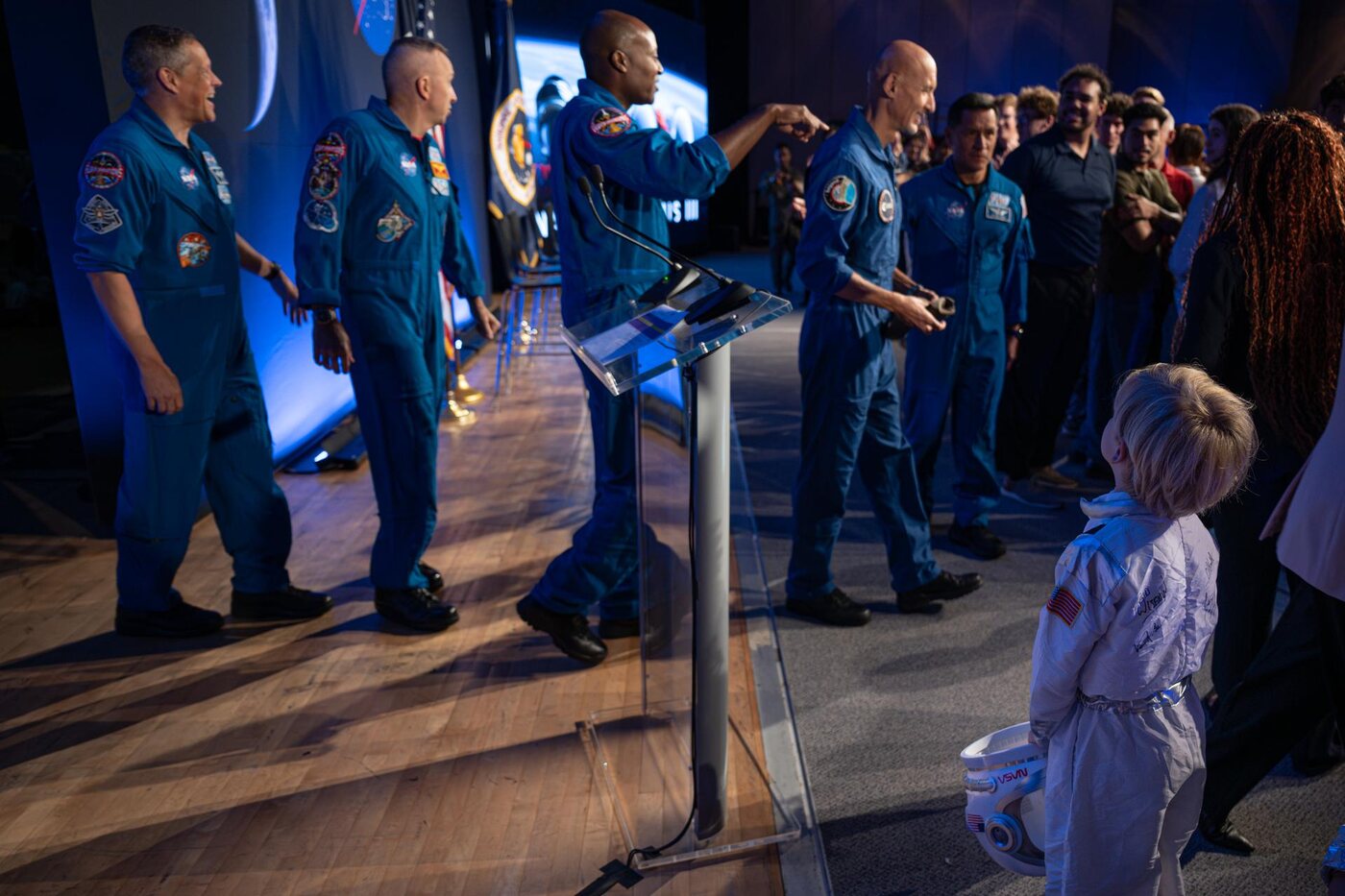
On 9 June 2026, NASA named the crew of Artemis III. At eight o’clock the next morning, they were at work.
That detail comes from Debbie O’Connell, the mission’s Chief Training Officer, on episode 434 of NASA’s Houston We Have a Podcast, recorded on 7 August 2026. The host, Leah Cheshier, mentions that she’d seen the crew at four in the afternoon on announcement day and had sent them off with “have fun at training tomorrow morning.” O’Connell’s answer is four words long: “Eight A.M. the next day.”
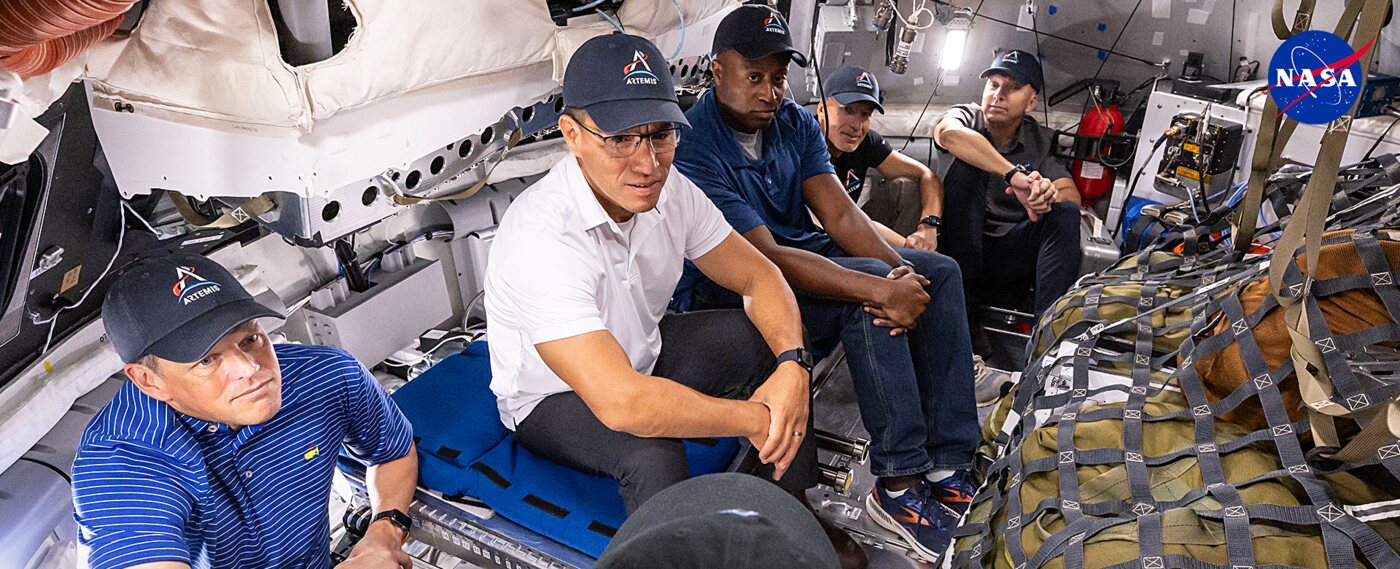
Here is the thing about a mission everyone talks about in terms of hardware: somewhere underneath the rocket coverage, a person with a badge and a calendar is scheduling a food tasting. Somebody else is writing the sim where the ground goes quiet. This is what it actually looks like when four people are handed a spacecraft and told to learn it.
The woman with the clipboard
O’Connell has been at NASA about fifteen years, all of it her only full-time job. She went to Embry-Riddle for aerospace engineering — she credits her dad dragging her to air shows instead of vacations, which she did not enjoy at the time — and NASA “wasn’t even on my radar until a recruiter came.” She told her mother she’d been hired to train astronauts. Her mother didn’t believe her.
She spent about a decade as an ETHOS flight controller for the International Space Station, the console that owns the station’s environmental and life-support systems. She was on DM-1 and DM-2, the first Dragon missions, and drafted procedures for them. Then Starliner. Artemis III is the first time she has worked on Orion at all.
Asked what skill turned out to be unexpectedly useful in the job, she says: motherhood.
“It was actually the first thing that I told the Artemis III crew is the two things you have to know about me is I’m hard-headed and I’m a mom.”
The hard-headed part was a joke, and a fresh one. Right after they were assigned, before she’d even had a chance to sit down with them, there was a training event where she stood up too fast and cracked her head. Everyone looked. So she played it off — yeah, I’m hard-headed, I’m good to go — and it stuck as an introduction.
She’d had a six-month-old at home when they offered her the assignment, plus two other kids. She went home and checked with her husband first. The next day she came back in and said she was all in.
Building 9 has the mockups. Building 5 has the sims.
O’Connell says she is rarely at her desk. She is in front of a cockpit trainer with the crew, or over in Building 9 in a mockup, or in Building 5 in a sim. There can be two or three training events running at once with the crew split between them, so she doesn’t attend everything — instructors teach the lessons, and her job is making sure it all fits together and lands on time.
The course flow so far, in her words: fundamentals first, which sounds like a 101 class and is actually “like that on steroids” — a two-week crash course in Orion. Then what it’s like to do a burn, with the procedures they run every time they translate the spacecraft. Then malfunctions, ascent and entry, the worst cases. Then practice getting in and out of the vehicle smoothly. But most of the crew’s hours go into simulations, over in Building 5.
Most of those sims run live with the flight control team, because working as one big team is the point. Some don’t.
The sim where nobody is listening
The crew-only sims exist for failures that aren’t much of an exercise for the ground. O’Connell’s example is losing communication with the capsule:
“The flight control team just loses all their data, has no one to talk to. So it’s not as exciting. Whereas that’s when the crew role really picks up.”
Which is a very calm way to describe rehearsing the moment four people are on their own with a problem and no Houston. It is on the schedule. Somebody wrote it, somebody runs it, and afterwards — this is new since Artemis II — they can play the sim back to the crew and talk through it. Where the teamwork sagged, what verbiage they used, and what was actually on the display at the time.
The sound is getting better too. The simulator’s audio was built from Artemis I recordings; after Artemis II actually flew with people aboard, the crew came back with notes on what sounded right and what didn’t, and those files are being updated now.
The manoeuvre with no precedent
Cheshier asks what the most critical phase of Artemis III is, from a training perspective. O’Connell doesn’t hedge:
“Rendezvous, absolutely. That is the new untested thing that we are doing. So meeting up with HLS, our landers, and docking for the first time — that is what we plan on focusing most of our training on.”
HLS is the human landing system, the commercial lander the mission has to meet up with. Nobody has flown that approach. There is no crew to ask what it felt like, no veteran to say watch the third minute, it drifts. So it gets the largest share of the training budget, built out of judgement and simulation, by people who will not be aboard.
The pace is deliberately faster than it used to be. Normally a crew gets more background before being dropped into a simulator; this time they’re thrown in early, at a base level of knowledge, seeing procedures and sometimes hardware they’ve never heard of, with an instructor beside them teaching in the moment. O’Connell allows that it is “probably a little bit frustrating,” then adds that by early August they were four simulations in and already keeping up with the timeline and solving problems.
The other genuinely hard thing, she says, is simply that Orion is still being built while they train it. On the space station the mission is largely settled when training starts. Here the ops concepts are still in development, so the training leans on general skills and vehicle knowledge, waiting for everything to come together at the eleventh hour.
She has one predecessor to ask about all this: Jacki Mahaffey, the Artemis II Chief Training Officer, and until now the only person who had ever trained a crew to fly Orion. Mahaffey got promoted into O’Connell’s management chain, so they see each other weekly. Mahaffey built the training flow from nothing; O’Connell is building on it and trying to run it faster. She also, in a sim, will just climb in and fill a seat.
The food tasting
Then there’s the part of the job that sounds like ordinary life, because it is ordinary life, just performed at some distance from the ground.
The crew does food tastings and gets to pick what flies. O’Connell’s comparison:
“In my mind, it sounds a lot like when you’re getting married and you get to try some cake, but it’s a little bit more of a decision. They’re predicting what food they’re gonna eat a year from now.”
There is also day-in-the-life training — stowage, trash, where things go and how you get them back out. The stated goal is that they be efficient and not frustrated by it, which is a very human ambition to write into a lunar flight plan.
The part she hopes is wasted
Cheshier asks what would surprise the public about astronaut training. O’Connell’s answer:
“I think the most surprising thing is how little of our training I want them to use in flight.”
Most of the hours go into worst cases, failures, things going wrong. Ideally none of it is ever needed. What survives is the process underneath — how to work a problem as a team — while the specific scenarios stay unused, which is the whole idea.
And then there was last week, as of the recording. They suited the crew up, put them in the capsule as though it were launch day, and walked through some things.
“But just watching them on the video feed, all four of them in there, all suited up, it felt real. It felt like watching Artemis II crew on launch day. So that’s when I first got the goosebumps.”
Then, because she is who she says she is:
“I went into mom mode. I took a bunch of pictures.”
She figures she knows what the end of training looks like, and it isn’t a certificate. It’s getting into a sim and watching the entire team — not just the four in the seats — solve problems together, quickly, without everything being perfect. You see the transition, she says, and you know.
She’d like to be at Kennedy for the launch, in person, probably crying. During the mission she’ll be back at Johnson, glued to the screen. And when they come home:
“I’m just gonna hug them, and they’re gonna get a hug, and then after that, we’ll probably go right to business.”
Somewhere in Houston this morning, somebody is scheduling a docking that has never been flown, and somebody is booking a room for a food tasting. 🌒
Source: NASA, Houston We Have a Podcast, episode 434, “Artemis III Training” — recorded 7 August 2026, published 21 August 2026. Every quotation and detail above is from that episode’s transcript. The photograph of the announcement event is NASA’s own, with its caption.


