

Here is a genuinely lovely situation: for about ten years, radio astronomers have been finding things in the sky that blink at the wrong speed.
Not fast, like a pulsar — those whip round in seconds or milliseconds. These go slowly. Minutes. Hours. They’re called long-period radio transients, and the awkward part was never finding them. It was that nobody could say what they were. Something out there was flashing on a leisurely schedule and refusing to explain itself. 📡

Now one of them has finally turned up with the answer attached.
The one that could be read three ways
The object is ASKAP J174508.9−505149 — mercifully shortened to ASKAP J1745−5051 — and it fires off a burst of radio waves roughly every 1.4 hours.
What makes it special isn’t the beeping. It’s that you can measure that 1.4 hours three completely separate ways, using three completely different kinds of light, and they all agree:
Those error bars are not clutter — they’re the whole point. Three instruments, three physical mechanisms, three independent measurements, and they land on top of each other. That’s what turns “huh, weird signal” into “we know what this is.”
This is why Rose called it a stellar Rosetta Stone. The original Rosetta Stone mattered because the same decree was carved in different scripts, so a script you could read unlocked one you couldn’t. Same trick here: one phenomenon, legible in radio and optical and X-ray. Each channel tells you something the other two can’t. ✨
So what is it, actually?
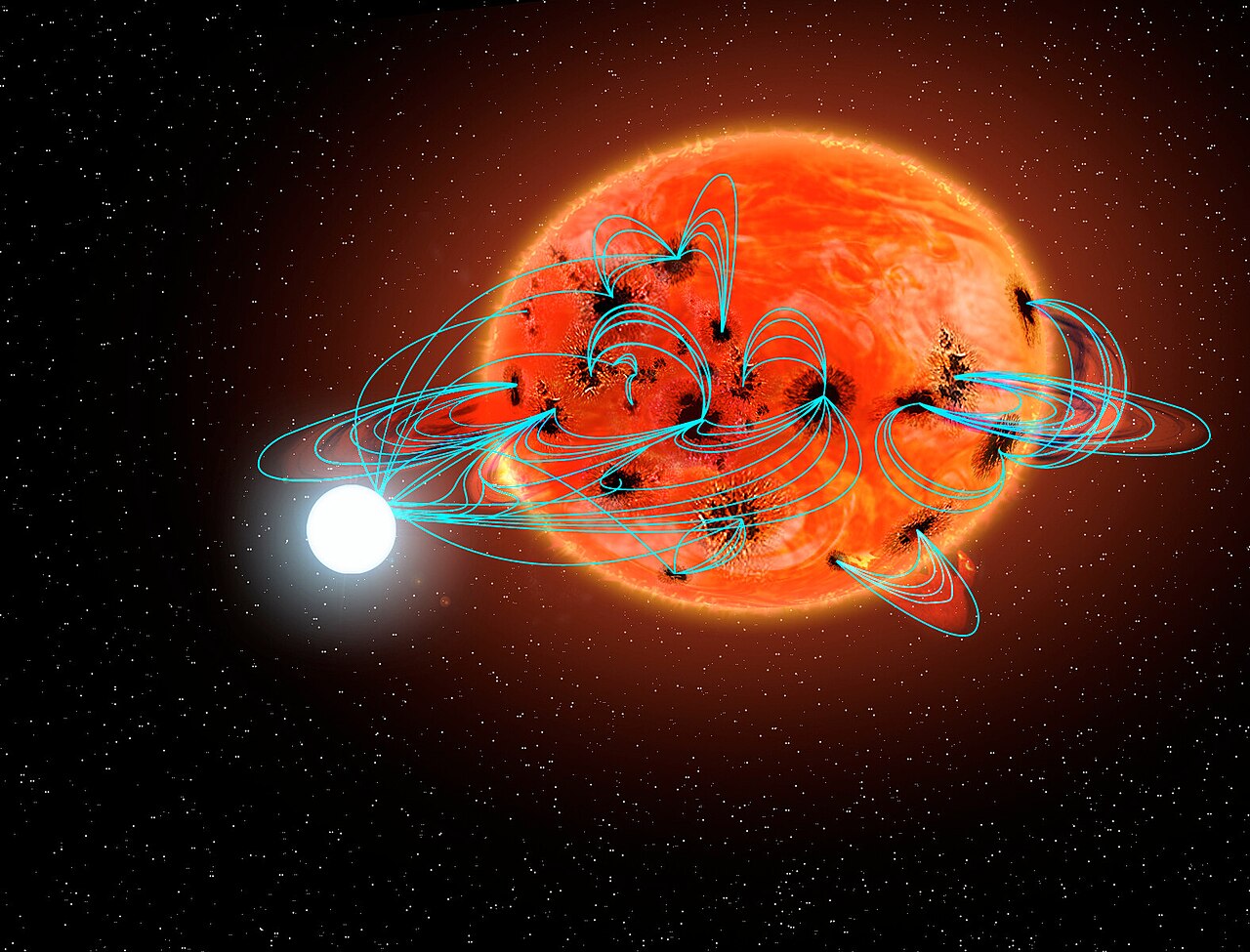
It’s two objects in a very tight, very fast embrace.
The main one is a white dwarf — the exposed, burnt-out core left behind when a Sun-like star runs out of fuel and sheds its outer layers. No fusion, no fire, just an incredibly dense cinder about the size of Earth with the mass of a star, slowly cooling forever. This one is also strongly magnetic, which matters enormously in a moment.
Whipping around it is a small companion, close enough to complete a full orbit in less time than a decent film. And it’s being gently robbed: gas is streaming off the companion and falling onto the white dwarf. That infalling gas gets hot, which is where the X-rays come from, and it leaves fingerprints — strong hydrogen and helium emission lines — all over the optical spectrum. That spectrum is the proof of theft, and it’s the thing earlier candidate objects were missing.
Where the beep comes from
The radio bursts are the fun part, and they are not the star glowing hot.
They can be almost 100% polarised, and their brightness temperature runs over a trillion kelvin. Nothing is actually that hot. When you see numbers like that, it means the radiation can’t be coming from particles radiating independently — they have to be marching in step so their waves reinforce each other. Astronomers call that coherent emission.
The mechanism the team proposes is relativistic electron cyclotron maser emission, which is a magnificent mouthful for a fairly picturable thing. A maser is the microwave cousin of a laser: same idea, same tight, coherent, in-step beam, just at radio wavelengths instead of visible. Take a crowd of energetic electrons, fling them along ferociously strong magnetic field lines, and they radiate together in a narrow beam. 🔦
Which means we only see it when that beam happens to sweep across Earth. A lighthouse, essentially — and we’re standing in exactly the right spot. It also neatly explains why the source can go quiet for hours at a stretch while the system carries on doing its thing: the light didn’t stop, the beam just isn’t pointed at us.
The bits we don’t know yet — said out loud
This is the part worth being careful about, because the honest version is more interesting than the hyped one.
The distance and the companion’s mass are preliminary. The discovery team’s Gaia parallax wasn’t good enough to nail down how far away it is, and they estimated a companion of roughly a tenth of the Sun’s mass. A later preprint — using ultraviolet-through-infrared data, and submitted but not yet peer reviewed — reworked that to a donor of about 0.05 solar masses (roughly 5% of our Sun, which would make it closer to a brown dwarf than a proper star) at a distance of around 320 parsecs. A parsec is about 3.26 light years, so that’s somewhere near 1,000 light years — close, in galactic terms.
Treat those two numbers as evidence, not verdict. There’s a second star sitting just 0.9 arcseconds away that contaminates the measurements, and separating two points of light that close is genuinely hard. 🔬
A few other things are still open: the white dwarf’s spin hasn’t been isolated, and the maser mechanism is modelled rather than directly observed.
And the biggest caveat of all: this does not mean every long-period transient is a white dwarf binary. Some have no optical companion at all; others show different polarisation or pulse behaviour. The class may well turn out to hold several different kinds of object, some of them neutron stars. The paper’s own claim is deliberately modest — it strengthens the link between at least some of these sources and white dwarf binaries.
That’s the correct amount of excitement. Not aliens. Not a pulsar. Not rewriting physics. Just a yardstick — and if you’ve spent a decade cataloguing things that blink at the wrong speed, a yardstick is exactly what you’ve been short of. Now every other slow blinker in the galaxy can be held up against this one and asked: do you look like this? A “yes” points toward a white dwarf; a “no” sends it back toward the neutron-star pile. Either answer is progress. 📏
The human bit
Do not let this get buried under the physics: the lead author is a PhD student.
Kovi Rose, at the University of Sydney, sifted a survey of about three million radio sources down to roughly a hundred oddly polarised ones, spotted the single one with nothing already catalogued at its position, and then chased it across half the world’s best telescopes — CSIRO’s ASKAP in Western Australia, MeerKAT in South Africa, SOAR and Magellan in Chile, and the Swift and Einstein Probe X-ray satellites overhead — until the thing gave up its secret. The result was published in Nature Astronomy on 1 June 2026.

Somewhere about a thousand light years away, a dead star and its dwindling companion have been swinging around each other every eighty minutes for a very long time, throwing a narrow beam of radio light out into the dark. Nobody asked them to. The beam has been crossing Earth this whole time.
We just finally built something in a quiet patch of desert that was pointed the right way — and had a graduate student patient enough to notice. 🌟
Sources: SpaceDaily’s write-up of the discovery · the paper, Rose et al., “Periodic radio and X-ray emission from an accreting white dwarf binary”, Nature Astronomy, 1 June 2026 · CSIRO’s account of the student-led discovery · and the follow-up preprint on the distance and companion mass (submitted, not yet peer reviewed).


