

There is a particular kind of cold that comes with chasing an aurora. You’re standing in a field in Tasmania or on a dark beach in southern Iceland at 2am, neck tipped all the way back, hoping the smudge of green on the horizon will brighten into something worth the frostbite. You wait. You look up.
Now flip it. You’re 250 miles up, the field is the whole Earth, and you’re looking down. ⬇️
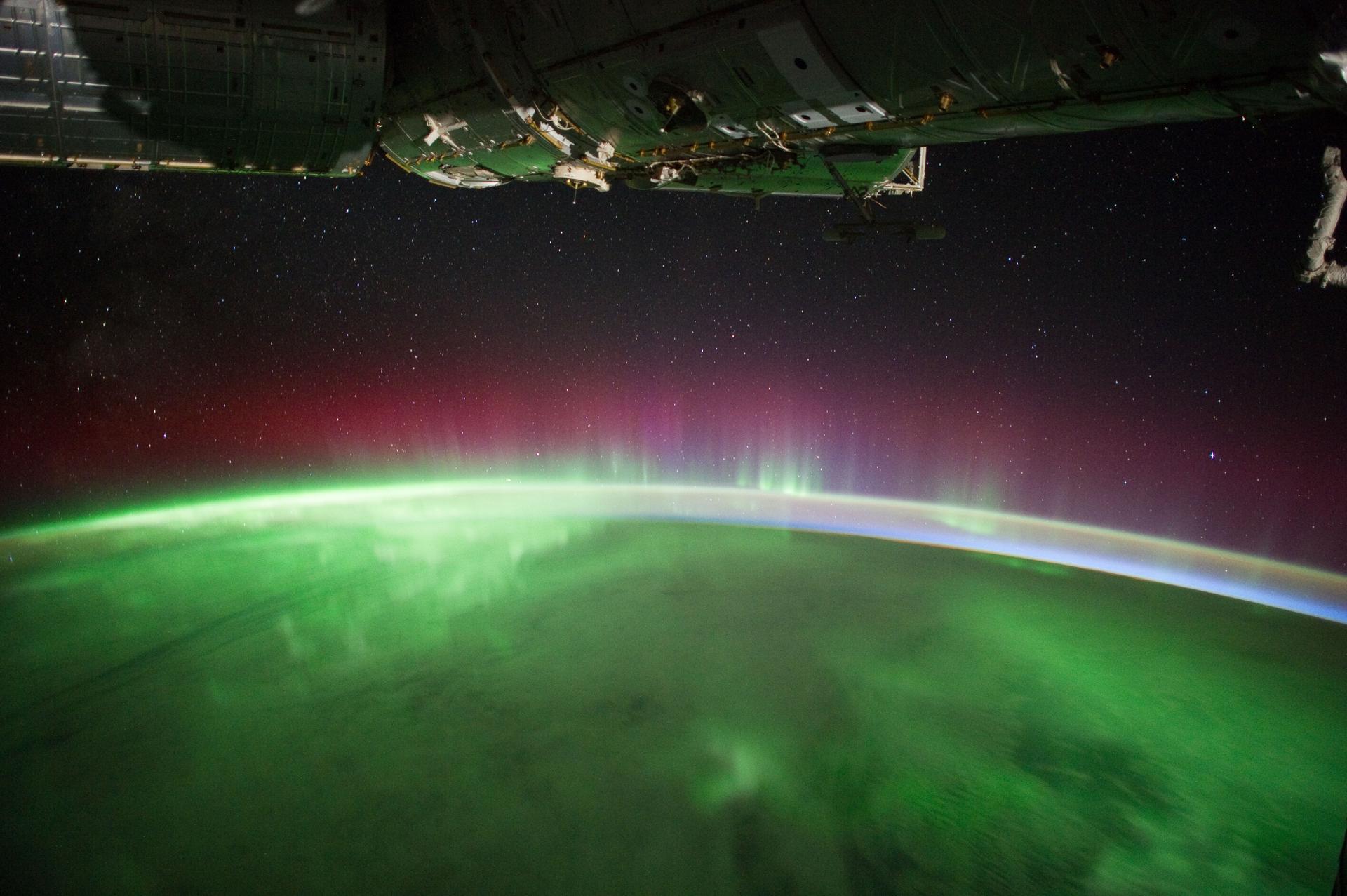
That’s the view NASA astronaut Jessica Meir had on June 5, 2026, sheltering aboard a SpaceX Dragon spacecraft as the Space Station swung over the Indian Ocean southwest of Perth, Australia. The Southern Lights weren’t a horizon-smudge to squint at — they were a glowing river of green and pink draped across the planet below her, snaking along directly underneath. And, as ever on the ISS, there was a camera handy.
The view they didn’t put on the poster
The poster version of an aurora is the ground version: a curtain of light hanging over you. From the ISS you get the part the poster leaves out — the same curtain seen from the top, laid flat across the dark side of the planet, with the thin blue line of the atmosphere on the horizon and the black of space above it.
Meir described this one as a step up even from the auroras she’d already seen. “As opposed to the previous aurora I’ve seen, this one danced and snaked its way directly below us, putting on quite a show,” she wrote. The light show was the gift of a recent solar event — the Sun had flung a wave of charged particles toward Earth, our magnetic field caught them, and the upper atmosphere lit up in response.
Here’s the part that makes it almost unfair: the ISS travels at roughly 17,500 mph. Whatever Meir was looking at was already sliding out from under her. The whole encounter — orbit, aurora, photograph — was a matter of minutes. But minutes was plenty.
Why it glows
The short version: the Sun is always blowing a stream of charged particles outward — the solar wind — and every so often it throws an extra-big batch our way. Earth’s magnetic field funnels those particles toward the poles, where they crash into the gases of the upper atmosphere and hand over their energy. The atoms light up as they shed it. Oxygen glows green (and, higher up, red); nitrogen glows blue and purple. The color is just chemistry, written across the sky at sixty miles up. 🎨
The southern half of the sky’s best show
The Aurora Australis is the Northern Lights’ identical twin — same Sun, same magnetic field, same physics, mirrored to the bottom of the world. The only real difference is the audience. The Aurora Borealis has Iceland and Norway and Alaska and a whole tourism industry pointed at it. The Australis has the Southern Ocean, the bottom edge of New Zealand, Tasmania on a good night — and Antarctica, which is prime aurora real estate occupied almost entirely by penguins. 🐧
Which is part of why a photo from orbit matters so much: it catches the show that most of the planet is too far north to ever see.
“I am in awe of this ethereal and emotionally evocative phenomenon.” — Jessica Meir
Why this is on a good-news blog
Because the whole thing is, quietly, a piece of good news about home. That glow is the visible proof that Earth still has a strong, active magnetic field — the invisible shield that deflects the worst of the solar wind and keeps our atmosphere from being stripped away. The same force that protects us is the one that throws the light show. Protection you can see.
And then a person, 250 miles up, in the middle of a busy and slightly tense day aboard the Station, looked down, felt awe, and reached for a camera so the rest of us could feel it too. The Earth glows, the field holds, and somebody up there is taking pictures for us. That’s the good news. 🌌💚


