

On 3 September 2026, about 200 million kilometres from the room where everyone was standing, a spacecraft threw away its own engine on purpose.
This was the plan. It was always the plan. It was still terrifying. 🛰️
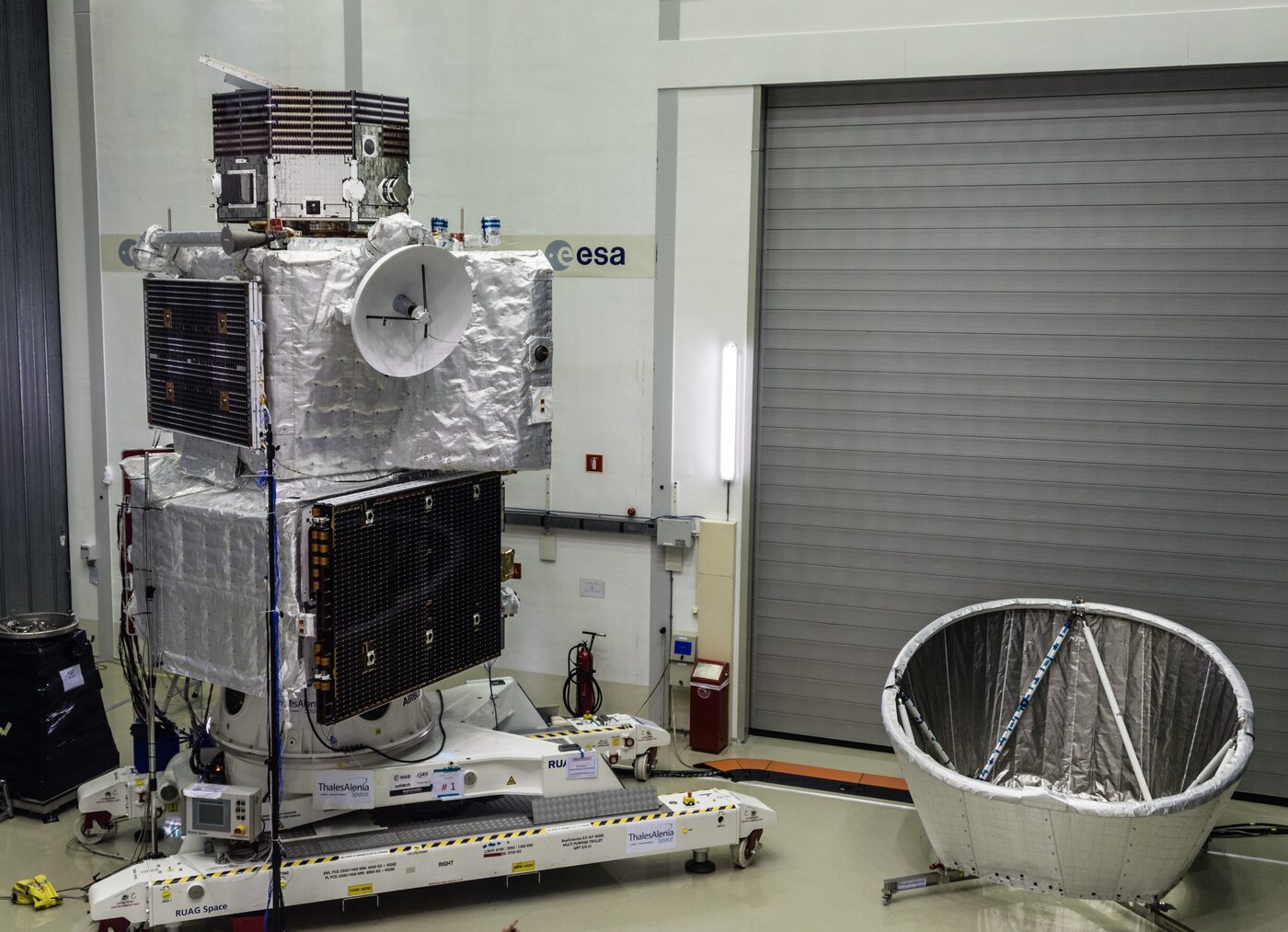
What was actually up there
BepiColombo is a joint ESA and JAXA mission, and for eight years it has flown as a stack — a tower of three separate machines travelling as one:
The Mercury Transfer Module was the one doing the driving. Roughly the size of a small car, it carried two 15-metre solar wings that powered the whole stack, and it flew on solar electric propulsion — sunlight turned into electricity, electricity turned into plasma from xenon gas, plasma thrown out of four ion thrusters in a push so gentle it can run for months and so efficient it made the entire trip possible.
Over those eight years the stack covered 9.9 billion kilometres and made nine planetary flybys, borrowing a little gravity from a planet each time. Along the way it had a genuine scare: a problem cut the power available from MTM’s solar arrays, and the teams had to re-plan the route mid-flight. They pulled it off.
On 15 June 2026 the ion engines were switched off for good. MTM’s driving was done.
The two hours
Here is the part that makes engineers quiet.
At 12:00 CEST on 3 September, the Mission Control Team at ESOC in Darmstadt gave the official “GO”. Separation was expected at 14:00 CEST — and then nothing. Silence in the Main Control Room, because a radio signal from 200 million kilometres away takes nearly two hours to get home. Whatever had happened out there had already happened, and there was no way to know which version of it was true.
At 14:20 CEST a preliminary Doppler reading came in — not a message, just the shape of the spacecraft’s radio tone, which flight dynamics could read well enough to say: it let go.
“We heard it loud and clear in the voice loop from Flight Dynamics Manager, Frank Budnik, that they could clearly see from the Doppler data that MTM had separated. After all this waiting and preparation, we all looked at each other and hugged. It was a very powerful moment.” — Emmanuela Bordoni, ESA BepiColombo B-shift Spacecraft Operations Manager
At 15:49 CEST, with ESA’s Cebreros and Malargüe deep-space antennas locked on, the full acquisition of signal arrived. Cheers. Applause. Spacecraft Operations Manager Ignacio “Nacho” Clerigo, described by ESA’s own write-up as beaming:
“We are thrilled, but also relieved. Separating two spacecraft from 200 million kilometres away is not something we do every day. We have prepared intensively for this moment, so we are really pleased to have had a perfect separation.”
Thousands of people watched it live on YouTube. A day later the team did what ESOC teams do: they stuck the mission’s sticker on the Briefing Room glass door.
The goodbye photo
MTM carried three monitoring cameras, and for the whole cruise they took daily snapshots of the journey. On its last day attached to the stack, it took its last pictures.
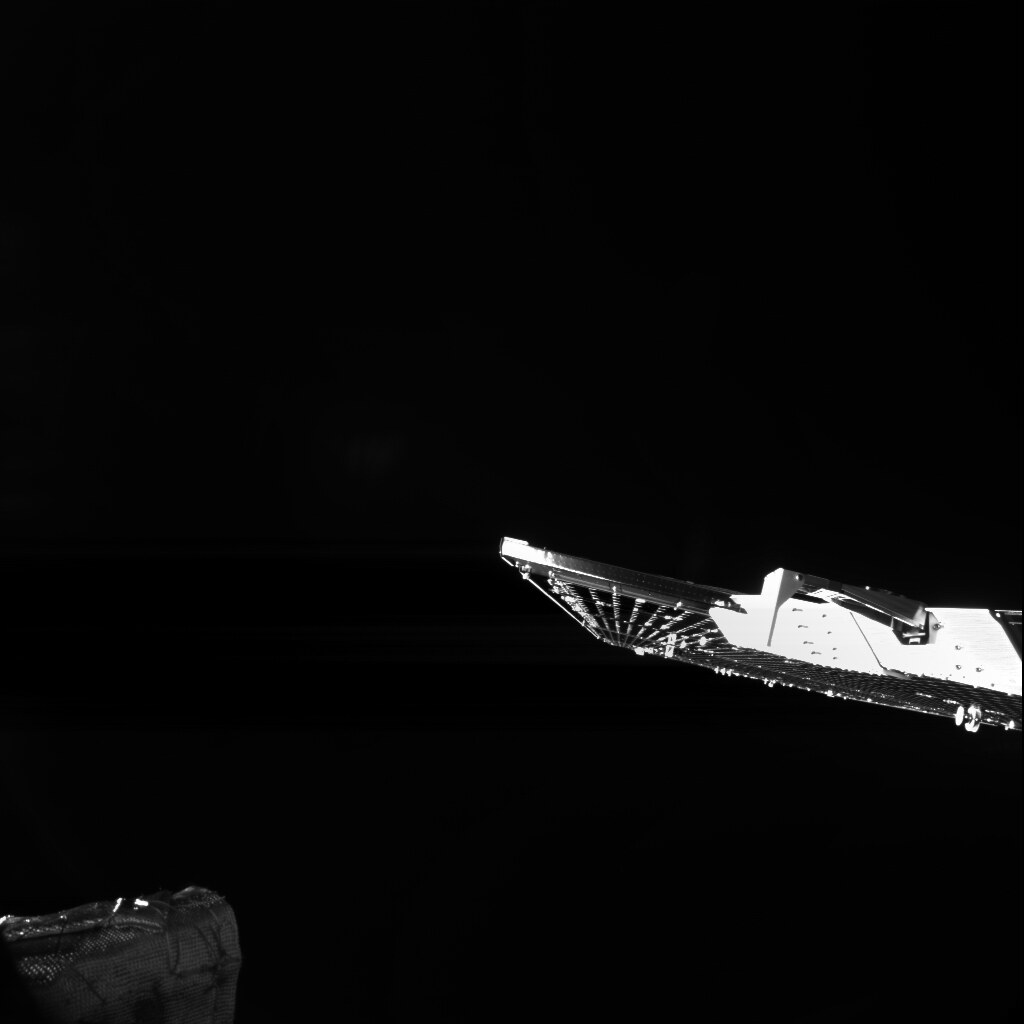
MTM has no antenna and no computer of its own. Now that it is loose, it cannot talk, cannot steer, and will never hear from anyone again. It will simply keep going around the Sun, in a stable orbit, forever.
Nacho’s line about it is perfect, and we are not going to improve on it:
“We feel a bit sad to see our old friend MTM going away. It did an astonishing job bringing the Mercury Planetary Orbiter and the Mercury Magnetospheric Orbiter here, but as Freddie Mercury once sang, the show must go on!”
“Arrival” is not a day. It’s a six-month manoeuvre.
This is the bit worth slowing down for, because the headlines will flatten it and the truth is better.
BepiColombo is still more than three million kilometres from Mercury. ESA is blunt about it: unlike most interplanetary missions, arrival here “is not a single event but a six-month sequence of carefully choreographed manoeuvres,” and it is one of the most complex planetary arrival sequences ESA has ever attempted.
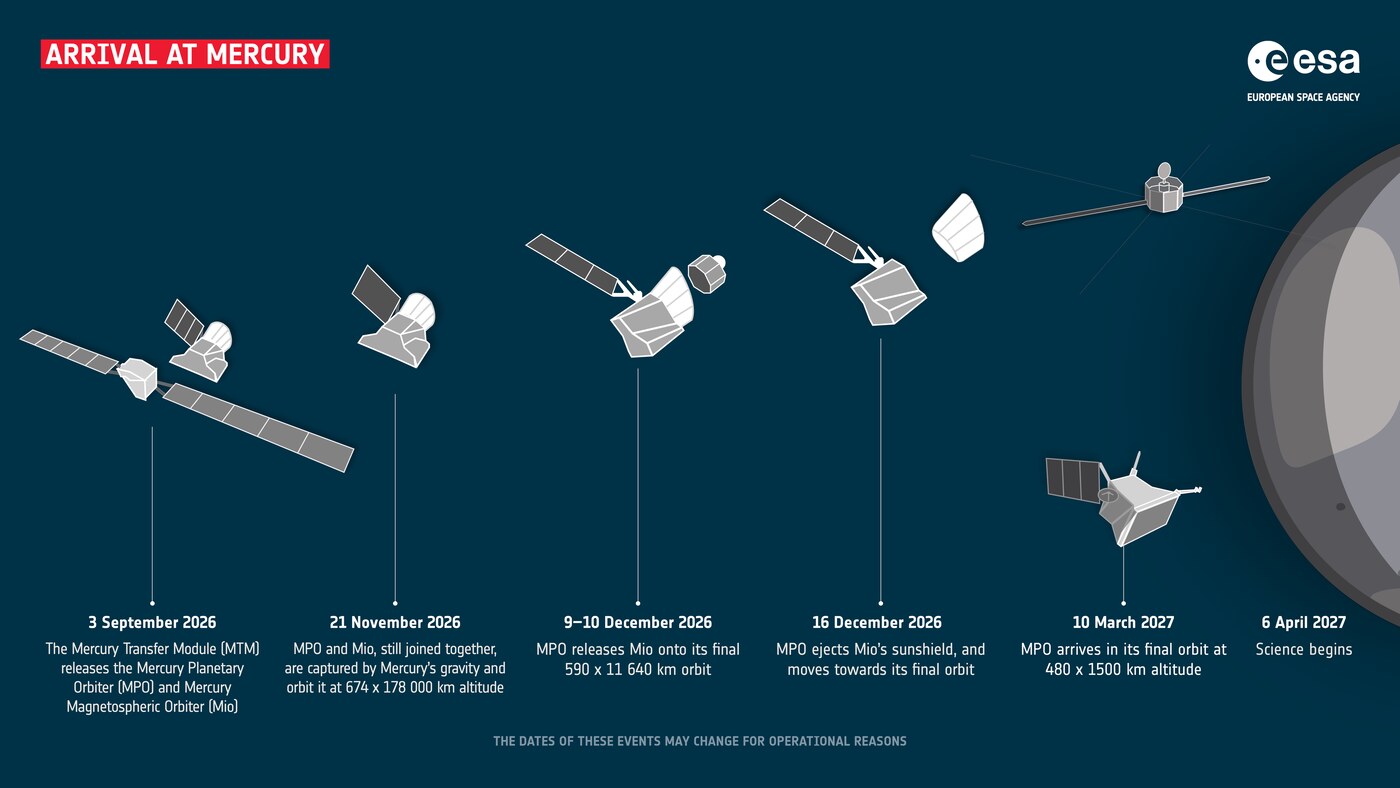
So depending on which milestone you pick, BepiColombo “arrives” at Mercury on several different days, all of them correct:
ESA describes the whole sequence as ending with the mission becoming the first ever to place two spacecraft in orbit around Mercury, in December 2026. Both framings are on the same page and neither is wrong — one is the moment gravity takes hold, the other is the moment there are genuinely two working orbiters up there. Space missions do not really have finish lines; they have a to-do list, and it gets ticked off slowly.
Next on the list: MPO’s chemical thrusters fine-tuning the approach, and then Mio’s turn to let go.
“The next separation will be Mio. After seeing the successful separation of MTM I feel confident about what lies ahead.” — Go Murakami, JAXA BepiColombo Project Scientist
Why this lives on a good-news blog
Because of the hug. 🫂
Somebody designed a separation mechanism a decade ago. Somebody ran the simulations for months, throwing failure after invented failure at the team to see what they’d do. Somebody sat in a room and said “GO” and then had to sit in that same room for two hours with nothing to do but wait for physics to finish telling them the answer.
And when the answer came back yes, a group of adults with engineering degrees looked at each other and hugged, from 200 million kilometres away, about a machine that can no longer hear them.
Mercury orbit insertion is 21 November 2026. Bepi’s still flying. Ask us again in November. 💛


