

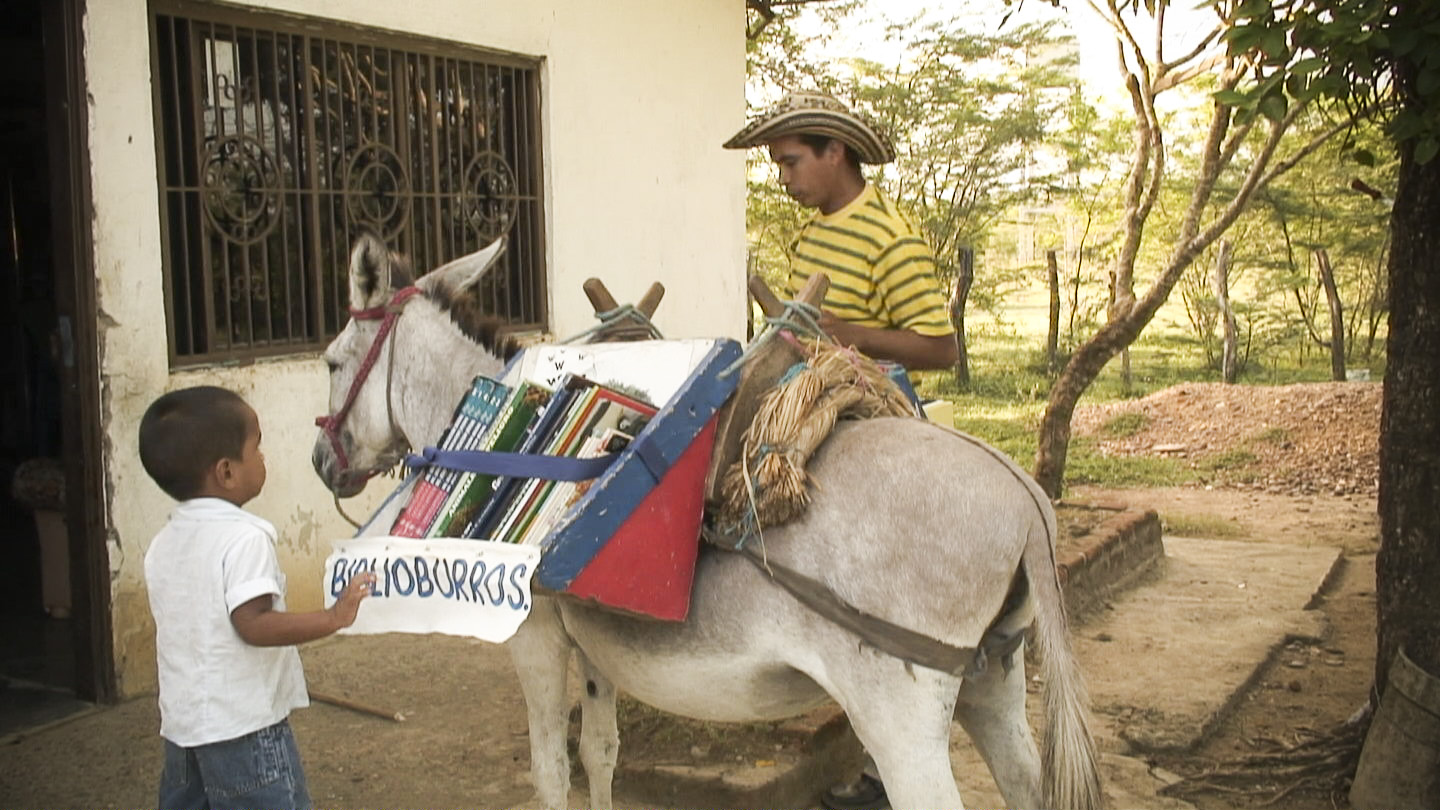
Most libraries expect you to come to them. You walk up the steps, past the returns cart, into the hush. But in the sun-baked villages of northern Colombia’s Caribbean back-country, where the roads turn to dust and the nearest bookshelf might be a full day’s walk away, a library figured out how to do the walking itself. It arrives, swaying gently up the track, on the backs of two donkeys. 📚
Their names are Alfa and Beto. This is not an accident. Say them together — Alfa, Beto — and you land on “alfabeto,” the Spanish word for alphabet. A traveling library carried by two donkeys who, between them, quite literally spell out the beginning of reading. It is the kind of small perfect joke the world sometimes tells when nobody’s forcing it.
One teacher, one worry, seventy books
The person behind it is a primary-school teacher named Luis Soriano Bohórquez. As a boy he had fallen hard for reading, thanks in part to a professor who trekked out to his village a couple of times a month to teach — so Luis knew from the inside exactly how much a book could change for a child who otherwise had none.
Teaching in the countryside around the town of La Gloria, he watched his young students — many of them growing up in a region that had seen more than its share of hardship — light up when a story arrived. The trouble was that stories mostly didn’t arrive. The books stayed in the towns; the children stayed in the villages; and the distance between them was measured in hours of walking.
So, starting in the late 1990s, Soriano did the obvious impossible thing. He loaded up his donkeys with seventy books and set off, a couple of days a week, to bring the library to the children instead. No building, no budget, no board of trustees. Just a teacher, two donkeys, and a wooden rack of stories bumping down the trail.
The letter that filled the saddlebags
For a while the Biblioburro stayed small — a couple of hundred children a month, borrowing from the same modest shelf of well-loved books. Then Soriano did something quietly bold: he wrote a letter to a well-known Colombian journalist and radio host, Juan Gossaín, asking for a copy of a book to add to his rounds.
Gossaín read the letter out on the air. And Colombia, hearing about the teacher who ran a library on two donkeys, did what people do when a good story finds them — they sent books. Boxes and boxes of them. The collection swelled from a shelf’s worth to roughly 4,800 volumes: encyclopedias, novels, a Spanish dictionary, medical texts, and — always the most requested — children’s adventure stories, the very genre that had hooked young Luis in the first place.
Eventually the donations helped fund something Soriano’s village had never had: a small library building, right next to his house, so the books had a home to return to between rounds. The donkeys still went out. They just had a bigger shelf to draw from now.
Not every trip was easy
It would be a thinner, less honest story if it were all gentle donkey rides through golden light. The back-country is real country: long distances, rough weather, and — on at least one occasion — bandits, who tied Soriano up while robbing him, discovered he was carrying no money at all, and made off instead with a novel. (Somewhere out there, a thief once stole a Paulo Coelho paperback from a donkey library. Reading finds people in the strangest ways.)
There was a serious accident, too — a fall involving one of the donkeys cost Soriano part of a leg. And yet the route kept running. When the person at the center of a good thing decides it simply must continue, it has a way of continuing.
The idea that wandered off on its own
Here is the part that makes this more than one man’s lovely hobby. The Biblioburro got noticed — by newspapers, by a documentary filmmaker, by television crews who came to film the donkeys with the books. And once the world saw it, the world started copying it.
Turns out a great many places have children on one side of a hard journey and books on the other. So the mobile library multiplied and adapted to whatever animal or vehicle the terrain demanded: donkey and mule libraries, an elephant library in the jungles of Southeast Asia, camel libraries crossing the dry country of the Horn of Africa, boat libraries on rivers and lagoons. Different animals, same simple insight — if a child can’t reach the books, bring the books to the child.
Why this one lives on a good-news blog
Because it’s such an unglamorous kind of heroism, and those are the best kind. Nobody invented a gadget. No fortune was spent. A teacher looked at the children in front of him, decided the distance between them and a book was unacceptable, and closed that distance himself — one dusty round trip at a time, on the patient backs of Alfa and Beto.
And the shape of it is so plain that anyone, anywhere, could recognize the move and repeat it. Which is precisely what happened. Somewhere today, on a trail or a river or a red dirt road, a child is watching a library appear over the horizon — carried by a donkey, or an elephant, or a boat — and reaching up for a story that came all that way just to find them. The world does that kind of thing more often than you’d think. 📚💛
Know a wonderfully stubborn act of kindness from your corner of the world? Sign the guestbook and tell us about it. ✍️


