

Picture a wind turbine. You’ve got it already: the tall white mast, the three long blades, the slow patient rotation against the sky.
Now take the blades off.
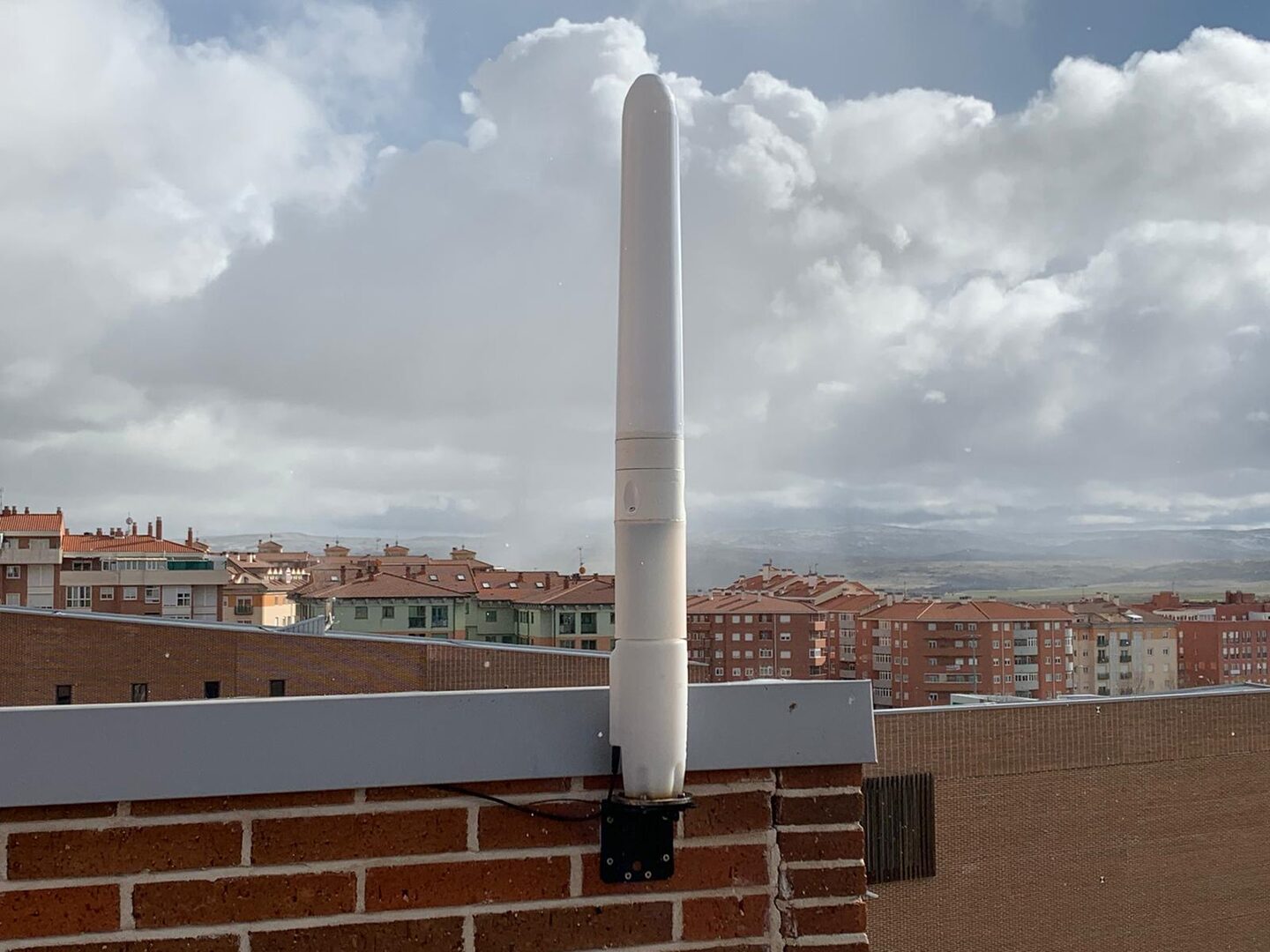
Take the gearbox off. Take the oil out. Take out everything that goes round, in fact, because nothing in this machine is going to rotate — not once, not ever. What you’re left with is a smooth vertical cylinder, standing in a field on a springy rod, doing nothing.
Then the wind picks up, and the pole begins to shiver. 🌀
That shiver is the entire machine. That’s how it makes electricity.
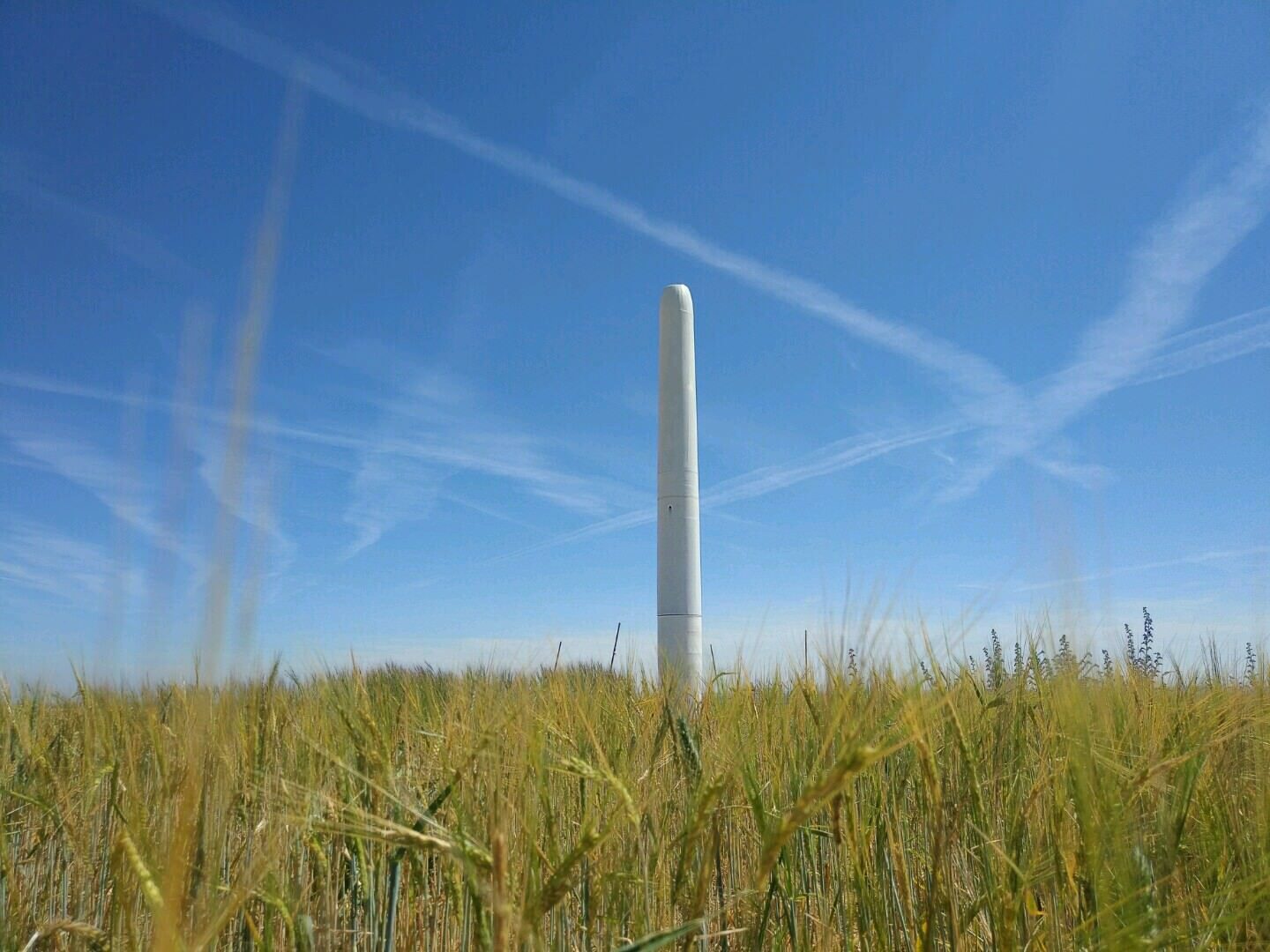
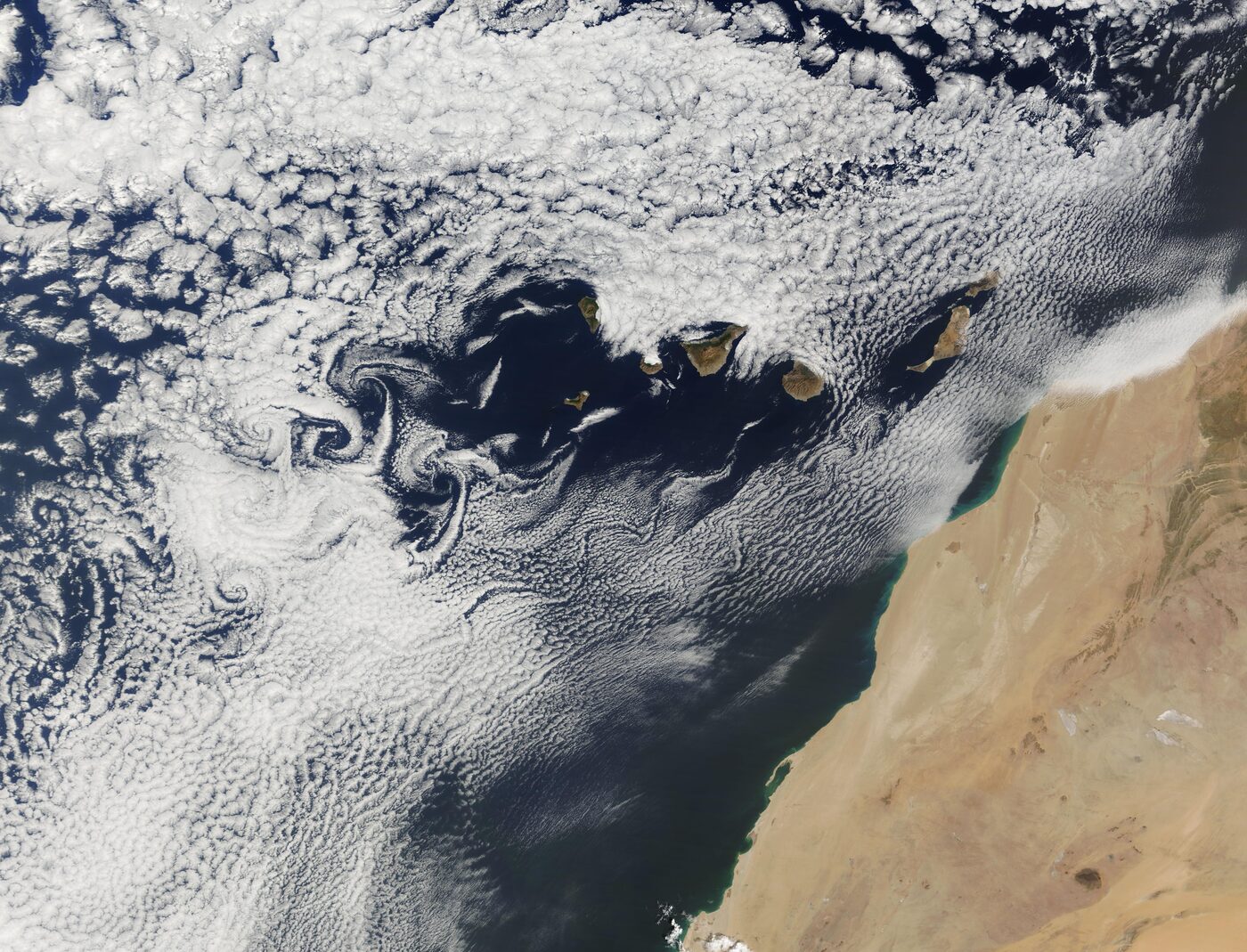
That is a real machine, in a real field, and it is genuinely just a stick that wobbles. Here is the effect it is trying to eat, photographed from orbit:
You already know what this sounds like
Before any jargon, three things you have definitely experienced.
One. A power line, on a windy day, humming. Not a buzz from the electricity — an actual note, made by the wind going past the wire.
Two. A flag on a pole, snapping back and forth in a steady breeze. Not flapping randomly. Flapping rhythmically, in time with itself.
Three. The old whip aerial on a car, doing that fluttery shimmy at exactly one speed on the motorway, and stopping when you slow down.
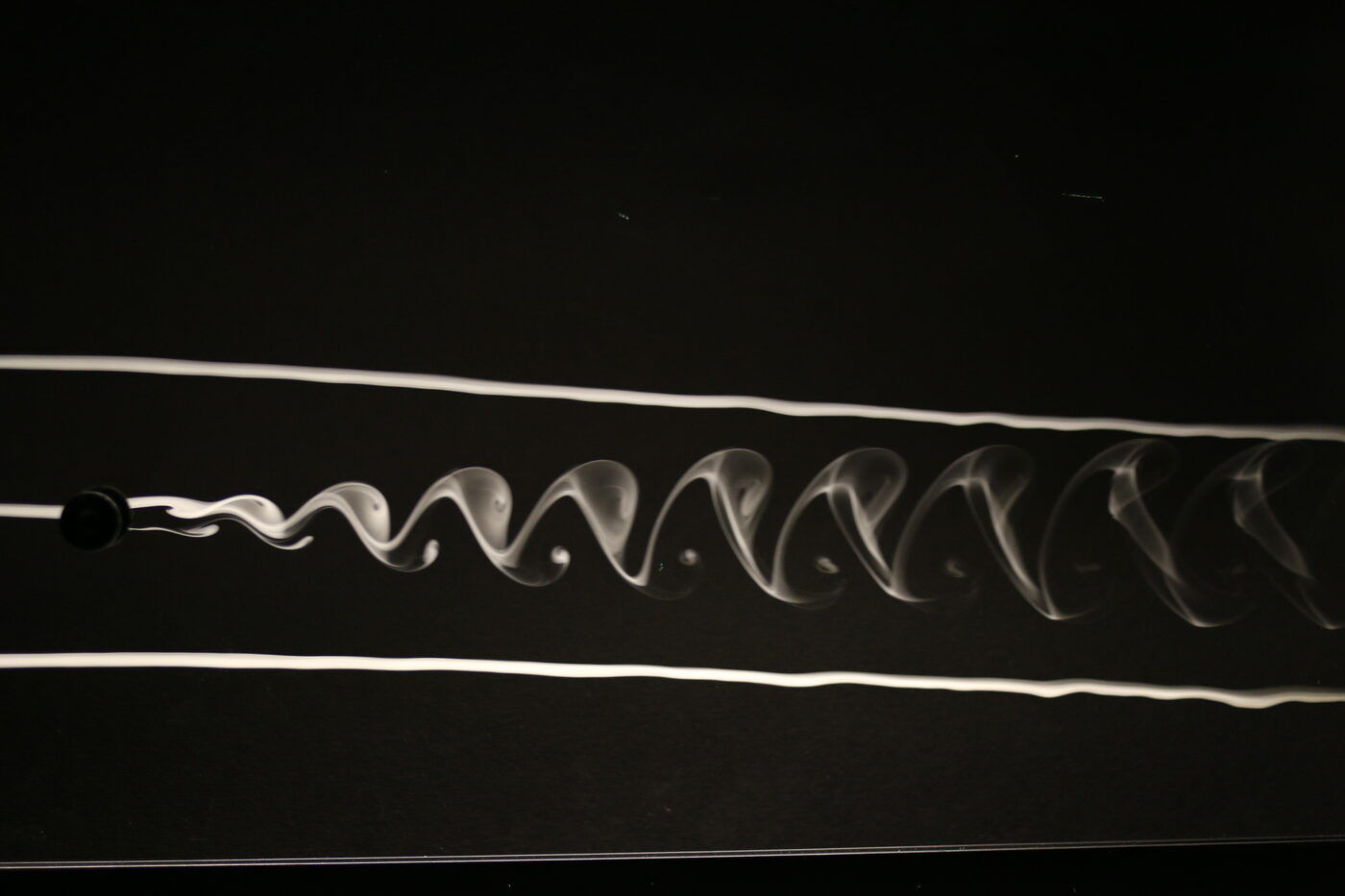
All three are the same thing. When moving air runs into something blunt — a wire, a rope, a pole, an island — it can’t stay tidily wrapped around it. It peels off. And crucially, it doesn’t peel off both sides at once: it lets go of one side, then the other, then the first side again, over and over, flinging off a neat alternating chain of little whirlpools. Each time one lets go, it tugs the object sideways. Left. Right. Left. Right.
That is vortex shedding, and the tidy zip-line of swirls it leaves behind is called a von Kármán vortex street, after the Hungarian-American aerodynamicist Theodore von Kármán.
The delightful bit: they can agree on a rhythm
Here’s where it gets good.
The swirls come off at a very regular rate, and that rate depends on almost nothing except how fast the wind is going and how fat the object is. Aerodynamicists have measured this so many times they’ve boiled it down to a single number — the Strouhal number, about 0.2 for a cylinder, and it stays stubbornly at roughly 0.2 across four whole orders of magnitude of conditions. Which means you can do this on the back of an envelope:
Take a fat power line, a centimetre across, in a brisk 10-metres-per-second wind. Shedding frequency ≈ 0.2 × 10 ÷ 0.01 = 200 wobbles per second. 200 hertz. That is a musical note, roughly a G below middle C, and it is precisely the hum you hear. The wind is not making a noise at the wire. The wire is being pushed left-right-left-right two hundred times a second, and your ears are calling that a note. 🎵
Now. Every object also has a rhythm it likes to wobble at — its natural frequency, the same reason a ruler twanged off the edge of a desk always buzzes at its own particular pitch. And if you build your pole so that its favourite rhythm matches the rhythm of the swirls coming off it, the two lock together. The swirls start pushing in time with the wobble. The wobble gets bigger. Bigger wobble sheds stronger swirls. Stronger swirls push harder.
Engineers call this lock-in, and it is exactly the moment where a mildly interesting nuisance turns into a machine.
The machine
The company is Vortex Bladeless, a Spanish startup out of Madrid and Ávila, formalised in 2012 and founded properly in 2014 by David Yáñez, David Suriol and Raúl Martín.
Their device is almost insultingly simple to describe. A fixed base, anchored to the ground. A slender fibreglass-and-carbon-fibre mast standing up out of it, joined by a flexible carbon rod so it can lean and spring back. That’s it, from the outside. Down at the bottom, inside, are neodymium magnets and coils — a linear alternator, which is a generator that takes a back-and-forth motion instead of a round-and-round one. The moving parts never touch each other. There is nothing to grease, nothing to gear down, nothing to brake in a storm, and no need to swing the thing round to face the wind, because a cylinder looks identical from every direction.
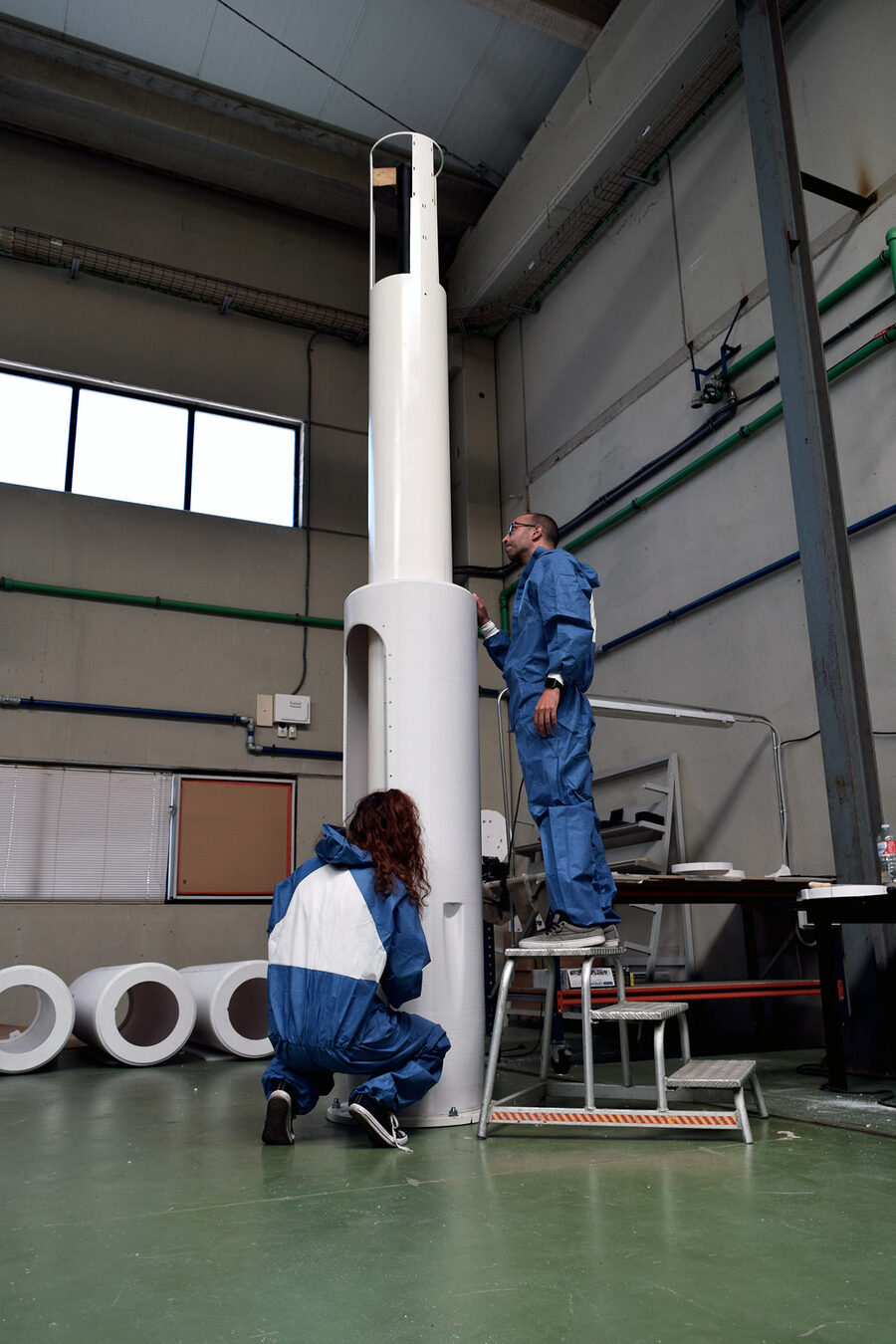
They even patented a neat trick for the lock-in problem: as the wind gets faster the swirls get faster, which would normally drop the pole out of its happy rhythm — so the alternator uses magnetic repulsion to nudge the mast’s own natural frequency along to keep up.
The European Union thought this was worth a look. Under Horizon 2020, the VORTEX project (grant 726776) ran from June 2016 to May 2019, with a total cost of about €1.9 million and an EU contribution of about €1.33 million. The company used a chunk of it to build a wind tunnel — reportedly the tallest in Spain — and to develop the oscillating alternator.
Right. The numbers. No fibbing.
This is the part where a lot of coverage of this thing goes soft, and we’re not going to.
The company’s own published line-up is a Vortex Nano, one metre tall, 3 watts. And a Vortex Tacoma, 2.75 metres tall, 100 watts. The 100-watt figure is the one they put in their EU grant application as the target for commercialisation, and it’s the number their spokespeople still quote: enough, they say, to run a fridge, some phones and a few LED lights at an off-grid house, alongside solar panels.
One hundred watts is a lightbulb and a half.
Meanwhile, a modern utility-scale wind turbine — the kind with the blades, the kind you drive past — is a multi-megawatt machine. New turbines installed in the United States averaged about 3.3 megawatts in 2023 and about 3.6 megawatts in 2024, going by the US Geological Survey’s turbine database. Call it 3.4 megawatts for a round modern turbine.
3,400,000 watts ÷ 100 watts = 34,000.
Thirty-four thousand shivering poles to equal one ordinary wind turbine. That’s the honest exchange rate, and the company doesn’t pretend otherwise — they’ve said repeatedly that they are not trying to compete with wind farms. They’re aiming at rooftops, small buildings, remote cabins, telecom huts: places where a spinning blade is impractical, unwelcome, or simply not allowed.
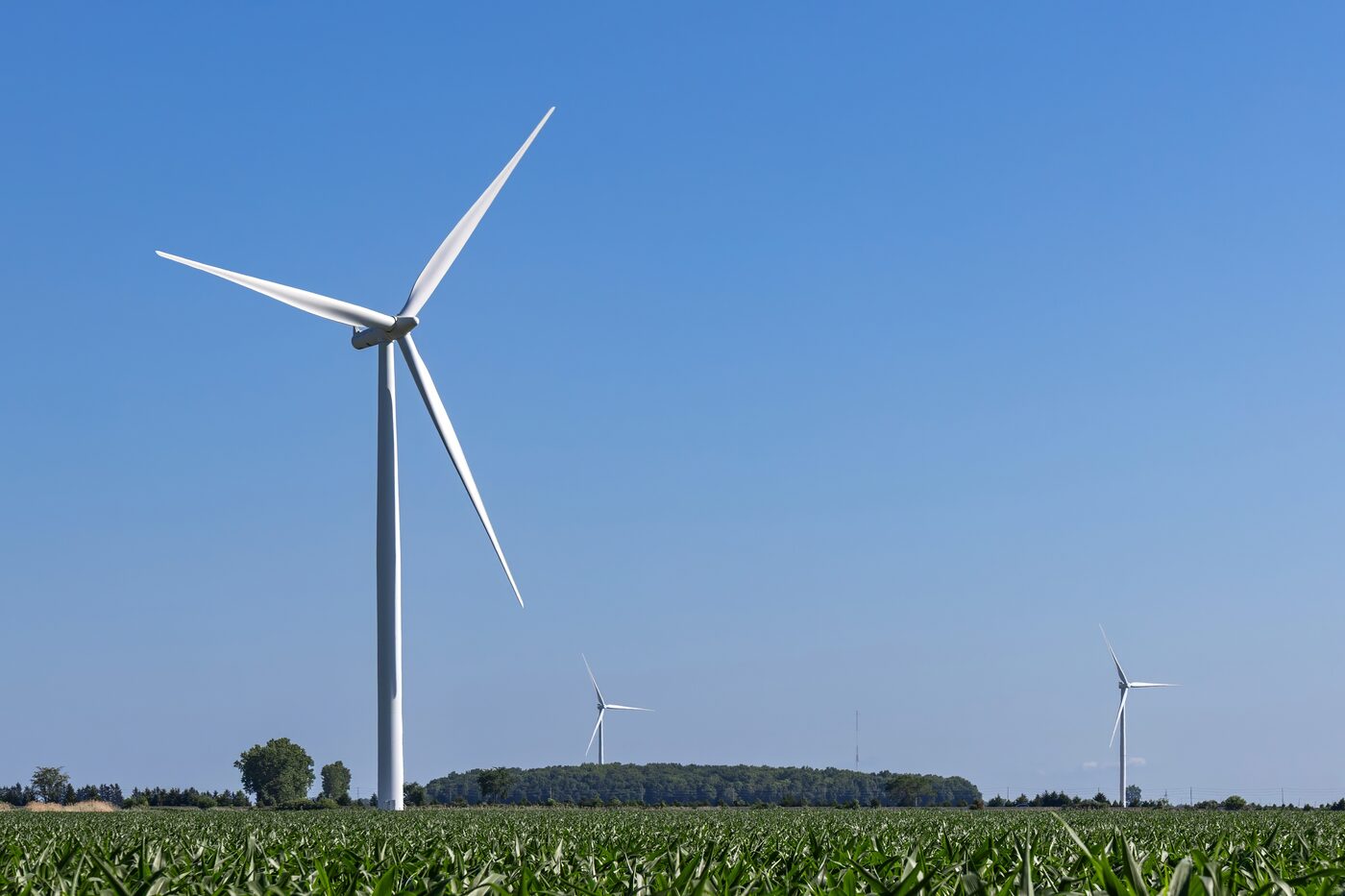
And what it does have going for it is real: it is quiet, it has no blades for a bird to fly into, there is essentially nothing to service, and it needs very little in the way of foundations or raw material. The company told the EU its device would come in at about half the cost of a comparable small wind turbine — that’s their figure, in their own funding pitch, not an independent audit, and it’s fair to file it under “claimed” until somebody sells a few thousand. As of now the technology is still, in the company’s own words on their website, under development.
The bit that makes engineers laugh
Vortex shedding is normally the enemy.
If you have ever looked at a tall steel chimney or a factory flare stack and noticed a corkscrew fin spiralling up the outside of it, that fin is there for exactly one reason: to wreck the tidy alternating swirl pattern before it can shake the chimney apart. They’re called helical strakes, and they exist because thin-walled steel tubes in a steady wind have genuinely torn themselves down. A fairground ride at Cedar Point lost one of its three towers to vortex shedding over the winter of 2001. Iranian gas refinery flare stacks got hit by it seven separate times between 1975 and 2003.
So there is a whole quiet corner of engineering whose entire job is stopping this from happening — and a Spanish startup that looked at the same effect and said: or, alternatively, we could plug it in. 🔌
A footnote on the bridge, because we’d rather be accurate than dramatic
The company’s origin story is that co-founder David Suriol saw footage of the 1940 Tacoma Narrows Bridge collapse — Galloping Gertie, twisting itself to pieces in a 40 mph wind — and thought: there is an enormous amount of energy in whatever just did that. Their 2.75-metre model is called the Vortex Tacoma.
Great story. One correction, though, because it’s the kind of thing physics textbooks have been getting wrong for decades: the Tacoma Narrows bridge did not fall down from vortex shedding. That was one of the proposed explanations, and it was rejected — the shedding frequency simply didn’t match the bridge. What actually destroyed it was aeroelastic flutter, a self-feeding twisting motion that grows without limit as long as the wind holds. Related family of ideas, different mechanism. The inspiration is real; the physics of the machine is the humming-wire kind, not the falling-bridge kind.
People are still working on it
This is not a finished idea sitting in a museum, which is part of why it’s fun.
In February 2026, a paper in the journal Energies proposed bolting a cylindrical cam mechanism onto the concept — a purely mechanical way to rectify the mast’s back-and-forth sway into one-way rotation, aimed squarely at low, gusty, urban wind. It’s a computational study: fluid dynamics and stress simulations showing the idea is plausible and the mast survives. Nobody has built it yet.
And a team at the University of Glasgow published a modelling study in Renewable Energy working out how long and how fat the mast ought to be. Their headline: a configuration that stayed inside safe bending stress reached a modelled 460 watts — a good deal more than 100, though still a model rather than a pole in a field. Their own conclusion is the honest one: to get past the roughly 1-to-100-watt range these devices live in today, somebody has to go and build the bigger ones and see.
Where this ends up, which is a hundred miles wide
Here’s the thing that makes this whole subject sing.
The effect Vortex Bladeless is trying to harvest with a 2.75-metre pole is not some exotic laboratory curiosity. It is scale-free. Run air past a blunt object — any blunt object, at almost any size — and you get the same alternating chain of swirls.
So: put an island in a steady ocean wind, hang a deck of low cloud over the water to act as ink, and point a satellite at it.
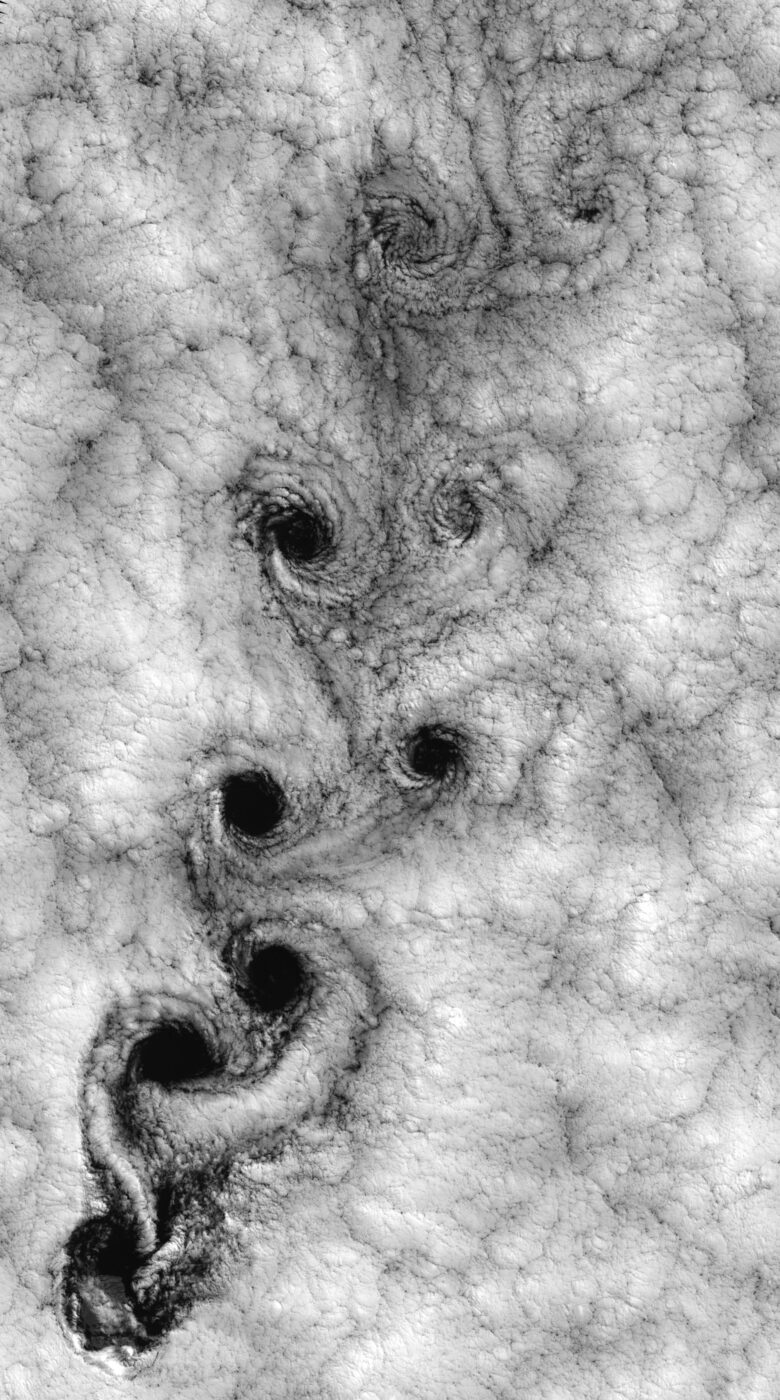
Same swirls. Same alternating left-right-left. Same tidy, patient, unhurried rhythm. Only now the cylinder is a volcanic island a few kilometres across, the fluid is the atmosphere of an entire planet, and the vortex street runs for hundreds of kilometres out across the Pacific.
Why this is on a good-news blog
Not because it’s going to power your town. It isn’t, and we said so, twice, with the arithmetic.
It’s here because of the move. Somebody looked at a phenomenon that engineering has spent a century treating purely as a hazard — the thing you wrap chimneys in corkscrew fins to prevent — and asked the small, cheerful, slightly cheeky question: what if we just let it happen, on purpose, into a magnet?
That’s the good bit. Not the wattage. The willingness to walk up to a well-known nuisance and see a machine in it. Right now the answer is a hundred watts and a pole in a field, shaking politely in the breeze. That’s a perfectly respectable place for an idea to be standing while people go and find out how big it gets. 🌀💛
And in the meantime, the same physics is up there over the Pacific, drawing hundred-kilometre spirals in the clouds, for free, and has been the entire time.
Go deeper (real links, no pop-ups, promise)
- 🌀 Wikipedia: Vortex shedding — the humming wires, the chimney strakes, and the Tacoma Narrows correction
- 🇪🇺 CORDIS: the EU’s record of the VORTEX project (grant 726776)
- 🔬 Energies (Feb 2026): a bladeless turbine with a cylindrical-cam conversion — open access
- 📐 Renewable Energy: how long and how fat should the mast be? — the Glasgow wake-oscillator study
- 🏭 Vortex Bladeless: how it works, in their own words
- 🛰️ Wikipedia: von Kármán vortex street — including a gallery of islands doing it


