

Here is a thing that is happening right now, tonight, without any fuss, above a dark paddock in southeastern Australia.
A brown moth about three centimetres long climbs into the air. It has never flown anywhere before. It has no parents to follow — they died months ago, hundreds of kilometres away. It has no map, no landmarks it has ever seen, and no older moth showing it the way. And it sets off on a journey of up to 1,000 kilometres, aimed at a handful of specific cool caves tucked into the Australian Alps — caves it must find, out of an entire continent, having never once been told where they are. 🌌
And in June 2025, a team of scientists finally worked out how it does it.
It’s looking up. It’s steering by the stars. ⭐

Meet the traveller
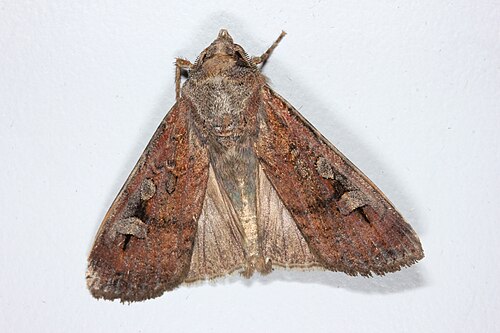
The bogong moth (Agrotis infusa) is not a showy insect. It is brown. Emphatically brown. It has a wingspan of about 40–50 mm and weighs roughly a third of a gram — you could post a dozen of them for the price of a stamp and the envelope would feel empty. Its name comes from Dhudhuroa, an Aboriginal language of the region: bugung, meaning brown moth. The name is fair.
If you live in Canberra, Melbourne or Sydney you may have met one bumping around a porch light in spring, blown off course by a strong wind, and thought nothing of it at all. This is the insect equivalent of finding an Olympic marathoner resting on your doormat and assuming they’re just some person.
The trip
The bogong’s life runs on a beautifully stubborn schedule.
The caterpillars grow over winter in the soil and pastures of southern Queensland, western New South Wales and Victoria. Come spring, the adults emerge — and the plains are about to become unbearably hot and food-poor. So they leave. Billions of them, flying at night, heading south and east toward the Australian Alps. The trip can take days or weeks.
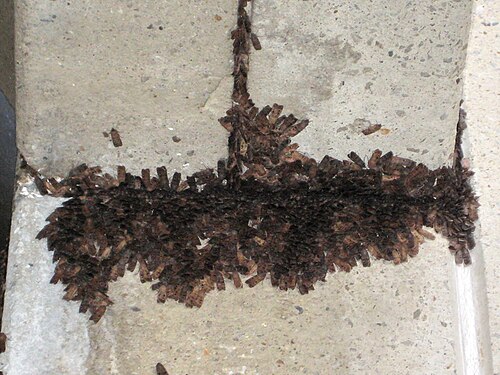
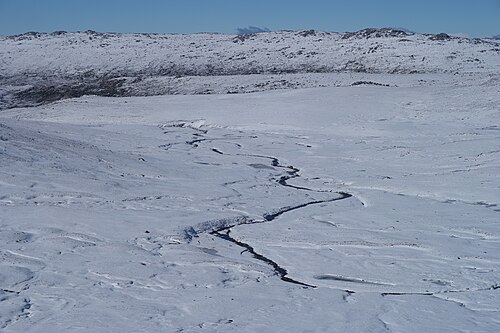
Their destination is not “the mountains” in a vague sense. It is a limited number of particular caves and rock crevices, typically above 1,800 metres, where the air stays cool and damp all summer. There the moths pack themselves onto the walls in an astonishing tiled arrangement — up to 17,000 moths per square metre, each one tucked head-down under the wings of the moth in front like roof shingles — and they go dormant. Not hibernation (that’s for winter); this is aestivation, sleeping through the heat.
Then, at the end of summer, the very same individuals wake up, fly all the way back to the lowlands, mate, lay eggs, and die. One moth. Round trip. The next spring, their children — who have never met them — make the identical journey to the identical caves.
So how do you find a cave you’ve never seen?
This has been a genuinely great mystery for decades. In 2018, researchers showed the moths can sense Earth’s magnetic field and use it together with visual landmarks to hold a course. Good — but a magnetic sense alone doesn’t explain the precision, and the moths kept flying true on nights when it shouldn’t have been enough.
So the team, led by Dr David Dreyer and Professor Eric Warrant at Lund University with colleagues in Australia and Germany, built something wonderful: an indoor flight simulator for moths.
A migrating moth is gently tethered so it can turn freely and “fly” in place. Above it, a projected natural, moonless night sky — the real southern stars, in their real positions. And around it, a set of coils that cancels out Earth’s magnetic field entirely, switching off the moth’s known magnetic compass so it can’t cheat.
Under those conditions, with nothing to go on but starlight, the moths flew in exactly the seasonally correct migratory direction. Spring moths headed toward the Alps. Autumn moths headed back. 🧭
Then the researchers rotated the projected sky — and the moths obediently turned with it. And when they scrambled the star pattern into meaningless dots, the moths lost the plot completely.
That’s a compass. A real one. Read off the stars.
The part that gives you chills
The team went further and recorded from individual neurons inside the moth’s brain while the sky turned overhead.
They found visual nerve cells, in several regions of the brain, that responded specifically to rotations of the night sky — all of them tuned to a shared sky orientation, and firing most strongly when the moth was pointed south.
Sit with that for a second. Inside a head you would need a magnifying glass to examine are nerve cells whose entire job is to answer the question “which way is south?” by looking at the stars. The moth is not vaguely drifting toward warmth. It is running a genuine celestial compass, in hardware, in an animal that weighs about a third of a gram.
A first for the whole invertebrate world
Birds do this. Seals do it. Humans figured it out and built an age of sail on it. Dung beetles were already known to roll in a straight line using the band of the Milky Way — a neat trick, but a short one, over a metre or two.
The bogong moth is the first invertebrate ever shown to use the stars as a compass for a genuine long-distance journey to a specific destination. The paper landed in Nature on 18 June 2025, and it rearranged a few assumptions about what a very small brain is allowed to be capable of.
The researchers think the moths run a layered system: stars as the primary compass, Earth’s magnetic field as the cloudy-night backup, so that a bank of weather can’t strand a generation. Belt and braces, evolved.
And for the last step — actually locating the one right cave on the one right ridge — there’s a lovely, still-unproven idea. Those caves have been used for uncountable generations, and their floors are deep in the remains of moths past. Scientists who’ve been inside report the smell is distinct and pungent. To a moth’s exquisite nose, the cave may simply announce itself: a scent beacon at the end of a thousand kilometres of starlight. Nobody has proved it yet. It remains one of the better things left to find out. 👃
An old, old appointment
People have known about this migration for a very long time.
For thousands of years, Aboriginal groups from many clans and language groups travelled up into the Alps each summer for the moths — a rich, high-fat food that arrived in reliable millions. The moths were gathered from the rock faces, roasted to remove the scales and wings, and eaten, or ground into cakes that kept for the journey home. They were said to taste nutty, like walnuts or almonds. These gatherings were major inter-tribal events.
And that’s not folklore reconstructed from guesswork. In 2020, researchers excavating Cloggs Cave, in the southern foothills of the Alps in Gunaikurnai country, found microscopic remains of ground and cooked bogong moths still clinging to a small grindstone — about 2,000 years old. It is the first confirmed archaeological evidence anywhere in the world of insect food remains on a stone tool. An oral history and a laboratory result shook hands across twenty centuries. 🪨
The honest bit, and the hopeful bit
The bogong moth is having a hard time. Severe droughts and warming caves drove a steep crash, and in December 2021 it was listed as Endangered on the IUCN Red List. This matters far beyond the moth: the endangered mountain pygmy-possum wakes from hibernation timed to the moths’ arrival and depends on them more than any other food.
But here’s the thing worth holding onto. The moths’ numbers rise and fall hugely with the rain, and a good season can send billions of them back into the sky — which means the migration is still there, still running, still waiting on better weather and on us. And it’s now being watched more closely, and understood far better, than at any point in history. Knowing how something works is usually the first step toward keeping it.
Why this is on a good-news blog
Because tonight, while you are reading this, a small brown insect that nobody would look at twice is flying through the dark over Australia, alone, toward a place it has never been, and it is finding its way by looking at the stars.
Nobody taught it. It just knows — the way you know how to yawn. That knowledge has been folded into a third of a gram of moth and posted forward, generation after generation, for longer than there have been people to notice it.
The universe is under no obligation to be this good. And yet: moths, navigating by starlight, right now, over a dark paddock, on their way to a cool cave in the mountains. 🌌💛
Seen something the world is quietly doing well? Sign the guestbook and tell us about it. ⭐
Go deeper (real links, no pop-ups, promise)
- 🔬 Dreyer et al., “Bogong moths use a stellar compass for long-distance navigation at night,” Nature, 18 June 2025
- 📰 Nature news: “These moths use the stars to navigate on an epic migration”
- 🧭 The 2018 discovery of the moth’s magnetic sense (Current Biology)
- 🪨 Cloggs Cave: 2,000-year-old bogong moth food remains (Scientific Reports)
- 🦋 The bogong moth on Wikipedia


