

Here is the thing everyone gets wrong about bowerbirds, and it’s worth getting out of the way in the first paragraph, because everything good about them depends on it.
A bower is not a nest.
No egg is ever laid in one. No chick is ever raised in one. Nobody sleeps in it. The female bowerbird builds her own nest, somewhere else entirely, out of sticks and leaves up in a tree, and she does it alone. The male has nothing to do with it and is never invited.
So what is he building? He’s building a venue. A stage set. A little roofless gallery with a walkway through the middle and a display floor at each end, which he will construct, decorate, curate, defend and continually re-hang for an entire breeding season — for an audience that visits for a few minutes at a time and then leaves to go and think about it. 🪶
First, the blue
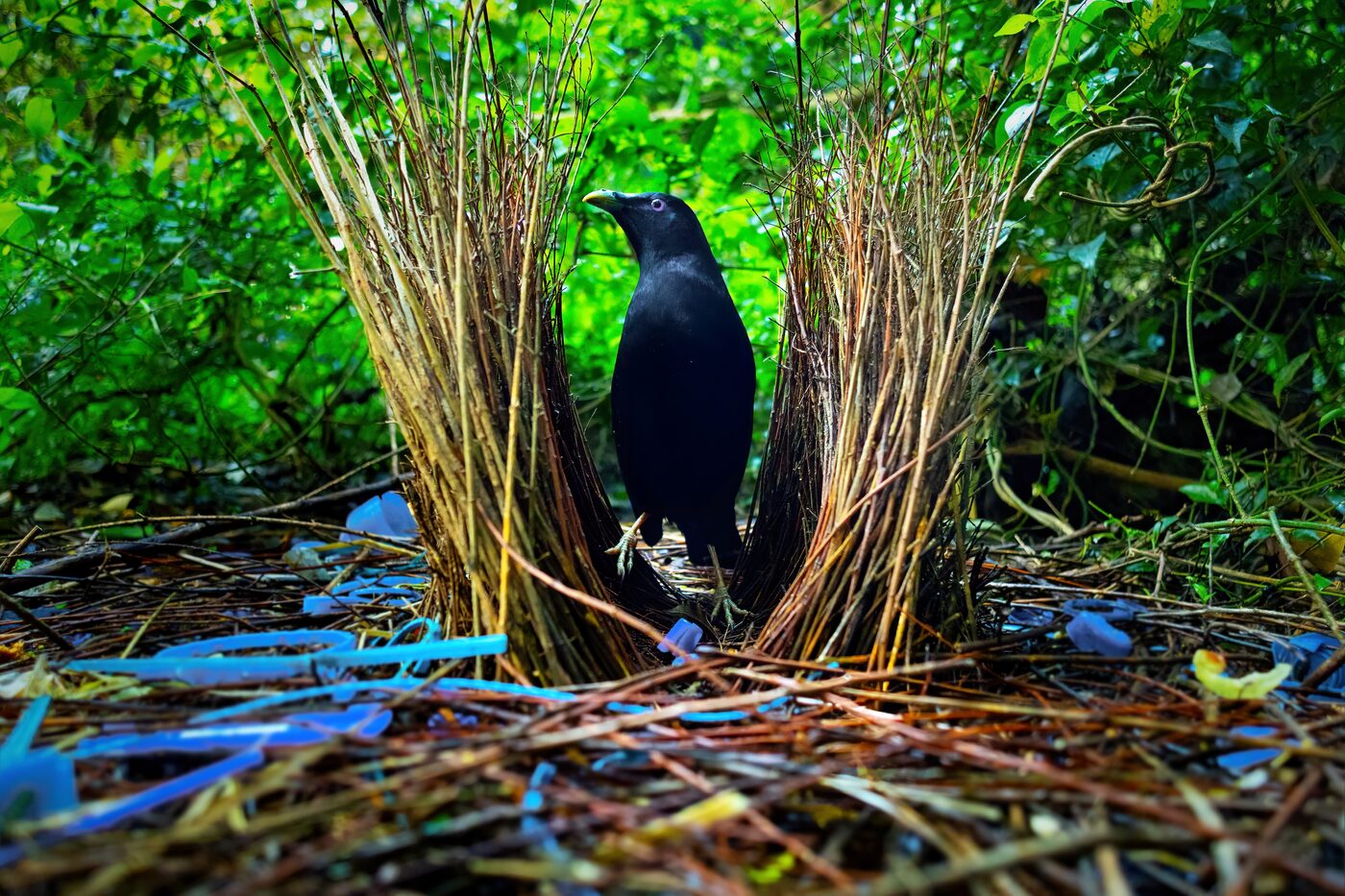
Start with the satin bowerbird, because his particular madness is the most immediately legible.
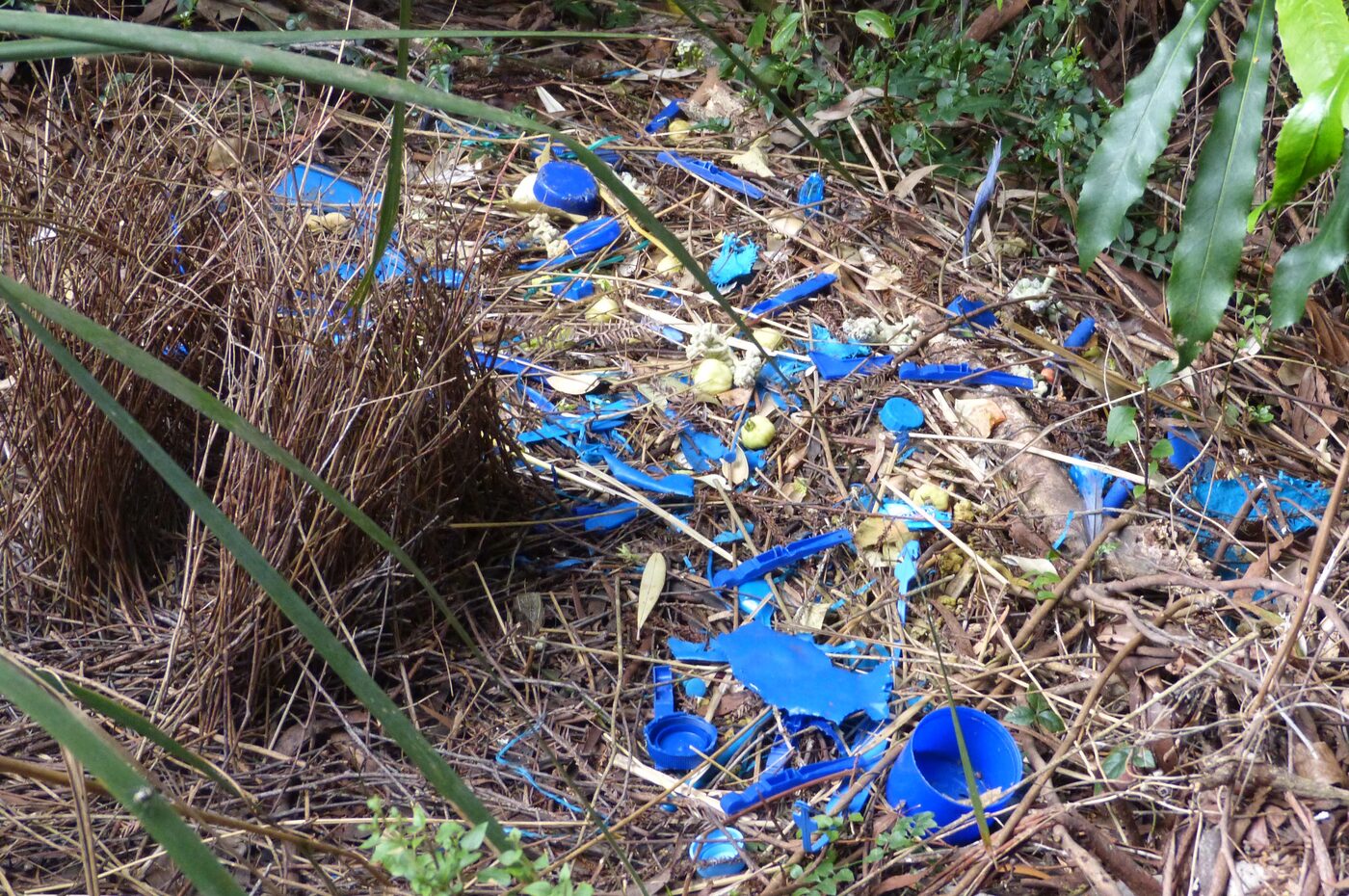
He likes blue. Not “prefers blue among other things” — likes blue, with the fixed and slightly alarming focus of a collector. He’ll take blue feathers, blue flowers, blue berries, blue snail shells. And since we turned up, he’ll take blue drinking straws, blue clothes pegs, blue bottle caps, blue pen lids, and blue bits of broken plastic that used to be something else. Younger males hedge with yellow and other shiny bits; as they mature, the collection goes bluer and bluer.
It is genuinely funny, and it is also a bit sad, and we think it’s allowed to be both at once. Every one of those bright blue chips is litter — and every one of them was found, judged, picked up, carried home and placed. He is doing exactly what he has always done. The raw material just changed. 💙
Then, the perspective
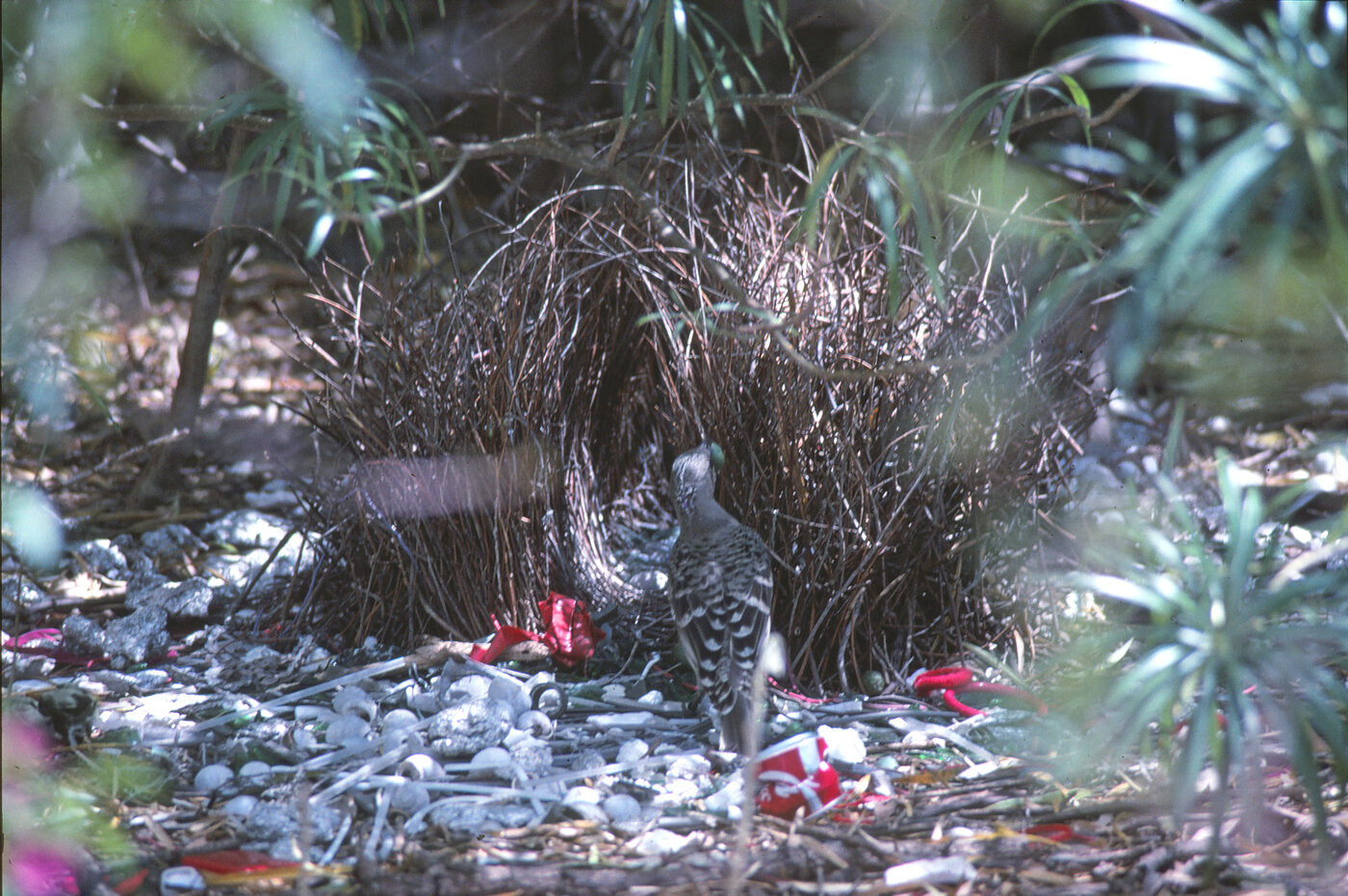
Now go north, to the dry woodland across the top of Australia, and meet the great bowerbird — the biggest of the family, 33 to 38 cm of fawn-grey bird with a small lilac crest on the back of his neck that he flashes at exactly the right moment.
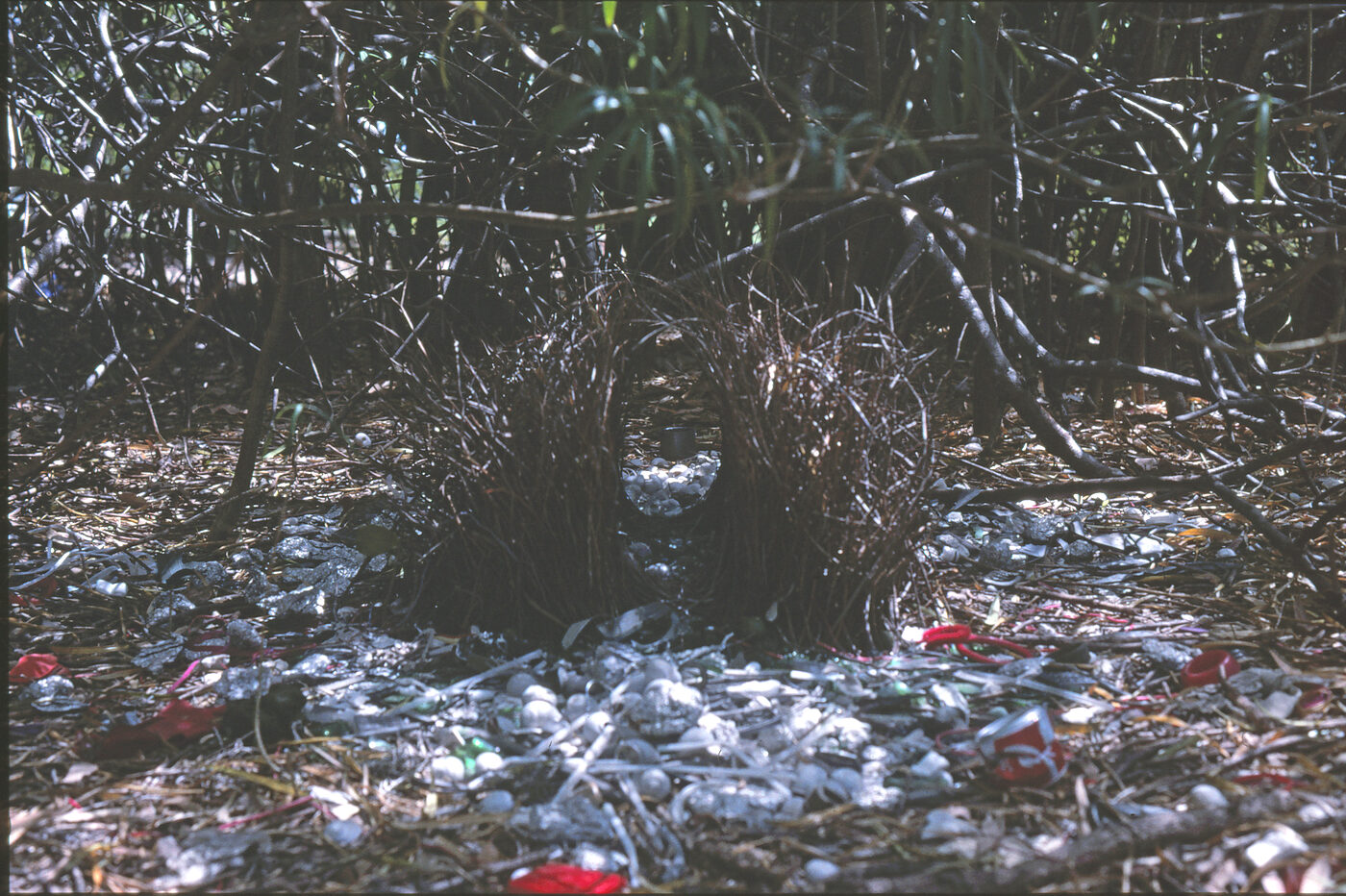
His bower is a proper piece of architecture: two densely thatched parallel walls of sticks forming an avenue about a metre long, with an open display court at each end. The courts are cleared patches of ground covered in tens to hundreds of pale objects — stones, snail shells, sun-bleached bones, bits of coral, and these days plastic and glass. They’re deliberately drab. They’re a background, against which he holds up something coloured and red and gorgeous while he displays. He’s built himself a neutral gallery wall.
And here is the part that has been keeping people up at night since 2010.
The objects on the court are graded by size. Small ones nearest the avenue. Larger ones further out. Not roughly — measurably, consistently, and individually: each male has his own characteristic gradient, and keeps it stable across the season and across years.
The female watches his display from inside the avenue, looking out along it. From that one specific viewpoint, a floor of objects that get bigger as they get further away subtends a strikingly even mosaic of visual angles — the far ones are bigger, but they’re also further, and the two effects cancel. The pattern reads as regular. It’s the same trick a film crew uses when they build a corridor that narrows toward the back to make it look longer, run in reverse. It has a name in art and in cinema: forced perspective.
The experiment that settles it
You could, if you were feeling stubborn, argue that a size gradient is just what happens when a bird dumps objects near a doorway. Big things are heavy, so they don’t get carried as far. Fine. That’s a real objection. So test it.
Test one (Deakin University, 2010–2012): researchers went into the courts and rearranged them — improving the gradient in some bowers, reversing it in others — and then backed off and watched. The birds restored their original arrangement within about three days. Both directions. The ones whose gradients had been “improved” undid the improvement.
That’s the detail that changes the whole story. A bird that pushes things around at random doesn’t notice when you tidy it. This one has a composition in mind, and he can tell when you’ve ruined it.
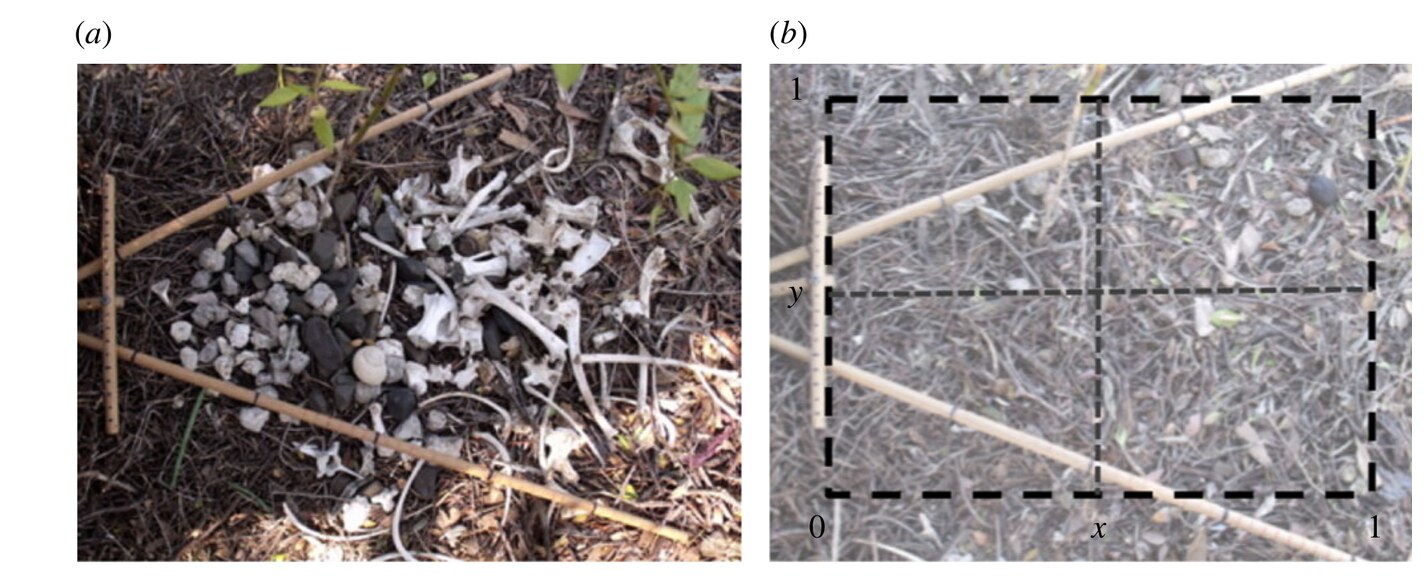
Test two (Kelley & Endler, 2017): harder. They found 14 wild males in Queensland, put motion-triggered cameras on their bowers, and then took every single object off the main display court and piled it up 20 cm to one side. Total wipe. Then they filmed what happened next.
- Every male started rebuilding within four hours. The average bird placed his first object 45 minutes after the researchers walked away.
- He didn’t start at the edges. He started in the middle of the court, in the visitor’s direct line of sight — the part she is guaranteed to see — and worked outwards. Which is, as the authors point out with obvious delight, exactly the order human beings lay a mosaic.
- The gradient wasn’t assembled by trial and error. It was there in the first ten objects. Ten. The geometry those first ten created was statistically indistinguishable from the geometry that had been there before the researchers destroyed it — and on average very slightly better.
- After 72 hours he’d only carried back about half his objects. He wasn’t finished. But the arrangement had been correct from nearly the first stone.
He wasn’t reconstructing a memorised map of where each object went. He was selecting — going to the pile, choosing an object of the right size for the spot he was filling, and placing it. Repeatedly. Correctly. From the start.
What the illusion actually does — and what we don’t know
This is where a lot of retellings sprint past the evidence, so let’s walk.
What is measured is this: the size–distance gradient is real, it is consistent within a male and different between males, and from the female’s viewing position it produces a regular mosaic of visual angles. And crucially — males whose courts look most evenly patterned from inside the avenue get the most matings. Not the males with the most objects. In the 2017 experiment, the sheer number of objects on a court predicted neither its quality nor the owner’s mating success. It’s the arranging that counts, not the hoarding.
What is interpreted is what that regularity does inside her head. John Endler, whose team found the effect, describes it as giving “the illusion that the court is smaller than it is and anything displayed within the court is larger than it really is.” That’s a plausible and carefully worded reading of the geometry — and it is a reading. Nobody has been inside a bowerbird’s visual cortex. You will see this flattened elsewhere into “he tricks her into thinking he’s bigger,” and that is further than anyone has actually gone.
Honestly? The uncertainty makes it better. What we know for certain is that a bird is maintaining a precise optical arrangement that only resolves from one specific viewpoint that isn’t his own. He builds it, and then he steps outside it, and the only creature who ever sees it properly is his audience. Whatever it does to her, he can’t see it. He’s working from the other side of the picture. 📐
The engine is her, not him
It’s tempting to read all of this as a story about male effort. It isn’t, quite. It’s a story about female attention.
Bowerbird females are not easily impressed and they do not decide quickly. They visit bowers repeatedly — some while the male isn’t even there, just to look at the work unaccompanied — and they compare. In satin bowerbirds, a female will sample several males multiple times in a season, and come back to a male she liked in later years. Young females weight the bower itself most heavily; older, more experienced females pay more attention to the dance.
That is the whole engine. The reason a bird spends a season sorting pebbles by size is that somebody is genuinely, carefully, repeatedly looking — and can tell the difference between a court that’s been maintained and one that hasn’t. The extravagance on one side is a direct measure of the discernment on the other.
Which, if you’ve ever made anything, is a familiar feeling.
Why this one stayed with us
Because he is not building shelter. Nothing about the bower keeps anyone warm or dry or safe. It has no function except to be looked at, and it is the entire basis on which he’ll be judged.
Because the thing he’s actually good at isn’t construction — plenty of birds build. It’s curation. The sticks are the easy part. The art is in which object, and where, and how big, and whether the one you found this morning is better than the one that’s already there.
And because when scientists took his whole collection away and dumped it in a heap beside him, he waited forty-five minutes, walked over, picked out the right-sized stone, and put it exactly where it went. 🪶💙
Know an animal with unreasonably good taste? Sign the guestbook and tell us about it.


