

Let’s start with the date, because the date does most of the work.
1901.
The Wright brothers would not get off the ground for another two years. Queen Victoria died that January. There was no such thing as a radio broadcast, and the Model T was seven years away from existing.
And in a little wooden hose cart house on L Street in Livermore, California, somebody screwed in a light bulb.
It is still on. 💡
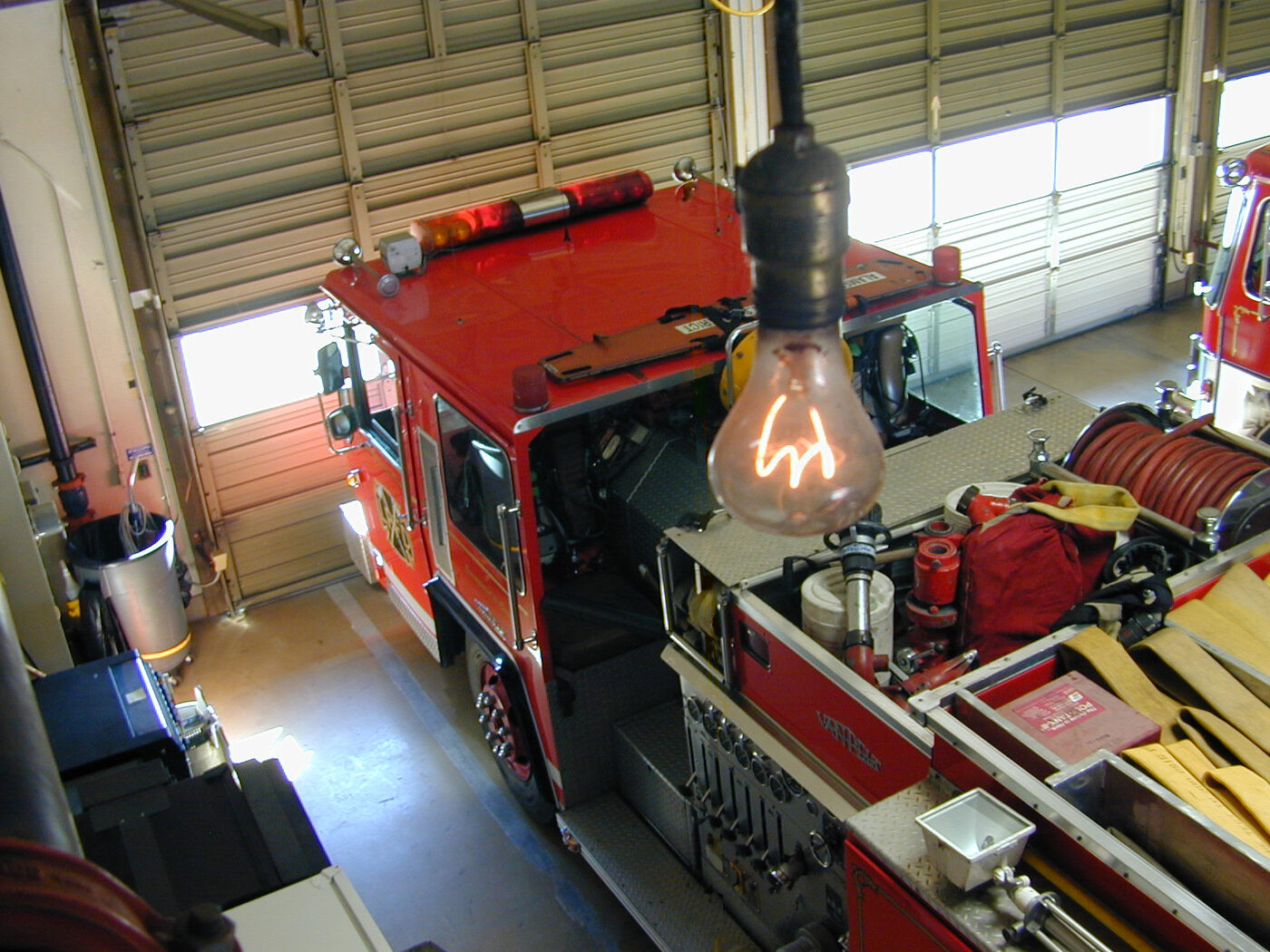
It is not in a museum. It is at work.
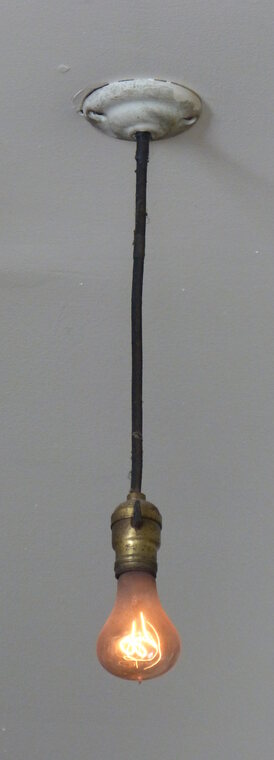
You can go and see it. It hangs from the ceiling of Fire Station #6 at 4550 East Avenue, Livermore, about fifteen feet up, and the firefighters will let you in and point at it if they aren’t out on a call. It is a few inches long, shaped like a pear, and it gives off a warm orange glow that is genuinely, unmistakably dim.
That dimness is not a flaw in the story. It’s the whole story. Guinness World Records notes that the bulb is “left on 24 hours a day in order to provide night illumination of the fire engines” — which is to say this thing is not a relic under glass. It’s the nightlight over the trucks. It has one small job and it has been quietly showing up for it for a hundred and twenty-five years.
For its first seventy years nobody thought much of it. Then in 1972 a Tri-Valley Herald reporter named Mike Dunstan spent weeks talking to old Livermore residents, worked out that the thing in the firehouse had never been replaced by anybody’s memory, and wrote it up. He mailed the story to Guinness, to Ripley’s, and to General Electric. All three came back and said the same thing: yes, as far as we know, that’s the oldest one.
The reason is slightly funny
Here’s the part that surprises people, and it’s the good part.
The bulb has not survived because it is a miracle bulb. It survived because nobody keeps flicking it.
Think about when a light bulb actually dies. It’s almost never while it’s sitting there glowing quietly. It’s the instant you hit the switch — that little tink, and the room stays dark. That’s not a coincidence. A filament that’s been running is hot, evenly, all the way along; a filament you’ve just switched on goes from room temperature to blazing in a fraction of a second, and then cools all the way back down when you leave. Do that enough times and the constant swelling and shrinking finds the one thin spot and snaps it.
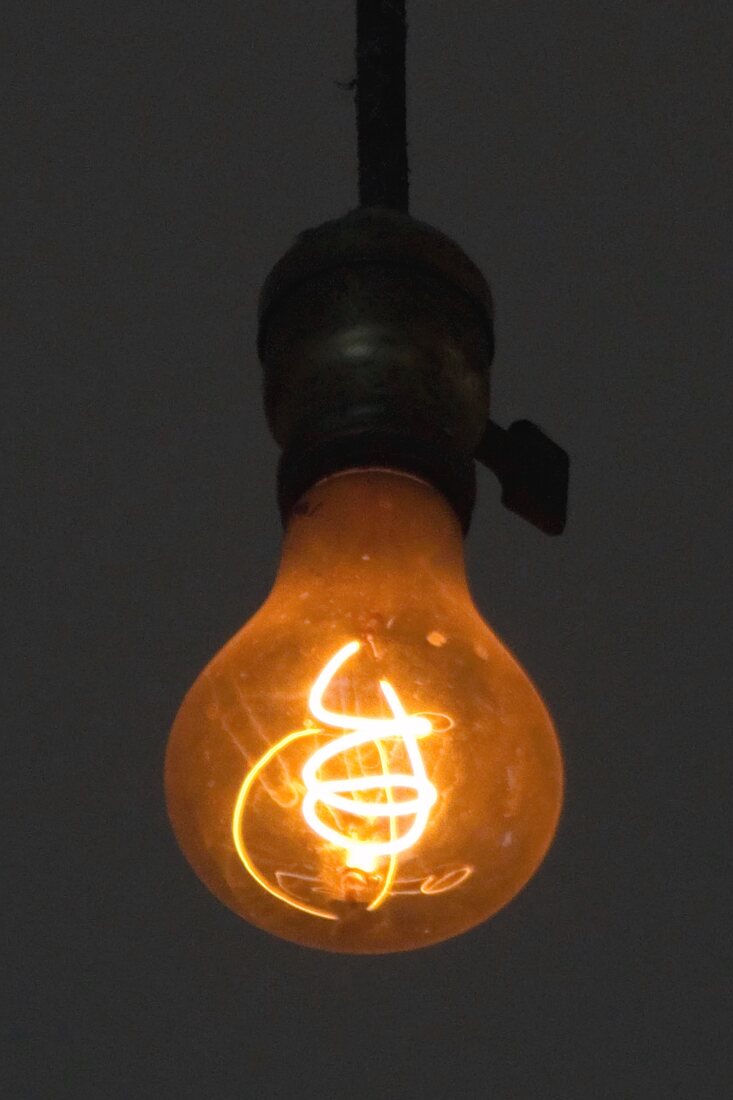
The Centennial Light almost never gets switched. So it almost never gets that shock. It just sits at one steady, gentle, unexciting temperature — about four watts’ worth — hour after hour, decade after decade, doing the least stressful possible version of being a light bulb.
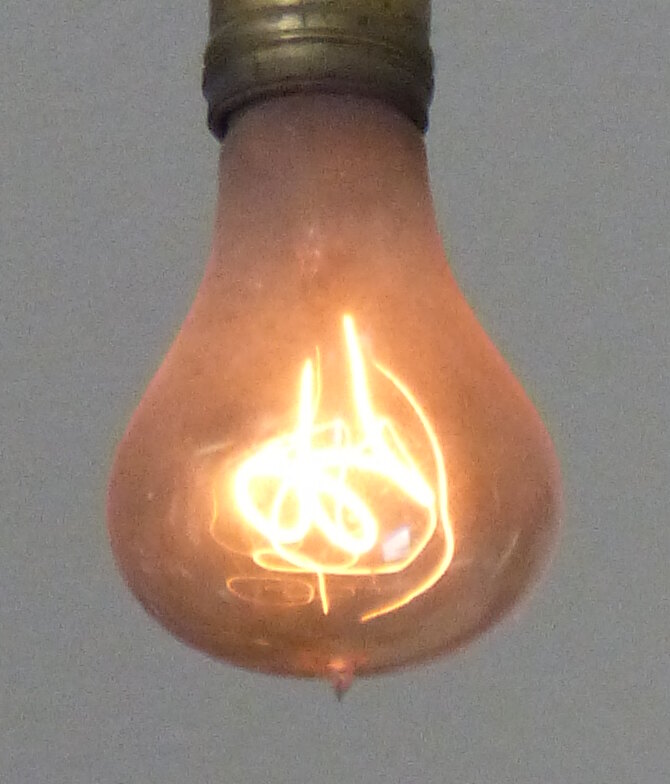
The rest of the reasons are all about being made carefully and asked for very little: a thick carbon filament, much chunkier than the fine tungsten hair in a modern bulb; good glass and brass; a seal that has simply never let go. And a workload of four watts, which is barely a workload at all.
Made in Shelby, Ohio, by a man from France
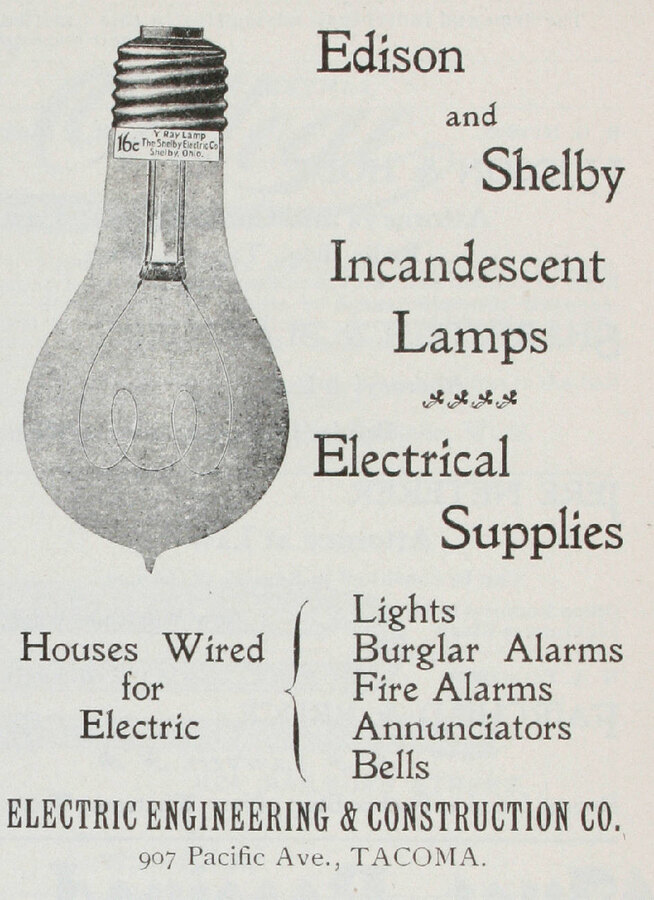
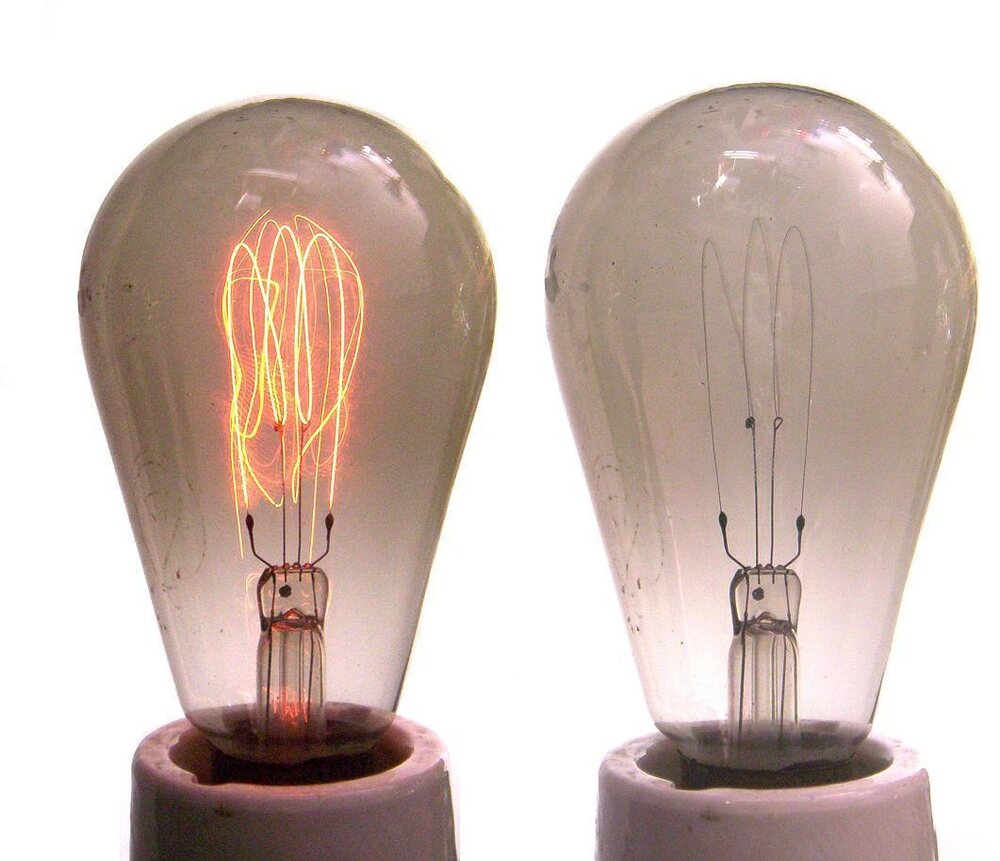
The bulb was made in the late 1890s by the Shelby Electric Company of Shelby, Ohio, hand-blown, from an improved lamp design by a French engineer named Adolphe Chaillet.
It got to California because of a small act of small-town courtesy. Dennis Bernal owned the local power company, and in 1901 he sold it. On his way out he donated a light bulb to the fire department.
That’s the entire origin story. A man sold his business and gave the firehouse a bulb.
And here is the detail that quietly proves the whole point: the Centennial Light is not a one-off. Plenty of other Shelby bulbs from the same era still exist, in collections and in a museum back in Shelby, Ohio — and when people plug them in, a fair number of them still light up. They were good bulbs. This is simply the one that nobody ever unplugged.
“Continuously,” with an asterisk or two
It has been on since 1901, but Livermore is refreshingly honest about the gaps, and the gaps are charming rather than damning.
Guinness counts exactly one break: the move between fire stations. The bulb’s own caretakers keep a stricter ledger. It was off for about a week in 1937 while the firehouse was renovated. And on the night of May 20, 2013, people watching the bulb’s live webcam — yes, it has a live webcam — saw it go dark and understandably panicked. An electrician turned up the next morning and found that the bulb was fine; its uninterruptible power supply had died instead. About nine and a half hours later it was glowing again.
Then it did something nobody has explained. For a few hours after coming back, it burned at a full 60 watts — the brightness it had in 1901 — before settling back down to its usual four. 💛
Four generations of people being careful
Until 1976 the bulb ran straight off the city’s 110-volt supply — and not off the fire station’s backup generator, because somebody worried a generator surge might be the thing that finally killed it. Since 1976 it has had its own dedicated power supply, arranged by the city electrician.
Somebody has been making decisions like that on this bulb’s behalf, continuously, since before the First World War. It now has a committee — the Livermore-Pleasanton Fire Department, the Livermore Heritage Guild, and scientists from Lawrence Livermore and Sandia national labs, who have all agreed to look after a light bulb. The fire department’s stated plan is simply to keep it burning for as long as it will burn.
Crews have come and gone around it for four generations. Every firefighter who has ever worked that station has walked underneath it, in the dark, and let it be.
Why this lives on a good-news blog
Because it’s a whole town being gentle with something for a hundred and twenty-five years, for no reward at all.
And because of what happened in 1976, which is the best thing in this entire story.
The fire department was moving to a new building. They had to take the bulb. Unscrewing it was considered too risky — you could crack the seal — so they cut the cord instead and carried bulb and socket together in a specially built box. A full police and fire truck escort ran with it through Livermore, under the eye of a fire captain named Kirby Slate. An electrician was waiting at the other end to wire it straight back in. It was without electricity for about twenty minutes, and Ripley’s ruled the pause too short to break its record.
So: a motorcade. Lights, engines, officers, a captain, a box on a seat — moving one small dim glass pear across town at the speed of something precious.
Nobody made them do that. They just thought it deserved it. 💡💛


