

Here is a thing our species did, together, on a Monday.
We built a spacecraft about the size of a vending machine, gave it a camera and no scientific instruments whatsoever, launched it on a nine-month trip to a pair of asteroids 6.8 million miles away, and then — deliberately, on live television, with a countdown — flew it straight into the smaller one at 14,000 miles per hour. 🎯
And the rock moved.
Not much. Not dramatically. Nothing exploded in a way you’d recognise from a film. But the little moon called Dimorphos finished its next lap around its parent asteroid about 32 minutes early, and in that half hour something quietly enormous happened: for the first time in the history of everything, human beings measurably changed the motion of another world.
First, the reassuring part
Dimorphos was never going to hit us. Neither is Didymos, the bigger asteroid it orbits. The pair doesn’t cross Earth’s path at all, and crashing into a moonlet a kilometre from its parent couldn’t have made it dangerous even if anyone had wanted it to. NASA picked this system because it was safe, well-behaved, and easy to watch.
So this wasn’t a rescue. It was a rehearsal — the kind you run in calm weather, years ahead of any emergency, so that if the sky ever does send a bill, somebody has already done the homework. 🕊️
The homework question was simple and had never been answered: if you hit an asteroid with a spacecraft, does it actually change course — and by how much? Every model said yes. Nobody had checked.
The little spacecraft that had one job
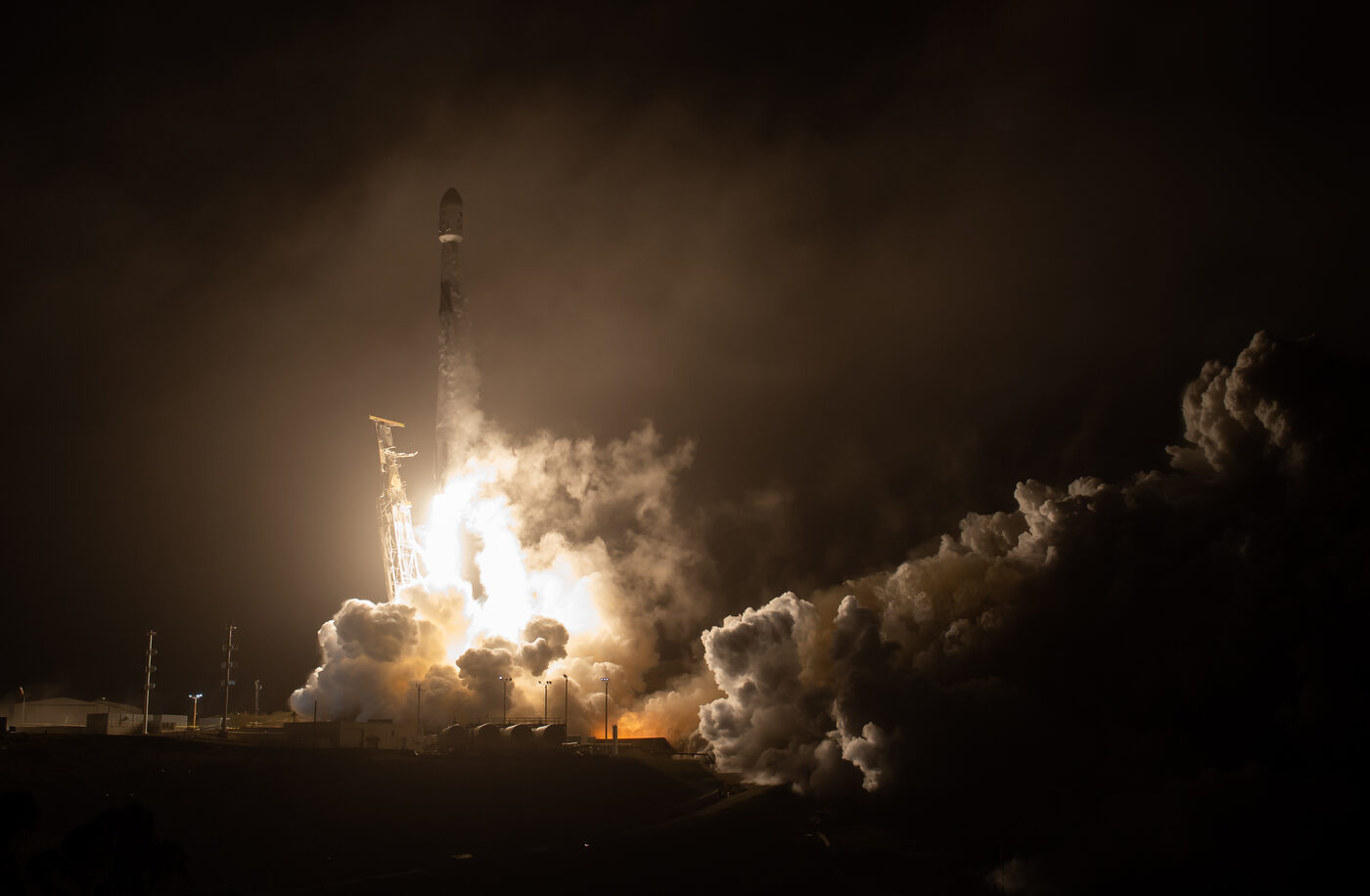
DART — the Double Asteroid Redirection Test — launched from Vandenberg Space Force Base on a Falcon 9 at 06:21 UTC on 24 November 2021, in the middle of a California night. It weighed 610 kilograms at launch. It carried no scientific payload at all: no spectrometer, no sample arm, no lab. Just navigation sensors, two long roll-out solar wings, and a single 20-centimetre telescope-camera called DRACO, whose entire purpose was to find the target and steer into it.
It was, sincerely and by design, a very expensive dart. 🎯
The target was chosen with real care. Didymos is about 780 metres across. Dimorphos orbits it at a distance of roughly a kilometre, taking 11 hours and 55 minutes to go round — and, crucially, passing in front of and behind its parent every lap. From Earth the two are far too close together to see separately, even in a good telescope. But every time Dimorphos crosses, the combined dot of light dips.
Which means you can time an asteroid’s orbit from a hundred million kilometres away with nothing but patience and a light meter. The whole experiment was built around that blink. 💡
Four hours of being completely on its own
Radio takes time. At the moment of impact, Dimorphos was far enough away that nobody on Earth could have flown the last approach even if they’d wanted to — the answer would have arrived long after the question mattered.
So DART flew it itself.
Four hours out, about 90,000 kilometres from the asteroid, control passed to an onboard system called SMART Nav, and the spacecraft was on its own. Three hours out it took an inventory of everything in view and worked out which dot was the one it wanted. Ninety minutes out it locked in the final trajectory.
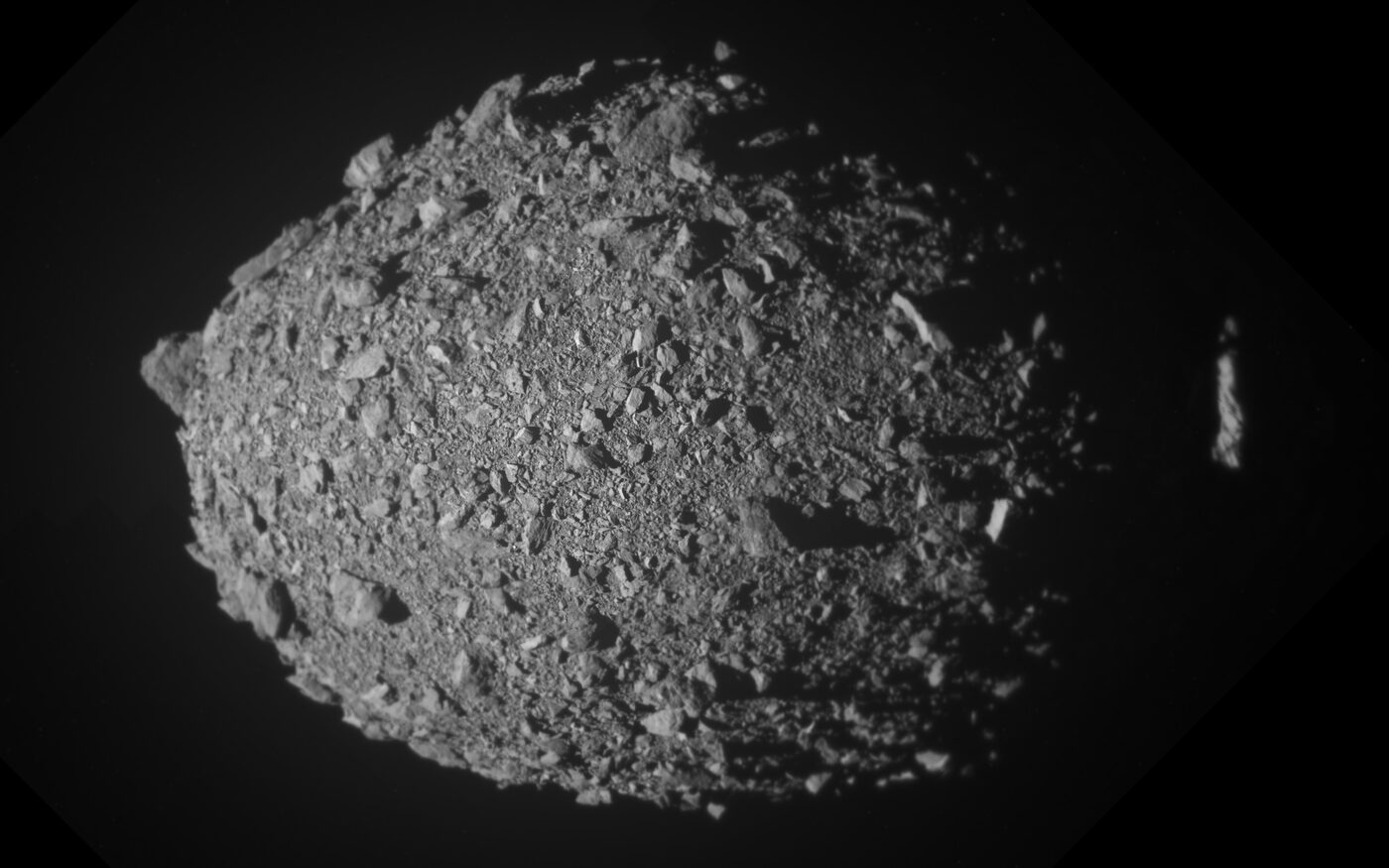
And here’s the detail that gets me: for most of that approach, DART could not see its target at all. Dimorphos didn’t resolve into anything more than about 1.4 pixels until the spacecraft was 24,000 km away. It spent the entire cruise aiming for something it had never actually seen — a smudge next to a brighter smudge — and then, in the last minutes, watched a real place resolve out of the dark: ridges, shadows, boulders, a surface.
Four minutes before impact it fired its thrusters one last time and then switched them off, because the vibration blurred the pictures and everyone wanted the pictures.
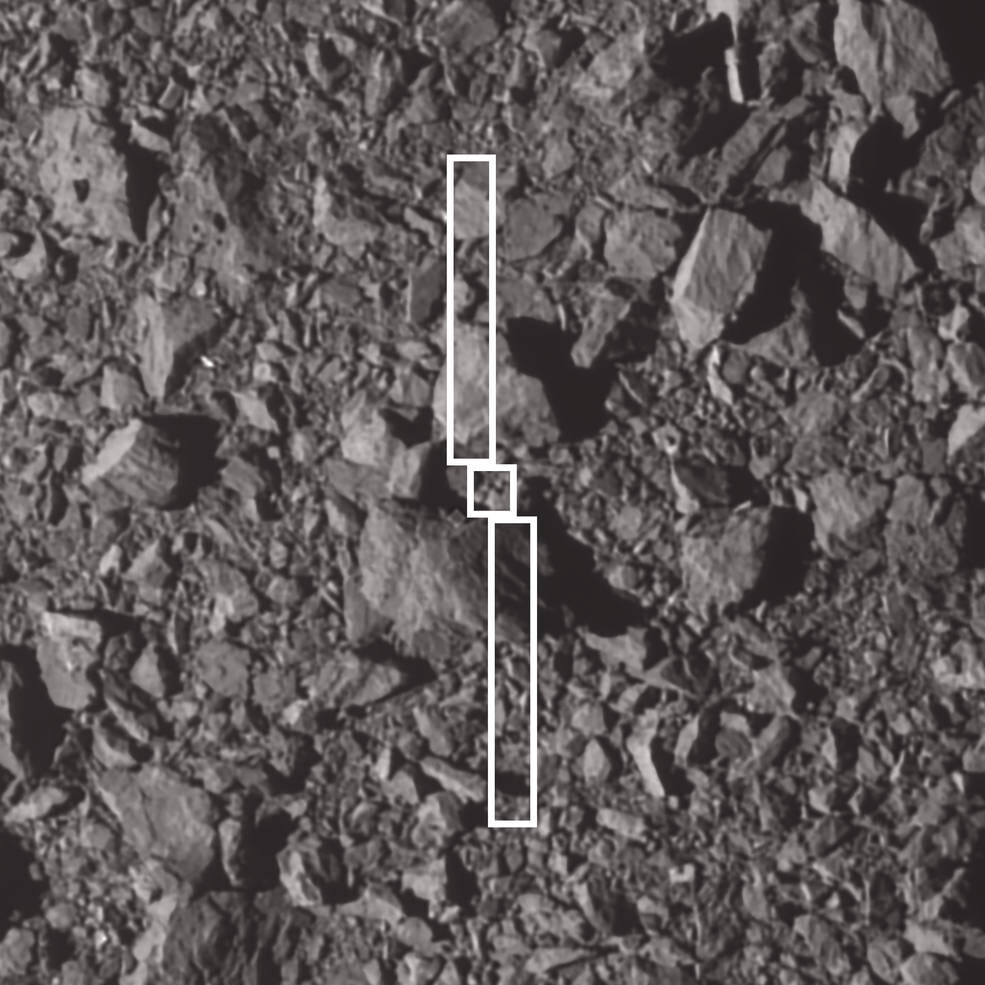
The last complete image came in two seconds before impact, at about three centimetres per pixel. The frame after that is a partial — a strip of rock, and then nothing, because the camera had become part of the asteroid. 23:14 UTC, 26 September 2022.
Italy sent a shoebox to take pictures
DART had a passenger. LICIACube — the Light Italian CubeSat for Imaging of Asteroids — is a 14-kilogram cube built by the Italian Space Agency, carrying two cameras named, with enormous charm, LEIA and LUKE. 🇮🇹
It detached on 11 September 2022, fifteen days ahead of impact, and coasted along behind at a careful distance so it wouldn’t get hit by anything. 165 seconds after DART hit, it swept past just 56.7 kilometres from the asteroid and photographed the aftermath — the first fully Italian spacecraft ever to operate in deep space, doing a high-speed drive-by of a crime scene it had helped plan.
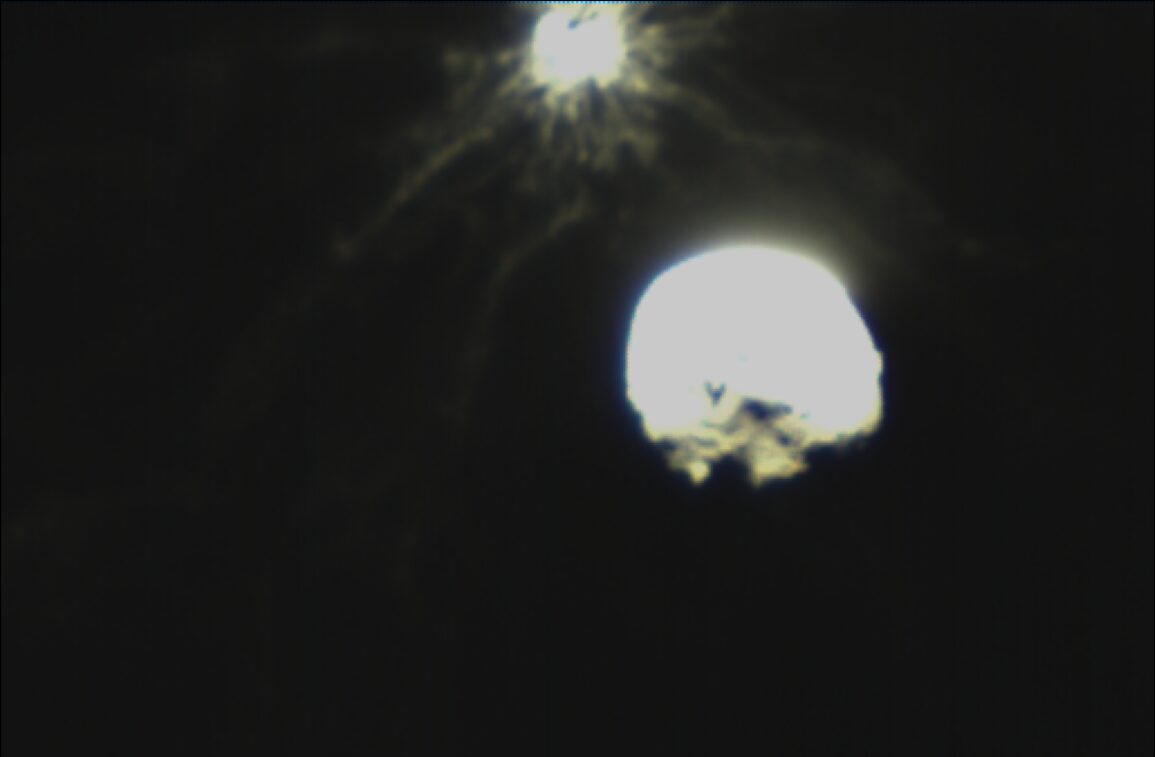
That plume is not a side effect. It is the best part of the whole result.
The rocks did most of the pushing
Here’s the physics, and it’s lovely.
If DART had simply hit Dimorphos and stuck there like a fly on a windscreen, it would have handed over exactly its own momentum — one spacecraft’s worth of shove. But it didn’t stick. It blew more than a million kilograms of rubble off the surface and out into space, and all that debris flying one way pushed the asteroid the other way, exactly like air escaping a balloon.
That bonus is called the momentum enhancement factor, written β, and measuring it was the real experiment. The answer came back at about 3.6 — the ejecta contributed more push than the spacecraft did. 🎈
Which is genuinely good news, and it’s the reason this post is in the good-news pile: it means that if we ever need to nudge something for real, we can do it with a smaller spacecraft, or with less warning, than anyone had dared to plan for.
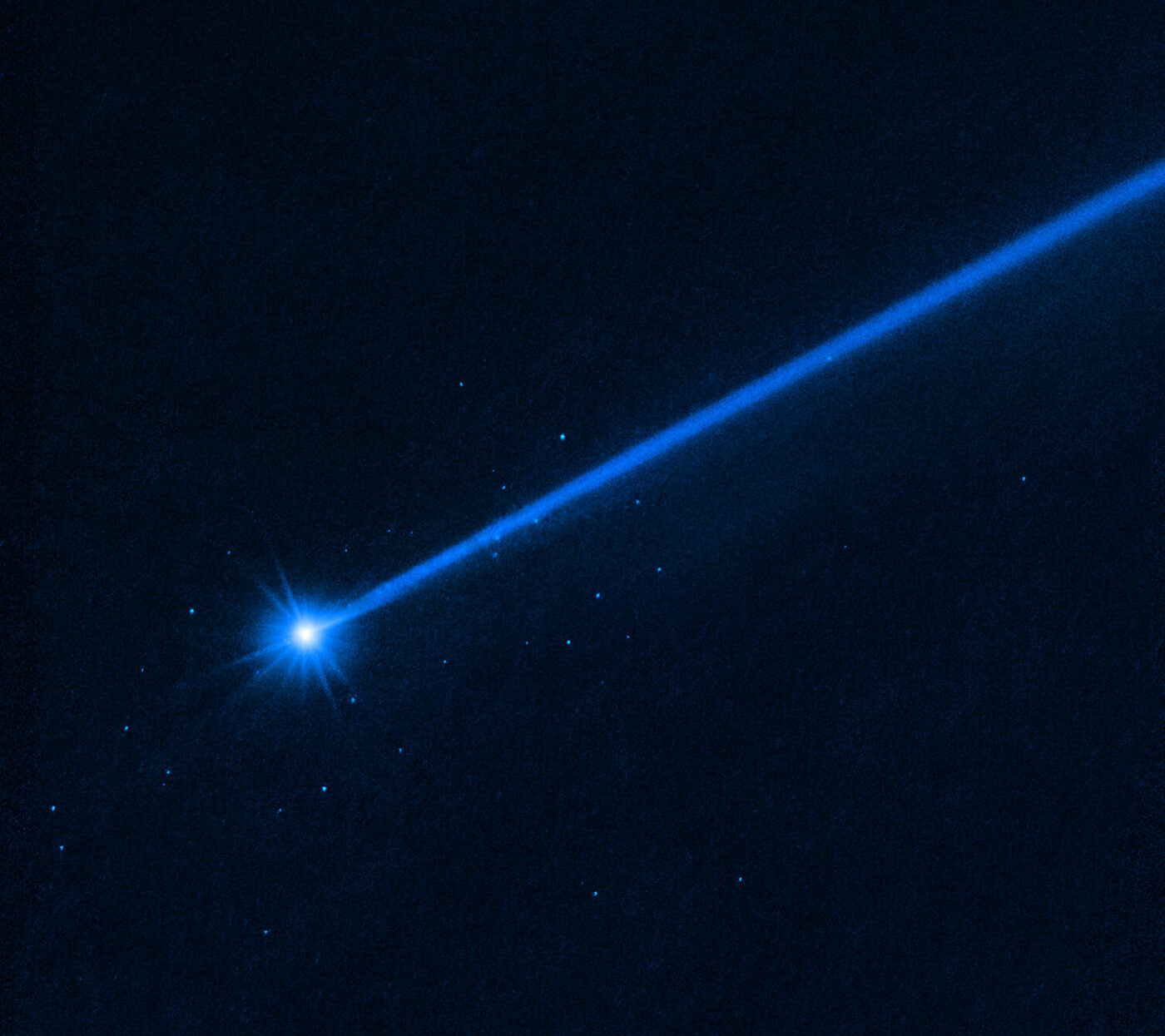
Telescopes everywhere watched the result. Hubble and Webb both caught the impact flash and the expanding cloud. Dimorphos grew a comet-like tail of dust tens of thousands of kilometres long and kept it for months — a small grey rock suddenly wearing a streamer. And when Hubble looked again in December, it found something nobody had ordered: a few dozen boulders, between 1 and 6.7 metres across, drifting slowly away from the asteroid at about a kilometre an hour. Walking pace. They are among the faintest things Hubble has ever photographed inside our solar system.
The number that got confirmed
On 11 October 2022, two weeks after impact, the investigation team announced the measurement: Dimorphos’s orbit had gone from 11 hours 55 minutes to 11 hours 23 minutes. A change of 32 minutes, give or take two.
The pre-agreed pass mark had been 73 seconds.
We beat it by more than twenty-five times. Later analysis, with more data, refined the figure to around 33 minutes — but the headline never needed refining. It worked. It worked embarrassingly well.
And then, in a follow-up that I find almost unreasonably charming, researchers went looking for whether the whole two-asteroid system had budged in its orbit around the Sun. It had. The pair’s year is now 0.15 seconds shorter, and its speed changed by about 1.7 inches per hour.
Inches per hour. Around the Sun. We did that, from here, with a robot the size of a vending machine — and the way they proved it was partly by timing the exact instant the asteroid blinked out a background star, an observation amateur astronomers around the world helped collect from their own back gardens. 🔭
The bit that gets me 💛
Every part of this was voluntary.
Nothing was coming. No siren, no deadline, no rock with our name on it. A large number of people — at NASA, at the Johns Hopkins Applied Physics Lab, at the Italian Space Agency, at observatories on several continents and in a great many back gardens — spent years and a great deal of money to answer a question that only matters to somebody who might not be born yet.
They picked a harmless target on purpose. They published the pass mark in advance, which is the scientific equivalent of calling your shot. They livestreamed the whole thing, so the last thing millions of people saw before the feed cut to static was a grey field of boulders rushing up at a camera. And then they told everyone exactly what happened, including the parts they hadn’t predicted.
And it isn’t over. The European Space Agency’s Hera spacecraft launched on 7 October 2024, swung past Mars for a gravity assist in March 2025, and is out there right now, carrying two CubeSats called Milani and Juventas, due to arrive at Didymos in November 2026 to survey the crater up close and weigh what’s left.
Which means that in a few months, a second spacecraft from a different continent will arrive at a small rock in the dark to inspect a dent that humanity put there on purpose — as practice, for a rainy day, for everyone. 🎯💛


