

Somewhere out past the asteroid belt, orbiting Saturn, there is a small snow-white moon that has decided the best thing to do with an entire ocean is to shoot it into space.
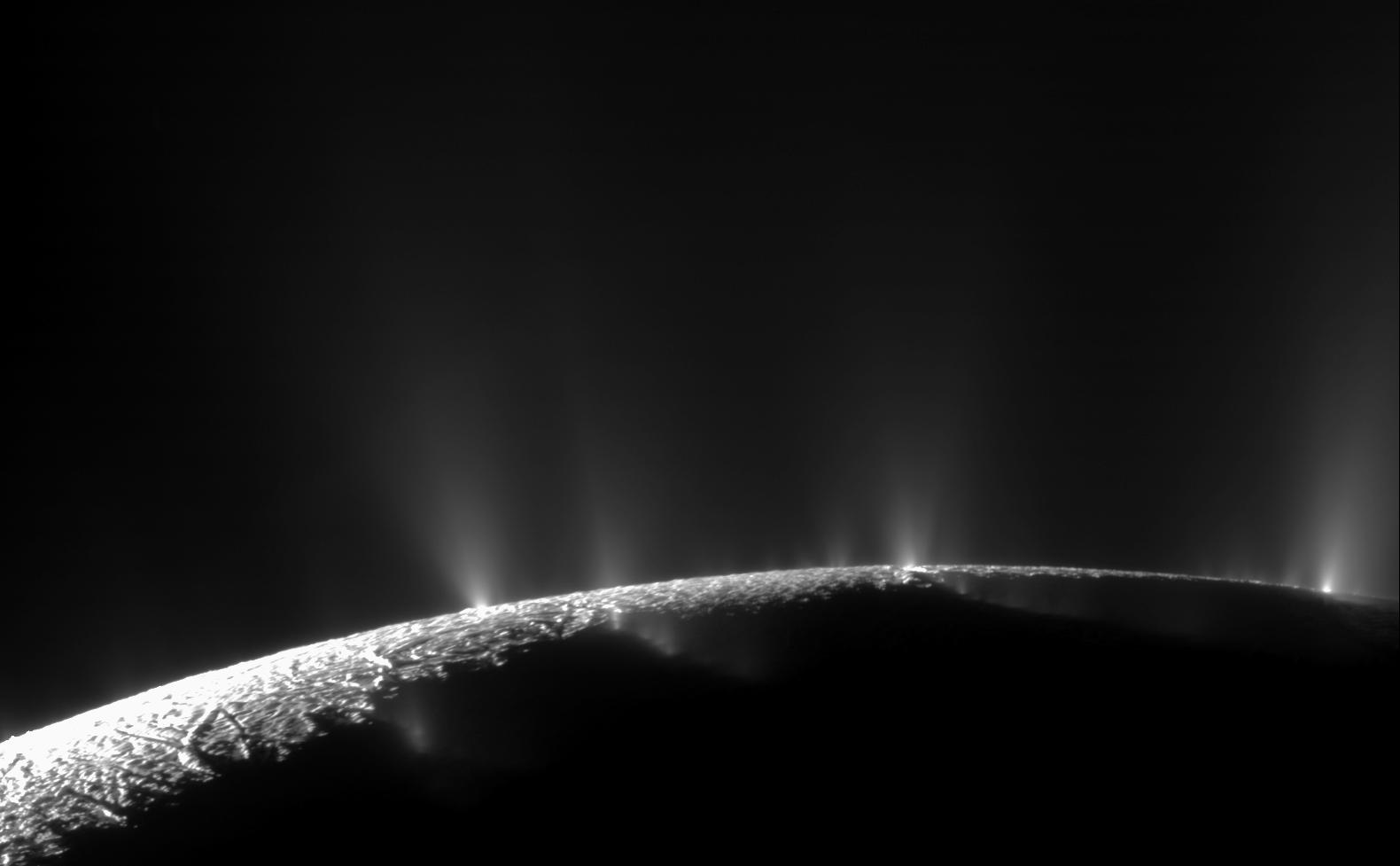
Not metaphorically. Enceladus is about 310 miles across — you could tuck the whole moon inside Arizona — and under its bright icy shell it holds a global ocean of liquid saltwater. And at its south pole, through cracks in the ice, it fires that ocean upward in enormous jets: water vapor and ice crystals streaming out at around 800 miles per hour, reaching hundreds of miles into space. A moon-sized sprinkler, running for at least as long as we’ve been watching. 💦
A moon that couldn’t possibly be doing anything
For a long time, Enceladus was supposed to be boring.
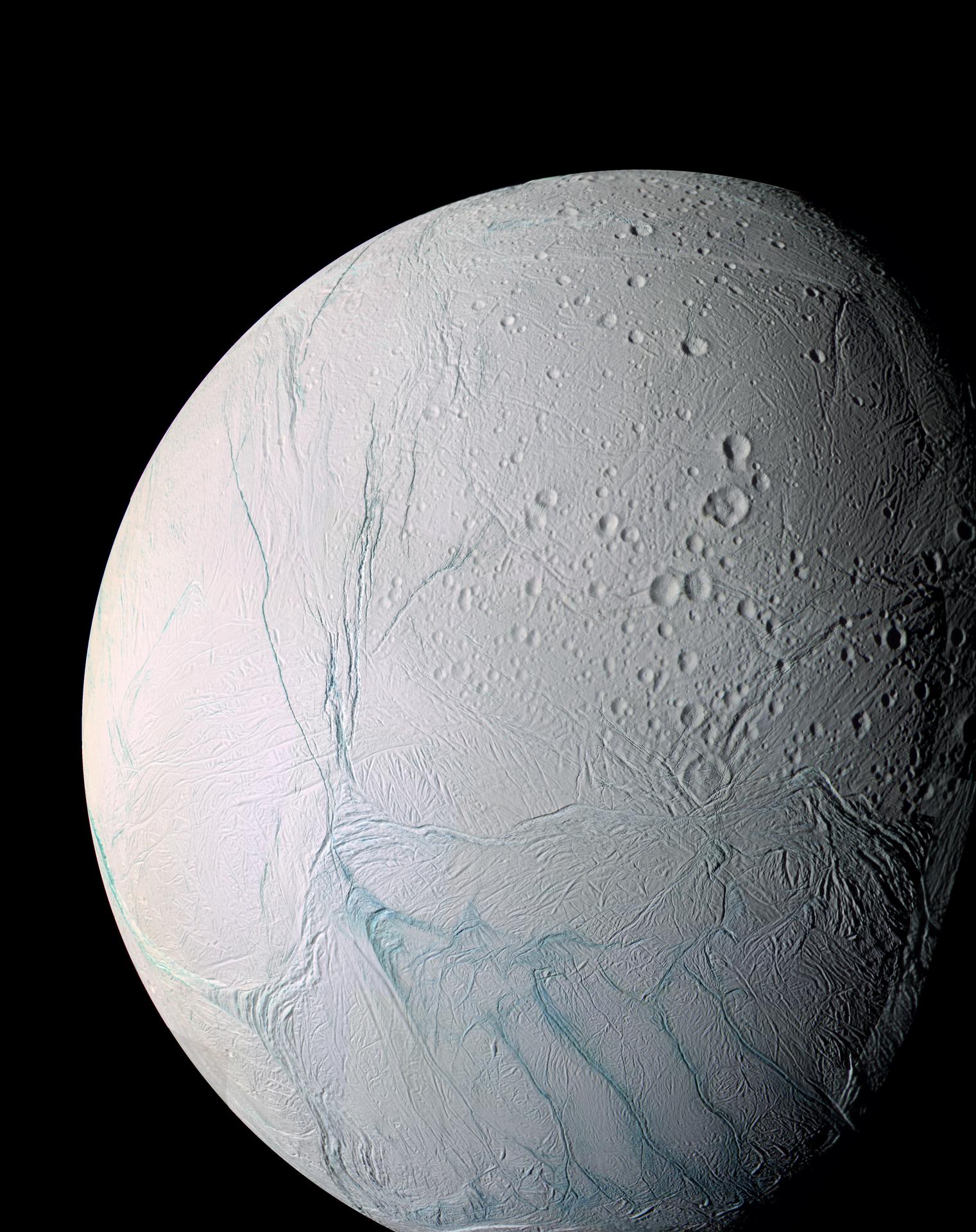
It’s tiny. Small worlds are meant to be dead worlds — no heat left inside, frozen solid all the way through, geologically finished billions of years ago. Enceladus looked the part, too: it’s the whitest, most reflective object in the whole solar system, a little pearl of ice bouncing back nearly all the sunlight that hits it. The kind of thing you’d expect to be quietly, completely frozen.
Then, in 2005, NASA’s Cassini spacecraft flew past, pointed its cameras at the south pole with the Sun behind the moon — and saw the ice breathing. Great backlit plumes of water fanning out into space, glowing where the sunlight caught them.
A dead moon does not do that. This one was very much alive.
The tiger stripes
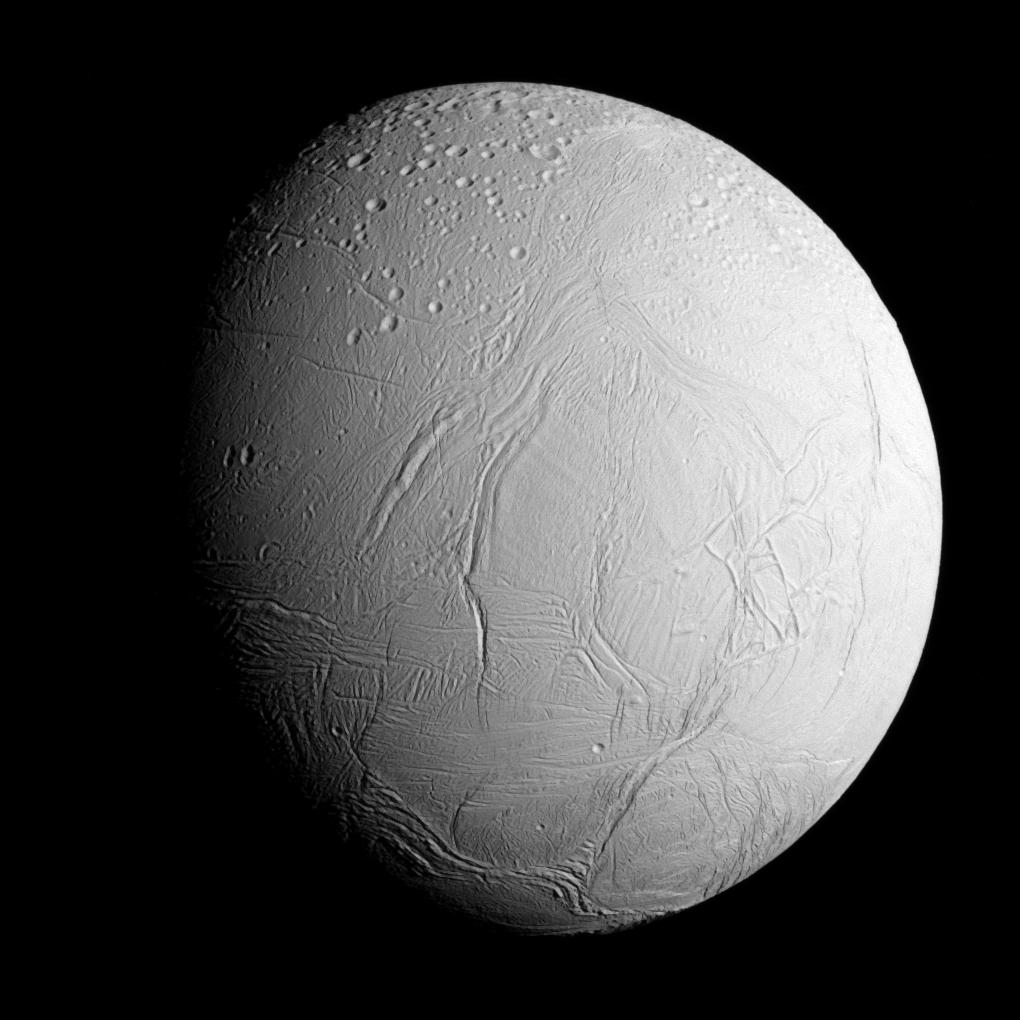
Look at the south pole up close and you find four long, roughly parallel fractures in the ice, warmer than everything around them, running for a hundred-odd miles each. Mission scientists nicknamed them the tiger stripes — and they’re the vents. A 2014 Cassini study counted more than 100 individual geysers jetting out along them. 🐯
That’s the part that gets me. It isn’t one dramatic super-volcano. It’s a hundred separate little fountains, all up and down these cracks, quietly hosing an ocean skyward around the clock.
We didn’t have to land. We just flew through it.
Here’s the thing that makes Enceladus almost unfair as a target.
Normally, to find out what an alien ocean is made of, you’d have to build a lander, drop it onto the surface, drill down through miles of ice, and somehow sample the water without contaminating it. It’s the kind of mission that takes generations.
Enceladus skips the line. It hands you a sample of its ocean, for free, above the surface. So Cassini did the obvious-once-you-say-it-out-loud thing: it flew straight through the plume and tasted it directly, on the way past.
And the spray turned out to be extraordinary.
Cassini found tiny grains of silica in it — a specific kind that, as far as we know, only forms where hot water (above about 90 °C) is chemically reacting with rock. In other words: at the bottom of that hidden ocean, water is meeting rock at seafloor hydrothermal vents, the same kind of hot deep-sea chimneys where some of the hardiest life on Earth thrives.
Then it got better. In the ejected grains, scientists later found phosphorus — one of the handful of elements every living thing on Earth is built from, the “P” in DNA and in the energy your cells run on. It was the first time phosphorus had ever been detected in an ocean beyond our own. 🧪
So let’s tally up what’s inside this little moon, based on water it threw at us: liquid water, warmth, the right minerals, an energy source, and the essential chemical building blocks of life. That’s not proof anything lives there. But it is, more or less, the full shopping list.
Why this is on a good-news blog
Because the universe keeps turning out to be more generous than it has any obligation to be.
We went to Saturn to look at the rings. And tucked in among its moons was a frozen little pearl the size of a US state that decided, all on its own, to take its secret ocean — the warm, salty, mineral-rich, maybe-habitable one hidden under miles of ice — and launch it into space where a passing robot could catch it.
Nobody had to drill. Nobody had to land. A moon just held out a sample of a possibly life-friendly alien sea and said, here, have some. And we flew through it and caught the spray. 💦💛


