

Here is a fact about the world that we would like you to sit with for a second.
Plants glow.
Not metaphorically. While a leaf is photosynthesising — absorbing sunlight, turning it and carbon dioxide into energy — it also throws a tiny amount of that light back out as fluorescence. Every blade of grass you have ever walked past. Every houseplant you have ever under-watered. All of them, faintly luminous, the entire time, and invisible to the human eye. 🌱
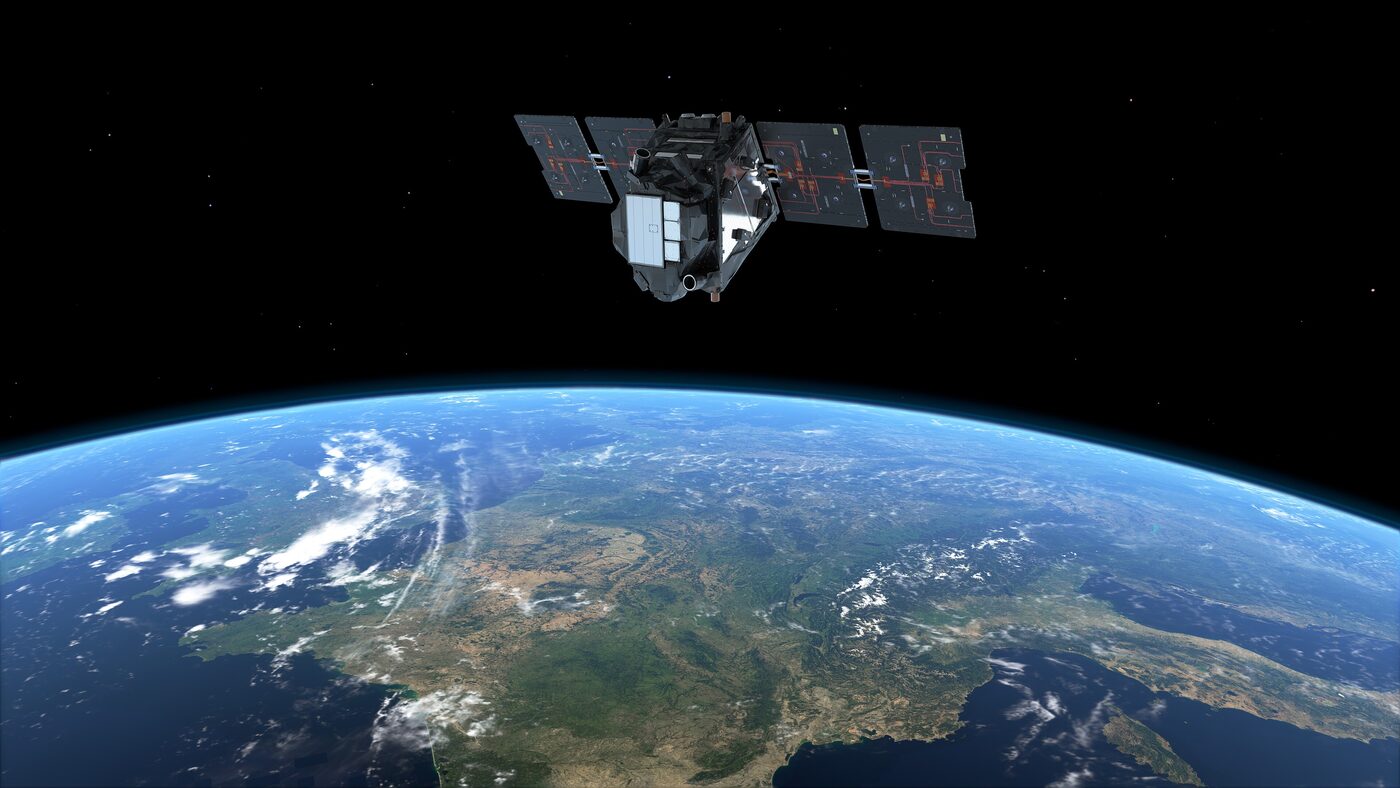
On 15 September 2026, Europe launched a satellite whose whole reason for existing is to go look at that.
The launch
Flight VV30 lifted off from Europe’s Spaceport in French Guiana at 03:21 CEST on 15 September — which was 22:21 the previous evening, local time, a detail we love because it means the people at the pad watched a night launch and the people at mission control watched a very early morning one.
Vega-C didn’t go up with one satellite on board. It went up with two entirely separate missions, stacked inside the fairing using a launch adapter called Vespa — the Copernicus Sentinel-3C satellite riding on top, FLEX tucked inside underneath. Sentinel-3C was released into its orbit first; FLEX followed about an hour later, into a different one.
The rocket climbs on three solid-propellant stages and then hands over to a fourth, liquid-propellant stage whose job is the fiddly bit: putting each satellite exactly where it needs to be. Then ESOC in Germany got its first signal from each spacecraft, one after the other, and everybody could breathe.
So what does an invisible glow tell you?
Quite a lot, as it turns out. FLEX is ESA’s first satellite designed specifically to measure photosynthetic activity from space, and it carries an instrument called the Fluorescence Imaging Spectrometer, built to detect — in ESA’s own words — “the extremely faint fluorescence emitted by plants as they absorb sunlight during photosynthesis.”
That faint signal is not decoration. It is a direct readout of how hard the plant is working: how efficiently it is turning sunlight and CO₂ into energy. And crucially, it changes with stress — heat, drought, disease, bad soil — often before anything visible happens to the leaf at all.
Which means a satellite watching the glow is watching the health of the world’s vegetation in something close to real time. Ecosystem productivity. Crop stress. How plants are coping with a changing climate. All of it, read off a light you cannot see with your own eyes.
ESA’s Director of Earth Observation Programmes, Simonetta Cheli, put it plainly:
“Developed within ESA’s FutureEO programme, FLEX is a research mission that will advance our understanding of plant health and the role of photosynthesis in the carbon and water cycles.”
Why it needs a partner
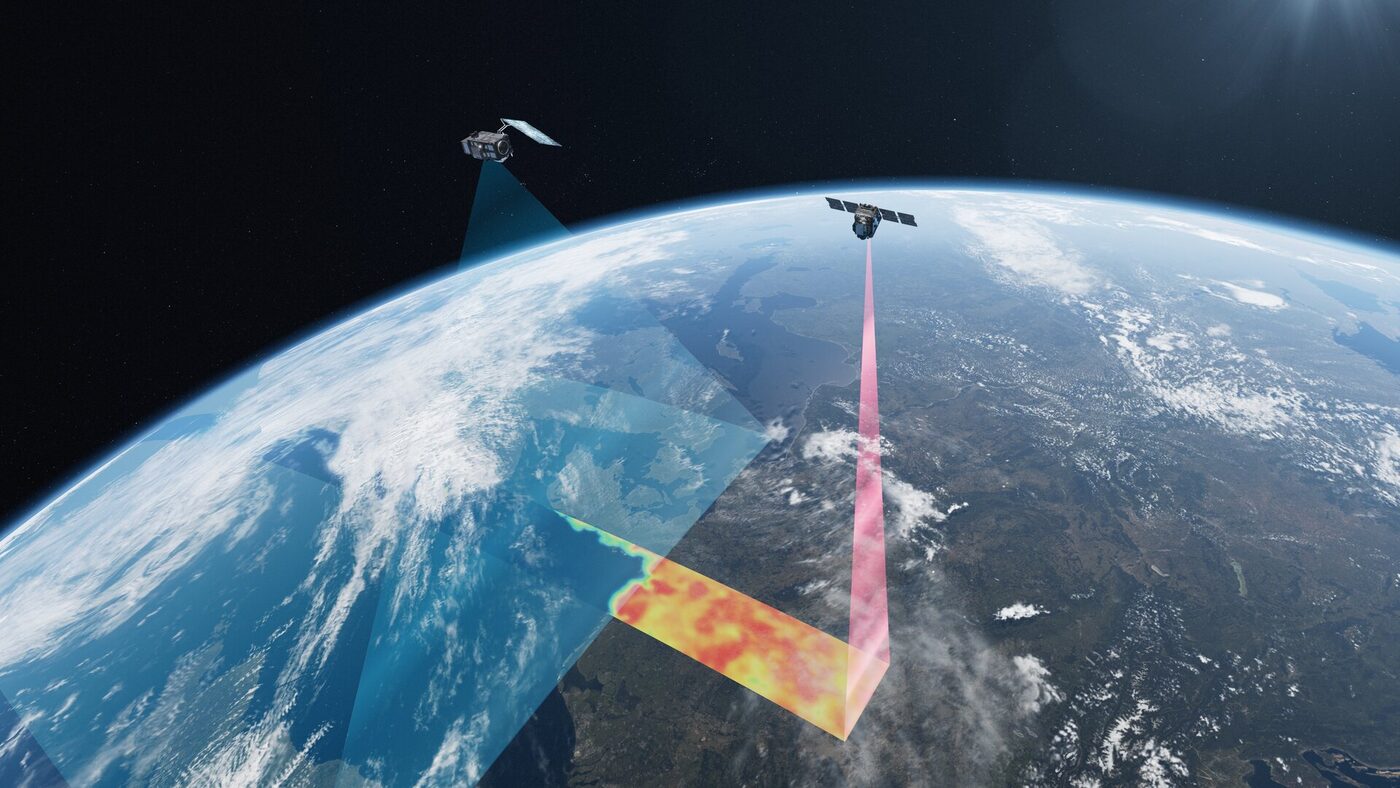
There is a problem with measuring a very faint light from orbit: everything in between gets a vote. Clouds. Aerosols. Water vapour. The land surface itself, its temperature, what’s growing on it.
So FLEX doesn’t fly alone. It flies in tandem with a Sentinel-3 satellite, which measures exactly those things — atmosphere, surface temperature, land cover, additional vegetation parameters — over the same ground at nearly the same moment. Pair the two data sets and the interference becomes information: you can subtract what the air did and keep what the plants did.
ESA is doing some orbital gymnastics to set this up, and the tandem partner will change over as the Sentinel-3 series evolves. The principle stays the same: two satellites, one patch of ground, one instant.
And Sentinel-3C, the other passenger
Worth a paragraph of its own, because it also matters. Sentinel-3C is the third satellite in the Sentinel-3 series and part of Copernicus, the Earth observation arm of the EU’s space programme. Its instruments systematically watch oceans, land, ice and atmosphere — ocean and land-surface temperatures, ocean colour, sea and ice conditions, vegetation, inland-water levels — and much of it flows out in near-real time to ocean forecasting and climate monitoring.
ESA built it; after commissioning, ESA and Eumetsat run it jointly, with Eumetsat taking routine operations and the marine and near-real-time atmospheric data, and ESA delivering land, cryosphere, inland water and offline atmospheric products. FLEX stays under ESA’s control.
Two satellites. One rocket. One morning. 🚀
Why this lives on a good-news blog
Because at some point a group of people looked at a leaf, noticed it was quietly emitting a light nobody could see, and decided the correct response was to build a spectrometer, put it on a rocket, and fly it around the planet so they could watch every plant on Earth doing it at once.
Nobody needed to know this. A leaf will photosynthesise whether or not anyone is measuring it. But somebody wanted to know how the world’s plants are feeling, in the only language plants have — and then spent years of their working life building the instrument that could hear it.
Go outside. Everything green out there is glowing. It always was. Now there’s something up above watching, very carefully, and taking notes. 🌱✨


