

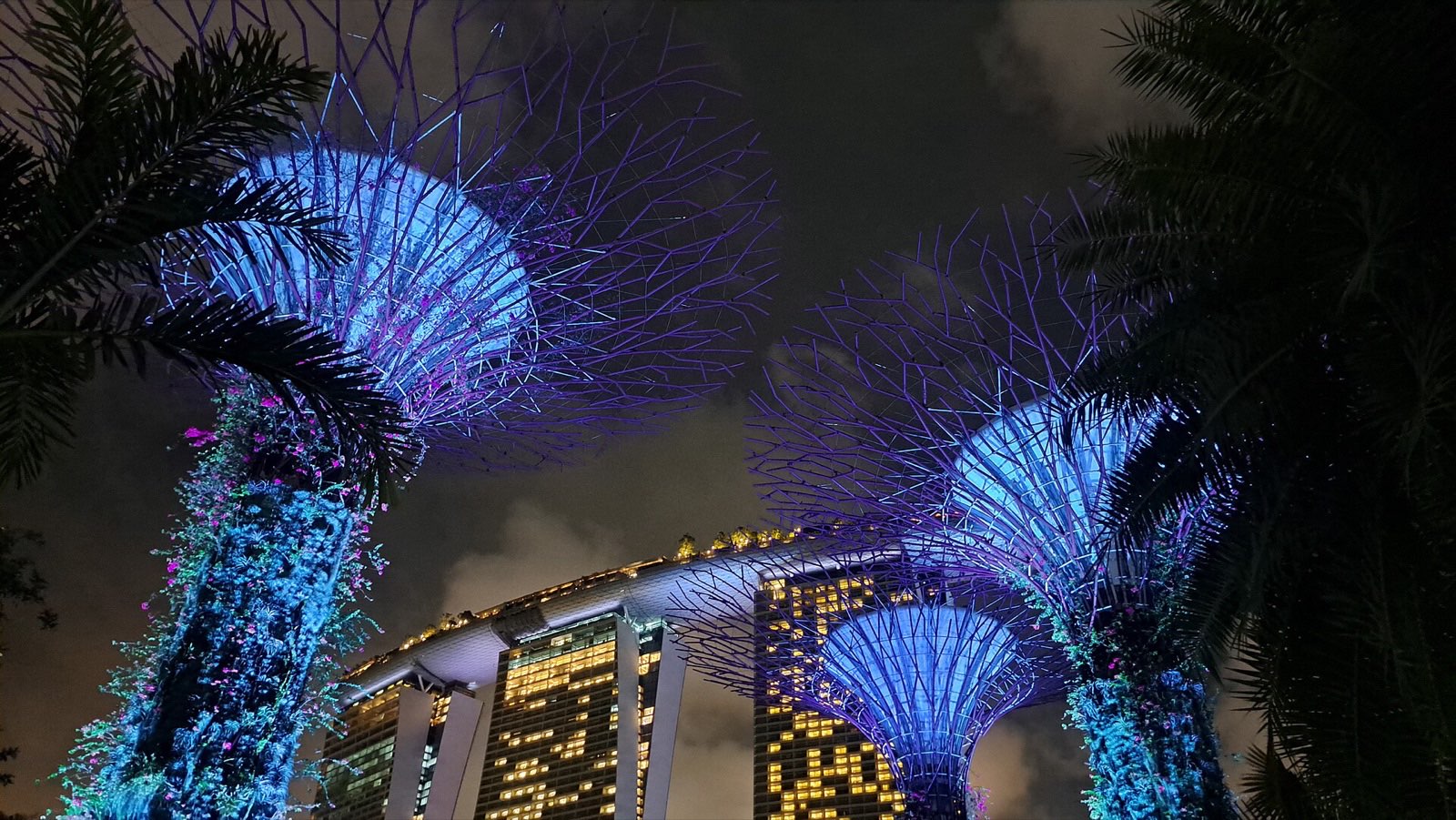
You come up out of the Marina Bay waterfront in Singapore, into heat and humidity and the glitter of one of the densest skylines on Earth — and then you see them. Tall, branching shapes against the sky, glowing faintly, neither tree nor tower. They look like something a forest would become if a forest were also a machine. Your brain files them under plant and building at the same time and refuses to commit. These are the Supertrees, and this is Gardens by the Bay — a forest that Singapore grew on land it pulled up out of the sea. 🌳
What the Supertrees actually are
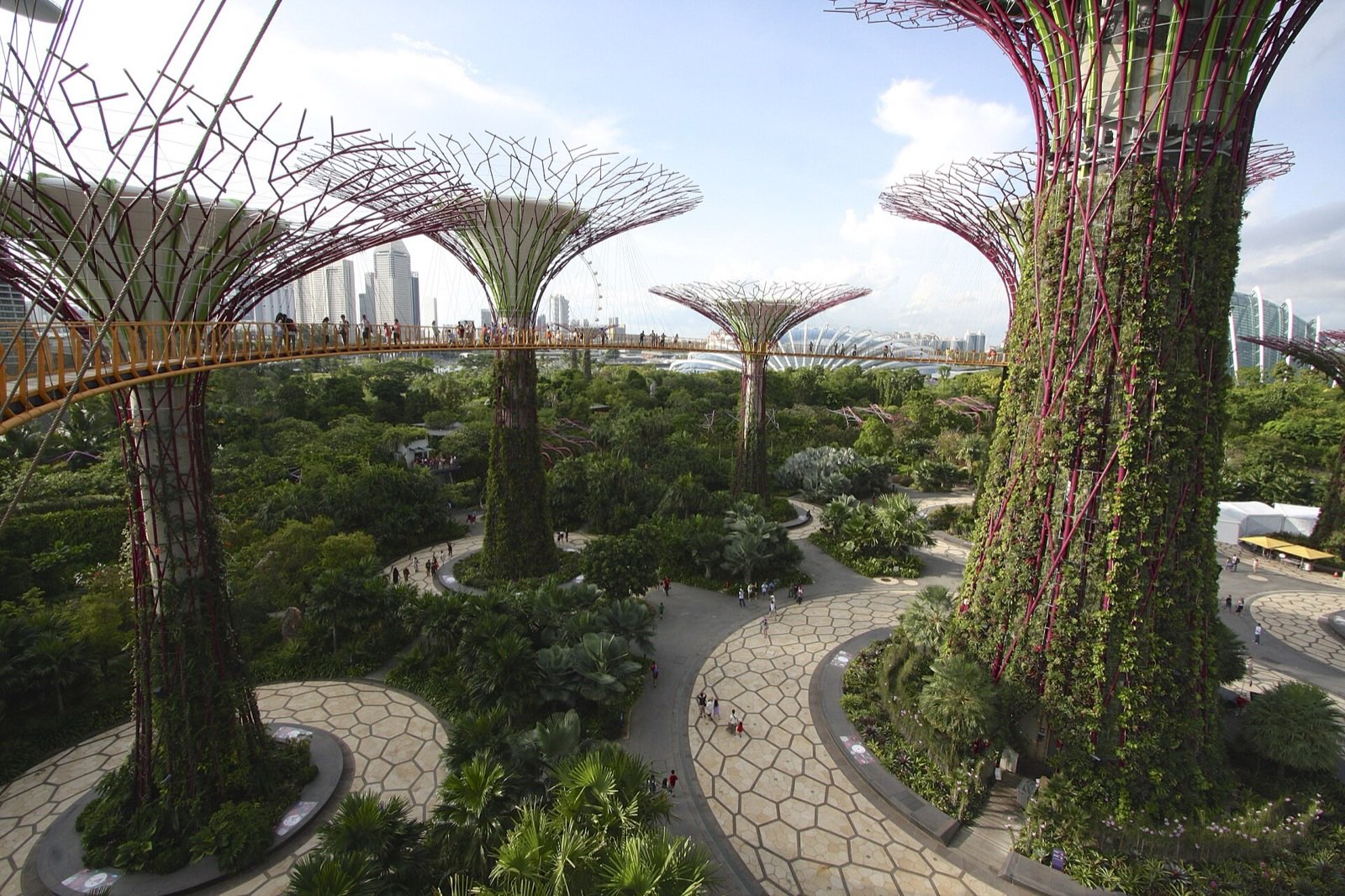
Here’s the part that sounds like science fiction but isn’t: the Supertrees are real, working vertical gardens. There are eighteen of them, standing 25 to 50 metres tall, and their trunks and canopies are clad in more than 162,000 living plants — bromeliads, orchids, ferns, flowering climbers — that grow right up the structure like ivy on a cathedral.
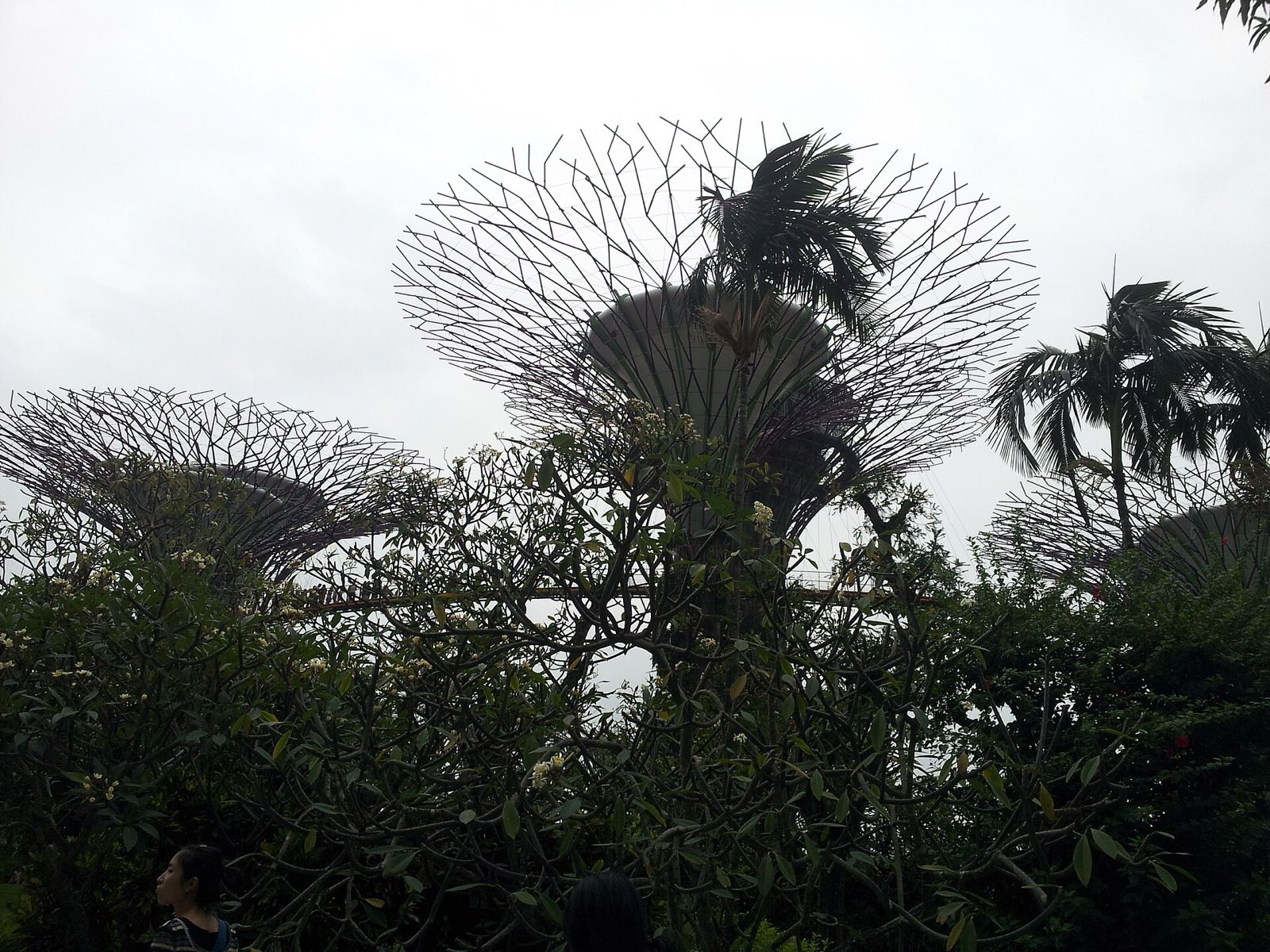
But they aren’t only decorative. The largest Supertrees are fitted with photovoltaic cells that generate electricity, rainwater collection systems that feed the irrigation and the cooling for the conservatories nearby, and air-exhaust functions tied to the park’s climate-control plant. They are, quite literally, a grove of trees that does the jobs of real trees — capturing sunlight, collecting rain, moving air — only deliberately, and at the scale of a city block.
And you can walk among their crowns. Strung between two of the tallest Supertrees is the OCBC Skyway, a 128-metre aerial walkway suspended 22 metres up, so you can stroll through the canopy and look down on the grove and out across Marina Bay.
Two worlds inside glass
If the Supertrees are the park’s exterior wonder, the two conservatories are its hidden ones — and they could not be more different from each other.
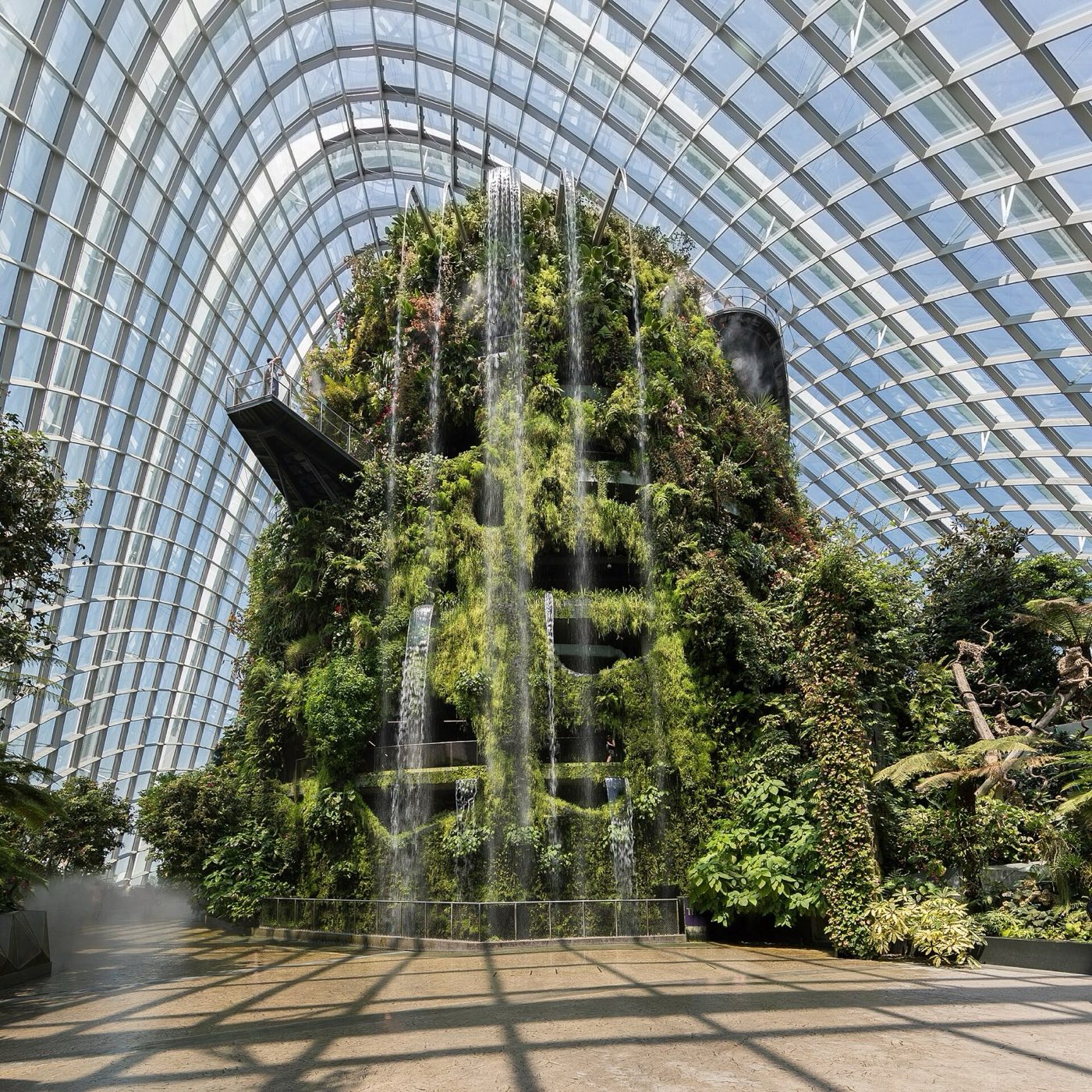
Step into the Cloud Forest and the air turns cool and damp, and the very first thing you see is the world’s tallest indoor waterfall — a 35-metre cascade pouring down the side of a green mountain wrapped in mist. Elevated walkways spiral up and around the mountain, carrying you through the canopy past orchids, ferns, pitcher plants and other carnivorous oddities, recreating the cool, wet highlands you’d otherwise have to climb a tropical mountain to find.
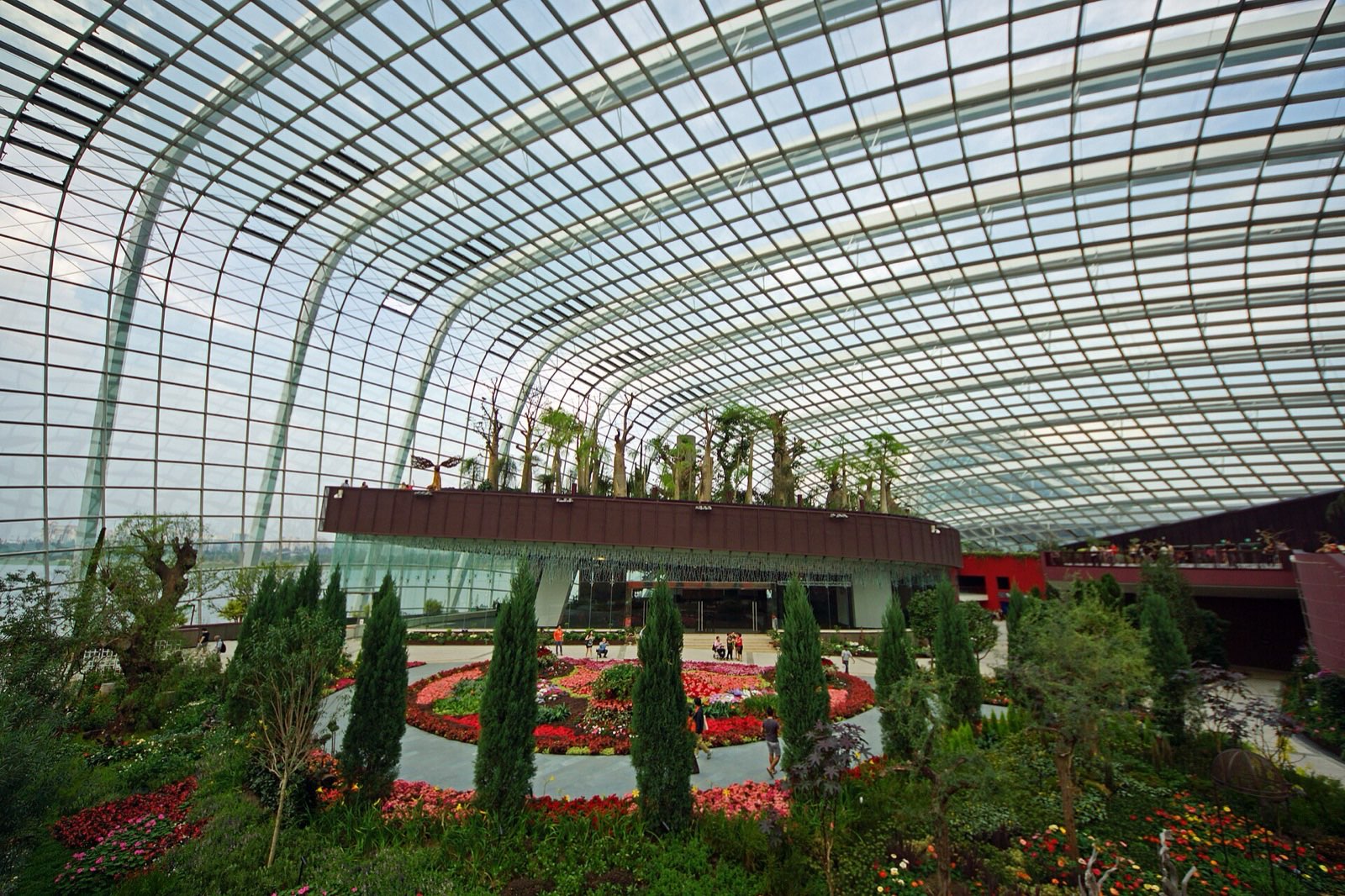
Then walk next door into the Flower Dome and the whole climate flips: cool and dry now, a perpetual Mediterranean spring. It’s the world’s largest column-free glasshouse, and inside it grows a collection gathered from five continents — ancient olive trees, towering African baobabs, spiny South American cacti — around a central display that’s replanted for each season and festival. One dome is a misty mountain; the other is an eternal dry-country garden. They sit side by side under glass, a few steps apart.
How this exists
None of this happened by accident, and none of it happened quickly. Gardens by the Bay is the centrepiece of a national project that Singapore has been pursuing for more than half a century — the deliberate, top-to-bottom decision to make a hyper-dense island city into a “City in a Garden.”
The roots go back to the 1960s, when founding prime minister Lee Kuan Yew launched relentless tree-planting and greening campaigns, treating urban nature not as a nicety but as policy. Decades later, in 2011, the government broke ground on Gardens by the Bay on freshly reclaimed land beside the new Marina Bay, and the park opened in 2012. Almost the entire site sits on ground that was pulled up out of the sea — it simply did not exist a few decades earlier.
It was a billion-dollar statement, built into the heart of the most valuable real estate in the country: proof that a city can be ultra-modern, ultra-dense, and deeply, genuinely green, all at once — and that you don’t have to pick.
Why this lives on a good-news blog
We tend to talk about cities and nature as opposites — as if every tower goes up at the expense of a tree, as if “developed” and “green” pull in opposite directions. Singapore looked at that trade-off and quietly refused it.
The Supertrees don’t collect rain and sunlight because a regulation forced them to; that’s how they were designed from the first sketch. The waterfall, the domes, the canopy walk, the free nightly light show that anyone can wander in and watch — none of it is an apology bolted onto a development. It’s the whole point. The ambition and the greenery are the same project.
That’s the hopeful thing here. Gardens by the Bay is a working, walk-through, hundred-hectare argument that beauty and density and care for the living world don’t have to be in competition. A country grew a forest on the sea, put a rainforest inside it, and invited everyone in for free after dark. Some places exist just to prove a better idea is possible. Go stand under a Supertree at night and watch one of them. 🌳💛


