

Here is the thing you have to get straight before anything else makes sense: the instrument is not in the cave. The instrument is the cave.
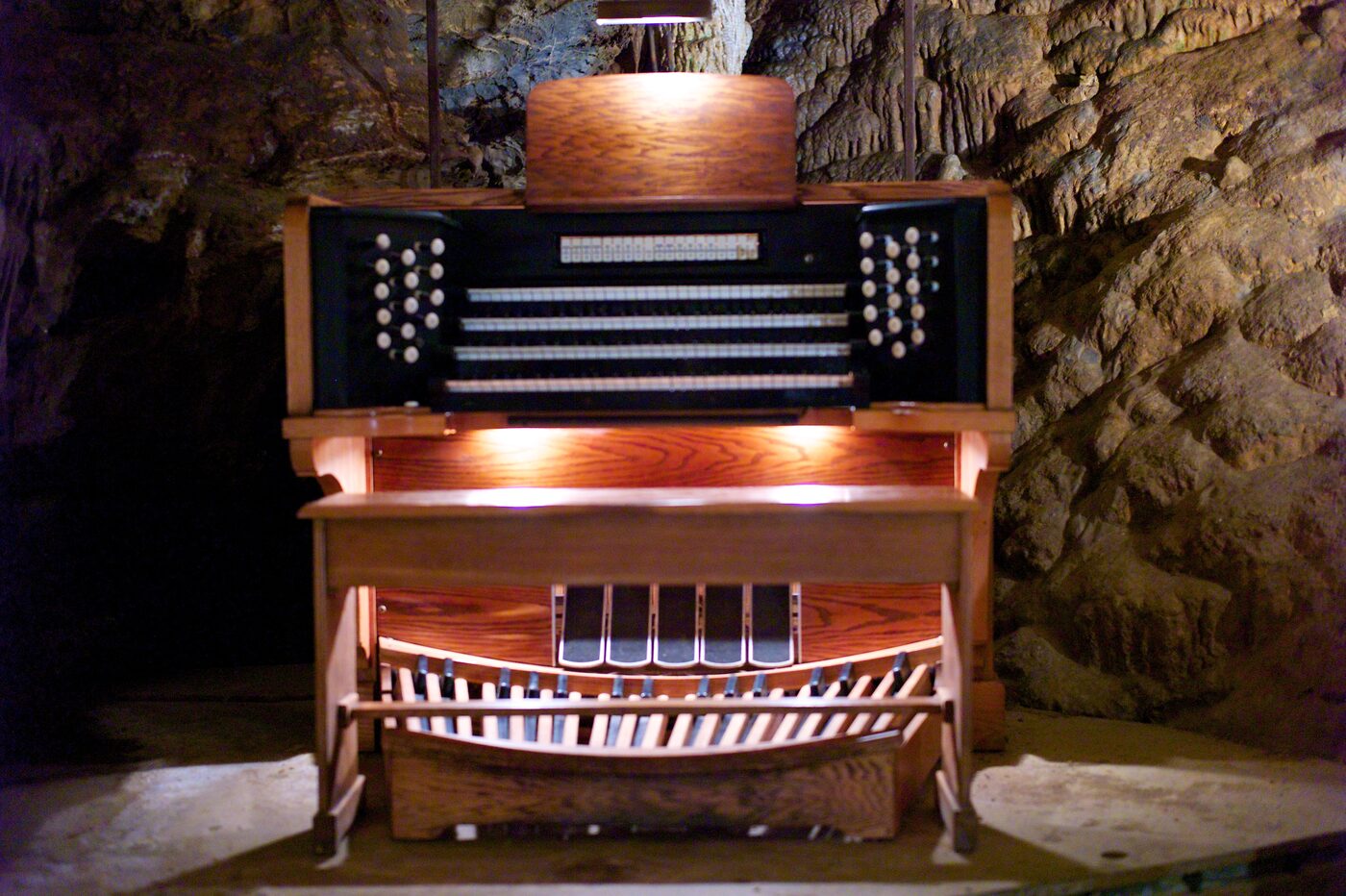
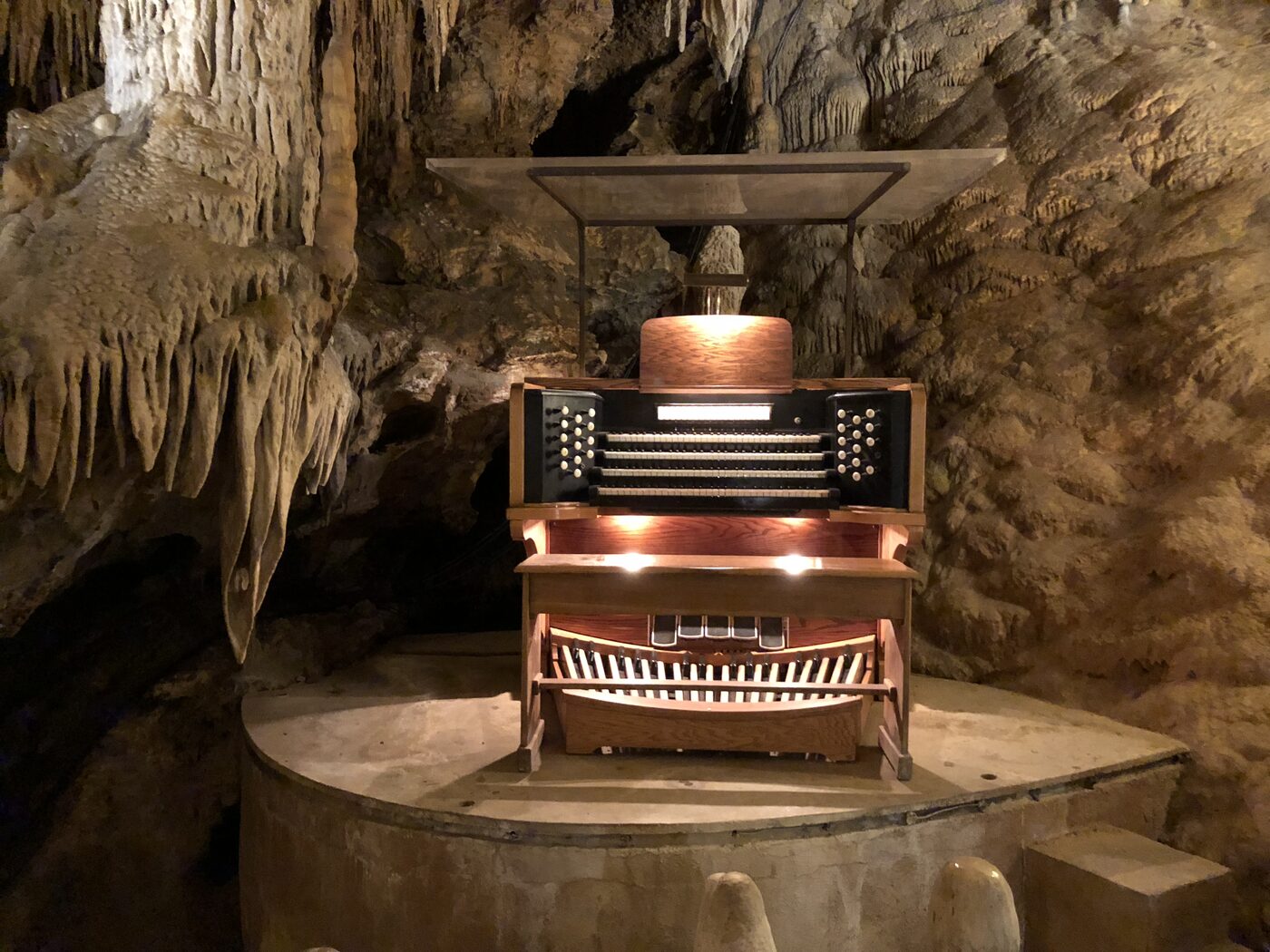
In Luray Caverns, in Page County, Virginia, there is a wooden organ console. It has four stacked keyboards, a pedalboard, and rows of little white drawknobs, and it sits on a concrete pad surrounded by dripstone. It looks completely normal, in the way that a fire hydrant on the moon would look completely normal.
Press one of those keys and nothing happens at the console at all. Instead, an electrical signal runs off into the dark, reaches a rubber-tipped mallet bolted to the rock somewhere out in the caverns, and taps a stalactite. About a second later, the note arrives back at your ears from a direction you were not expecting.
There are 37 of those stalactites. They are spread across roughly three and a half acres of cave, and the sound carries across the caverns’ full 64 acres. Guinness World Records calls it the largest musical instrument in the world, which feels less like a superlative and more like a simple description of a floor plan. 🎹
First, the word: lithophone
A lithophone is any instrument you play by striking stone. That’s the whole definition. A xylophone with rock bars instead of wooden ones is a lithophone. So is a row of tuned slates. So, it turns out, is a cave.
Stalactites are the ones that hang from the ceiling — they grow downward, a fraction of a millimetre at a time, as mineral-rich water drips through limestone and leaves a whisper of calcite behind. Because they hang freely, like a bell or a tuning fork does, they ring when you hit them. A short fat one gives you a low tone. A long thin one gives you a higher one. Nature has, without being asked, produced several thousand pitched objects and hung them from a ceiling.
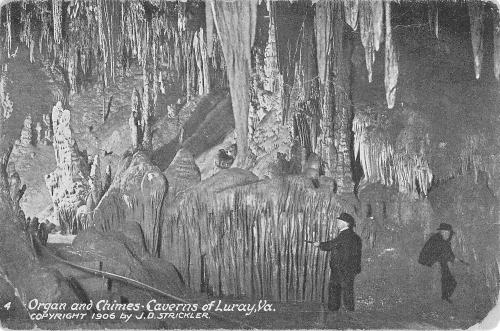
People noticed this almost immediately. Luray Caverns was discovered in 1878, and by 1880 — when the Smithsonian sent a group to have a look — co-discoverer Andrew Campbell was surprising visitors by tapping out a tune on a formation. By the early 1900s, playing hymns and folk songs on the rocks was a standard part of the guided tour. There’s a postcard from 1906 advertising the “Organ and Chimes,” and in it you can see a gentleman in a bowler hat doing exactly that. 🎩
So the raw idea was old. What happened in 1954 was that somebody looked at the tour guide’s little rubber mallet and thought: yes, but what if all of them, at once, from a keyboard.
Enter a Pentagon mathematician with a hobby
Leland W. Sprinkle of Springfield, Virginia was a mathematician and electronics scientist who worked at the Pentagon. He was also a musician. In 1954 he came to Luray Caverns on a tour — by the Luray Caverns’ own telling, on his son’s birthday — and watched the guide tap the formations and produce a note.
(There is a second, more slapstick version of the origin story, printed in a 1961 Meccano Magazine and a 1959 Rosicrucian Digest: that Sprinkle’s son bonked his head on a stalactite, it rang, and that was the moment. Both versions survive. We are not going to adjudicate. Either way, a rock went ding and a man’s life changed.)
What Sprinkle did next is the part that should be taught in schools. He went to the caverns’ management and asked permission to turn their cave into an organ — and, astonishingly, they said yes.
Then he got 13 English tuning forks and started walking.
Three years of tapping rocks
For three years, mostly on weekends, Sprinkle went through the caverns tapping stalactites and comparing what he heard to his tuning forks. Luray’s director of public relations later put it plainly to PBS NewsHour: “He spent virtually every weekend during that period prospecting for stalactites that could be perfectly tuned.”
Prospecting. Like a man panning for gold, except the gold is an F sharp.
Most formations were no good — wrong shape, wrong thickness, cracked, damp, growing, buried in a wall. The ones that rang true got selected. And then came the part that still makes musicians wince slightly: the ones that were close got sanded down until they were exact. Of the 37 stalactites that ended up in the instrument, all but two had to be shaved to hit their note.
Consider the arithmetic of that. These formations took an unimaginable amount of time to grow — the limestone itself started as sea floor over 400 million years ago, and the stalactites accumulated drip by drip over many thousands of years after that. And a man came along with a hand tool and took a little off the bottom, because it was flat. 😳
How you make a cave push a button
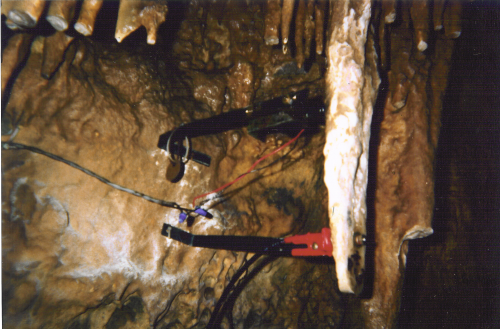
The mechanism is beautifully, almost comically direct. Each chosen stalactite has its own striker: a solenoid — an electromagnet that yanks a metal rod when current runs through it — mounted on the rock beside the formation, with a rubber-tipped mallet on the end. The mallet assembly is over a foot long. Rubber, so the tone rings clean rather than clacking, and so that a several-thousand-year-old object gets hit considerately.
Wires run from every one of those strikers back to the console, which was built by Klann Organ Supply of Waynesboro, Virginia. Press a key, close a circuit, energise a solenoid, tap a rock. That’s the entire chain. There is no amplifier making the note — the cave genuinely rings.
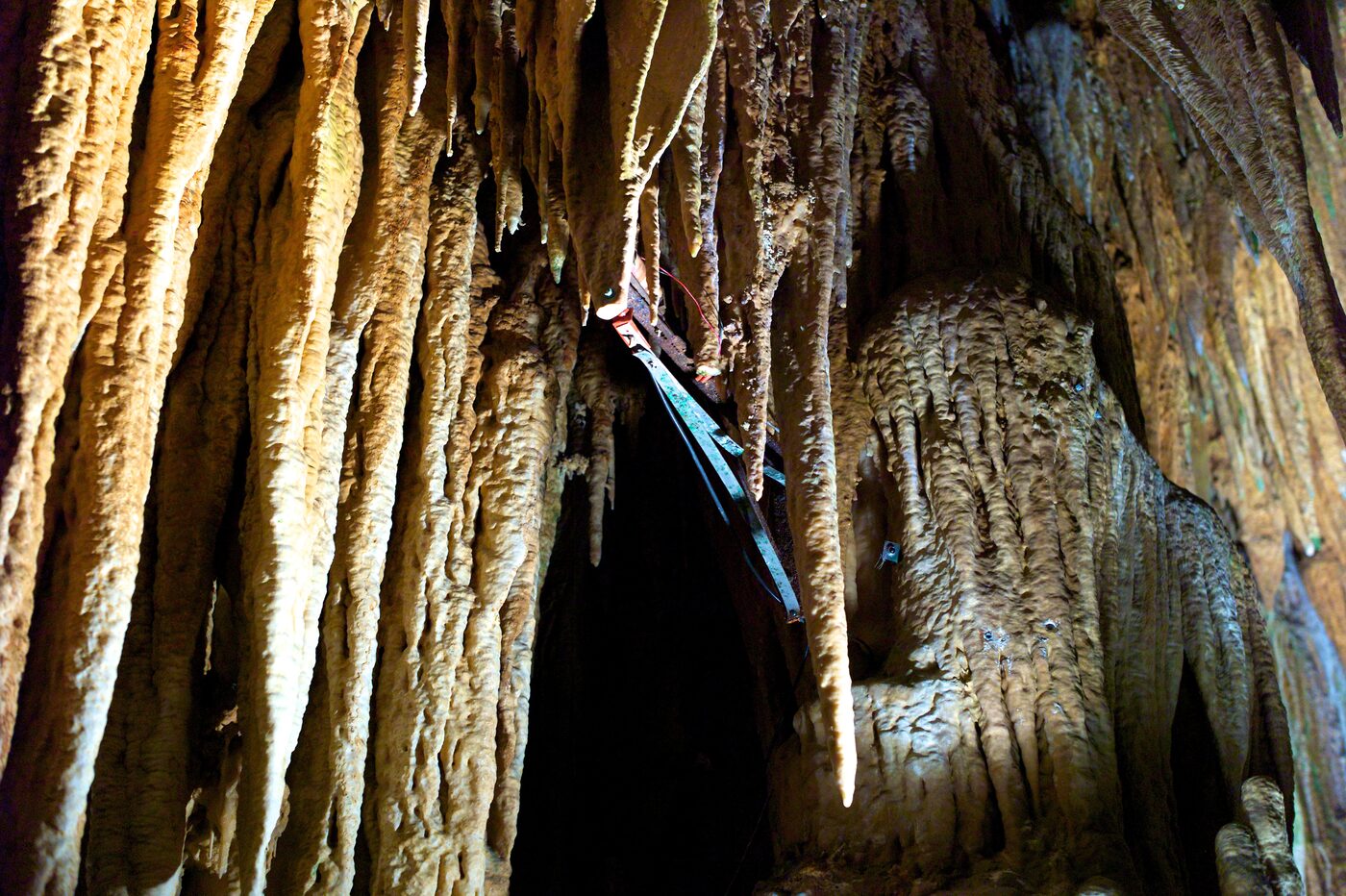
Because the notes are physically scattered across acres of rock, the sound takes time to arrive — close to a full second between pressing a key and hearing the result, and the delay isn’t even the same for every note, because every stalactite is a different distance away through a differently-shaped room. An acoustician who studies caves told PBS that Luray’s porous, bumpy rock behaves a bit like the foam lining of a recording studio: it soaks up just enough echo to keep the notes from smearing into mush, while still letting them travel.
Which is lovely, and also means that playing this thing live is hard. You are not playing an instrument; you are conducting one that is standing in another room and thinking about it. For that reason, most performances today run off an automated system — Luray likens it to a child’s music box; PBS describes the mechanism as a perforated plastic sheet rotating over a metal drum, like a player piano. It can still be played by hand, exactly as Sprinkle played it for years, and occasionally is.
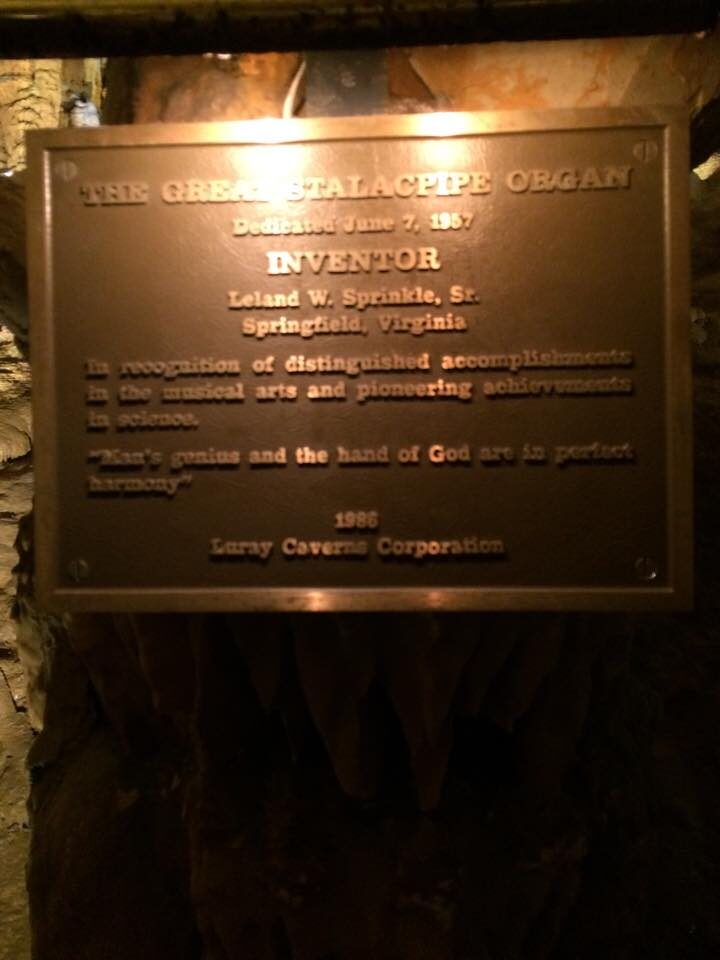
The organ was dedicated on June 7, 1957. There’s a plaque in the cave.
Keeping a cave in tune
A cave is a terrible place to keep electronics. The humidity in Luray runs near 100 percent, and the machinery corrodes accordingly, so the crew runs heaters and dryers to keep the console and its guts alive. And because nobody manufactures spare parts for a 37-stalactite lithophone, the team makes replacements in-house. The operations manager who looks after it learned the job from Sprinkle himself.
Then there’s the tuning, which is where the whole project reveals how carefully it was thought through. Sprinkle chose formations in dry, non-growing parts of the cave — the ones no longer receiving their nightly drip. If they were still growing, they’d get very slightly bigger, and a slightly bigger stalactite is a slightly flatter one. The estimate the caverns give: a growing stalactite would need re-sanding roughly every hundred years.
That is a maintenance schedule measured in centuries, and somebody sat down and worked it out. 🛠️
It gets played, constantly, forever
Around 400,000 people a year hear the Great Stalacpipe Organ, which makes it one of the most-listened-to instruments almost nobody has heard of. It’s turned up on NPR, on Good Morning America, on Voice of America — and, delightfully, on Mister Rogers’ Neighborhood, which is exactly where a cave that plays hymns belongs.
Musicians keep coming, too. Recordings were sold in the gift shop for decades, first on vinyl with Sprinkle himself at the keyboard, later on cassette, later still on CD. And in 2011, the Finnish-Swedish group Pepe Deluxé became the first artists to write and record an original composition for the instrument — a track called “In The Cave.” Fifty-odd years on, someone finally sat down at Sprinkle’s console and wrote something new for it.
Why this lives on a good-news blog
Because the story is, start to finish, about people saying yes to a slightly ridiculous idea.
A tour guide, decades ago, decided the fun thing to do was tap the rocks. A cave company let a man from the Pentagon spend three years of his weekends wandering their property with a bag of tuning forks. A workshop in Waynesboro agreed to build an organ console that would never be connected to a single pipe. And a maintenance crew has now spent nearly seventy years hand-making parts to keep a cave in tune, in near-total humidity, because the alternative — letting it stop — was never really on the table.
Nobody needed the Great Stalacpipe Organ. There was no shortage of organs in 1957. It exists because a rock went ding and one person could not let it go, and because everybody he asked for help said sure, why not.
It’s playing right now, most likely. A signal is running out into the dark and a mallet is tapping something that has been quietly hanging there since before anyone thought to name it. And somewhere in that cave, for a second or so, the note is still on its way. 🎶💛


