

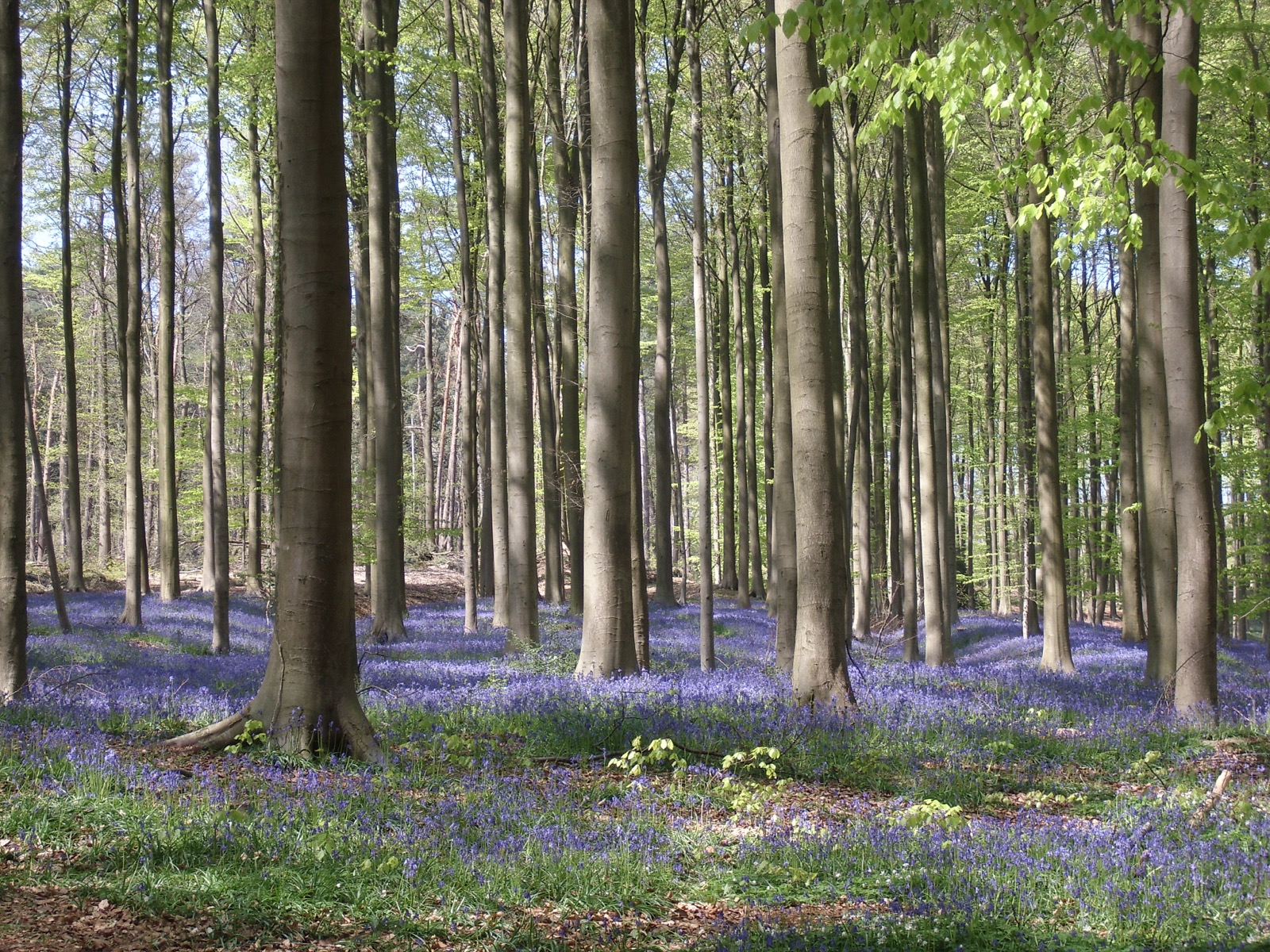
Somewhere near the Belgian town of Halle, just south of Brussels, there is a forest that spends fifty weeks of the year looking like a perfectly nice, ordinary wood — tall grey beech trunks, a quiet floor, the usual birds. And then, for about two weeks in April, the ground disappears. 💙
Not literally. What happens is that the entire forest floor of the Hallerbos erupts into a carpet of wild bluebells so dense and so unbroken that, from a standing height, you stop seeing soil at all. You see violet. It rolls away between the trunks in every direction like someone spilled the sky. People come from all over Europe to stand in it, and then — because it only lasts a fortnight — they go home and wait a year to do it again.
The two-week window
The flower doing all this is the wild bluebell (Hyacinthoides non-scripta) — a small, nodding, bell-shaped bloom that grows from a bulb and comes up in enormous colonies on old woodland floors. The trick to the carpet is timing. Bluebells race to flower in early spring, in the narrow window after the days warm up but before the beech leaves fully open overhead. For a couple of weeks they own all the light on the forest floor. Once the canopy closes and the shade comes down, the show is over for the year.
That’s the whole magic of it: it is genuinely, unavoidably brief. There’s no way to stretch it, bottle it, or schedule it for a convenient weekend. The bluebells come up when they come up, hold their colour for roughly two weeks, and then quietly fold. It’s a spectacle you have to show up for, and half the joy is that so many people do.
It doesn’t start blue
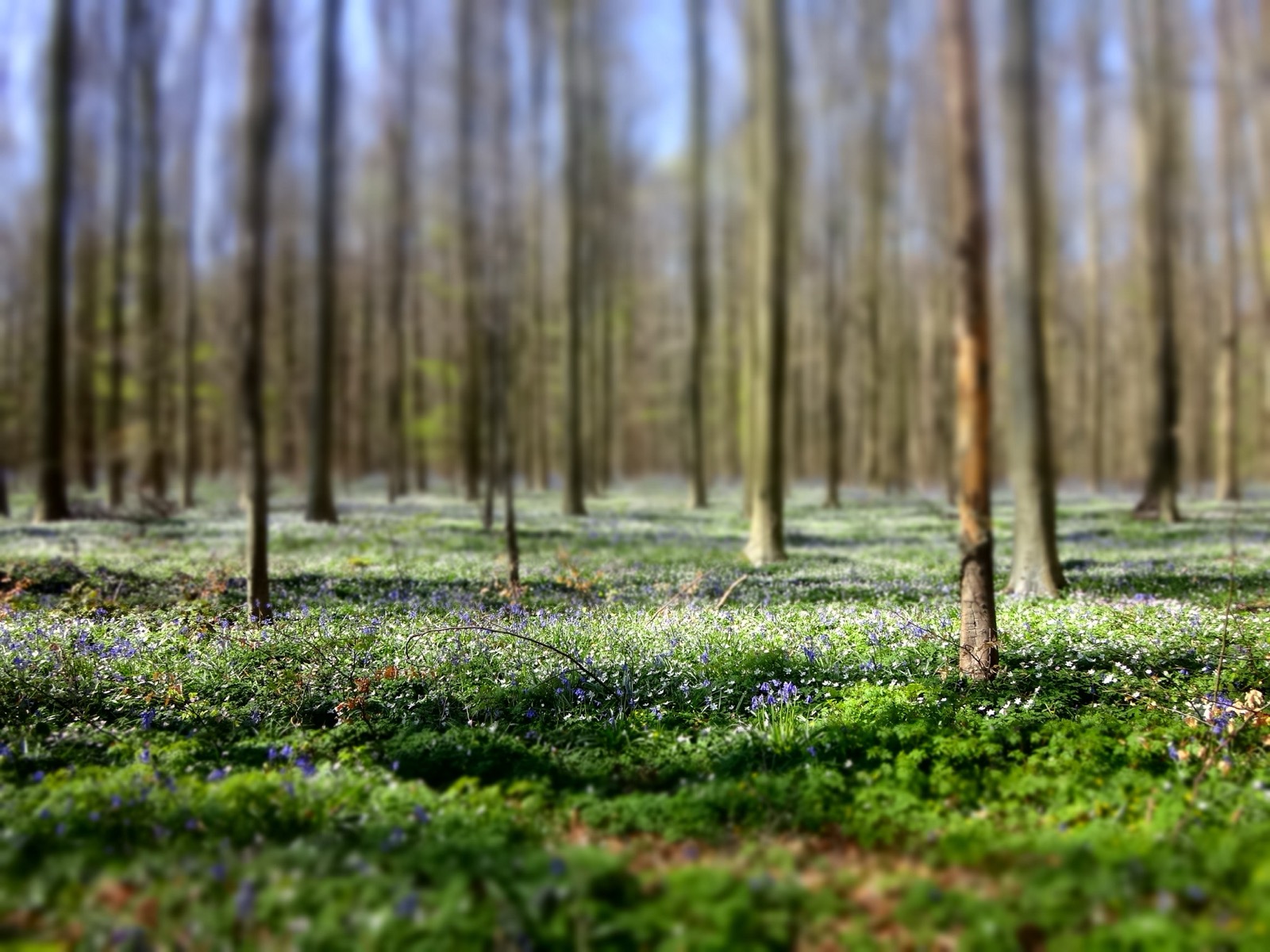
Here’s a lovely detail most photos skip: the Hallerbos doesn’t go straight to violet. The floor runs through colours in sequence, like a slow curtain-raiser.
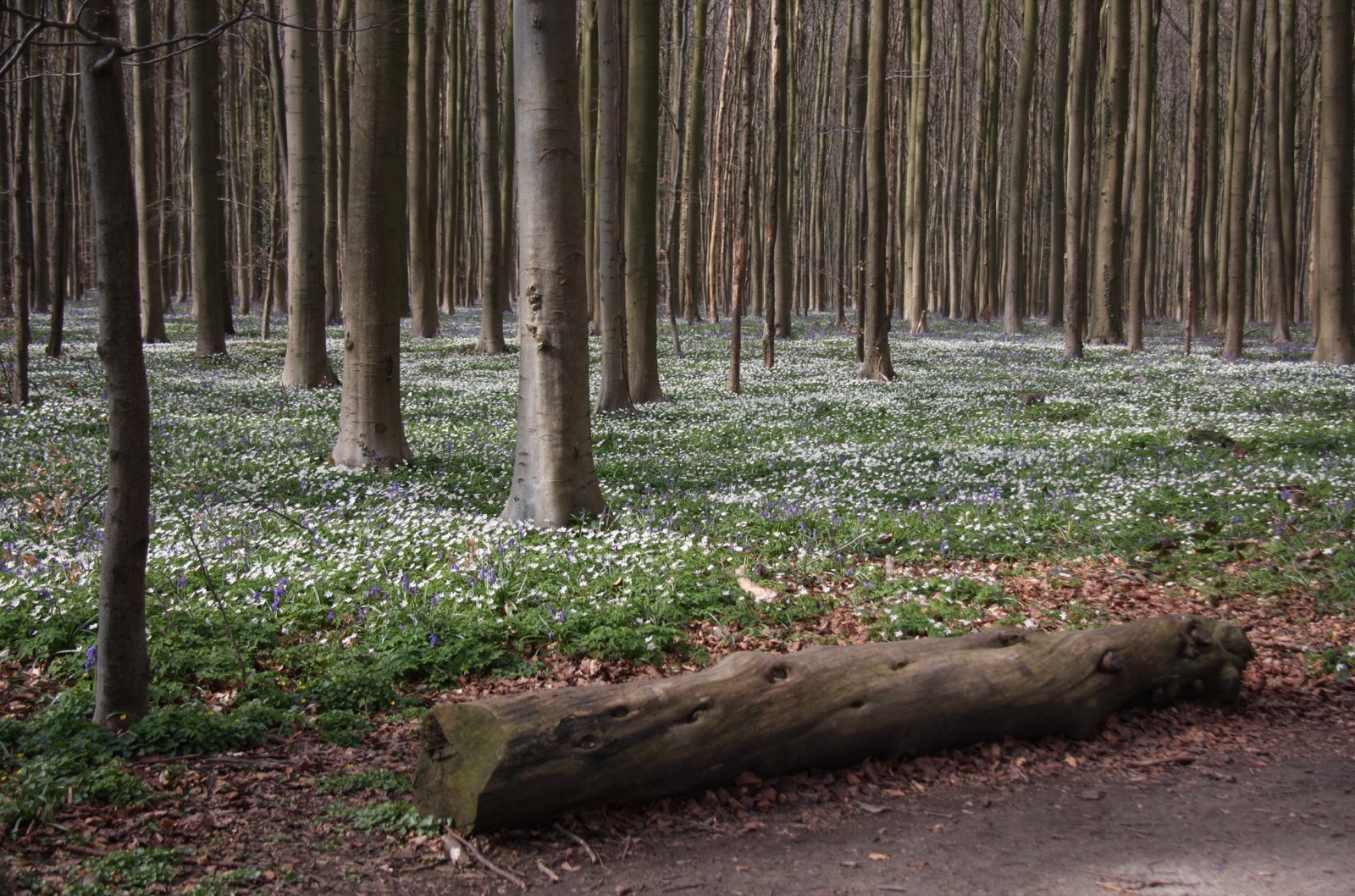
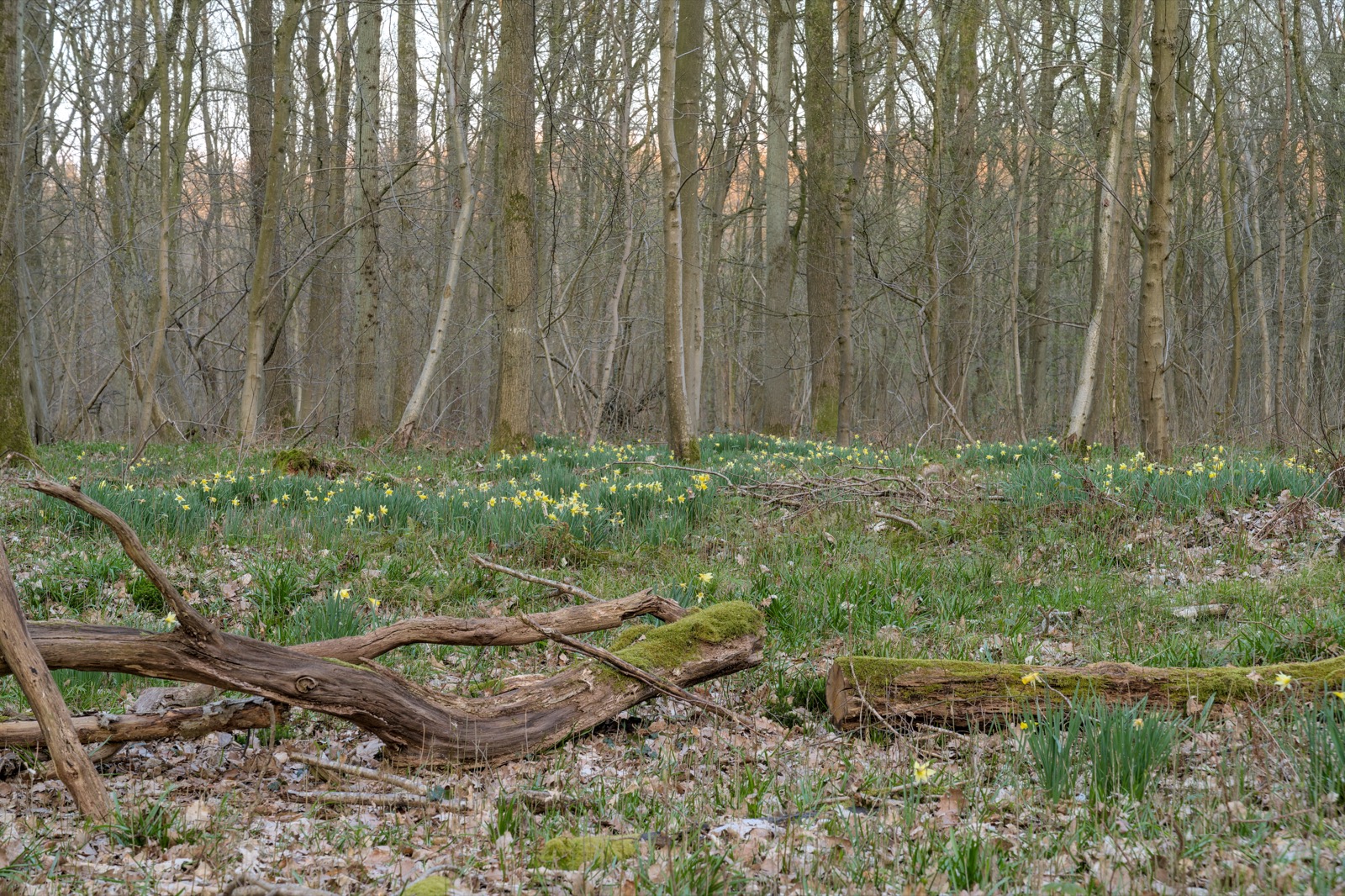
First, while the beeches are still bare, comes a scatter of wild daffodils (Narcissus pseudonarcissus) — little pale-yellow trumpets nodding among the dead leaves. Then the ground goes white, as thousands of wood anemones (Anemone nemorosa) open all at once. Only after the white round does the blue flood in and take the whole forest over. If you time a few visits across April, you can watch the same square of ground repaint itself twice before the headline act.
The forest itself is a comeback
Now for the part that turns this from “pretty” to “quietly amazing.” The beech forest you walk through — the one holding up all those bluebells — is, in tree terms, young. And it’s here on purpose.
The Hallerbos is the surviving edge of something enormous and ancient: the Silva Carbonaria, the “Charcoal Forest,” a vast wood that once sprawled across this part of Europe. As late as 1777 the Hallerbos was still joined by a strip of trees to the great Sonian Forest outside Brussels. It is, in other words, a genuinely old patch of woodland.
But old woods have hard centuries. During the First World War, the occupying army logged the Hallerbos hard, taking out most of the mature trees and leaving the place close to bare. The tall, elegant beech columns that make today’s forest look like a cathedral aren’t the survivors of that — they’re the replacements. Between 1930 and 1950, people deliberately replanted the Hallerbos, tree by tree.
So the most swooned-over spring spectacle in Belgium is happening in a forest that, a hundred years ago, had been logged nearly to the ground. Someone decided it was worth putting back. They planted the beeches, the bluebells kept the ancient woodland floor they’d always held, and now — a century on — the two things together do this every single April, for free, for anyone who comes to look.
💙 Smile Fact: The Hallerbos bluebell carpet isn't planted, staged, or ticketed — it's the forest's own wild floor doing its yearly thing. The most-photographed two weeks in Belgium cost the forest nothing and cost you nothing but the trip. The only "price of admission" is showing up in the right fortnight.
Why this lives on a good-news blog
Because the Hallerbos is two good stories folded into one. It’s the small, honest joy of a thing that only happens briefly — a spectacle you can’t hoard, can’t reschedule, and can only enjoy by being present for it, which is exactly what makes people treasure it. And it’s the deeper, slower joy of a forest that was taken apart and put back: logged bare in a war, replanted by hand, and now healthy enough to throw the most extravagant flower show in the country.
The world, it turns out, is also doing this — quietly keeping a wood alive so that once a year the ground can turn the colour of the sky, and a few thousand people can walk very slowly through it, grinning at their shoes. Somebody replanted the trees. The bluebells did the rest. 💙🌳🌱


