

In the small hours of 6 December 2020, people in South Australia looked up and watched a very small, very fast, very deliberate shooting star cross the sky.
It was a capsule. About 40 centimetres across and 20 centimetres tall — a wok with a heat shield — coming in at 12 kilometres per second, glowing, shedding its shielding, and then, at around ten kilometres up, quietly putting out a parachute and starting to transmit a beacon into the dark. 🪂
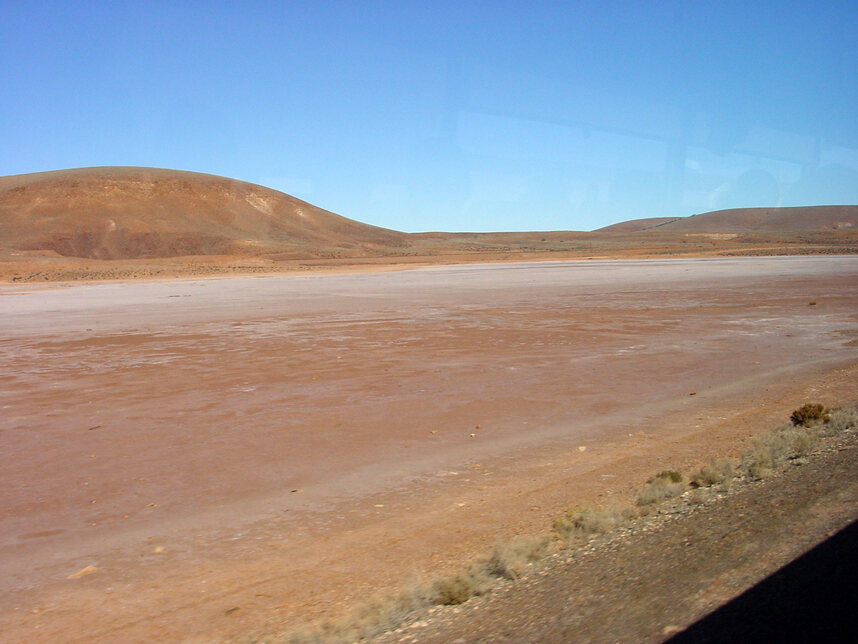
It came down in the Woomera Prohibited Area, a slab of red dirt and salt pan in the South Australian outback that Australia has kept mostly empty since 1947. Five hours later a recovery team had walked out to it, checked it for live pyrotechnics, and carried it home. ☄️
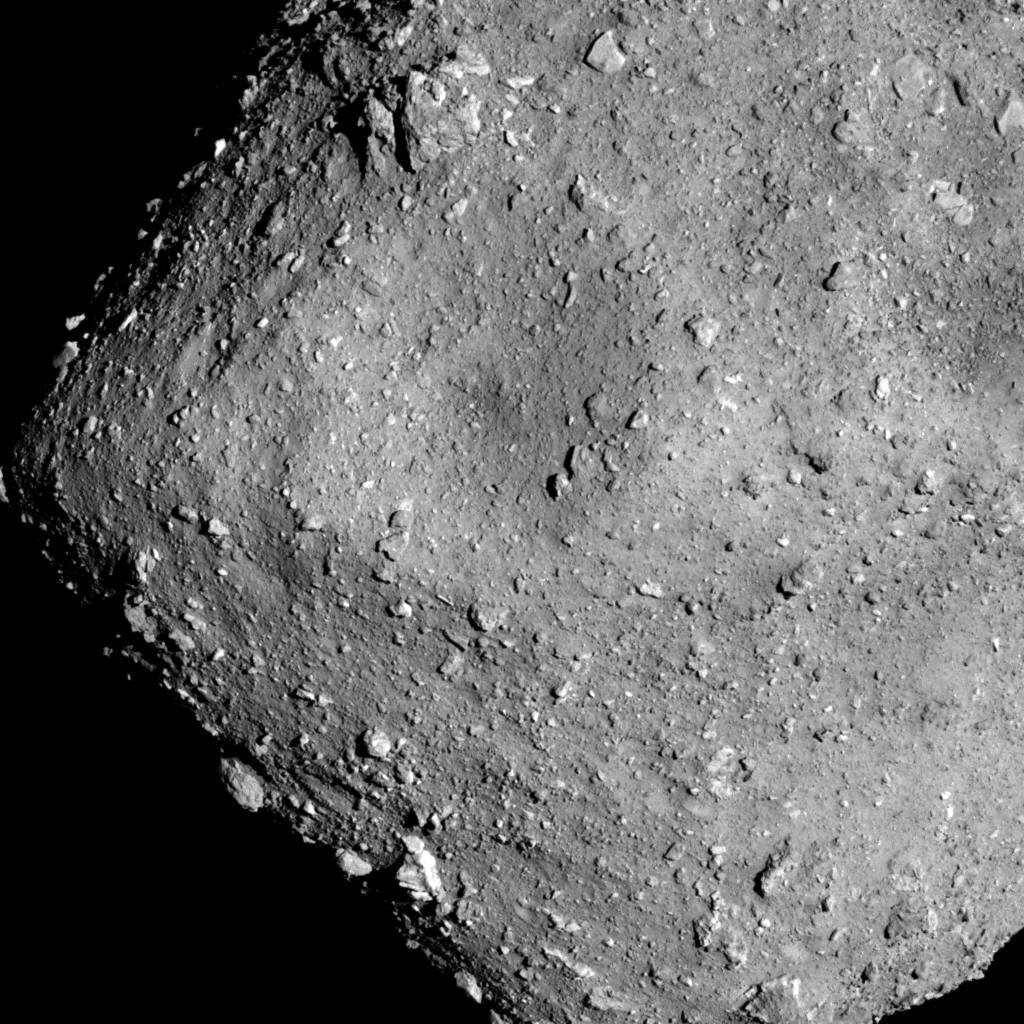
Inside the capsule were 5.424 grams of a carbon-rich asteroid called Ryugu. About a teaspoon’s worth. It had never touched Earth’s air, and — as we’ll get to — that turned out to be the entire point.
The bird that went and got it
Hayabusa2 means “peregrine falcon 2,” and it is a sequel, which is a lovely thing for a spacecraft to be. JAXA launched it on 3 December 2014, it arrived at Ryugu on 27 June 2018, and it stayed for a year and a half.
Ryugu is a C-type asteroid — the dark, carbon-rich, water-altered kind, the sort of rock that has been quietly stewing since before the planets finished forming. It’s a little under a kilometre across and shaped like a spinning top with a ridge round its middle.
Getting a sample off it was, frankly, cheeky. The spacecraft lowered a horn until it touched the surface and fired a five-gram tantalum slug into the ground at 300 metres per second, then caught the debris that floated back up the tube in Ryugu’s almost-nonexistent gravity. That was 22 February 2019, Japan time.
Then it did something better. To get material from below the surface — stuff the Sun and cosmic rays had never touched — it dropped a free-flying gun onto the asteroid, backed away to hide on the far side, and detonated it. A 2.5 kilogram copper block, accelerated by a 4.5 kilogram explosive charge, punched a ten-metre crater in Ryugu. Months later the spacecraft came back down and took its second sample next to the hole. 🕳️
Both hauls went into separate sealed chambers. Chamber A — the surface scoop — ended up holding 3.237 g. Chamber C, from the crater visit, held 2.025 g. Chamber B, which only caught what drifted between the two, held 13 milligrams, and somebody weighed that too.
The most careful unboxing in history
Here is where the story stops being about rockets and starts being about paranoia, in the best possible sense.
The recovery team did not open the capsule in the field. They took it to a temporary lab inside the Woomera Prohibited Area, and on 7 December they pierced the sealed container with a tungsten carbide needle — not to get at the rock, but to get at the gas. Ryugu had brought some of its own gas home with it, sealed in there — the first gas ever returned from an asteroid — and they wanted it before anything else could leak in.
And in doing that they learned the single most reassuring fact of the whole mission: the container was still under vacuum. After four years in space, a fireball, a parachute and a hard landing in the desert, the seal had held. Nothing from Earth had got inside. 🫙
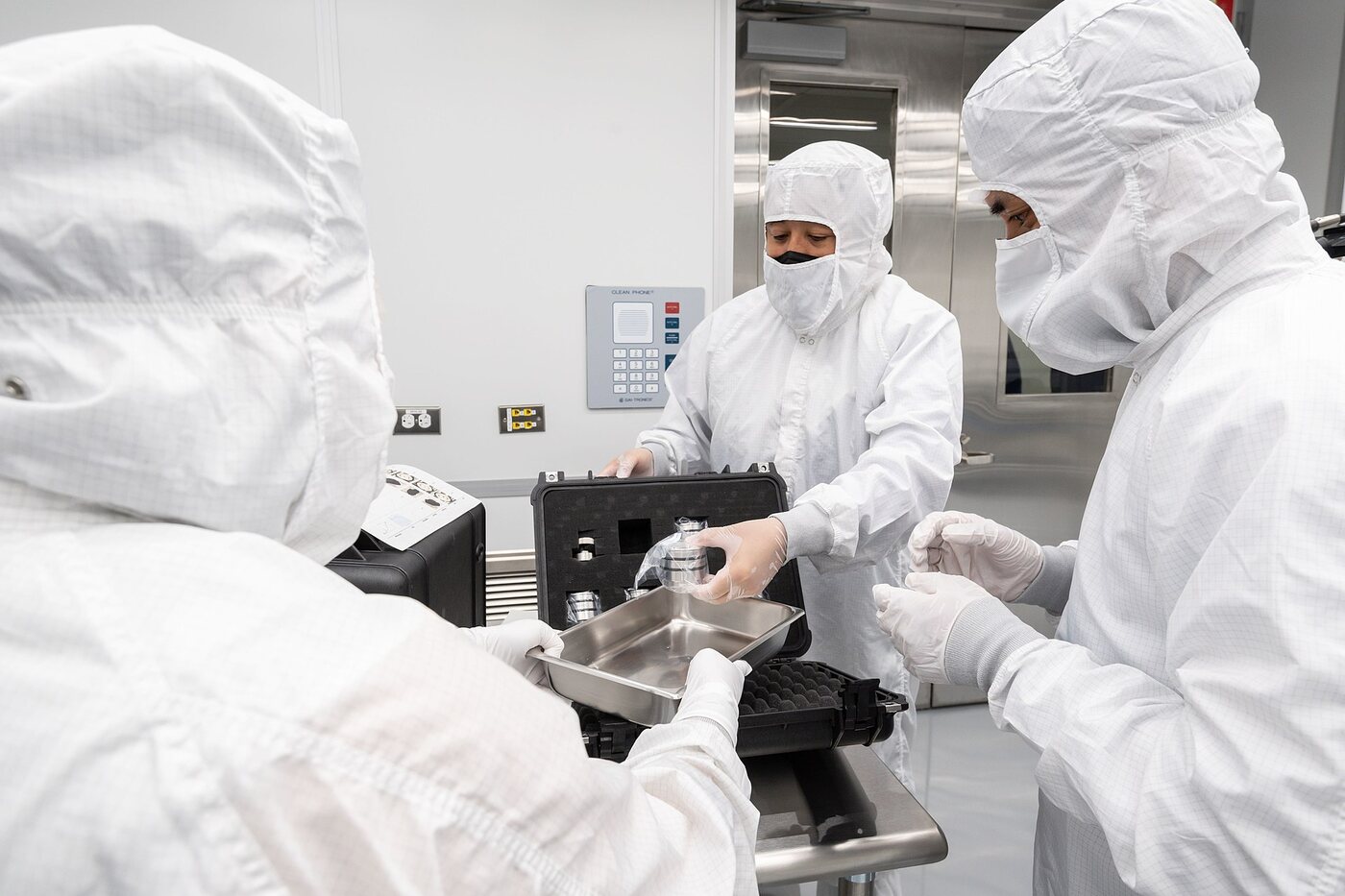
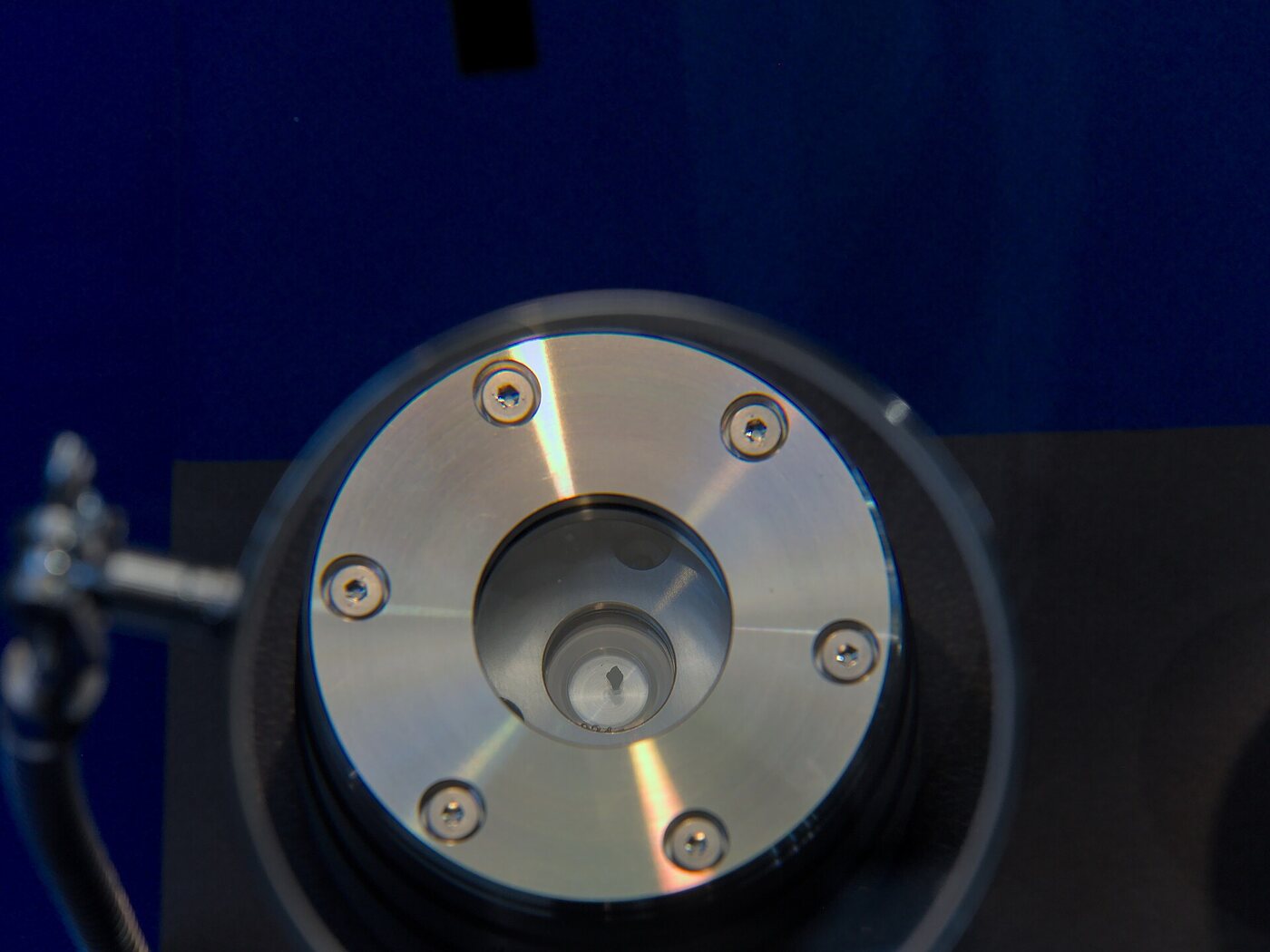
The container reached JAXA’s curation centre at Sagamihara about 57 hours after landing. It was attached to a vacuum clean chamber 132 hours after landing. It was opened on 14 December 2020. From that moment to this one, the Ryugu grains have been handled only in vacuum or in ultra-purified nitrogen — never once exposed to the air you and I are breathing.
What was in it
In 2023 a team led by Eric Parker at NASA Goddard, working with the Hayabusa2 analysis group, published the amino acid results in Geochimica et Cosmochimica Acta. They took two tiny allotments — one from Chamber A, one from Chamber C — brewed them in hot water, and put the extracts through liquid chromatography and high-resolution mass spectrometry.
Thirteen amino acids were detected and quantified. A further five were tentatively identified but could not be quantified — glimpsed at the very edge of what the instruments could separate, present but not measurable. Those two numbers are different things and it matters that they stay different, because press accounts have a habit of adding them together into a rounder, wronger “eighteen.”
Among the thirteen are names you may recognise from a biology class: glycine, the simplest amino acid of all; alanine; aspartic acid; glutamic acid. And among them are names you almost certainly won’t, because life on Earth barely uses them: β-alanine, α-aminoisobutyric acid, β-aminoisobutyric acid, α- and β- and γ-aminobutyric acid. Those last ones are the interesting company. They’re rare in biology and common in space chemistry.
The quantities are almost comically small — individual amino acids at 0.02 to 15.8 nanomoles per gram. You would need a very good imagination and a very good machine to call that a meal. But it’s there, and it’s measured, and it came off an asteroid.
The hands 🤲
Now the part that the whole post is for.
Hold up your left hand and your right hand, palms towards you. Same hand. Same five fingers in the same order, same thumb, same everything. Now try to lay one on top of the other so every finger matches. You can’t. They’re mirror images: identical, and not interchangeable. That’s why a right glove is useless on a left hand.
Most amino acids are like that too. The same atoms, bonded in the same order, can be assembled two ways that are mirror images of each other. Chemists call the two versions L (left-handed) and D (right-handed), and the property itself is chirality — from the Greek for “hand.”
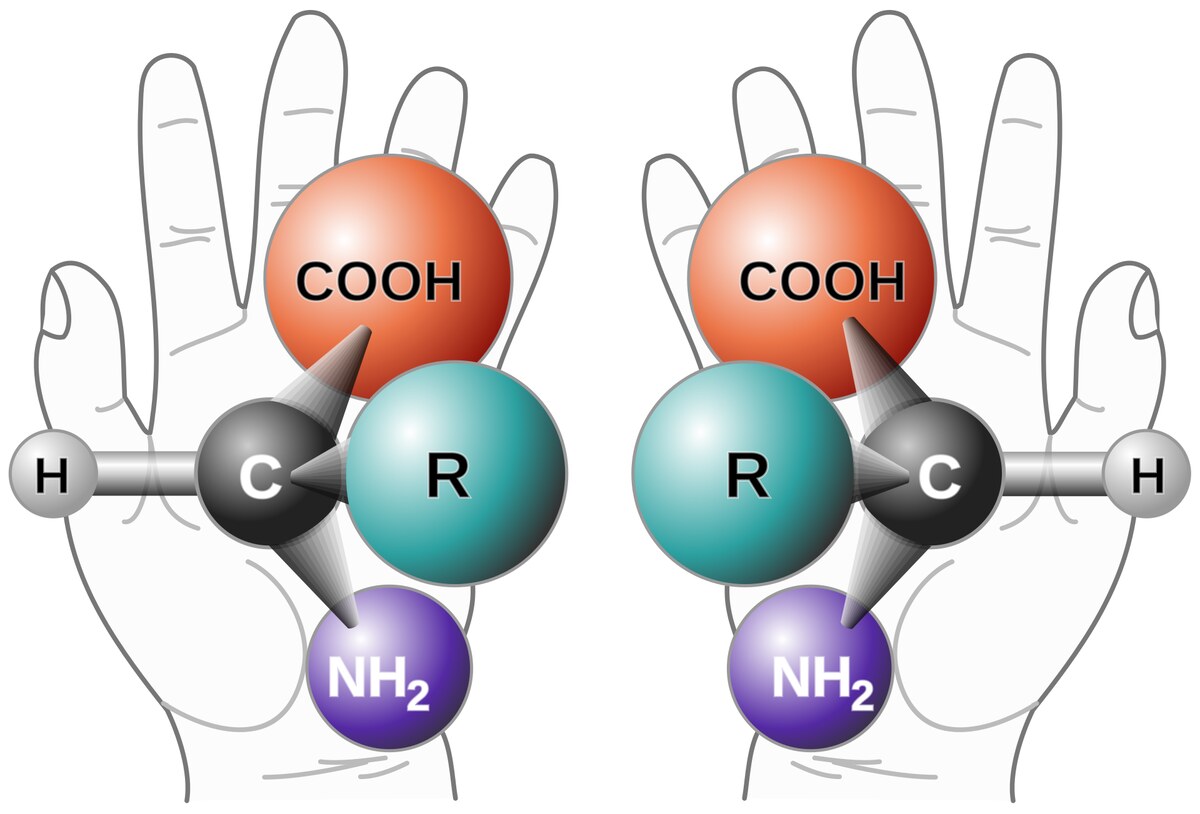
Here’s the strange thing: plain chemistry has no preference. Cook amino acids in a flask, or in a warm wet rock, and you get a racemic mixture — a coin-flip 50/50 split of left-handed and right-handed molecules.
Life on Earth is not like that at all. Every protein in your body, in the cat, in the grass outside, is built almost exclusively from left-handed amino acids. All of it. Every living thing we have ever found. Nobody fully knows why the coin landed the way it did, but it landed, once, a very long time ago, and everything since has inherited the same handedness.
Which gives you the most beautiful contamination test ever devised.
If a scientist sneezes, or a glove sheds a skin cell, or a speck of dust from a lab bench finds its way into an asteroid sample — that contamination came from life, so it will be overwhelmingly left-handed. But if the amino acids in a rock were made out in space by ordinary chemistry, with nothing alive anywhere near them, they should come back racemic: a near-even mix, no favourite hand.
The Ryugu amino acids came back with no favourite hand.
Alanine — a workhorse protein amino acid, and therefore a prime suspect for contamination — was racemic within measurement error in both samples, with a D-to-L ratio of 1.09 ± 0.15. A perfect 50/50 split would be 1.00. β-aminoisobutyric acid came in at 0.95 ± 0.08 and 0.98 ± 0.12. β-amino-n-butyric acid was racemic within error in every single sample they ran.
Roughly half and half. Nobody’s thumbprint. The paper’s own conclusion is that these molecules are “likely to have been indigenous to the samples and are of extraterrestrial origin” — and the reason they can say that is the coin flip.
The test that also caught itself
There’s a coda to this that I love, because it’s the sound of scientists being honest in public.
The same measurements that certified most of the sample also found one amino acid — serine — that came back with a big left-handed excess. Not racemic. Lopsided, in exactly the direction a living thing would push it.
So the team wrote it down and said so: that is a trace of terrestrial contamination, at low level, riding along with the real thing. The handedness test doesn’t just tell you what’s real. It tells you what isn’t, and it doesn’t let you quietly keep the flattering half of the answer.
That is the difference between “we found amino acids in an asteroid” and “we know which amino acids in this asteroid are actually from the asteroid.” It took the whole apparatus — the sealed container, the vacuum, the nitrogen, the mirror-image measurement — to earn that second sentence.
What this does and doesn’t mean 💛
It does not mean Ryugu had life on it. It didn’t.
It does not mean life on Earth came from space. Nobody has shown that, and this doesn’t.
What it means is smaller, and honestly nicer: the ingredients are ordinary. The building blocks of proteins are not some rare miracle that only happens in an ocean on a lucky planet. They assemble themselves out of dust and water and cold and time, on a nine-hundred-metre pile of rubble drifting between Earth and Mars, with nothing alive within a hundred million kilometres. And then bits of that rubble fall on planets, because bits of rubble always do.
The universe was already stocking the pantry. It just hadn’t cooked anything yet.
The bit that gets me
Hayabusa2 didn’t come home.
It flew past Earth, released the capsule from up in the dark, made three trajectory corrections in the following hour to pull itself back out of Earth’s grip, and carried on. JAXA’s own announcement of the recovery is mostly a long, formal thank-you note — to Australia, to NASA, to “the people of Japan and the world” — filed the same day, while the capsule was still sitting in a shed in the desert.
The spacecraft still had about 30 kilograms of xenon left in the tank. So they gave it more to do. It flew past the asteroid Torifune in July 2026, and in 2031 it will catch up with 1998 KY26 — a rock perhaps thirty metres across, spinning once every ten minutes, which nobody has ever seen close up.
Meanwhile a share of Ryugu went to Houston, and a share of asteroid Bennu came back the other way, because two space agencies on opposite sides of the Pacific decided the most sensible thing to do with a teaspoon of the early solar system was split it with someone else who would look after it properly.
A box of dirt fell into the outback. Somebody drove out and got it. And when they finally looked inside, the molecules in there had no favourite hand — which was, all along, exactly the answer that would prove it was really theirs. 🤲💛
Go deeper (real links, no pop-ups, promise)
- 🪂 JAXA/ISAS: the results of the Hayabusa2 re-entry capsule recovery
- 🧪 Parker et al. 2023: extraterrestrial amino acids and amines in Ryugu samples (PDF)
- ⚖️ Yada et al. 2022: preliminary analysis of the returned Ryugu samples (Nature Astronomy)
- 🇦🇺 Science: Japan’s Hayabusa2 capsule lands with carbon-rich asteroid samples
- 🛰️ JAXA: the Hayabusa2 project


