

Here is a thing you can go and stand next to.
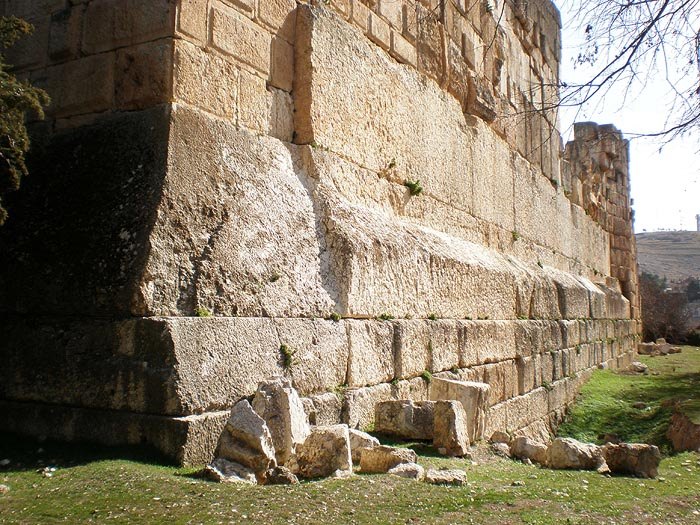
In the wall of a temple in Lebanon there are three stones lying end to end. Each one is about 19 metres long, 4.2 metres high and 3.6 metres thick, and each weighs somewhere around 750 to 800 tonnes. For scale: a fully loaded Boeing 747 comes in around 400 tonnes. So each of these is two jumbo jets. There are three of them, side by side, high up in a wall, and they have been sitting there for roughly nineteen centuries.
Nobody is confused about who put them there. We have the inscriptions, the coins and the emperors’ names. But there are still specific, narrow, genuinely unresolved questions about how — and archaeologists say so out loud, in print, without any embarrassment at all.
That is the good version of this subject, and it’s the one we’re doing. 🪨
The house rules, up front
Because this subject attracts a particular kind of nonsense, here’s how we’re playing it.
Every number in this post has a name attached to it. Weights and dates get inflated with each retelling — a 300-tonne stone becomes 1,000 tonnes in about four hops — so where there’s an estimate, we say whose it is and how they got it.
“We don’t know exactly how” is a sentence we’re happy to write. “Nobody can explain it” almost always isn’t true, and it’s usually a sign someone is about to sell you something.
And the people who dig these sites up are our source, not the people who write about them. As it turns out, they’re much more fun.
1. Göbekli Tepe: older than farming, and it keeps rewriting its own story
Start in southeastern Turkey, on a bare hilltop about 15 km from Şanlıurfa.
Göbekli Tepe is a mound 15 metres high and around 9 hectares across, and the first remarkable fact about it is that the entire mound is man-made. It isn’t a hill somebody built on. It’s a hill made of the archaeology itself.
Inside it are big round structures — the excavators now carefully call them “special buildings” rather than temples — built from T-shaped limestone pillars set into thick walls, with two taller pillars standing facing each other in the middle of each ring. The central pair are over 5 metres tall. Many are carved in relief with foxes, boars, snakes, vultures, spiders and scorpions. Some have arms, hands, a belt and a loincloth, which is why the T-shape is read as a stylised human body with the crossbar for shoulders.
And the dates. The oldest layers sit in the Pre-Pottery Neolithic A, roughly 9600–8800 cal BC, on the excavation team’s own radiocarbon summary. That is around eleven and a half thousand years ago — before pottery, before farming, before writing, before metal, before the wheel. These are the oldest known megaliths anywhere on Earth.
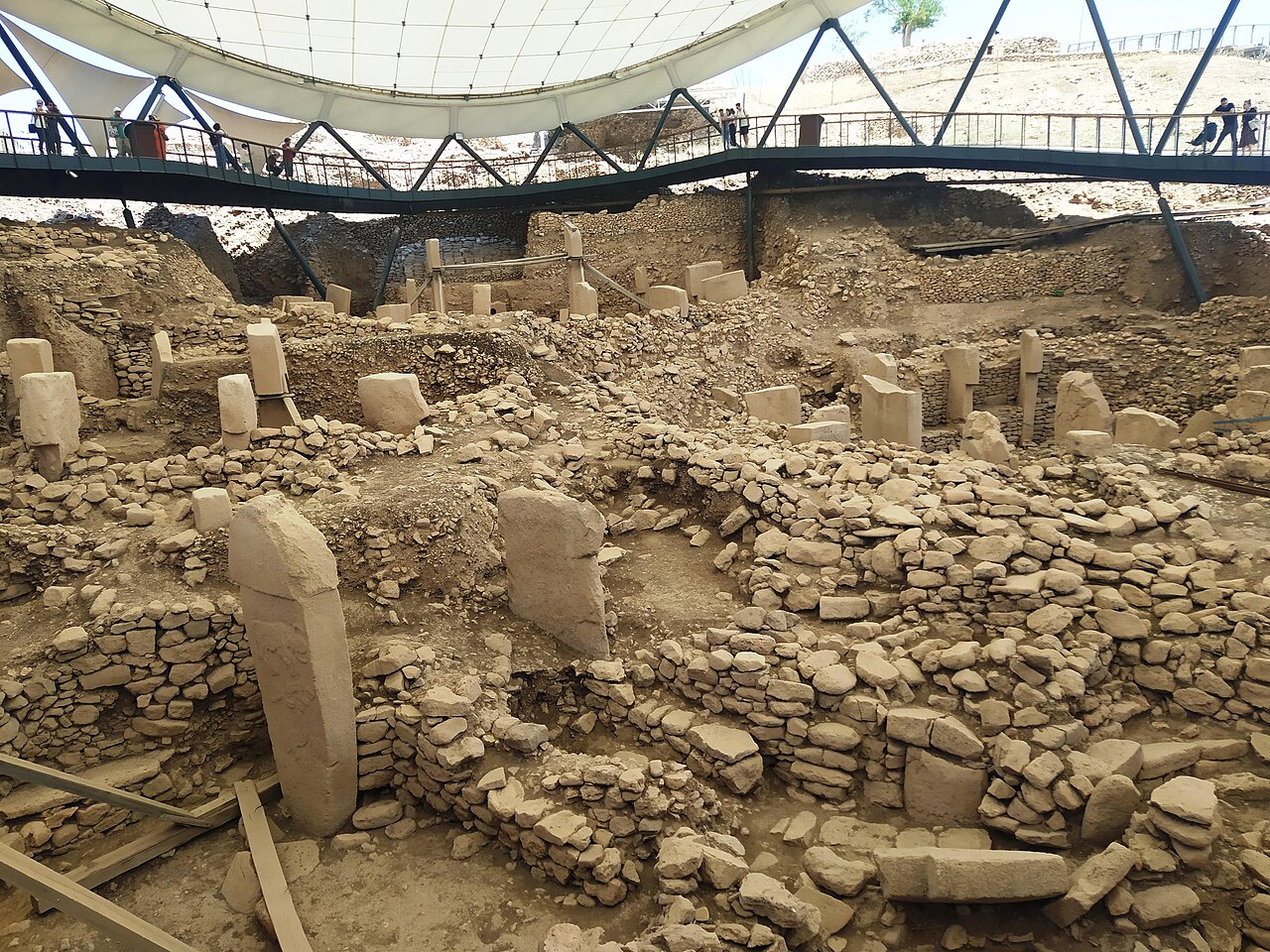
Klaus Schmidt of the German Archaeological Institute spotted the significance of the site in 1994 and started digging in 1995. He directed the work until his death in 2014.
Now the part that makes this genuinely delightful
Göbekli Tepe is famous for a story that goes roughly: wandering hunter-gatherers with no farming and no village built a colossal temple, then deliberately buried the whole thing.
Three parts of that have quietly changed, and the excavators changed them themselves.
It probably wasn’t deliberately buried. This is the big one. The German Archaeological Institute’s own published FAQ addresses it directly, and the answer is a model of how to update in public: the filling process, they write, “was much more complex than initially thought.” Some of it was people dumping sediment while building new structures — but a lot of it was landslides: slope slides, heavy rainfall, earthquakes, sediment sliding downhill into the enclosures over a long period. The buildings sit more than 10 metres below the highest part of the settlement, and at least one enclosure was wrecked by a landslide, repaired, given terrace walls to protect it, and then hit again. The intentional-backfilling reading has fallen out of favour since Schmidt’s death.
It probably wasn’t built by people who didn’t live there. The old picture was a sanctuary that nomads visited for festivals. But the site has since produced fire installations, remains of consumed food, cisterns cut into bedrock holding at least 150 cubic metres of rainwater, grinding stones, mortars and pestles showing serious cereal processing, burials, and a great many buildings. It’s now read as a settlement with a strong ritual component. People lived there.
And it may not have taken a vast workforce at all. Schmidt argued the pillars were beyond “a few people,” reasoning from Thor Heyerdahl’s experiments with the Rapa Nui moai — 50 to 75 people to shift one 15 km. But E. B. Banning’s 2011 reassessment put it at 7 to 14 people with ropes and a lubricant, using the same sorts of techniques proposed for Stonehenge. And experiments at Göbekli Tepe itself, published by Moritz Kinzel and Lee Clare in 2020, suggest all the exposed structures could have been built by 12 to 24 people in under four months, including quarrying and feeding everyone. That’s within reach of a single extended family or village — and, they note, roughly the number who could comfortably fit inside one of the buildings at once.
None of this makes the site less astonishing. The stone came from bedrock pits about 100 metres away, cut out with flint points, by people with no metal. A dozen of them may have built the oldest monumental architecture on the planet in a single season. That’s more impressive, not less.
What actually is unresolved here
Plenty, and the team is clear about it. We don’t know what the special buildings were for. No definitive purpose has been established. We don’t know whether they were roofed — the excavators say it’s “perfectly conceivable and technically feasible,” but the evidence isn’t there yet. We don’t know what the animal reliefs mean. And on the popular astronomical alignment theories, the team has worked with archaeo-astronomers and reports that so far no link between sky phenomena and the orientation of the pillars could be identified.
Those are real open questions, held open honestly. That’s what it looks like when people don’t know something.
2. Cusco: the joints you cannot get a blade into
Now to Peru, and to the thing everybody notices first.
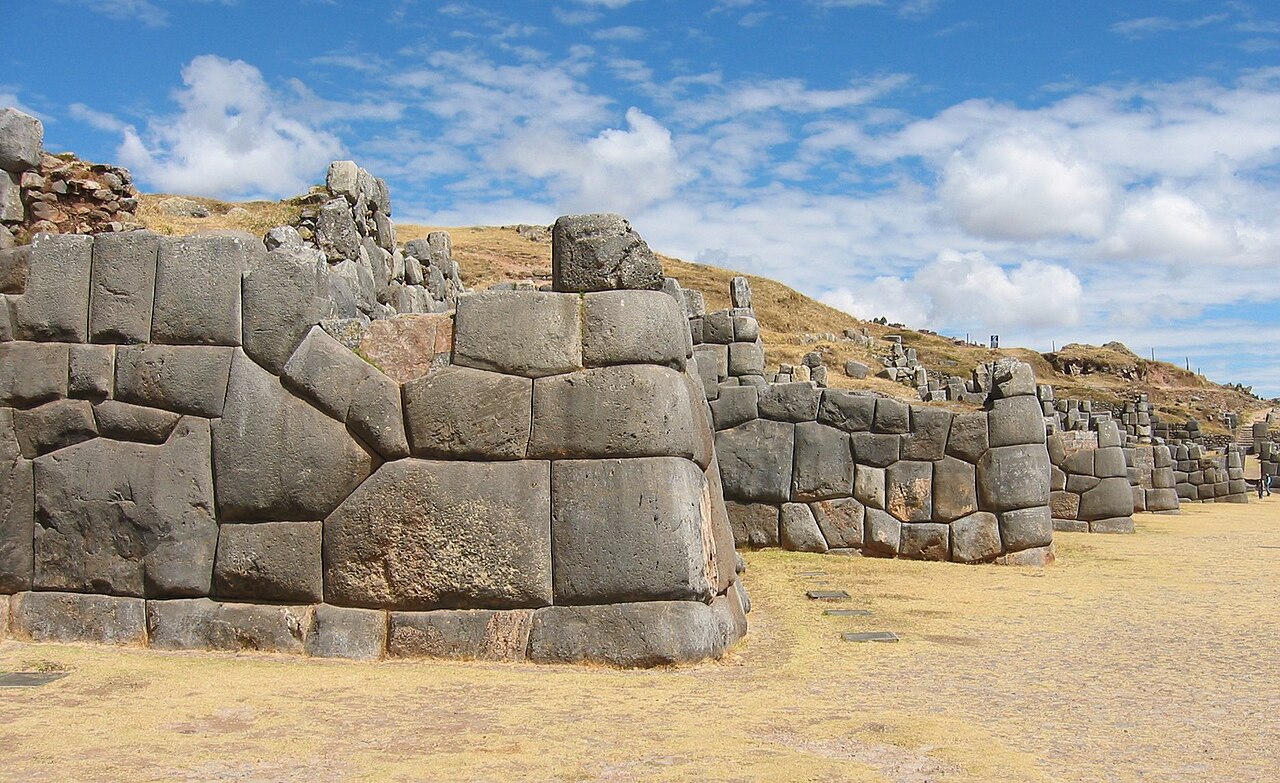
Inca walls are made of irregular, many-sided blocks laid without mortar, and they meet along their whole length so closely that the joint is often a hairline. At Sacsayhuamán, above Cusco, the three great terrace walls run about 400 metres at the longest, stand around 6 metres tall, and contain over 6,000 cubic metres of stone. Estimates for the largest single block there range from 128 to almost 200 tonnes — a genuinely wide range, which is what an honest estimate of a partly buried irregular boulder looks like.
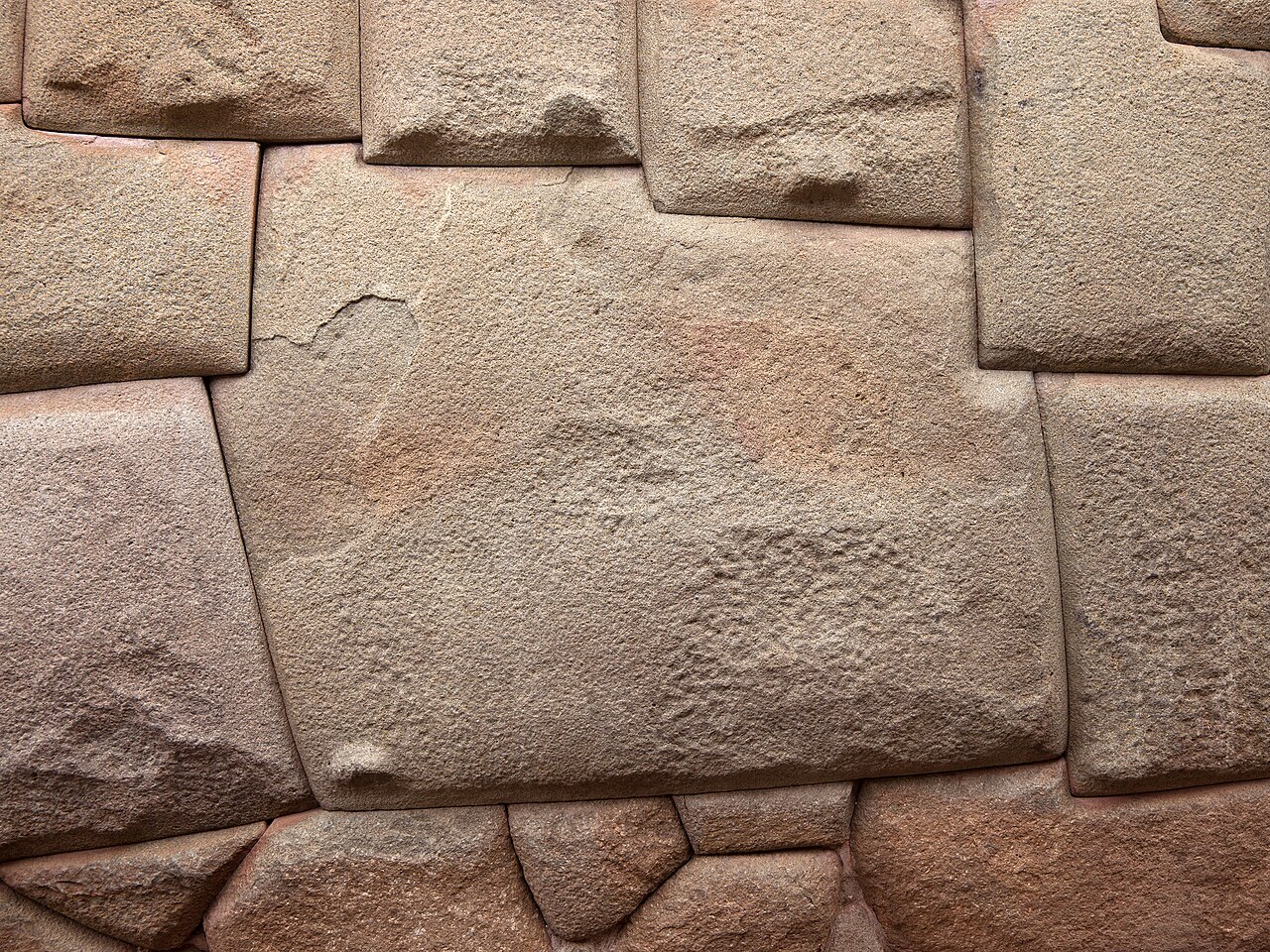
The Spanish were staggered, and helpfully wrote it down. Pedro Pizarro, who was there, described stones “so large and thick that it seemed impossible that human hands could have set them in place… so close together, and so well fitted, that the point of a pin could not have been inserted in one of the joints.”
And the chronicler Pedro Cieza de León, writing in 1553, recorded the labour organisation from Inca testimony: the provinces were to supply 20,000 men, working in relays so nobody was kept at it permanently — 4,000 to quarry and cut the stone, 6,000 to haul it “by means of great cables of leather,” and the rest on foundations and timber.
So we have a date, a workforce, a management structure and a named eyewitness. The Inca built these in the fifteenth century. This is not a mystery of authorship.
How they did it — and how we know
The evidence is sitting on the walls, if you know what to look for.
Hammerstones. The faces of the blocks carry hammerstone impact marks, and excavations at the foot of the walls turn up the small stone chips knocked off during shaping. The tools left their debris exactly where you’d expect.
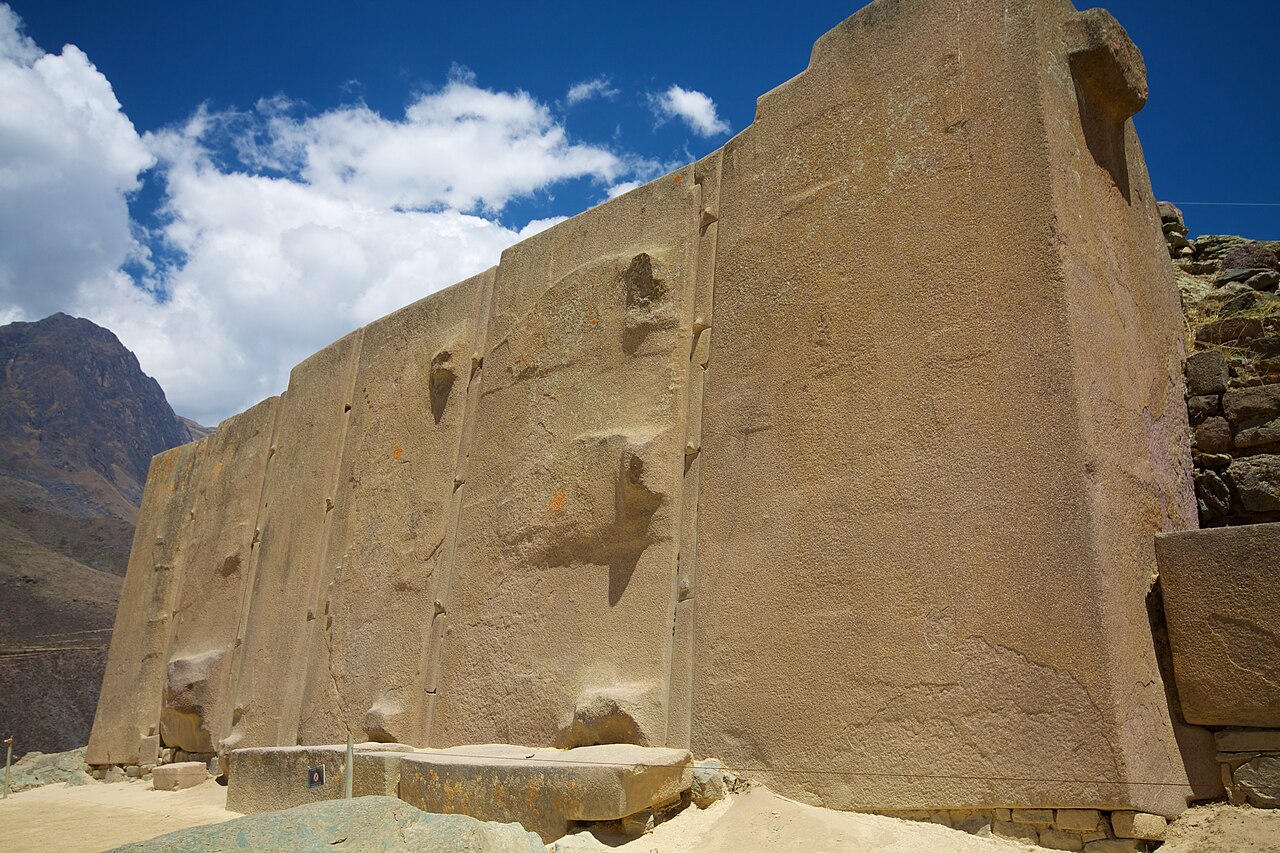
Lifting bosses. Those odd protruding lumps left on the outer faces of so many Inca blocks are handles — points to sling a rope round or lever against. They were never trimmed off the unfinished work, so we can see the method mid-sentence.
Ramps. Unfinished sites still have their stone ramps in place, and at Ollantaytambo a large earthen ramp still runs from the quarry up to the Wall of the Six Monoliths. Better still, Father Bernabé Cobo watched Inca builders use exactly this technique while Cusco Cathedral was going up.
And the stones that never arrived. Cieza de León walked out from the fortress and found an enormous shaped block lying by itself on the ground. He asked, and was told the stone “got tired” at that point and could be moved no further. Peruvians still call them piedras cansadas — tired stones. They lie along the transport routes, cut and abandoned in transit.
A dropped stone halfway along the road is about as direct a piece of evidence for a haulage method as archaeology ever gets. It’s also, quietly, one of the most human things on this entire list: a job that was too hard, given up on, and left where it stopped.
The architect Jean-Pierre Protzen spent years on this, quarrying and cutting stone at Ollantaytambo himself to test what the tools could do, and published the results in Inca Architecture and Construction at Ollantaytambo (Oxford University Press, 1993). The broad answer — hammerstones, repeated trial fitting, ramps, ropes, an enormous amount of patient labour — holds up.
What’s genuinely open
The exact fitting sequence. Getting a 100-tonne block to seat against several neighbours along every face is an extraordinary problem, and there is no single agreed reconstruction of the workflow. The architect and explorer Vince Lee proposed cutting the joints in advance and lowering each block into a prepared pocket on a stack of logs, removing them one at a time; his small-scale experiments worked, but didn’t reach Inca precision. Whether the masons adjusted by eye, or with a compressible dust, or by repeated lifting and re-scribing, is still argued. There are also competing readings of the glassy sheen on some surfaces — chemical etching versus dissolved calcite redeposited naturally.
Those are arguments about technique, between people who all agree on who built it and when. That’s a healthy, well-fed scholarly disagreement, and it is not the same thing as a mystery.
3. Baalbek: the largest stones anyone ever moved
Back to Lebanon, and the three blocks we opened with.
The Trilithon forms part of the podium of the Temple of Jupiter at Baalbek — Roman Heliopolis. The complex is dated by inscriptions and coins across the first to third centuries AD, and the surrounding masonry is signed all over with Roman names: a lifeguard of the First Parthian Legion who gilded some capitals, dedications to Septimius Severus, a forecourt added by Trajan, a hexagonal court added by Philip the Arab.
The three Trilithon blocks sit in a course well above head height, resting on a layer whose stones already weigh around 350 tonnes each. Above them, the temple’s architrave and frieze blocks run up to 60 tonnes, and one corner block is over 100 tonnes — raised to 19 metres above the ground.
Now for the detail that gets left out of every dramatic retelling, and which is the most satisfying fact in this post.
The quarry is uphill. It lies roughly 800–900 metres from the temple, and it sits slightly higher than the complex. Nobody ever had to lift these stones. They had to be levered, packed, rolled and dragged — probably on rollers along temporary earthen embankments — but always very slightly downhill. Take one look at the site’s topography and the single most impossible-sounding part of the problem simply evaporates.
That’s what good archaeology usually does. It doesn’t remove the wonder; it removes the wrong wonder, and leaves you with a sharper one.
The ones they never finished
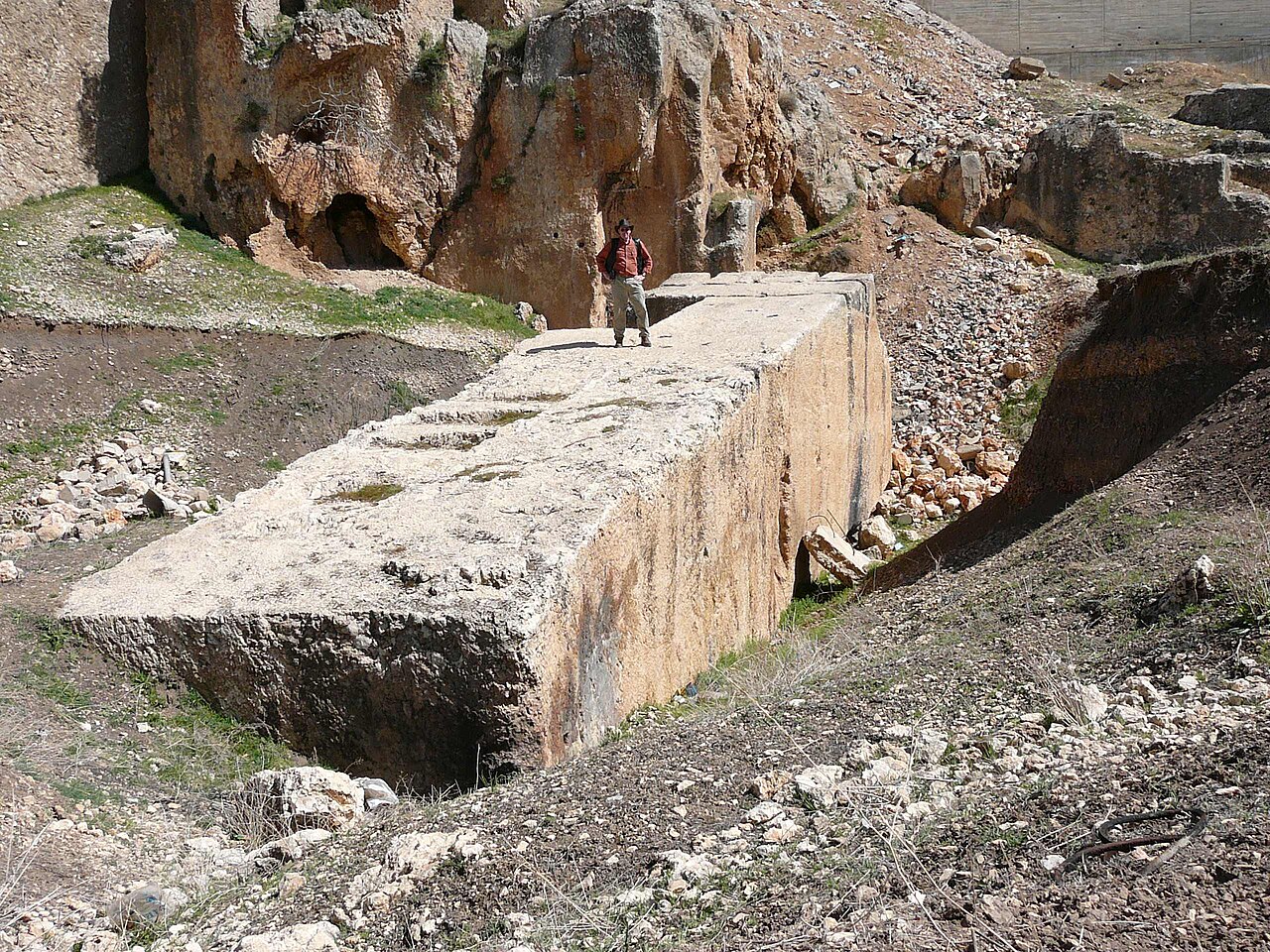
Down in the quarry lie three more, still lying where they were cut.
The Stone of the Pregnant Woman (Ḥajar al-Ḥibla) was measured in 1996 by a geodetic team from the Austrian city of Linz, who surveyed it properly and put it at about 1,000 tonnes — confirming an earlier estimate by the French archaeologist Jean-Pierre Adam. It’s about 20 metres long and still attached to the bedrock along its underside.
The Stone of the South, relocated in the 1990s, comes in around 1,242 tonnes.
And in 2014, archaeologists from the German Archaeological Institute working the quarry found a third, larger still: the Forgotten Stone, roughly 19.6 m by 6 m by at least 5.5 m, estimated at about 1,650 tonnes. The quarry itself was published by Jeanine Abdul Massih in 2015. These are the largest worked stones known from the ancient world, and the reason they’re still lying in the quarry is the least mysterious reason imaginable: they were never finished.
What’s genuinely open here
The corner block. Getting a 100-tonne architrave block up to 19 metres is a real, live engineering question, because individual Roman cranes of the period simply could not lift that much. The leading answer is that these too were rolled into place along temporary earthen banks rather than lifted — an enormous ramp of packed earth, built and then dug away again. It’s plausible, it’s consistent with what we know of Roman practice, and it is not directly attested here. So it’s a strong hypothesis, not a settled fact, and it’s fine to say so.
4. The biggest stones of all are Chinese, medieval, and were abandoned on purpose
Here’s the punchline, and it’s a good one.
The largest worked stones on Earth aren’t ancient, aren’t mysterious, and aren’t the ones anyone argues about. They’re at the Yangshan Quarry near Nanjing, they were ordered in 1405 by the Yongle Emperor, and we know exactly why they exist.
Yongle wanted a memorial stele for the mausoleum of his father, the founding Ming emperor. Chinese steles come in three pieces — a base, a body and a crowned head — so three pieces were cut, at a scale that is difficult to hold in your head:
- Stele base: 30.35 m long, 13 m thick, 16 m tall — around 16,250 tonnes.
- Stele body: 49.4 m long, 10.7 m wide, 4.4 m thick — around 8,799 tonnes.
- Stele head: 10.7 m tall, 20.3 m wide, 8.4 m thick — around 6,118 tonnes.
Assembled, the finished monument would have stood about 73 metres tall. That’s a twenty-storey building, in three pieces of rock.
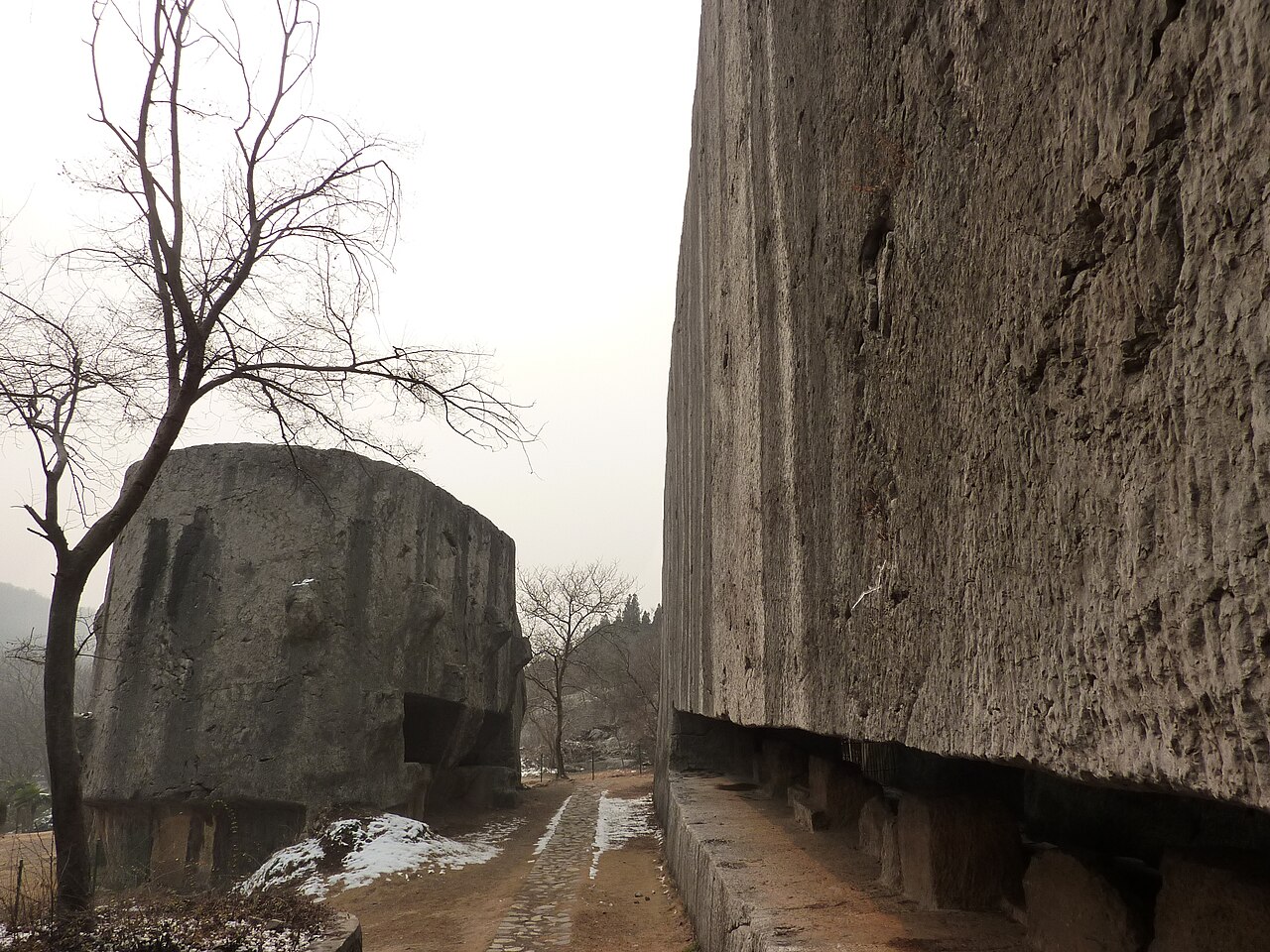
They cut all three. They very nearly finished. And then, in the words of the record, the architects worked out that moving stones that big to the mausoleum — let alone standing them up once they arrived — would not be physically possible. So the project was cancelled, and in 1413 a much smaller stele went up instead: the Shengong Shengde stele, a perfectly respectable 8.78 metres tall.
The three giants have been lying in the quarry ever since, still half-attached to the mountain, and you can walk around them today.
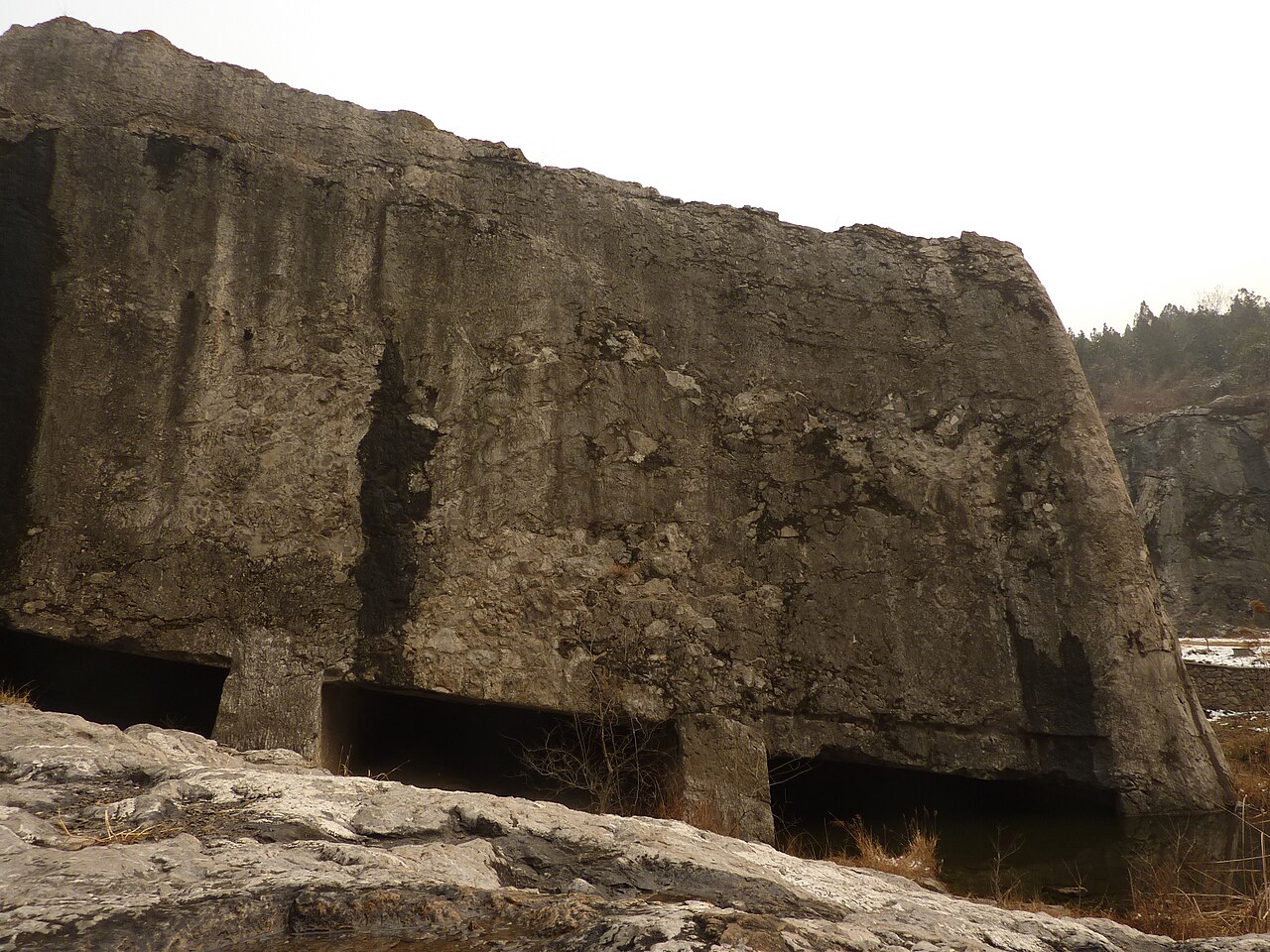
The poet Yuan Mei (1716–1797) visited and wrote a poem about the abandoned stele. Its last line is the whole story: “one hundred thousand camels could not move it.”
So the definitive record for “largest stone a human being ever shaped” belongs to a well-documented medieval Chinese building project that failed, and we know it failed because the people running it did the sums and stopped. Meanwhile the record for the largest stones anyone actually moved and placed stays with Baalbek — at a fifth of the weight.
That gap between the two records tells you something rather lovely: the limit was never imagination. Every one of these cultures could conceive of a stone far larger than it could shift. Yangshan is what happens when ambition wins the argument and physics wins the war. 🐫
Why this is on a good-news blog
Not because of the mystery. Mostly because of the honesty.
Go and look at the German Archaeological Institute’s Göbekli Tepe FAQ. It is a public document by the team that actually digs the site. In it, they revise their own founder’s most famous conclusion about the burial of the enclosures. They decline to call the buildings temples, on the grounds that the word implies more than they can demonstrate. They report that their archaeo-astronomy collaboration hasn’t found the alignments people keep asking about. They say plainly that they don’t know what the buildings were for.
And near the bottom, as question eighteen, they have included this:
18. Is it true that aliens built the Göbekli Tepe special buildings?
No.
That is the entire answer. One word, no argument, filed politely between a question about future excavation plans and a note about opening hours. 😌
We left two of the sites off the original list for this post, both because their own excavators had already settled the question that put them on lost-civilisation lists in the first place — and repeating a claim in order to knock it down still spreads it. The reasoning is written up on the ticket where it belongs.
What’s left is this: eleven and a half thousand years ago, a small group of people on a Turkish hilltop, with no farming and no metal, carved five-metre pillars out of bedrock, put foxes and vultures on them, stood them in a circle, and kept repairing them for centuries after landslides knocked them down. Fifteenth-century Andean masons cut boulders you’d need a crane for into shapes that fit their neighbours exactly, and left the handles on. Roman engineers moved two jumbo jets’ worth of limestone across a valley — and were clever enough to quarry it uphill first. And a Ming emperor’s stonemasons very nearly cut a 73-metre monument out of a mountain before somebody sensible did the arithmetic.
All of that is true, all of it is sourced, and not one line of it needs a lost civilisation to make it work.
The stones are quite enough on their own. 🪨💛
Go deeper (real links, no pop-ups, promise)
- 🗿 Göbekli Tepe Project FAQ — the German Archaeological Institute’s own answers — including question 18
- 🏛️ UNESCO World Heritage: Göbekli Tepe
- 🇱🇧 UNESCO World Heritage: Baalbek
- 📐 Jean-Pierre Adam (1977), on transporting and placing the Baalbek trilithon — in Syria, and still the reference point for the weight estimates
- 🧱 Wikipedia: the Baalbek stones — dimensions and estimates for all six, with the sources listed
- 🇵🇪 UNESCO World Heritage: City of Cuzco — which includes Sacsayhuamán
- 🐫 Wikipedia: Yangshan Quarry — the measurements, the abandonment, and Yuan Mei’s poem


