

Let’s start with the number that breaks your brain, and it isn’t the big one.
A newborn megalodon — a baby, brand new, first day on the job — was about 3.6 metres (12 feet) long. That is roughly the length of a fully grown male great white shark. Not a big one. A whole adult one. 🍼
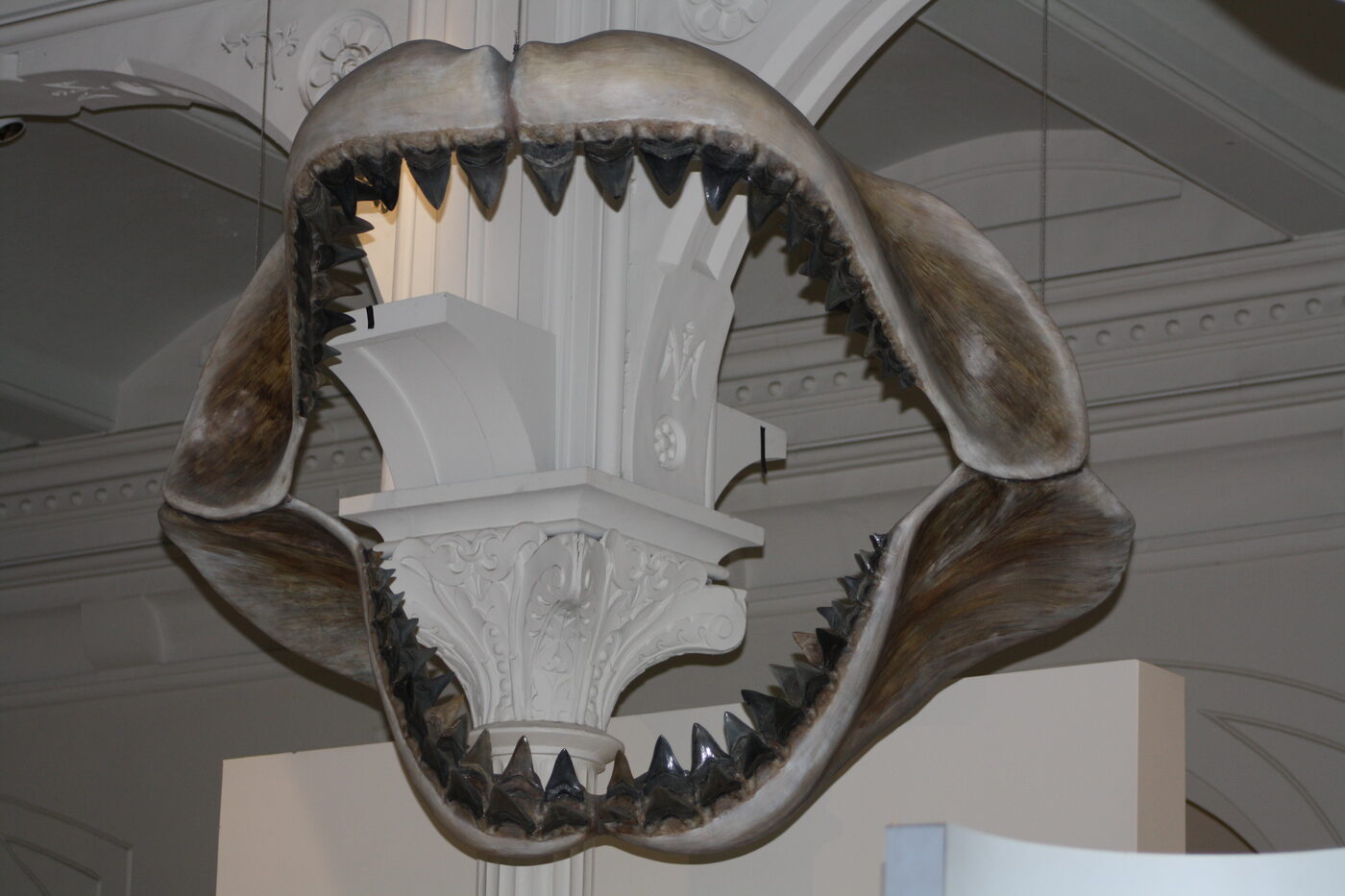
Now scale that baby up over the course of a life, and you get Otodus megalodon: the largest shark that has ever existed, cruising the Miocene oceans at a size we are still arguing about because the animal had the poor manners to be made almost entirely of cartilage, which does not fossilise.
Almost entirely. There are the teeth, which everybody has seen. And then there are the vertebrae — dense, calcified, rare, and far more useful. The biggest ones ever found came out of a clay pit in Denmark, went missing for the better part of three decades, and turned up in a box.
1978: a very good day at the clay pit
The Gram clay pit in southern Denmark was dug for brickworks, which means it was in the business of removing enormous quantities of soft grey Miocene clay and not at all in the business of palaeontology. This happens to be an excellent way to find fossils.
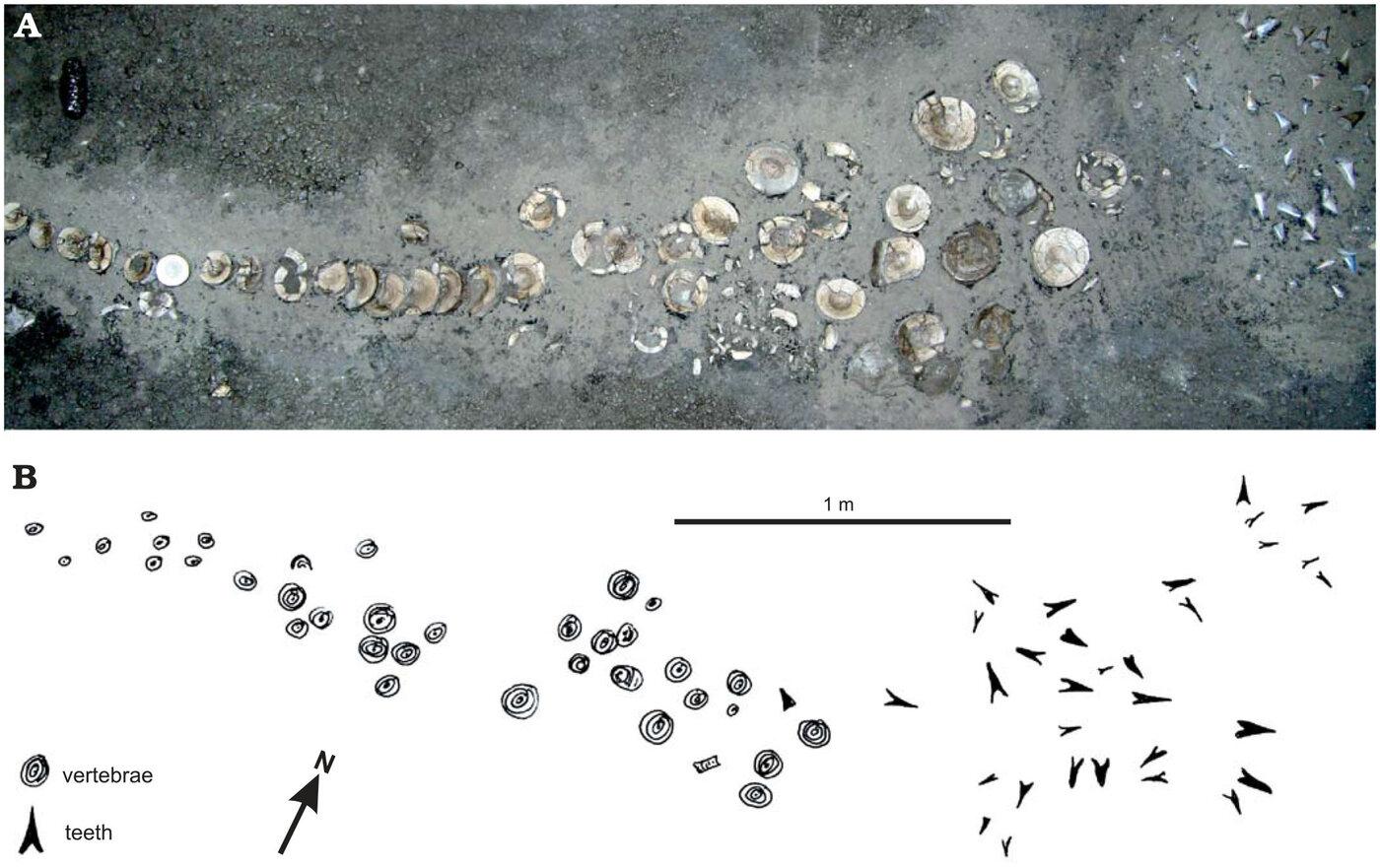
In 1978, the pit gave up an associated set of gigantic shark vertebrae — around twenty of them, from one animal, sitting about 3–4 metres above the base of the Gram Formation. The rock they came from dates to roughly 10.8 million years ago. They went to the Geological Museum in Copenhagen, were photographed, were described in print in 1982 and 1983, and one of them was recorded as measuring an implausible 23 centimetres (9 inches) across.
For context on how implausible: the biggest vertebra ever reliably measured from a living whale shark — the largest fish alive today — is about 10 cm, from a shark 10 metres long.
1989: the part where it all goes wrong
Then somebody moved the collection from one storage facility to another.
The specimen was severely damaged in the move. Broken. And with it broken and scattered, the record of the largest shark vertebrae in the world quietly collapsed into a set of old photographs and a description. Every size estimate for megalodon published in the following decades leaned on those photos — on a picture of a bone nobody could find any more.
Here is the small, unglamorous act of decency the entire story turns on: a palaeontologist named Frank Osbæck saved the fragments. He did not have a plan for them. He just did not throw them away. Somebody swept up the pieces, put them in a box, and the box went onto a shelf.
And then everyone forgot which shelf.
The largest bones of the largest shark that ever lived were not destroyed, or stolen, or sold. They were filed.
2017: somebody opens the box
Fast-forward twenty-eight years. Bent Erik Kramer Lindow, a vertebrate palaeontologist and curator at the Natural History Museum of Denmark, notices a box of jumbled remnants — and slowly realises what he is looking at.
It is not a triumphant moment with a spotlight on it. It is a man in a storeroom going hang on.
Tallying the contents took years. The final inventory: two partial vertebrae, at least 185 small vertebral fragments, and several lumps of rock carrying natural casts of vertebrae that had long since dissolved away. The best-preserved piece — the researchers call it Vertebra I — is about one third of one face of one vertebra, roughly 5 millimetres thick. A chip. A shard.
It was enough.
Because that shard preserves the centre point and three points of the rim, the radius could be measured directly: 115 mm. Assume the vertebra was round, double it, and you get 230 millimetres — 23 centimetres, exactly as reported in 1982.
The team’s lead author, palaeobiologist Kenshu Shimada, told ScienceAlert what that moment was like: “In science, reproducibility of data is critical, so when I confirmed that measurement, I literally exclaimed, ‘Yes!’”
Decades of scientific literature, resting on a photograph, suddenly resting on an actual object again. That’s a good “yes.”
Why bones beat teeth 🦴
Here is the part that makes the vertebrae worth all this fuss.
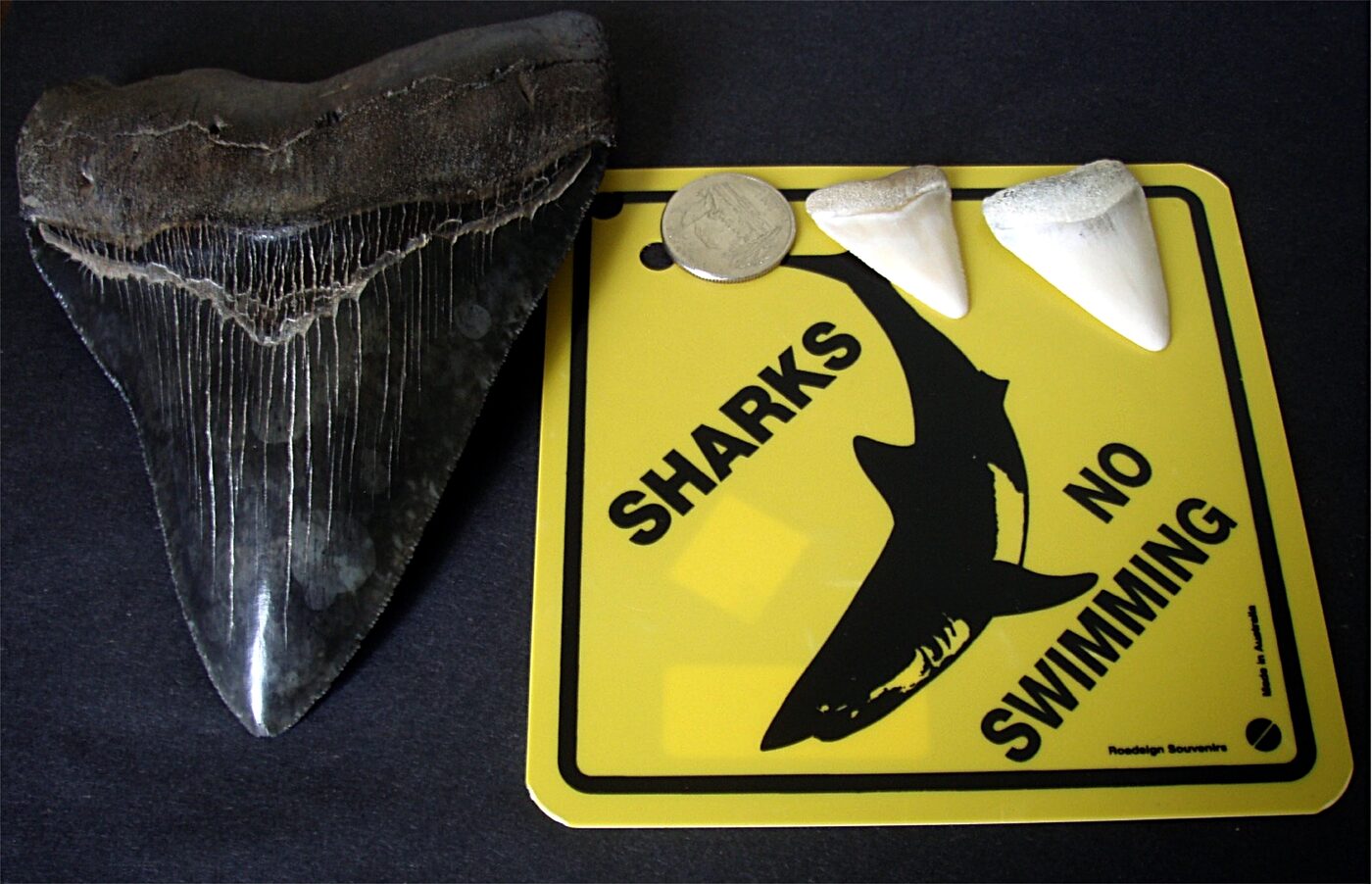
A shark tooth tells you the shark was big. That’s about it — and megalodon shed teeth constantly, the way we shed everything, so a tooth is a postcard from an animal you’ll never meet.
A vertebra keeps a diary. Shark vertebrae are built from calcified cartilage laid down in concentric bands — a groove-and-ridge pair for each cycle of growth, spreading outward from the middle like rings in a tree trunk. Count the rings, and (with care, and some caveats we’ll get to) you can count the years. Measure the spacing, and you can watch the animal grow: fast here, slower there, barely at all near the end.
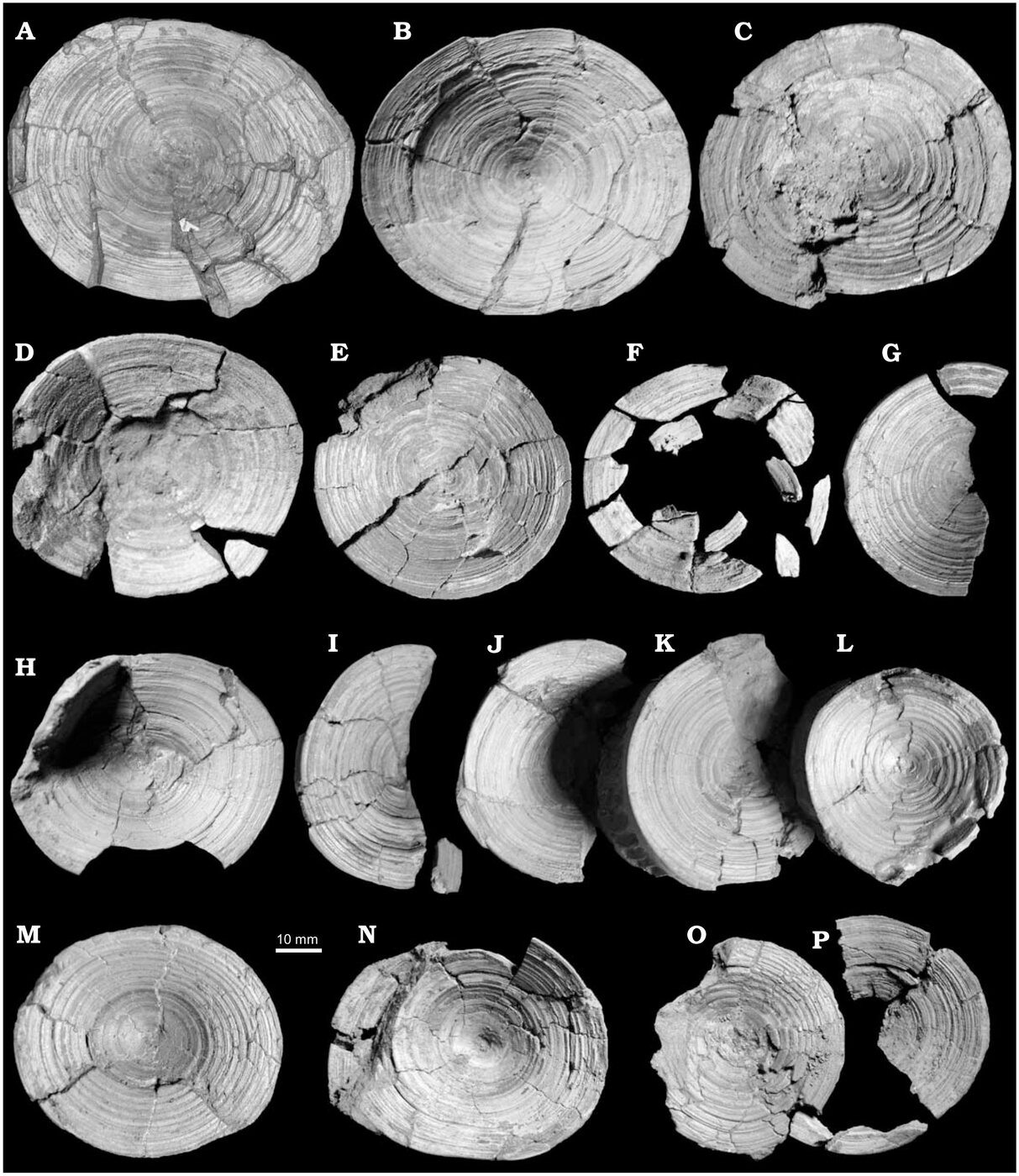
On the Danish shard, 28 outer growth bands can still be made out, some only under X-ray. And they do something rather moving: they get closer and closer together. The spacing shrinks from about 1.6 mm down to 0.4 mm across the final twelve bands.
That’s an old, old animal, still growing, but only barely — adding a hair’s breadth a year, the way an ancient tree does.
So how big, and how old?
Now for the honest arithmetic, because this is where a lot of megalodon coverage goes feral.
Working from those bands and from a better-preserved megalodon spine in Belgium, the team fitted growth curves and landed on three figures:
- Size at birth: about 3.6 m (12 ft). The number we opened with.
- Longevity: no more than about 96 years. Nearly a century of shark.
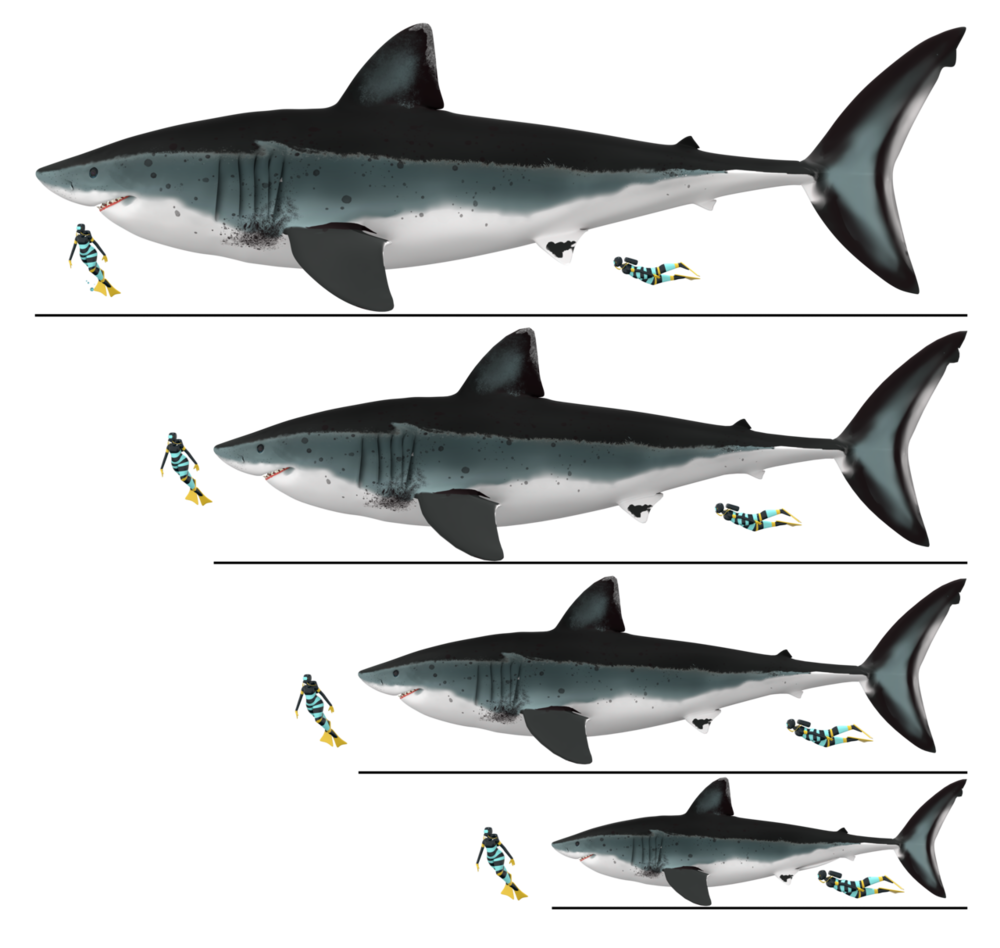
- Theoretical maximum size: no more than about 28 m (92 ft) — but the authors do not claim megalodon reached that. They explicitly recommend keeping 24.3 metres (about 80 feet) as the largest scientifically reasonable estimate for the species.
And the researchers are refreshingly upfront about the wobble in all this. The growth model, they write, “must be viewed as highly tentative.” The band counting assumes one band per year, which is true of many sharks and demonstrably not true of all of them. The whole curve comes from a single individual, and one individual is not a species.
Which is exactly why the rediscovery matters more than any of the headline numbers. The 24.3-metre estimate used to rest on a photograph of a lost object. Now it rests on an object. That is a small, boring, enormous upgrade. 🔬
A snack in the sediment
One more thing fell out of the box, and it is delightful.
The fragments came with their original sediment still clinging to them, so the team put it under a microscope. Out came gill rakers — the comb-like filters a basking shark uses to strain plankton — and 75 pieces of basking shark skin denticles, three of them still fused together in pairs.
The vertebrae themselves are definitely not a basking shark’s; the shape and proportions are wrong. So what’s a basking shark doing in the same handful of clay?
The researchers’ careful suggestion: those may be stomach contents. Ten point eight million years old, and we may be looking at what it had for lunch. 🍽️
Every museum has boxes
It is tempting to make this a story about somebody messing up. It isn’t, really.
The Natural History Museum in London holds something like 80 million objects. Multiply that by every museum on Earth and you are looking at one of the largest filing problems humans have ever created — mostly staffed by people doing their best with limited shelving. Things get shuffled during moves. Labels fade. A specimen ends up one aisle over, like a library book reshelved under the wrong letter, and vanishes into a collection the size of a small city.
Fossils have been lost to bombing raids, to shipwrecks, to fires, and to simply crumbling quietly in a drawer. Against that, “it broke, someone kept the pieces, and a curator recognised them 28 years later” is a fantastic outcome. 💛
Why this is on a good-news blog
Because the shelf is not the end of the story. 🦈
Somebody in 1989 stood over a broken specimen, decided the fragments were worth keeping even though they looked like gravel, and boxed them up. Somebody in 2017 walked past that box, stopped, and looked properly. Somebody after that spent patient months trying to fit 185 pieces back together. And the result is that the largest bone the ocean has ever produced is back in the scientific record, with the age of the animal, the size of its babies and possibly its final meal thrown in.
Nothing about this required a new expedition, a new dig, or a single euro of new field funding. It required a cardboard box, and attention.
There are more boxes. There are always more boxes. 📦
Go deeper (real links, no pop-ups, promise)
- 🦈 The paper itself: Shimada et al., Palaeontologia Electronica, 2026 — open access, and the photographs of the actual Danish fossil are in there. Go and look at the real thing.
- 📰 The Conversation: Megalodon’s legendary life revealed by fossil rediscovery — written by researchers, with a superb detour into all the other ways museums mislay things.
- 🔍 ScienceAlert’s write-up — where that “I literally exclaimed, ‘Yes!’” quote comes from.
- 💾 The CT scans, on MorphoSource — the team put full-resolution micro-CT data of both vertebrae online. Somebody’s 36-gigabyte scan of a shard of shark is sitting there for anyone who wants it.


