

On a Sunday morning in September 2023, in a stretch of Utah scrub belonging to the Department of Defense, a scorched black cone about the size of a patio table came down under a parachute, bounced gently once on the salt flat, and sat there in the sagebrush looking like the world’s most serious picnic cooler.
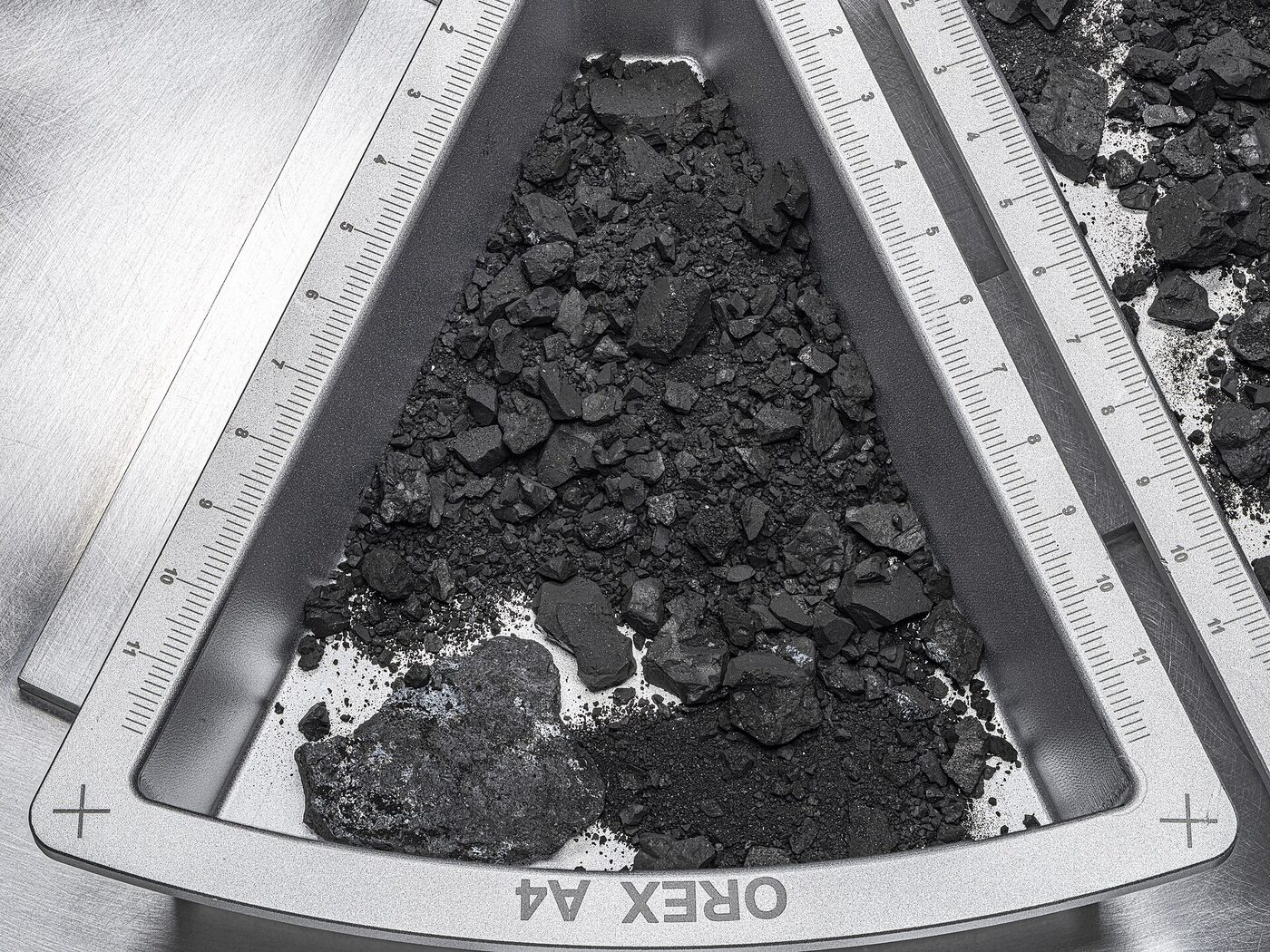
Inside it: 121.6 grams of asteroid. About four ounces. A double handful of black gravel that had never touched Earth, never touched air, never been warmed by anything but the Sun, and had been sitting undisturbed since before there were planets. ☄️
Somebody went and got that. On purpose. It took seven years.
The mission with the extremely NASA name
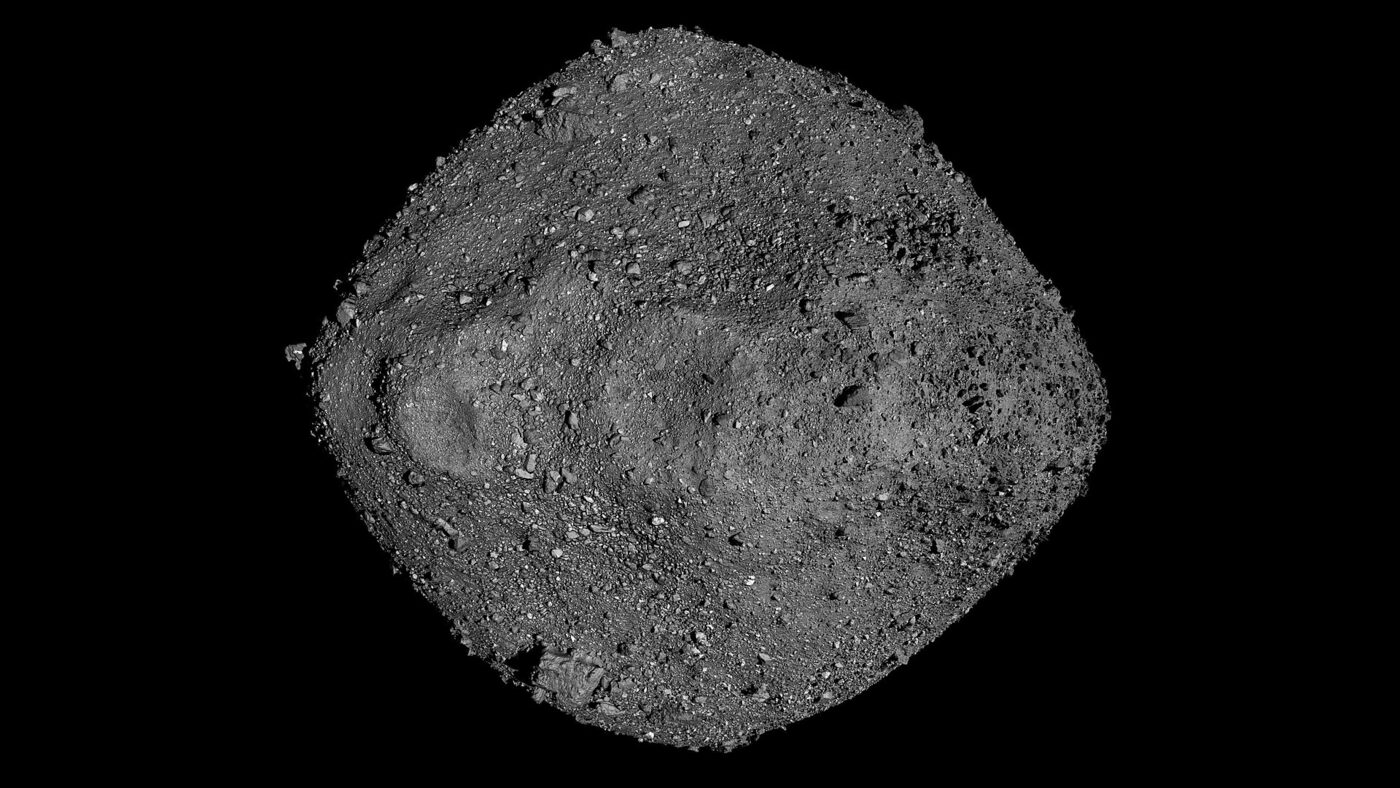
OSIRIS-REx stands for Origins, Spectral Interpretation, Resource Identification, and Security — Regolith Explorer, which is an acronym so hard-won you can practically hear the whiteboard squeaking. It launched on 8 September 2016 on an Atlas V, swung past Earth a year later for a gravity assist, and arrived at asteroid Bennu on 3 December 2018.
Bennu is small. About 500 metres across — you could walk its circumference in twenty minutes if walking were a thing you could do there. Its gravity is so weak that the spacecraft orbiting it set a record just by managing to stay in orbit at all. Nudge a pebble too hard on Bennu and you’d lose it to the solar system forever.
And it had a name because of a kid. In 2013 NASA ran a “Name That Asteroid!” contest, and a nine-year-old third-grader from North Carolina called Michael Puzio looked at the spacecraft’s long sampling arm and outstretched solar panels, decided it looked like a bird, and suggested Bennu — the heron-shaped Egyptian deity associated with creation and rebirth. Which, for a rock that turned out to be carrying the chemical ingredients of life, is an uncannily good call from a third-grader. 🪶
Plan A did not survive contact with Bennu
The mission was designed around an assumption: that Bennu would have beaches. Big smooth ponds of fine sand, tens of metres wide, where a spacecraft could set down its sampler and hoover up a scoop without drama.
Bennu had no beaches. When the first close-up images arrived, Bennu turned out to be wall-to-wall boulders — a 500-metre pile of rubble with barely a clear patch anywhere on it. The team had built a machine to land on a parking lot and arrived to find a quarry.
So they spent nearly two years mapping every rock on the entire asteroid, at a resolution nobody had ever needed before, hunting for somewhere — anywhere — to touch down. They found four candidate sites, named them after birds (Nightingale, Kingfisher, Osprey, Sandpiper), and chose Nightingale: a crater near Bennu’s north pole with a patch of clear ground about the size of a few parking spaces, ringed by a boulder the team nicknamed Mount Doom.
Then they told a spacecraft 200 million miles away — far enough that a radio message took about 18 minutes to arrive, and another 18 to hear back — to go and put itself in that spot, alone, unsupervised, in real time.
It touched down within 92 centimetres of the target. Three feet. From two hundred million miles. 🎯
The six-second high-five
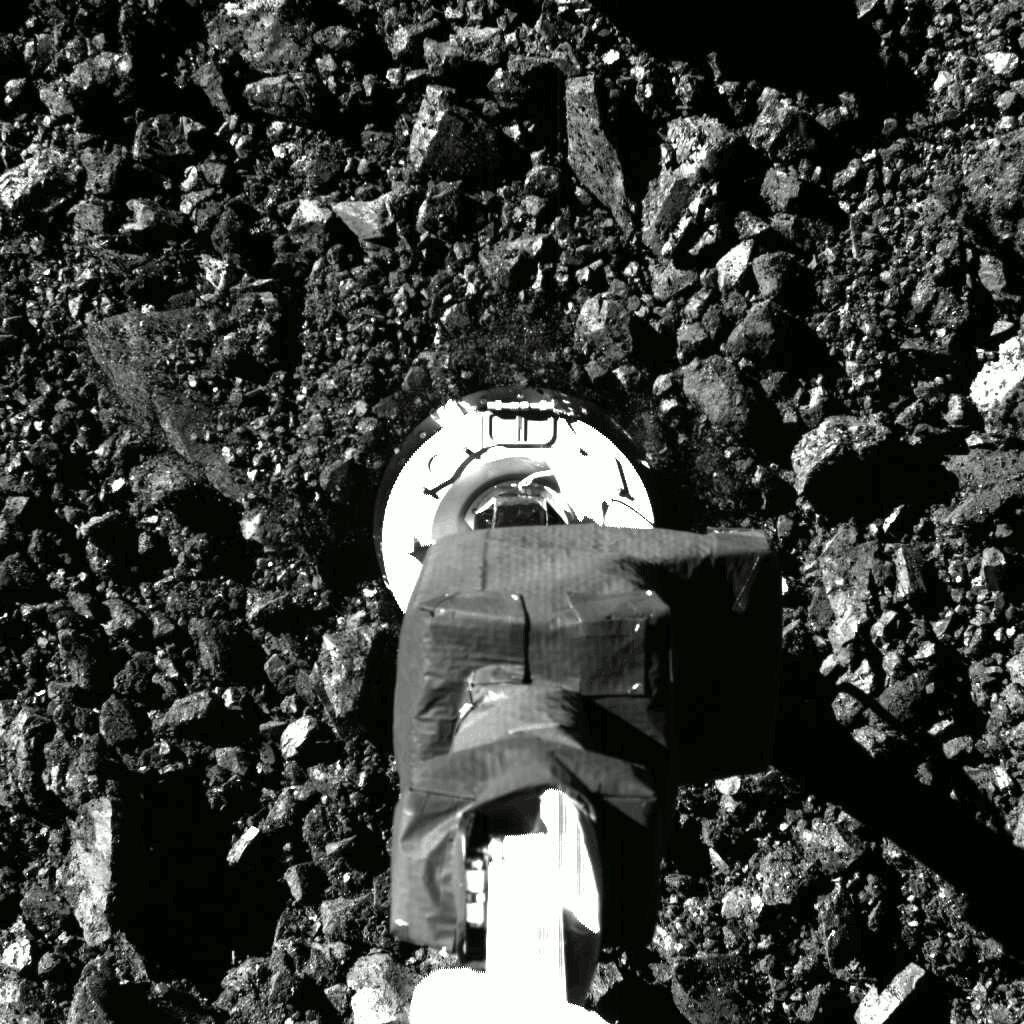
The technique was called TAG — Touch-And-Go — and it is exactly as cheeky as it sounds. The spacecraft never landed. It reached out with a 3.35-metre arm, pressed a round sampler head against the surface, fired a bottle of nitrogen gas into the ground to blow loose gravel up into the collector, and immediately backed away.
Total contact time: about six seconds.
And here is where Bennu had one more surprise. The surface was not solid. The sampler head sank straight in, about half a metre, and later analysis showed the spacecraft would have kept sinking if it hadn’t fired its thrusters to leave. NASA’s own description of the result is one of my favourite sentences ever published by a space agency: touching Bennu was like touching down in a pit of plastic balls. 🫧
The asteroid is barely holding itself together. It’s a loose bag of rocks in a very tenuous conversation with gravity.
Meanwhile, the six-second high-five had gone too well. The images of the sampler head showed rocks wedged in the mylar flap that was supposed to keep the sample in — the collector was so overstuffed that the door wouldn’t shut, and precious asteroid grains were drifting away into space in front of the camera.
There was a plan for this. The plan was to spin the spacecraft to weigh the sample and confirm they had enough. The team looked at their leaking, overflowing sampler, cancelled the weighing manoeuvre entirely — we clearly have plenty, stop wobbling it — and moved the stowage up by more than a week. On 28 October 2020, the sample was sealed inside the return capsule and the lid was latched. 🪨
Four billion miles later, an appointment in the desert
OSIRIS-REx took a farewell lap around Bennu in April 2021, departed on 10 May 2021, and spent two more years flying home.
On the morning of 24 September 2023, from 63,000 miles out — a quarter of the way to the Moon — it released the capsule and then immediately steered away from Earth, because the spacecraft itself was never coming home.
The capsule hit the atmosphere at 27,650 mph. Its drogue parachute didn’t deploy when it was meant to (a wiring fault, found later). The main chute came out at around 9,000 feet instead, at higher speed than it was designed for, and held anyway. At 8:52 a.m. Mountain Time the capsule touched down on the Utah Test and Training Range at about 11 mph — jogging pace — a minute earlier than predicted, on target, upright, intact.
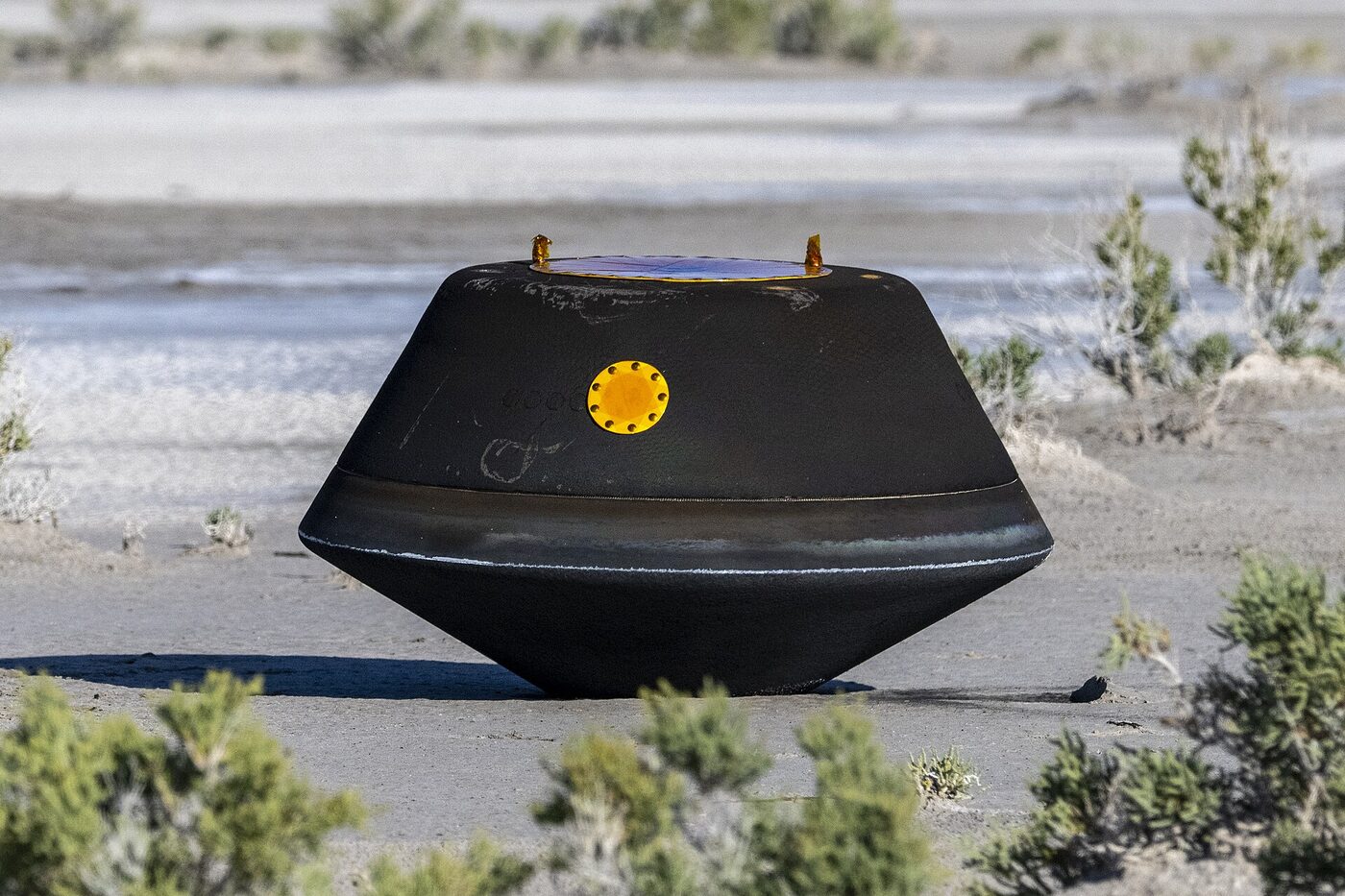
A helicopter lifted it to a clean room hangar the same morning. Nobody opened it in the field. It had been sealed for three years; it could wait a few more hours.
The stuck lid, and the best kind of problem
The first look was already a surprise: there was black dust and rock all over the outside of the sampler head, spilled during stowage. Just the material collected from outside the collector came to 70.3 grams — already past the mission’s 60-gram requirement, before anyone had opened the actual container. 😄
Then the container jammed. Two of the thirty-five fasteners on the sampler head refused to budge, and the curation team could not simply reach for a bigger wrench — every tool that touches the sample has to be non-contaminating, non-magnetic, made of approved materials, and small enough to work through the glovebox. So they designed and built new tools, out of surgical-grade stainless steel, and tested them until they were sure, and only then went back in. It took until January 2024.
Final measured mass, announced on 15 February 2024: 121.6 grams. Slightly more than double what the mission had committed to bring back. ⚖️
What was in it 💛
This is the part the whole seven years was for.
The Bennu grains are soaked in the past. They contain clay minerals that only form in the presence of liquid water, meaning Bennu’s parent body once had water sloshing through it. They contain salts — the kind left behind when briny water evaporates, the mineral residue of a vanished puddle billions of years old.
And they contain carbon chemistry that is startlingly close to home. Researchers have found 14 of the 20 amino acids life on Earth uses to build proteins. They found all five nucleobases — the letters A, G, C, T and U that spell out DNA and RNA. Since then the sample has kept giving: sugars, an unusual gum-like organic material never seen before in space rocks, and an unexpectedly high abundance of stardust from ancient supernovae, older than the Sun.
None of this means Bennu was alive. It means the ingredient list was already written, and lying around in the rubble of the early solar system, long before Earth had oceans to put it in. The building blocks were common. They were everywhere. They were falling on us the whole time.
The bit that gets me
Most of the sample isn’t being used.
At least 70% of it is being sealed up and stored, deliberately untouched, at Johnson Space Center — held back for scientists who are currently in primary school, or who haven’t been born. Portions went to Canada and Japan under the partnership agreements. But the majority of the asteroid is simply being kept, for instruments that don’t exist yet, to answer questions nobody has thought to ask.
That’s the part I keep turning over. A whole civilisation’s worth of engineering — a rocket, seven years, a boulder-mapping campaign, a robot arm, a nitrogen bottle, a heat shield, a parachute, a custom-forged wrench — and the plan was always to hand most of the prize forward to strangers in the future.
And the spacecraft? It’s still flying. It dropped the capsule, changed its name to OSIRIS-APEX, and set course for asteroid Apophis, which makes a famously close pass by Earth in April 2029. It’ll be waiting there to see what a near-miss with a planet does to a rock.
It went to an asteroid. It tapped it on the shoulder for six seconds. It came back, dropped off a jar of the early universe in the Utah desert, waved, and kept going. ☄️💛
Go deeper (real links, no pop-ups, promise)
- ☄️ NASA: OSIRIS-REx mission
- 🪨 NASA: the Bennu sample reveals a mix of life’s ingredients
- 🍬 NASA: sugars, ‘gum’ and stardust found in the Bennu samples
- 🫧 NASA: surprise again — Bennu’s surface is like a plastic ball pit
- ⚖️ NASA: announcing the OSIRIS-REx bulk sample mass (121.6 g)
- 🛰️ NASA: OSIRIS-APEX, on to Apophis


