

Late on Thursday 27 August (early Friday the 28th in UTC), the full Moon walks into the shadow Earth is always casting, and very nearly vanishes. Not quite, though — and the “not quite” is the whole point. 🌘
🌘 What’s happening, and why 0.930 is the interesting number
Earth’s shadow has two parts. The penumbra is the outer, half-lit part — the Moon passing through it just looks slightly grubby, and plenty of people don’t notice at all. The umbra is the real shadow, the one where Earth blocks the Sun completely, and that’s the one that takes visible bites.
How deep the Moon goes into the umbra is a single number: the umbral magnitude. Over 1.0 and the Moon is completely swallowed — that’s a total eclipse. Under 0.0 and it never reaches the umbra at all — that’s a penumbral eclipse, and it’s the astronomical equivalent of a shrug.
On 28 August the umbral magnitude is 0.9299 — call it 0.930.
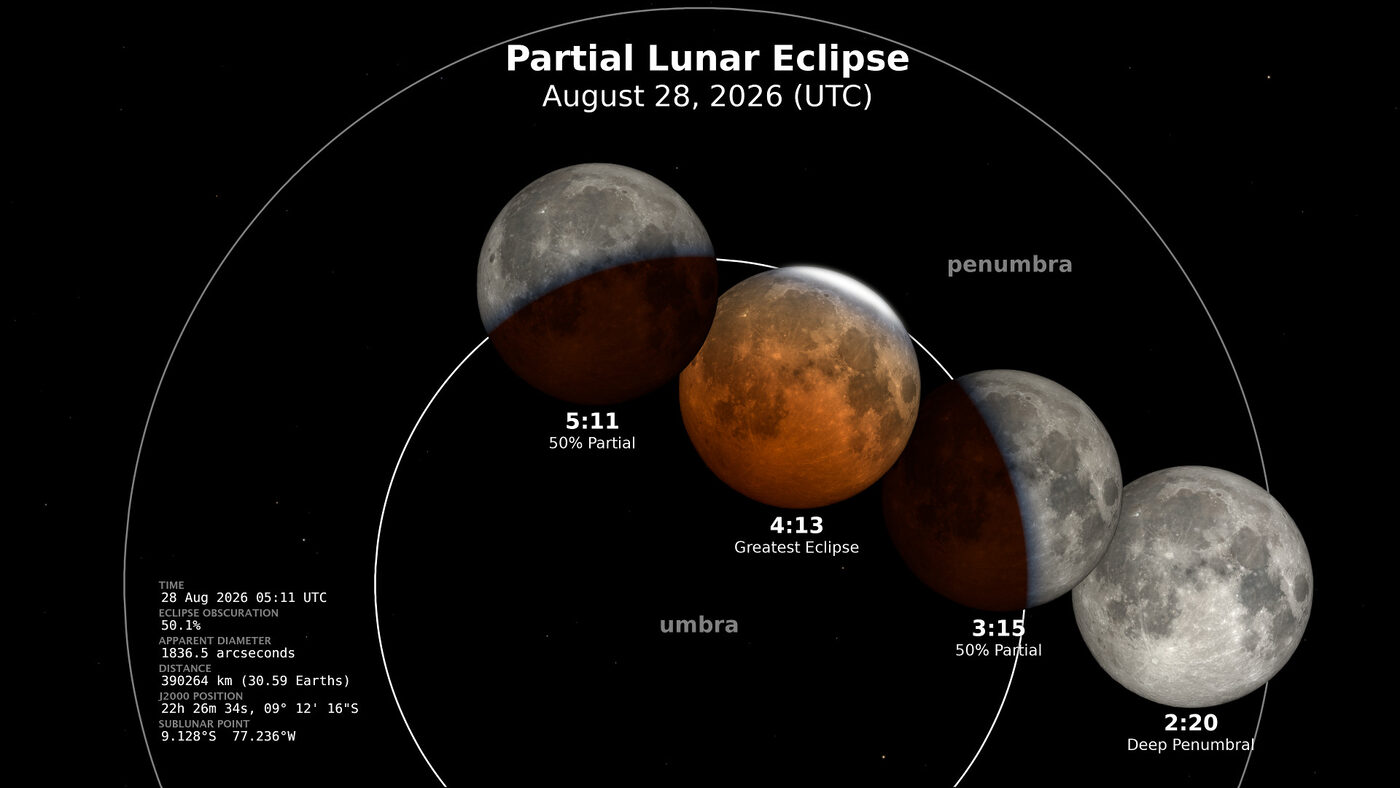
NASA’s own footnote is precise about what that measures: it’s the fraction of the Moon’s diameter covered by the umbra at maximum, not the fraction of the disc. Measured by area, NASA’s Scientific Visualization Studio puts the obscuration at maximum at 96.3%.
So: ninety-three percent of the way across, ninety-six percent of the disc, and then it stops. The remaining sliver sits along the Moon’s northern limb — the geometry parameter astronomers call gamma is +0.4964, meaning the Moon passes north of the centre of the shadow, so it’s the north edge that never quite gets in.
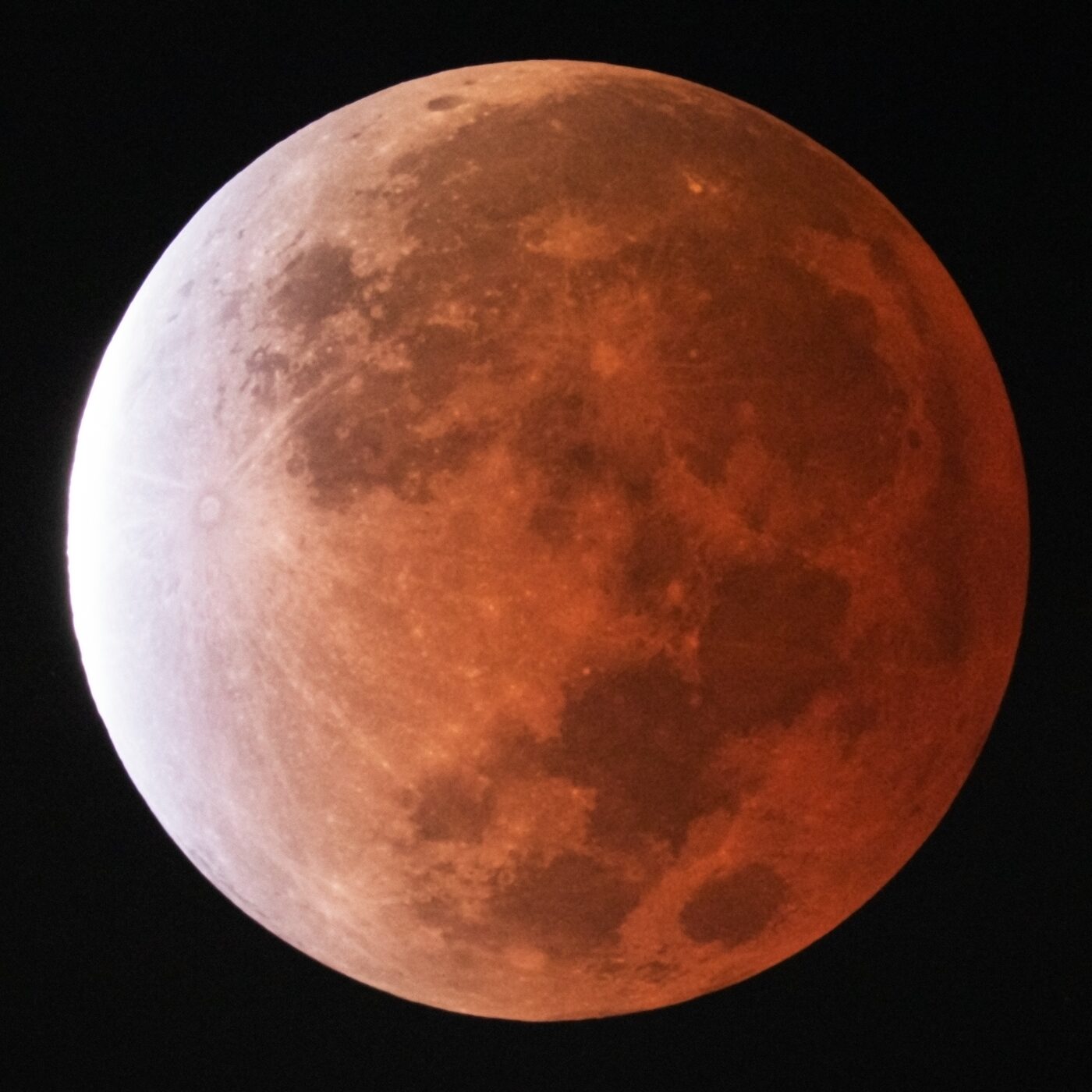
That leaves a genuinely strange-looking Moon for the best part of an hour: a big dark-red disc with one impossibly bright white rind along the top, so bright that it wrecks your night vision and makes the red half look darker than it is. Photographers hate it. Everyone else finds it wonderful.
⏱️ When — the five contact times
Lunar eclipses are quoted as five moments, and unlike a solar eclipse they happen at the same instant for everybody. There are no local circumstances to look up. If the Moon is above your horizon, you see it happen when it happens.
From F. Espenak’s NASA/GSFC eclipse plot for this eclipse, all five in Universal Time on 28 August 2026:
- P1 — penumbra first touches the Moon — 01:23:55 UT
- U1 — the umbra takes the first real bite — 02:33:48 UT
- Greatest eclipse — 04:12:49 UT
- U4 — the last of the umbra leaves — 05:51:55 UT
- P4 — the penumbra lets go — 07:01:41 UT
That’s 3 h 18 m 07 s of partial (umbral) eclipse, inside 5 h 37 m 46 s of penumbral eclipse.
An aside for the pedantic, and we mean that warmly. NASA’s decade summary table lists greatest eclipse at 04:14:04, which is 75 seconds later than the figure above. Both are right. The table’s column is TD — Terrestrial Dynamical Time, a smooth clock astronomers use so their equations don’t have to care about the Earth’s wobbly rotation. Civil clocks run on UT, and the gap between them, ΔT, is 75 seconds for 2026. Espenak prints both on the plot:
04:14:04.4 TD ( = 04:12:49.0 UT ). If you ever find two NASA pages disagreeing by about a minute on an eclipse, this is almost always why.
And the same five moments on some ordinary clocks. Nearly all of the Americas gets this as a Thursday evening event, which is a rare piece of scheduling luck.
- Pacific (PDT, UTC−7) — penumbra 6:23 p.m. Thu · umbra 7:33 p.m. · greatest 9:12 p.m. · umbra ends 10:51 p.m. · penumbra ends 12:01 a.m. Fri
- Mountain (MDT, UTC−6) — penumbra 7:23 p.m. Thu · umbra 8:33 p.m. · greatest 10:12 p.m. · umbra ends 11:51 p.m. · penumbra ends 1:01 a.m. Fri
- Central (CDT, UTC−5) — penumbra 8:23 p.m. Thu · umbra 9:33 p.m. · greatest 11:12 p.m. · umbra ends 12:51 a.m. Fri · penumbra ends 2:01 a.m.
- Eastern (EDT, UTC−4) — penumbra 9:23 p.m. Thu · umbra 10:33 p.m. · greatest 12:12 a.m. Fri · umbra ends 1:51 a.m. · penumbra ends 3:01 a.m.
- Brazil (BRT, UTC−3) — penumbra 10:23 p.m. Thu · umbra 11:33 p.m. · greatest 1:12 a.m. Fri · umbra ends 2:51 a.m. · penumbra ends 4:01 a.m.
- Britain and West Africa (UTC+1) — penumbra 2:23 a.m. Fri · umbra 3:33 a.m. · greatest 5:12 a.m. · umbra ends 6:51 a.m. · penumbra ends 8:01 a.m.
- Central Europe (CEST, UTC+2) — penumbra 3:23 a.m. Fri · umbra 4:33 a.m. · greatest 6:12 a.m. · umbra ends 7:51 a.m. · penumbra ends 9:01 a.m.
The seconds are in the UT list above if you want them; the local lists are rounded down to the minute, because nobody has ever needed to know that the umbra arrived at 48 seconds past.
If you’d rather not count on your fingers at all, our eclipse desk renders every one of these rows in your own browser’s clock, and counts down to the next one.
🗺️ Where — and who misses it
Everyone on the night side of Earth when it happens. That’s the whole rule. Nothing about a lunar eclipse depends on standing in the right stripe.
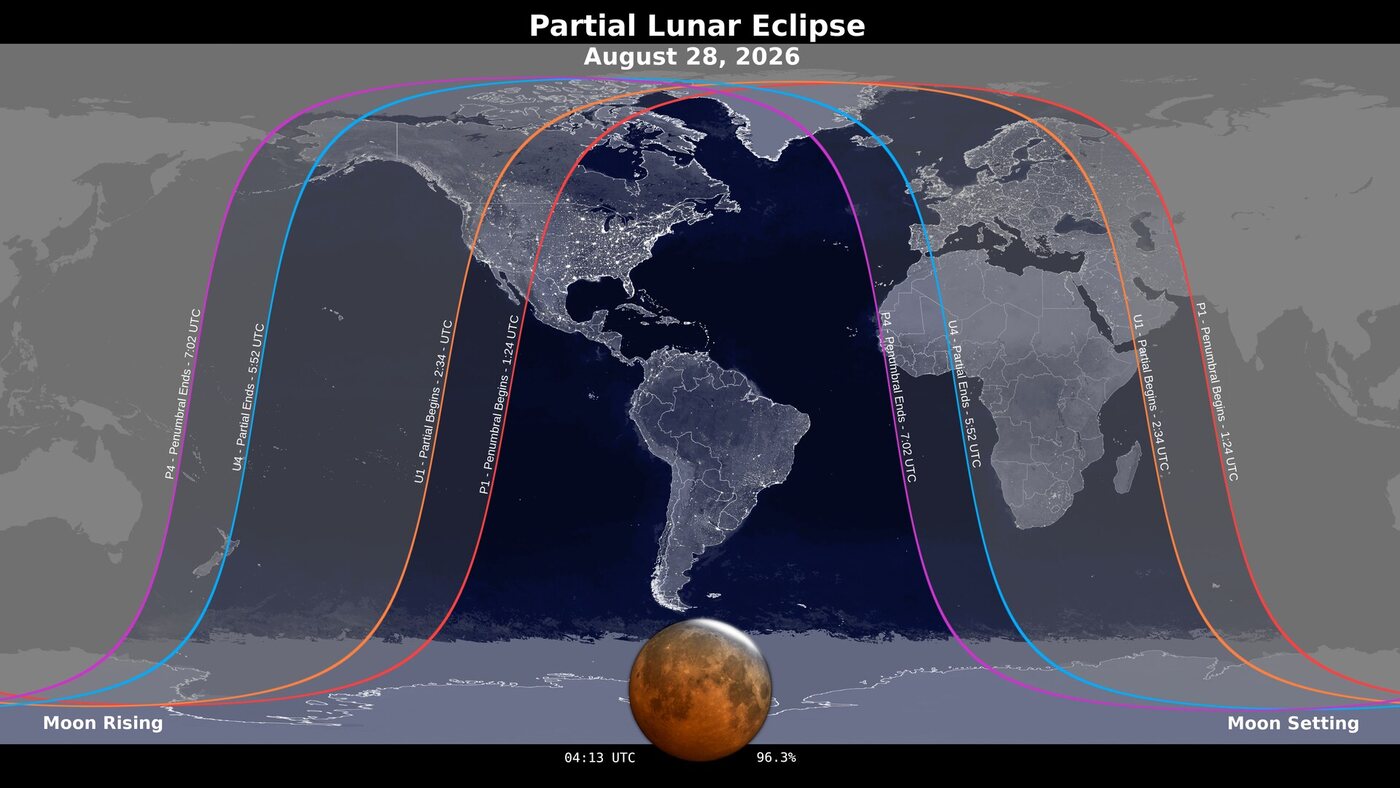
Reading NASA’s visibility map for this eclipse:
- East of a line down the middle of North America: the whole thing, start to finish. The P1 contour runs through central Canada, the Great Plains and central Mexico. Everywhere east of it — the eastern US and Canada, the Caribbean, and every bit of South America — has the Moon already up when the penumbra arrives, and still up when it lets go.
- West of that line, the Moon rises into it. The U1 contour follows the Pacific coast almost exactly, so out on the West Coast moonrise and the umbra’s first bite happen at more or less the same moment, low in the east. That is the single part of this eclipse that rewards planning: check your local moonrise and stand somewhere with a clear eastern horizon.
- Hawaii and the central Pacific catch the back half. They sit between the U1 and U4 contours, so the Moon comes up with the bite already taken out of it and the partial phase ends not long after.
- Europe, Africa and the Middle East lose it at moonset. The Moon sets during the eclipse, with the west getting more of it than the east. Britain and Ireland are watching a setting Moon go dark in a brightening pre-dawn sky, which is a lovely thing to see and a poor thing to photograph.
- Asia, Australia and the far western Pacific get nothing. It’s daytime, the Moon is below the horizon, and there is no consolation prize. Sorry.
👀 How to watch it
Go outside. Look up. That’s the entire method.
There is no safety section in this post, and that’s worth stating plainly, because the last one we wrote was almost entirely safety section. A lunar eclipse is just the full Moon with the lights turned down — the same Moon you glance at on the way to the car, only dimmer. There is nothing to filter, nothing to project onto a card, nothing to stack in front of a lens. Stare at it for three hours if you like.
A few things that genuinely help:
- Give your eyes fifteen minutes away from screens and porch lights before maximum. The difference between “the Moon looks a bit odd” and “the Moon is bleeding” is mostly your own dark adaptation.
- Binoculars are the single best upgrade and are entirely optional. Any pair will do. What they add is the umbra’s edge — during the partial phases it is visibly a curved, soft-sided shadow crawling over craters, and that’s when the whole thing stops being an image and starts being a solid object.
- You do not need a clear sky the whole time. This runs for hours. A gap in the cloud at almost any point in it gets you something.
- Your phone will disappoint you and that’s fine. It will meter for the bright rind and turn the red half black. Look with your eyes; let NASA’s cameras do the archiving.
- Watch for the colour to change during the event. It’s usually a duller brown-grey near the umbra’s edge and deeper red toward the middle, so as the Moon moves across, the shade shifts.
🌅 Why it goes red
The short version: the Moon isn’t in total darkness because Earth’s atmosphere is in the way, and the atmosphere doesn’t block light so much as bend and filter it.
Sunlight grazing the edge of Earth gets scattered on the way through. Blue scatters most — that’s why the sky is blue and why sunsets go orange — so what makes it all the way through the air and out the other side is the red end of the spectrum, bent inwards into the shadow and falling on the Moon.
Which means the red light on the eclipsed Moon is, quite literally, every sunrise and sunset happening on Earth at that moment, projected onto a rock a third of a million kilometres away. If you were standing on the Moon looking back, you’d see a black Earth ringed by a thin, brilliant band of every dawn and dusk in the world at once.
On the 28th, the ninety-three percent of the Moon inside the umbra gets that light. The other seven percent is still getting the ordinary Sun. That’s the whole picture: one small object, lit two different ways at the same time.
🔁 One line for the saros people
Eclipses come in families. A saros is a period of about 18 years and 11 days, after which the Sun, Earth and Moon come back to nearly the same geometry and do the whole thing again, a little further along.
This one is the 29th eclipse of saros series 138, a series that opened with a barely-there penumbral eclipse on 15 October 1521 and closes with another one on 30 March 2982. Each member goes a bit deeper into the shadow than the last, and you can watch the series arriving: 16 August 2008 managed umbral magnitude 0.8076, this one gets to 0.9299 — and NASA’s catalogue notes that this is the largest partial lunar eclipse the entire series will ever produce, because the next one along, on 7 September 2044, finally tips over into total. First total in five centuries of trying.
So the sliver that stays lit on Thursday is the series’ last near-miss. That’s a strangely nice thing to be standing under.
⏳ When the next one is
Not soon, if you’re being fussy about it.
- 20 February 2027 — penumbral, umbral magnitude −0.057. Which is to say: the Moon misses the real shadow entirely, and unless you’re photographing it carefully you will not be able to tell anything happened.
- 18 July 2027 and 17 August 2027 — also penumbral, also basically invisible.
- 12 January 2028 — partial, but with an umbral magnitude of 0.066. A nick out of the edge, gone in 56 minutes.
- 31 December 2028 — the next total lunar eclipse, 1 h 11 m of totality, over Europe, Africa, Asia, Australia and the Pacific. A New Year’s Eve blood Moon, which is showing off, frankly.
- 26 June 2029 — the next total one for the Americas, and a big one: umbral magnitude 1.844, 1 h 42 m of totality.
So Thursday’s near-miss is the best lunar eclipse most of the western hemisphere will get for about three years, and it costs nothing but going outside.
Every date here comes from the NASA Goddard eclipse catalogue (Espenak & Meeus), the same table that drives our own eclipse desk — where this one has a countdown running in your local time right now.
Clear skies. 🌘


