

In 1927, a physics professor at The University of Queensland decided to settle an argument with a funnel.
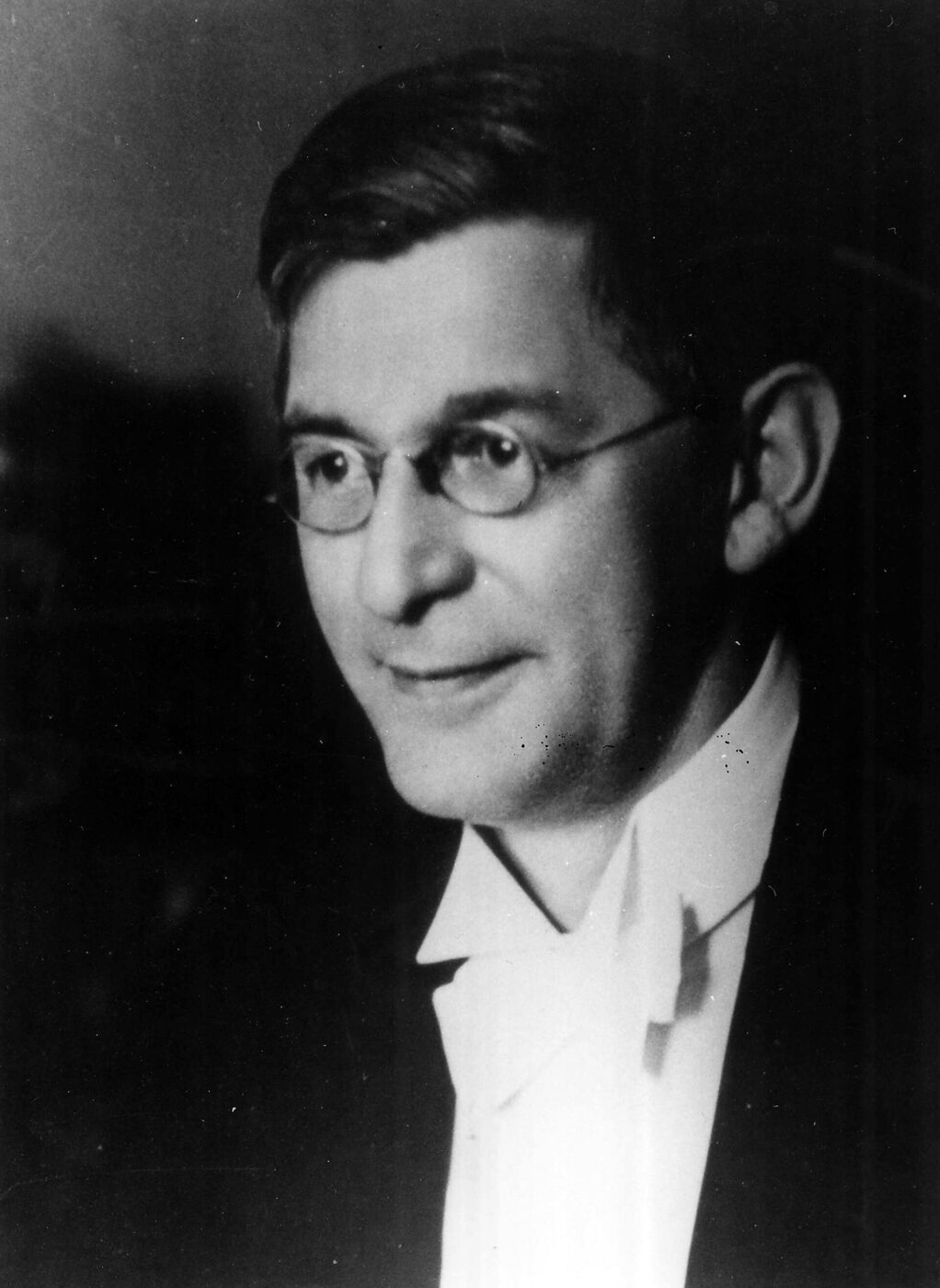
His name was Thomas Parnell, and he was UQ’s first Professor of Physics. The point he wanted to make to his students was a small one, and a strange one: that some things which look and feel completely solid are, in fact, liquids — just extremely reluctant ones.
So he took a lump of pitch — the black tar-derived stuff that used to be used for waterproofing boats — heated it until it flowed, and poured it into a glass funnel with the bottom of the stem sealed shut. Then he let it cool and settle for three years.
In 1930 he cut the stem open. 🕰️
And then everybody waited.
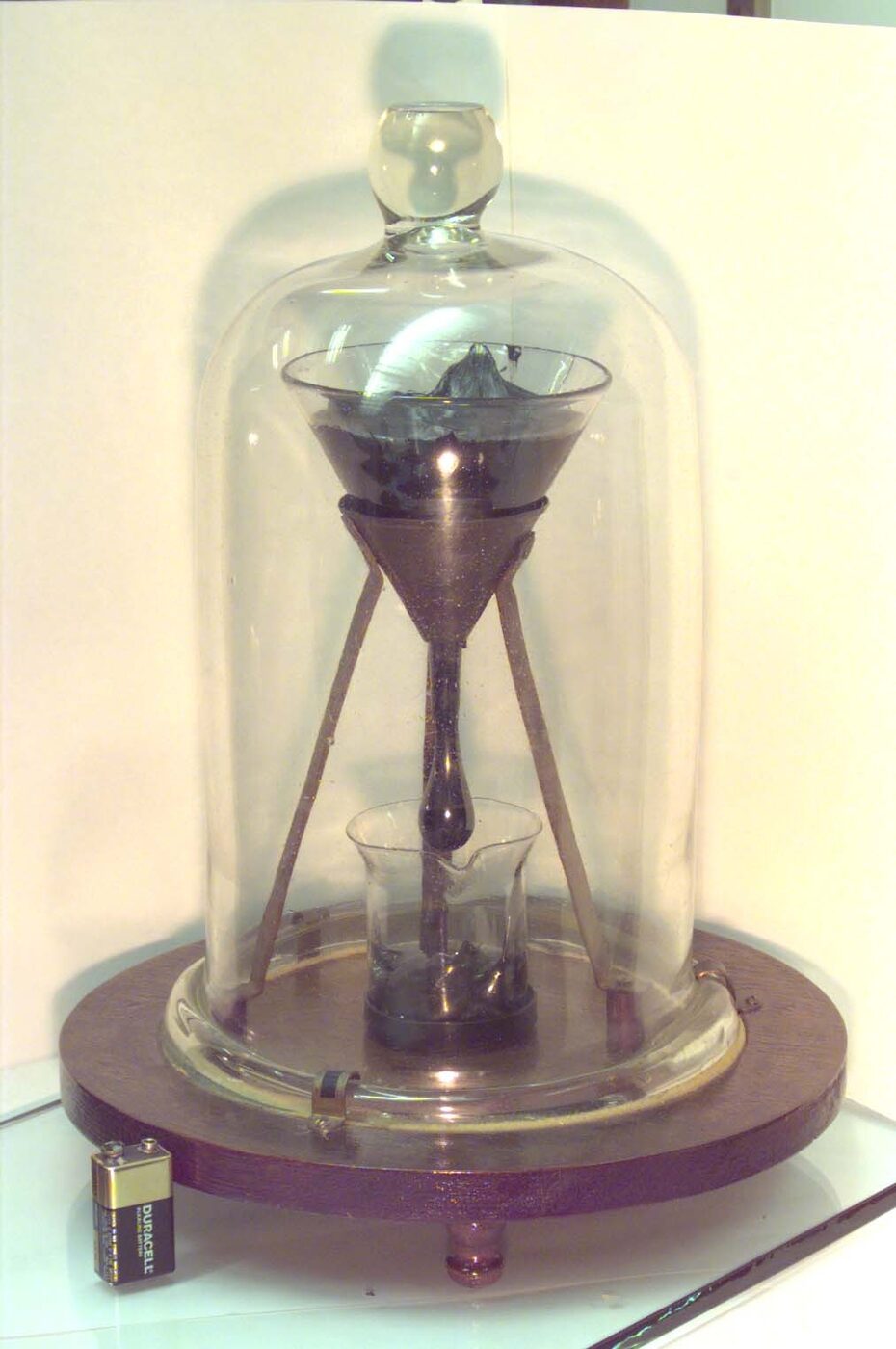
Ninety-nine years. Nine drops.
That’s the whole scoreboard. Nine.
Here is the entire history of this experiment, in full, with nothing left out:
The first drop took eight years to fall. The next five took seven to nine years apiece. Then things got slower and stranger, which we’ll come back to.
Guinness World Records has it down as the longest-running laboratory experiment in the world, and it isn’t close. It started dripping before penicillin was a medicine, before the transistor, before anything had been to space, and before anyone had drawn a picture of DNA. It has been dripping, without pause, the whole time.
It is still dripping now. The tenth drop is hanging there as you read this. 🖤
What “100 billion times thicker than water” actually means
No equations, promise. Here’s the whole idea.
Viscosity is just a measure of how much a liquid hates being made to move. Water has almost none — tip a glass and it’s gone. Honey has a few thousand times more, which is why it takes its time coming off the spoon. Golden syrup, more still.
Pitch is about a hundred billion times more viscous than water.
That number is so large it stops being a number and becomes a category. Pitch does not pour, it does not run, it does not drip in any sense your eye can detect. Sitting in a display case at room temperature, it looks like a lump of coal. It is cold and hard to the touch. If you hit it with a hammer, it shatters — into sharp black pieces, like glass or toffee.
And yet, given a funnel and a few decades, it flows. It is not a solid pretending to be a solid. It’s a liquid so slow that our whole intuition for “liquid” — splash, pour, drip — simply doesn’t apply at the speed we happen to live at.
That’s the entire point Parnell was making in 1927. Some things are only solid because you’re in a hurry.
Nobody has ever seen it happen
This is the part that turns the joke into something else.
In the entire ninety-six years the pitch has been dripping, no human being has ever witnessed a drop fall. Not once. Not in nine drops.
It isn’t that nobody tried. It’s that the experiment is essentially a slow, patient machine for being missed.
Parnell knew the dates of his drops the only way anyone could: a drop was attached one day, and the next day it wasn’t. He died in 1948, having never seen the thing he built actually do the thing he built it to do.
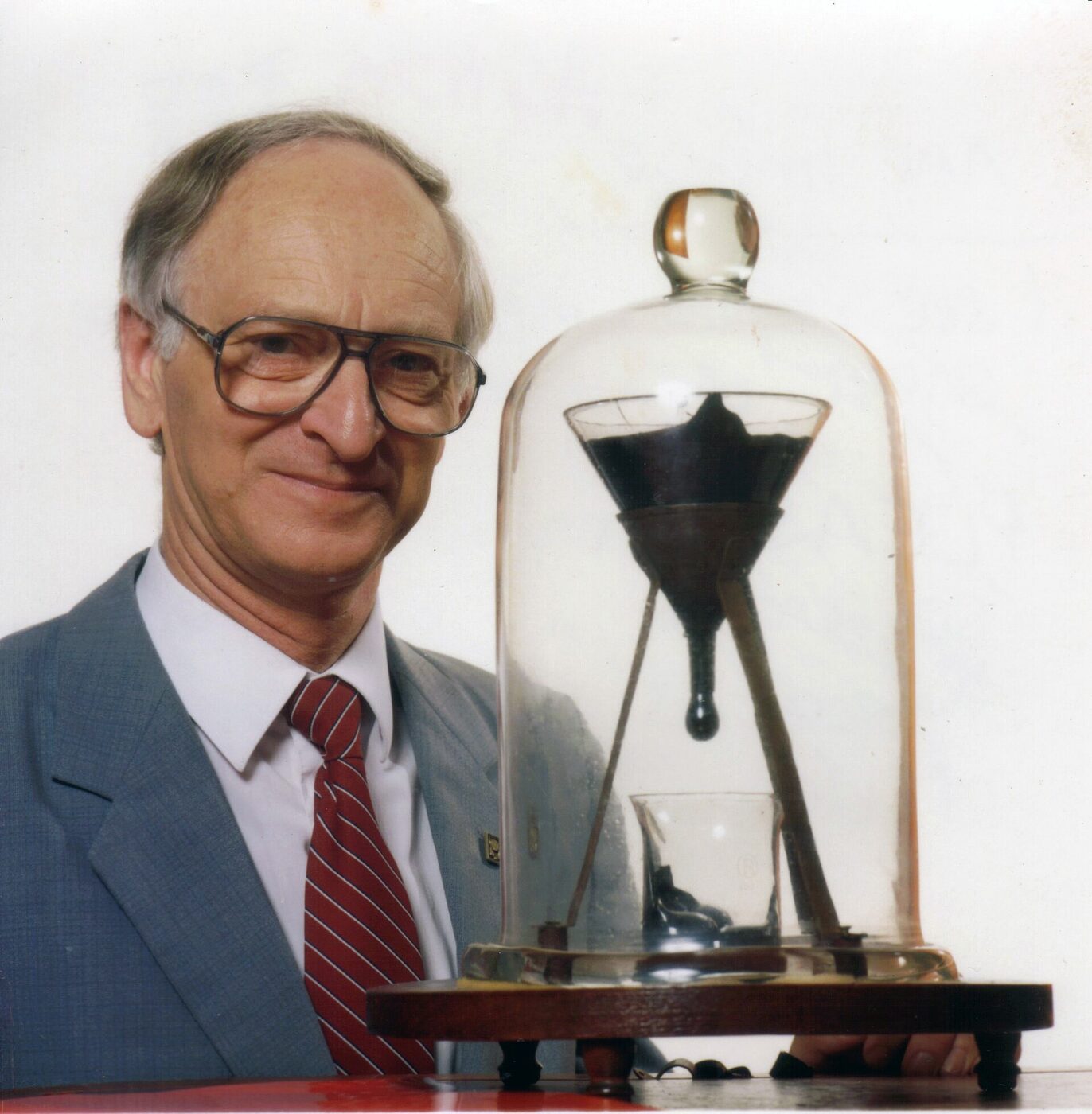
The job passed to Professor John Mainstone, who became the experiment’s second custodian in 1961. He looked after it for fifty-two years.
He never saw a drop fall either.
Then, in 2000, technology was finally going to fix this. A computer and a camera were set up and pointed at the funnel, ready to catch the eighth drop the instant it went.
There was a power blackout at exactly the wrong moment. The drop fell. Nothing recorded it. 🔌
You’ll find more colourful versions of these near-misses in circulation — cups of tea, weekends away, five minutes at the wrong time. We’re sticking to the plain account UQ gives itself, because honestly it doesn’t need embellishing: a man watched a funnel for fifty-two years and the universe would not give him the one moment he was waiting for.
The ninth drop, and the trapdoor
By the 2010s the experiment had a live video stream and tens of thousands of registered watchers around the world — 31,335 people from 158 countries were signed up to see the ninth drop go. A time-lapse camera had been recording since 2012. This was the one. This time it would definitely be witnessed.
The ninth drop declined to fall.
The eighth drop, still sitting in the beaker below, had left a tail sticking up. Rather than tidy it away, Mainstone had decided to leave the apparatus exactly as Parnell built it and see what happened. What happened was that the ninth drop, descending at a rate best measured in fractions of a millimetre per day, came down and gently touched the eighth. No fall. No moment. Just a slow, glancing arrival.
It was so gradual that pinning down when took actual detective work. UQ’s own accounts land in slightly different places — the Physics Museum records the touchdown as 24 April 2014, while a frame-by-frame analysis by Andrew Stephenson and Anthony Jacko, published by UQ, tracks the drop’s descent slowing from 0.25 mm a day to 0.1 mm a day and puts the contact on 12 April 2014. Both numbers are real, both come from UQ, and we’re giving you both rather than quietly picking the tidier one.
And then, on 24 April 2014, the experiment did something nobody planned.
Professor Andrew White — the third and current custodian — decided to swap out the beaker, which was getting too full for drops to fall freely. To do that he had to lift the glass bell jar off, for the first time in decades.
Nobody alive knew there was a seal between the bell jar and the wooden base. And nobody knew that it had degraded over the years into something sticky.
So instead of the jar lifting cleanly away, the entire experiment came up with it, hung there for a moment, and dropped back down onto the bench.
The shock snapped the ninth drop clean off the funnel. ✂️
After eighty-four years of nothing happening, the decisive event in the ninth drop’s life was somebody carefully trying to tidy up.
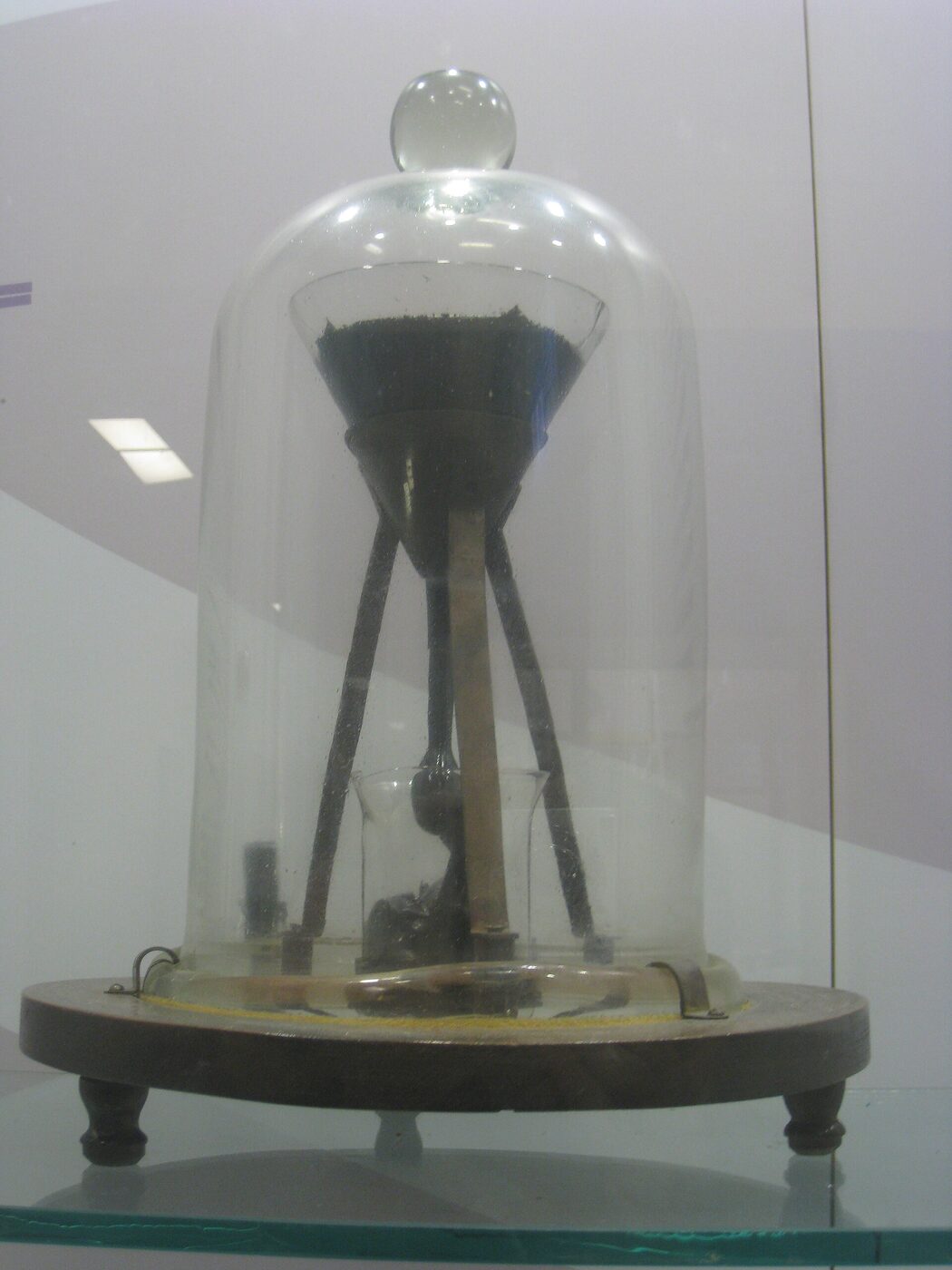
There was a consolation prize hidden in the wreckage. When they looked at the broken stem, there was a dip in the middle of it — which meant the drop hadn’t been hanging from the full circle of pitch above it at all. It had been hanging from a ring around the outside, with a hollow up the centre. Nobody had known that. You can only learn it by breaking one, and they’d been trying very hard for eighty-four years not to break one.
The fans accidentally sped it up
Here’s a detail we adore.
Because the pitch drop has an international audience watching it live, the display case needs its lights on all the time. In 2010 downlights went in. Later they were swapped for hotter halogen bulbs.
Halogen bulbs are warm. And the pitch is sealed under a glass bell jar, which is — as UQ’s own write-up cheerfully admits — its very own greenhouse.
When they finally took temperature readings in October 2014, the experiment was running several degrees above room temperature, with the pitch at the top of the funnel nearly ten degrees warmer than the pitch down in the drop. Warm pitch is runnier pitch. The tenth drop had been quietly bulking up at around 19 cubic millimetres a day — roughly a sugar cube’s worth every couple of months, which for this experiment is practically a stampede.
The world tuned in to watch the world’s slowest experiment, and by watching it, warmed it up and made it go faster. They’ve since switched to cool LEDs and brought it back down to room temperature. 💡
Somebody did eventually see one
Not this one.
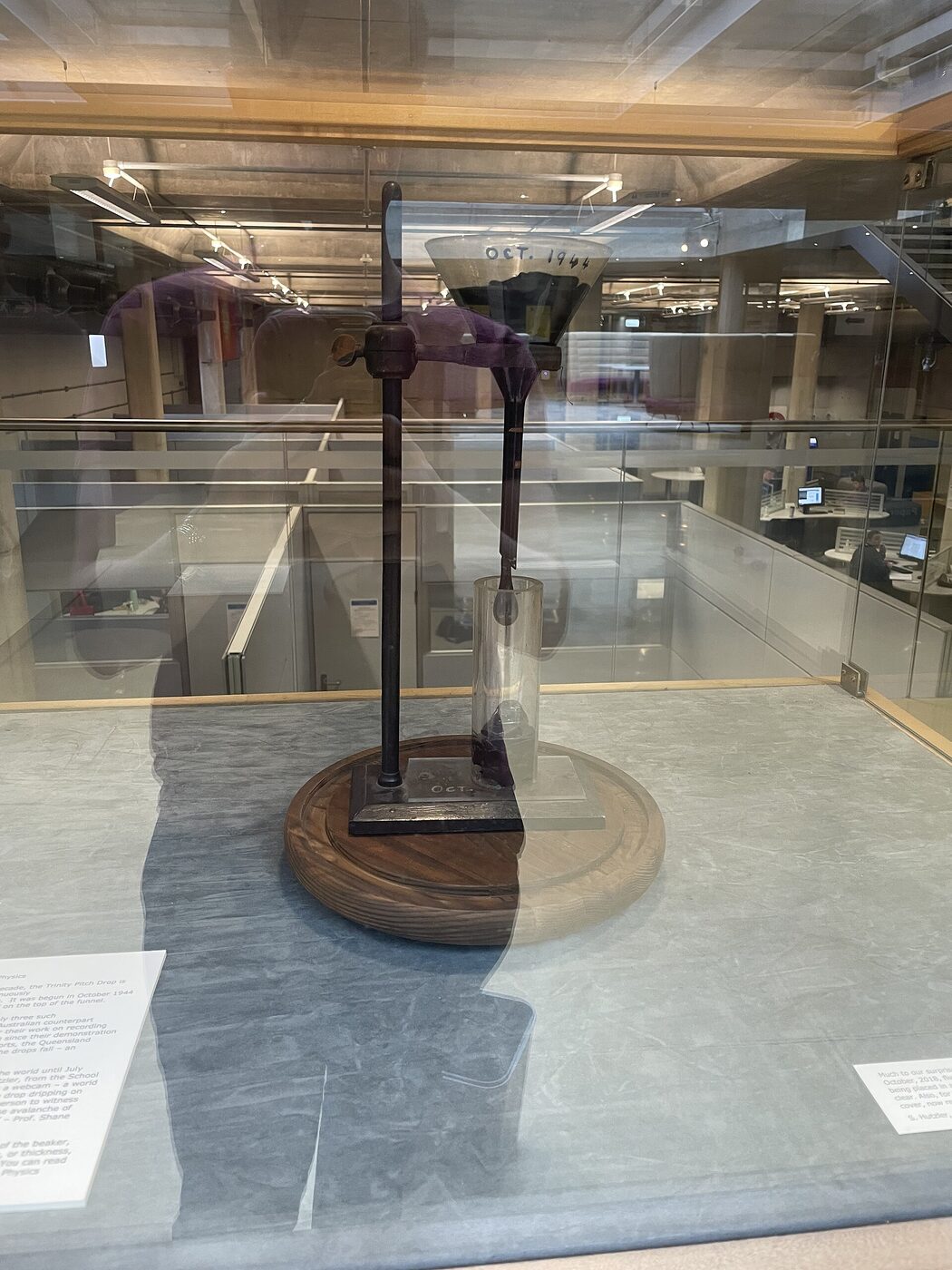
There’s a second pitch drop experiment, started in October 1944 at Trinity College Dublin, that sat forgotten on a lecture-hall shelf for decades, gathering dust and dripping unobserved. In April 2013 physicists there noticed a drip was forming, moved it somewhere they could watch it, and pointed a webcam at it.
At about five o’clock in the evening on 11 July 2013, it fell — and the camera got it. The first pitch drop ever recorded in the history of the world. 🎥
John Mainstone died later that same year.
Why this is on a good-news blog
Because of what it says about the people, not the pitch.
Thomas Parnell built this to make a point to a room of undergraduates in 1927. It was a teaching demonstration — a bit of classroom theatre, meant to be looked at for a minute and understood. He was not trying to make history. He was trying to explain something.
And then he died, and it kept going. And a man named John Mainstone picked it up and looked after it for fifty-two years — checking a funnel, keeping the records, answering the letters, waiting for a moment that never came for him. And when he died, Andrew White picked it up. And it is still going.
Nobody has to do this. There’s no grant riding on it, no deadline, no result pending. The 2005 Ig Nobel Prize in Physics went to Parnell and Mainstone jointly — one for starting it, one for patiently keeping it — which is exactly the right joke to make about it, and also exactly right.
It’s a hundred-year relay race where the baton is a funnel, and every single runner has handed it on without ever getting to see the finish. 🏅
And the point Parnell was making still stands, and it’s a good one to carry around: the thing in front of you that looks fixed and hard and permanent may simply be moving too slowly for you to notice. Glaciers do it. Mountains do it. Old grudges and stuck arguments and things-that-will-never-change do it.
Give it long enough, and the solid thing turns out to have been flowing the whole time. 🖤⏳
Go deeper (real links, no pop-ups, promise)
- 🏛️ UQ Physics Museum: the famous Pitch Drop Experiment
- 🔬 UQ School of Mathematics and Physics: Pitch Drop experiment
- 📰 UQ News explainer, by Andrew Stephenson — the ninth drop, the bell jar and the halogen bulbs
- 📄 Edgeworth, Dalton & Parnell (1984), Eur. J. Phys. — the only paper ever published about it


