

For most of the last century, Pluto was barely a rumor. Discovered in 1930, it spent 85 years as a faint smudge of light — a dot that wobbled a little between two photographs, too far away for even our best telescopes to turn into a place. We knew almost nothing. We didn’t even have a decent guess at what its face looked like.
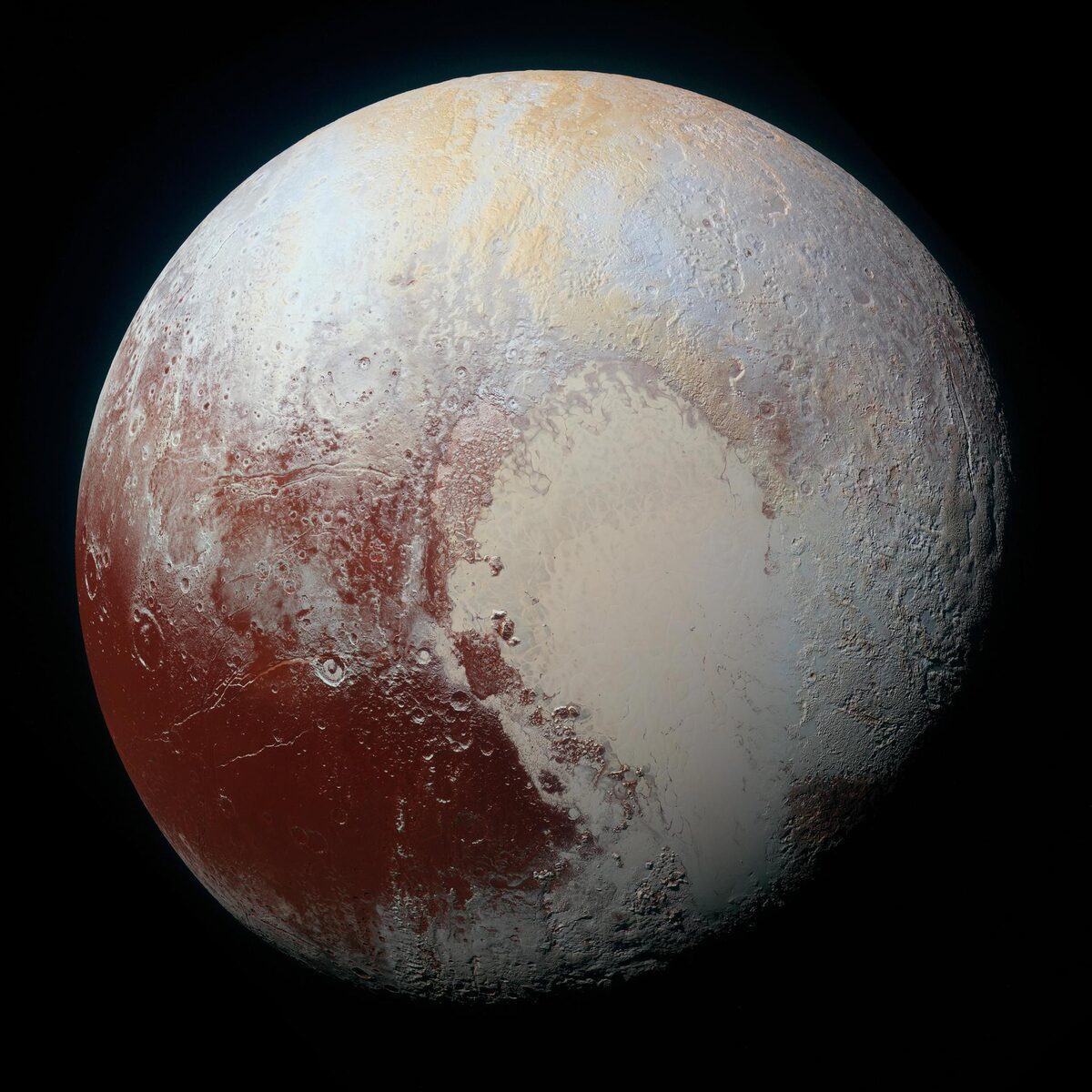
Then, on 14 July 2015, a spacecraft the size of a grand piano coasted silently past — and the dot became a world. 💙
A piano-sized probe, three billion miles from home
The spacecraft was New Horizons, launched on 19 January 2006. It weighed about as much as a couple of refrigerators and was shaped, more or less, like a grand piano with a big dish on top. To reach Pluto it flew for nine and a half years across roughly three billion miles of empty space — swinging past Jupiter for a speed boost along the way — and it had exactly one chance to get it right.
There was no slowing down, no orbit, no second lap. Pluto is so far out and New Horizons was moving so fast (about 14 kilometres every second) that the whole encounter was a flyby: sweep past, aim every camera and instrument at once, and gather as much as humanly possible in a few frantic hours. Then keep going, forever, into the dark beyond.
And what it found, splashed across Pluto’s face, was a heart.
The heart is named for the man who found the planet
That bright, pale region is officially called Tombaugh Regio, after Clyde Tombaugh — the young Kansas farm-boy-turned-astronomer who discovered Pluto in 1930 by painstakingly comparing photographic plates. He never got to see it up close; he died in 1997. But a portion of his ashes rode aboard New Horizons, which means the man who found Pluto quite literally flew past his own discovery. The International Astronomical Union approved the name Tombaugh Regio on 7 September 2017. 💙
“We came all this way to explore Pluto, and the most important thing is that we discovered how alive it is.” — the spirit of the New Horizons team, watching a ‘dead’ world wake up
“Dead” Pluto is secretly wide awake
Here is the part that genuinely surprised the scientists. Everyone expected Pluto to be a frozen, cratered, geologically finished little rock — dead and unchanging for billions of years. It is anything but.
The heart’s western lobe, Sputnik Planitia, is a glacier of frozen nitrogen about 1,000 km across. Its surface is broken into gently curved cells, like the top of a bowl of soup or a lava lamp — because it is slowly churning, warm ice welling up from below and cold ice sinking back down over millions of years. The whole plain is less than 10 million years old, which in planetary terms is practically this morning. Something out there, three billion miles from the Sun, is still resurfacing itself. 🌋

And rising above those plains are mountains — real ones, up to about 3,400 metres (11,000 feet) tall. They’re too big to be made of nitrogen or methane ice, which would slump under their own weight, so they must be built from water ice, which at Pluto’s brutal cold is hard as rock. A world smaller than our own Moon has snow-white peaks the height of the Alps.
Why this is on a good-news blog
Because for 85 years, Pluto was a question mark — the little dot at the far edge of the map that we simply couldn’t reach. And then a group of people built a piano-sized machine, aimed it across three billion miles of nothing, waited nine and a half years, and were rewarded with a portrait of a distant, frozen world that turned out to have a heart on its face and a pulse of its own.
We reached the last classic planet on the list, and it greeted us with the friendliest shape there is. Not bad for a dot. 💙🧊


