

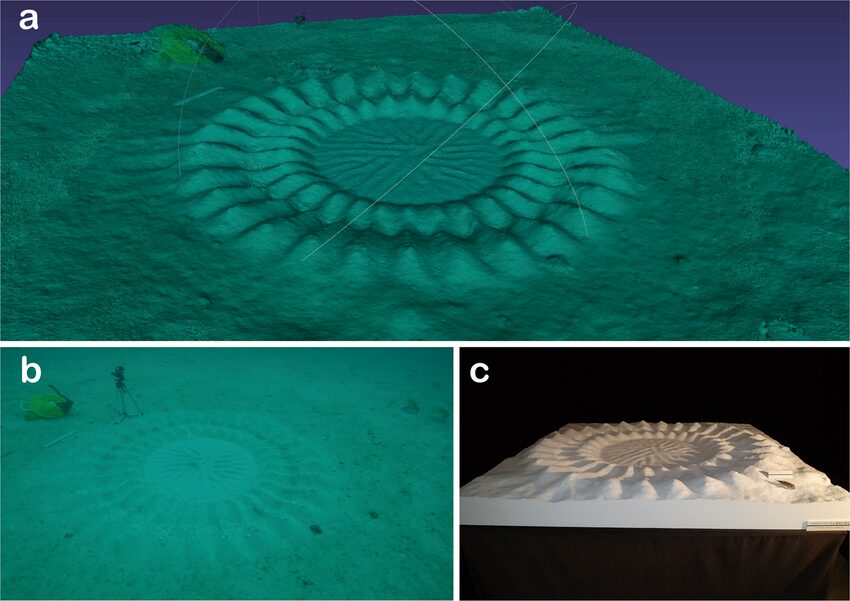
Somewhere off the south coast of Amami Ōshima, a subtropical island in Japan’s Ryukyu chain, the sea floor is mostly a flat, pale, unremarkable plain of sand. In 1995, divers swimming over it found something that had absolutely no business being there: a perfect geometric circle, about two metres across, carved into the bottom. Radiating ridges and grooves, like the spokes of a bicycle wheel. A smooth patterned disc in the middle. Little shell fragments arranged neatly along the tops of the ridges. 🌀
No one had any idea what made it. Not a current, not a machine, not a person — divers would find one, marvel, come back weeks later, and find it gone and another one a little way off. Local divers gave the things a name that admitted defeat honestly: mystery circles.
It took sixteen years to catch the culprit. And when someone finally filmed it, the answer was so much better than anything anyone had guessed.
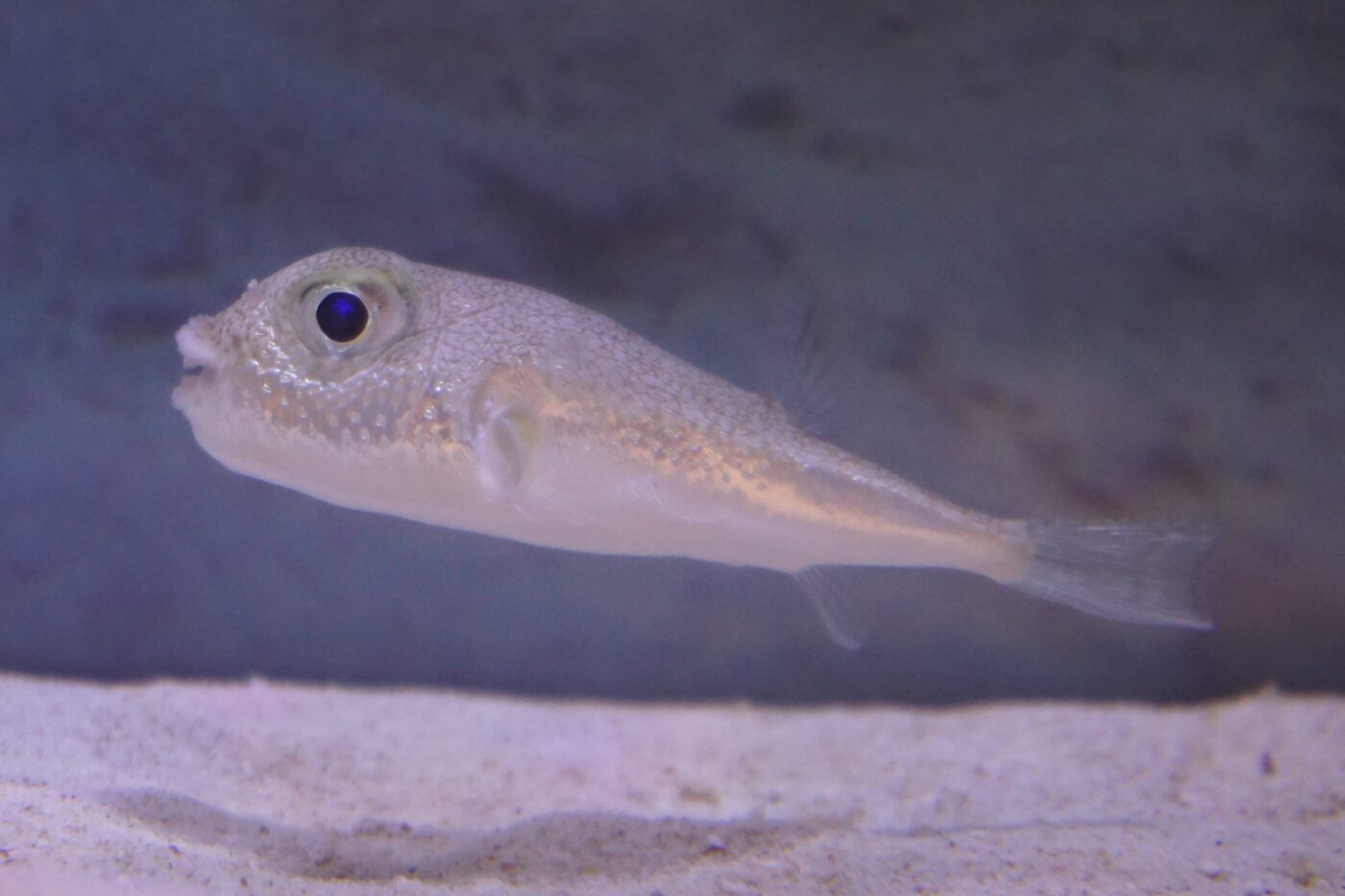
The artist is about as long as your hand
In 2011, a team including the underwater photographer Yoji Okata and biologist Hiroshi Kawase finally watched a mystery circle being made. The builder was a male pufferfish roughly 120 millimetres long — call it 12 centimetres, a fish you could hold in one palm — plain brown, faintly white-spotted, and, as far as the ocean is concerned, entirely forgettable.
He was making something about twenty times his own body length across.
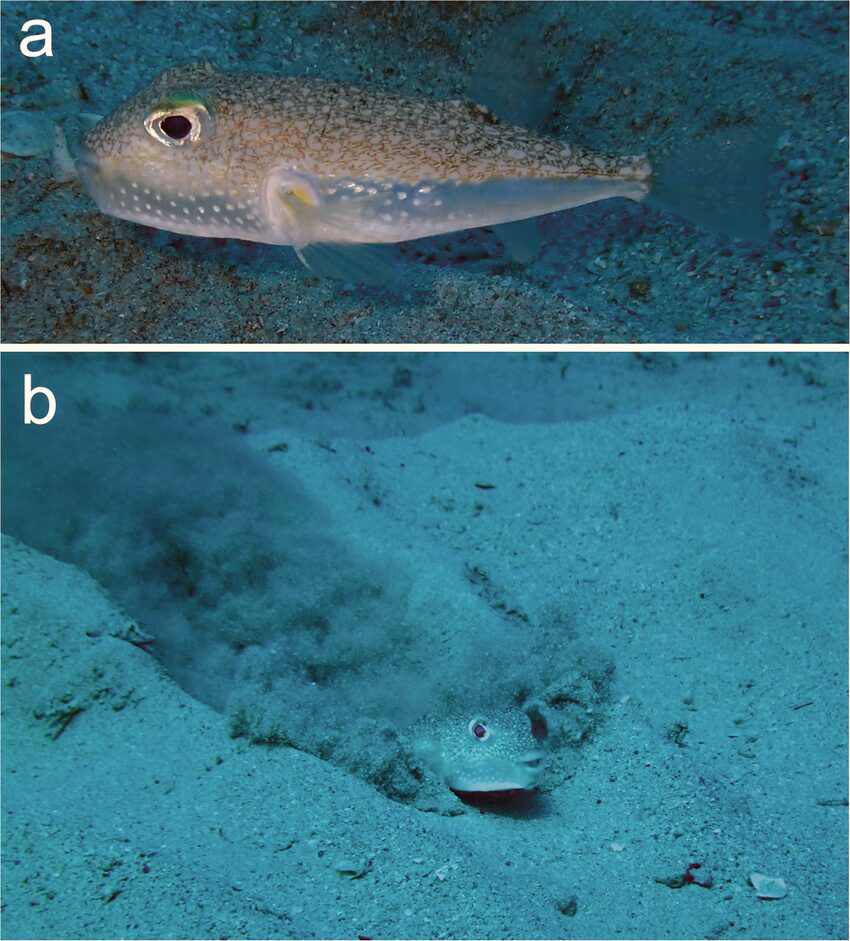
Their 2013 paper in Scientific Reports laid out how he does it, and it is honestly a bit heroic. He swims in a straight line along the bottom, flapping his pectoral, anal and tail fins to plough a valley in the sand. Then he does it again at a slightly different angle. And again. Working from the outside in, over and over, he raises 24 to 32 pairs of radiating peaks and valleys around a central clearing. The whole build takes seven to nine days, and he keeps grooming it right up until the moment it matters. 🐡
Every ridge is doing a job
Here’s the part that turns a nice story into a genuinely astonishing one. The circle isn’t just decoration. It’s engineering.
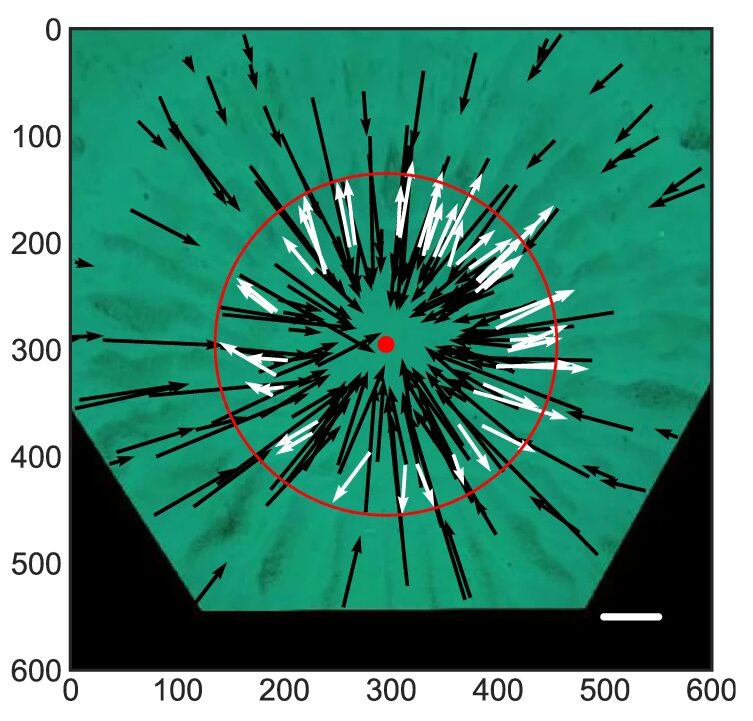
When he flaps his fins through the sand, the lightest, finest particles get stirred up into the water. The valleys he’s dug are almost exactly as wide as his body, and the peaks on either side act like walls that stop those fine grains drifting away. Then the shape of the whole structure takes over: the researchers built a half-scale model and ran water past it, and found that the radiating valleys funnel the current inward on the upstream side and out again on the downstream side — so no matter which way the tide is running, half the valleys are always sweeping fine sand toward the middle. Inside the central disc, the current drops by about 24 per cent.
So the finest, softest sand in the neighbourhood ends up gathered in the calm centre of the circle — which is exactly where the female will lay her eggs. In the last day or two he flaps his anal fin across that soft centre to work an irregular, almost woven pattern into it, and lays shell and coral fragments along the ridge tops as a finishing touch. 🐚
And it’s all… a very sincere question
The circle is a courtship display. Females come by only in the last stage, when it’s finished, and swim in to inspect it. He stirs the sand up so she can see what he’s collected, then rushes toward her and retreats, over and over, in a little loop of look, look, look at what I made. She stays about a minute, has a good look, and leaves — sometimes coming back to check again.
If she says yes, she settles into the soft centre and they spawn there. Then she leaves, and he stays: guarding the eggs for around six days until they hatch, chasing off anything that comes near, no longer bothering to repair the circle. Without maintenance the current smooths it flat within days, and the fine sand disperses.
Then — and this is the detail that got us — he never uses it again. He swims off and builds a completely new one, from nothing, somewhere else. The researchers think it’s because a single nesting cycle uses up basically all the fine sand the valleys can gather; the site is spent. So it’s nine days of work, one clutch of eggs, and then nine days of work again. Forever.
Simple rules, gorgeous results
A follow-up study in 2018 asked the obvious question: how does a fish with a fish-sized brain produce something that geometric? The answer, reassuringly, is that he isn’t holding a blueprint. Researchers tracked his movements and found the pattern falls out of a handful of simple local rules — swim toward the centre, flap, turn, repeat — applied a few thousand times. The geometry is emergent. Nobody is doing maths down there. 📐
The same work turned up a lovely wrinkle: bigger males push sand further, so their ridges end up spaced more widely apart. Which means the circle may quietly broadcast how big and healthy its builder is, before the female has even seen him. The sandcastle is the résumé.
Finally getting a name
For years after the discovery, the artist didn’t officially exist. He was written up in the 2013 paper as simply Torquigener sp. — a pufferfish, genus known, species unnamed.
That was fixed in 2014, when ichthyologist Keiichi Matsuura of Japan’s National Museum of Nature and Science formally described him as Torquigener albomaculosus — the white-spotted pufferfish, and the twentieth known species in his genus. (Two letters worth guarding there: albomaculosus, “white-spotted”, not albomaculatus.) The following year an international panel put him on its Top 10 New Species list — ten picks out of the seventeen thousand-odd species science formally names in a typical year. A fish that had been anonymous for two decades went straight onto the podium. 🏅
Narrating a BBC documentary the same year, David Attenborough summed him up about as well as anyone can: the fish is “dull, almost to the point of invisibility. But to compensate, he is probably nature’s greatest artist.”
And there may be more of them. In 2018, remotely operated vehicles working off Western Australia found strikingly similar circular nests on the sea floor — this time more than 100 metres down, far deeper than anywhere the Japanese fish has been seen. Nobody has filmed the builders yet. They’re presumed to be another Torquigener, quietly doing the same impossible thing in the dark, unwatched. 🌊
Why this one stayed with us
Because for sixteen years the ocean was making enormous, careful, beautiful geometry and nobody knew who was responsible. And when the answer arrived, it wasn’t a current or a phenomenon or anything grand — it was a small brown fish nobody would look at twice, doing nine days of patient work with his face, for one shot at being chosen, and then starting over.
The world is full of things like this: an entire body of work by an artist who has never been to a gallery, has no idea anyone is watching, and does it again tomorrow anyway. There are circles being drawn out there right now, off Amami Ōshima, that nobody will ever see. 🐡💙
Know a small creature doing something wildly out of scale with its size? Sign the guestbook and tell us about it.
Go deeper (real links, no pop-ups, promise)
- 🐡 Torquigener albomaculosus on Wikipedia
- 🔬 Kawase, Okata & Ito (2013), “Role of Huge Geometric Circular Structures in the Reproduction of a Marine Pufferfish” — Scientific Reports, free to read
- 📐 Mizuuchi et al. (2018), “Simple rules for construction of a geometric nest structure by pufferfish” — Scientific Reports, free to read
- 🌊 Bond et al. (2020), mystery circles found deep off Western Australia — Journal of Fish Biology


