

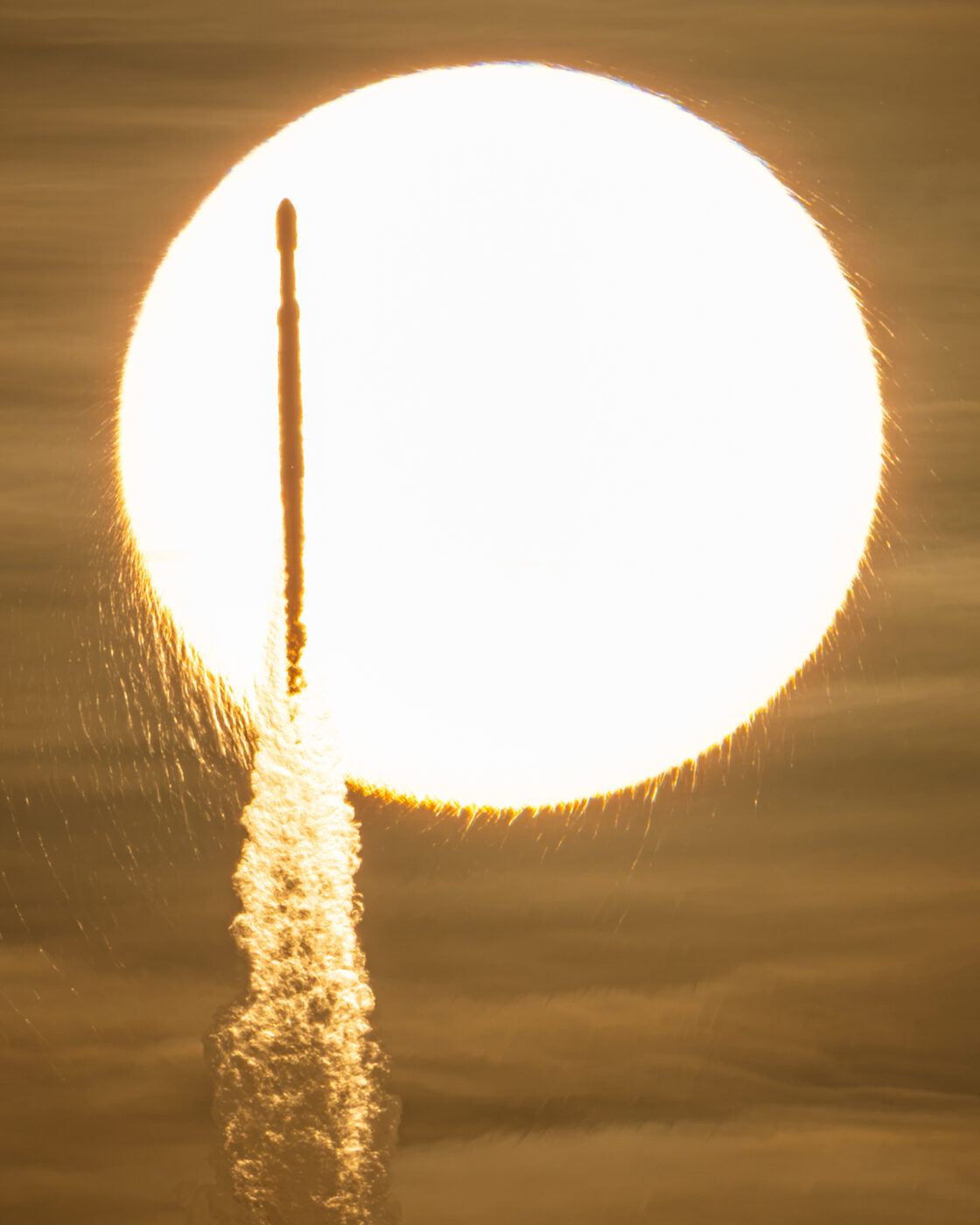
On 30 August 2026, a SpaceX Falcon Heavy lifted off from NASA’s Kennedy Space Center in Florida carrying the Nancy Grace Roman Space Telescope — and somebody standing a long way back, with a very long lens, caught the rocket passing directly in front of the Sun. 🌞
Roman is going to survey billions of stars and galaxies, with a field of view far larger than Hubble’s, to study dark energy, exoplanets, and how the universe grew up. That’s the headline, and it’s a good one.
But here’s the thing that makes it a story rather than a headline: Roman carries the same size mirror as Hubble. Exactly the same. 7.9 feet across — 2.4 metres. Same width, same job, thirty-six years apart.
And it sees a hundred times more sky at a time.
The same mirror, a quarter of the weight
Start with the weight, because it’s the quietest number here and maybe the loveliest.
Hubble’s primary mirror weighs 1,825 pounds (828 kg). Roman’s — the same width, doing the same job — weighs 410 pounds (186 kg). More than four times lighter, for an identical piece of optics.
Nobody invented a new law of physics to do that. It is simply three decades of people getting better at making mirrors, stated as a weight. (Hubble’s own engineers were doing the same trick in their day: they hollowed its mirror out into a honeycomb structure, which brought it down from about 8,000 pounds.)
The smoothness went the same way. Roman’s mirror is polished so finely that if you scaled it up to the size of the Earth, the average bump on its surface would stand about a quarter of an inch high. Do the same thing to Hubble’s mirror — an astonishing piece of work in 1990, and still — and the largest bumps come out around six inches. 🪞
Why the wide view: it’s the shape, not the size
If both telescopes have the same mirror, where does a hundred times more sky come from?
Focal length. Hubble folds light between two curved mirrors to give itself a long focal path, and a long focal length relative to the mirror means high magnification: a zoom lens. Roman uses three curved mirrors, shaped to give a focal length roughly three times shorter than Hubble’s — and a short focal length relative to the mirror means a wide field of view.
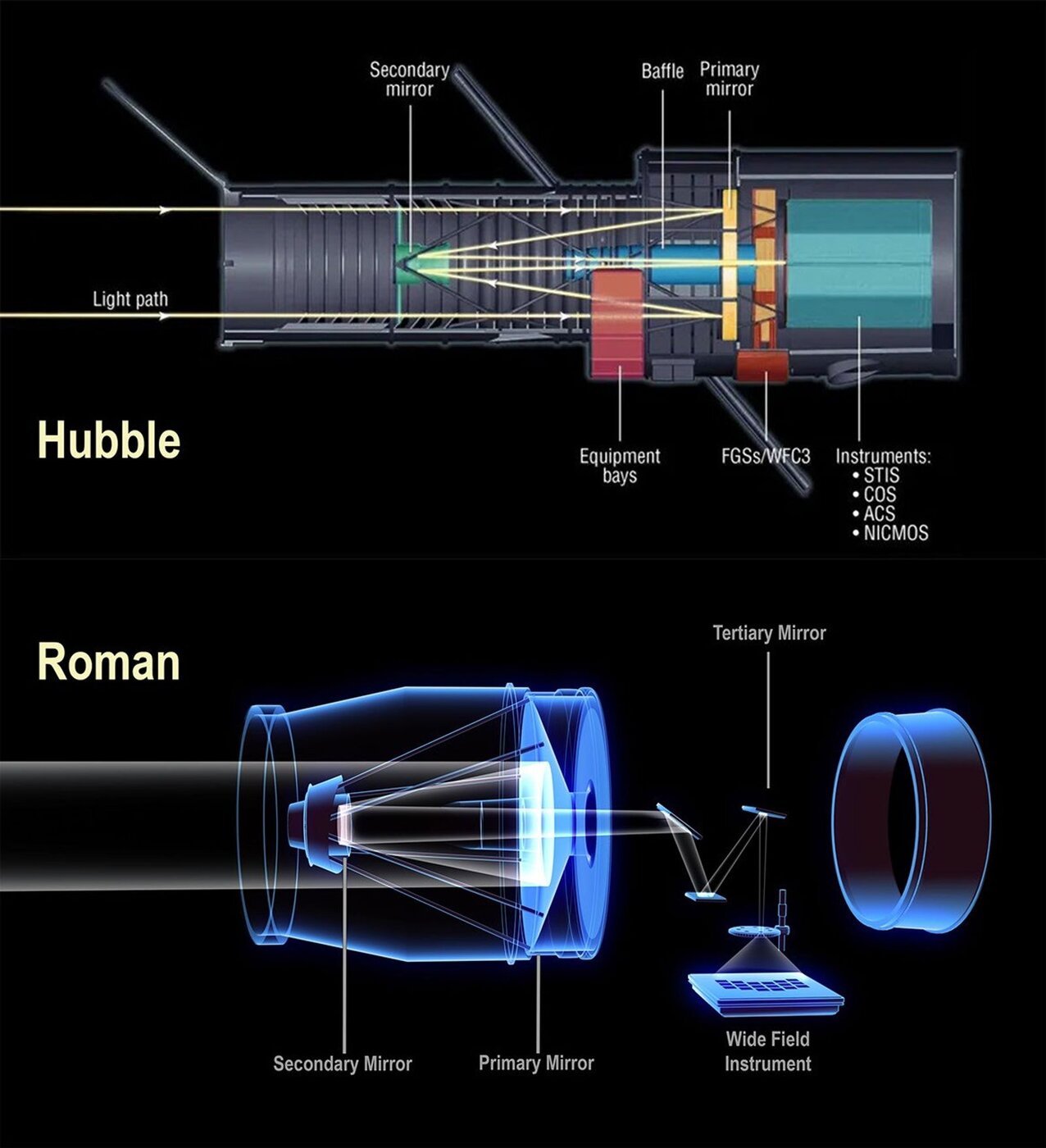
That geometry is what the numbers land on. Roman’s Wide Field Instrument — a 288-megapixel near-infrared camera with 18 detectors — takes in a patch of sky 0.8 by 0.4 degrees at once. That’s a bit wider than the full Moon, which is about half a degree across. Hubble’s Advanced Camera for Surveys takes in 0.056 by 0.056 degrees, on a 16-megapixel sensor.
Same mirror. A hundred times the view.
The consequence, which is the part that got us
Here is the sentence in NASA’s own comparison that stops you:
With more than three decades of observations, Hubble has only seen one-tenth of one percent of the sky. During its first five years, Roman will image 50 times as much sky as Hubble captured in 30 years.
Read that again slowly. Not fifty percent more. Fifty times — in a sixth of the time.
Not because Roman is a better telescope than Hubble. Because it is a wider one, and wide is what a survey needs. Hubble has spent 36 years going deep on chosen targets and building an archive we will be mining for the rest of our lives. Roman is going to go broad, and then hand the interesting bits to everyone else. 🌌
Hubble is still the sharper eye, and that’s the good bit
This is not a replacement story, and NASA is unusually direct about it: Roman “isn’t a successor to Hubble or the James Webb Space Telescope.” It joins the family.
Because there’s something Roman simply cannot do. In visible and ultraviolet light, Hubble remains sharper. Hubble’s Wide Field Camera 3 resolves 0.04 arcseconds per pixel; Roman’s Wide Field Instrument resolves 0.1 arcseconds per pixel in the near-infrared. Roman’s coatings are tuned for infrared — silver, optimised from 1.0 to 2.0 microns, seeing 0.48 to 2.30 overall. Hubble’s aluminium-and-magnesium-fluoride coating reaches from 0.1 microns in the ultraviolet all the way out to 2.4 — and in that range, NASA says flatly, no instrument outshines it.
NASA’s own way of putting it is the clearest thing on the page:
Think of Roman as a wide-angle lens in infrared light while Hubble is the zoom lens in ultraviolet and visible light.
Every photographer already knows how this ends. You don’t throw away the zoom because you bought a wide-angle. You carry both, and you shoot things you couldn’t shoot before. Roman will sweep the sky and spot what’s odd; Hubble and Webb will swing round and stare at it properly. 🔭
And the name on the side
The telescope is named for Dr. Nancy Grace Roman, NASA’s first chief astronomer — the agency’s first Chief of Astronomy, and the person NASA’s own Hubble pages call “the Mother of Hubble.”
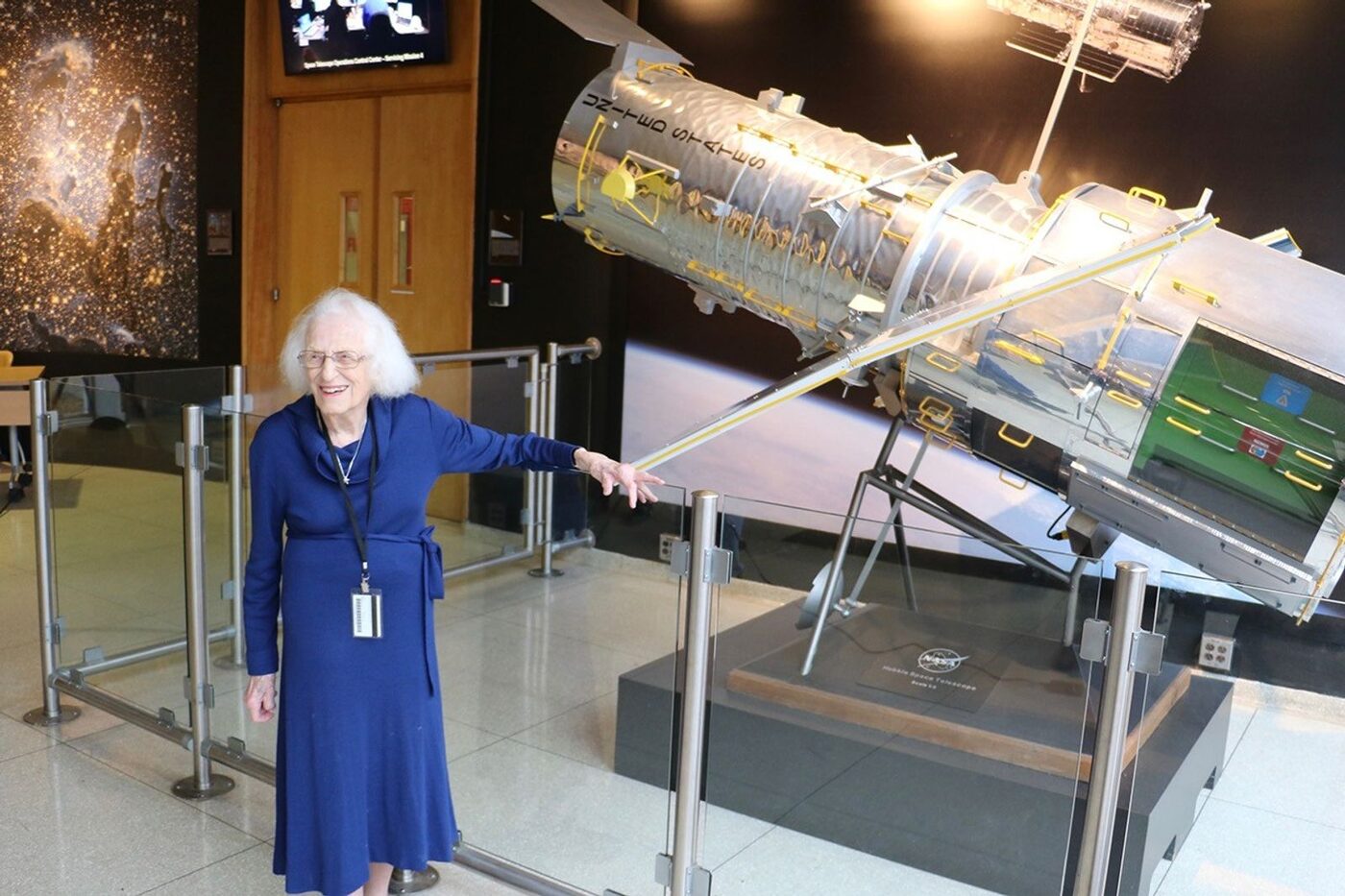
Look at that grin. That is somebody standing next to a thing she argued into existence.
Why this is on a good-news blog
Because of the shape of it.
Someone spent a career making the case for putting telescopes above the atmosphere, and for handing the data to everybody. Hubble happened. Thirty-six years of pictures happened, and one-tenth of one percent of the sky got looked at properly, and that turned out to be enough to rewrite what we know about the universe.
And then a generation of engineers who grew up on those pictures built a second telescope with the identical mirror — lighter, smoother, shaped to look wider — put her name on the side, and flew it out to a spot a million miles from here to photograph fifty times as much sky as the first one managed, in a sixth of the time.
At the end of August it went up over Florida, and on the way out it crossed the face of the Sun. ☀️💛
Go deeper (real links, no pop-ups, promise)
- 🚀 NASA: the Roman Space Telescope launches — and the photograph at the top of this post
- 🔭 NASA: Hubble vs. Roman — where every number above comes from, mirrors, focal lengths, arcseconds and all
- 🌌 NASA: the Nancy Grace Roman Space Telescope


