

Weather does a lot of shapes. Spirals, swirls, the long comma-curl of a hurricane seen from orbit. What weather is not supposed to do is draw a hexagon — a clean, six-sided geometric figure with straight edges and sharp corners, the kind of thing you’d get from a ruler, not a storm.
And yet: park yourself above the north pole of Saturn and that is exactly what you’ll find. A hexagon. A real one. Enormous, persistent, and spinning there — as far as we can tell — for at least the last forty years. 🔷
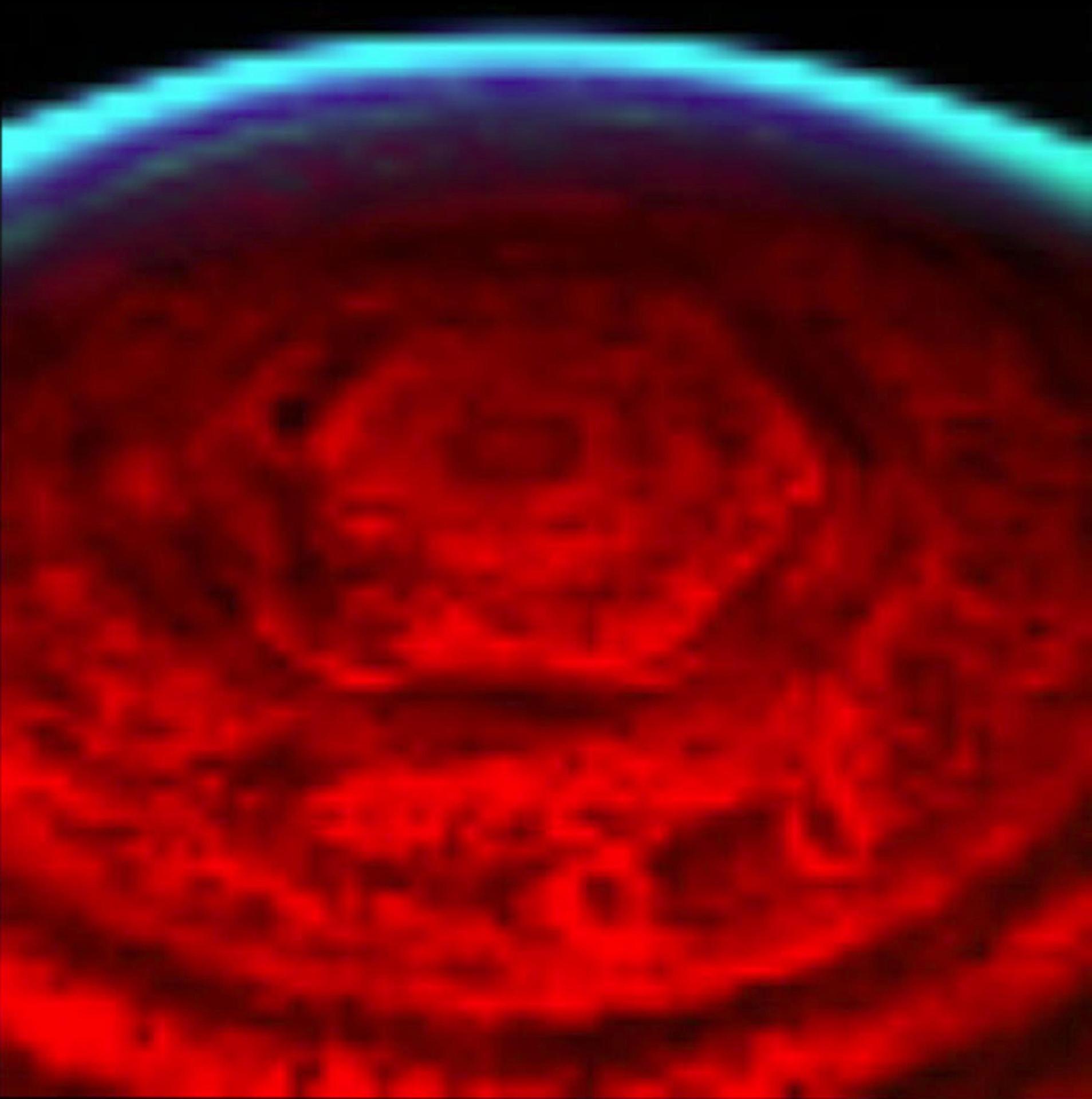
A shape you could lose four Earths inside
Let’s get the scale straight, because it’s the part that doesn’t fit in your head. Each of the hexagon’s six sides is about 14,500 kilometers long. Earth’s diameter is about 12,742 km. That means a single straight edge of this thing is longer than our entire planet is wide. The whole hexagon is wide enough to drop four Earths into it, corner to corner, with room to spare.
This is not a paint job on the surface — Saturn doesn’t have a surface, it’s a gas giant, all clouds and wind the whole way down. The hexagon is a pattern in the jet stream: a fast river of wind circling the pole. On Earth, jet streams meander and wobble in loose loops. On Saturn, this one has somehow settled into six long straight runs joined by six corners, and it has held that shape for decades.
Voyager saw it. Cassini stared at it.
We first caught the hexagon in the early 1980s, when NASA’s Voyager probes swept past Saturn and sent home images of something that looked too tidy to be real. For years it was almost a rumor — a weird geometric smudge on old photos.
Then, from 2004 to 2017, the Cassini spacecraft lived at Saturn, orbiting it hundreds of times, and got to watch the hexagon properly. It confirmed the shape was no fluke of lighting or a one-off. It was still there, decades later, turning slowly with the planet.
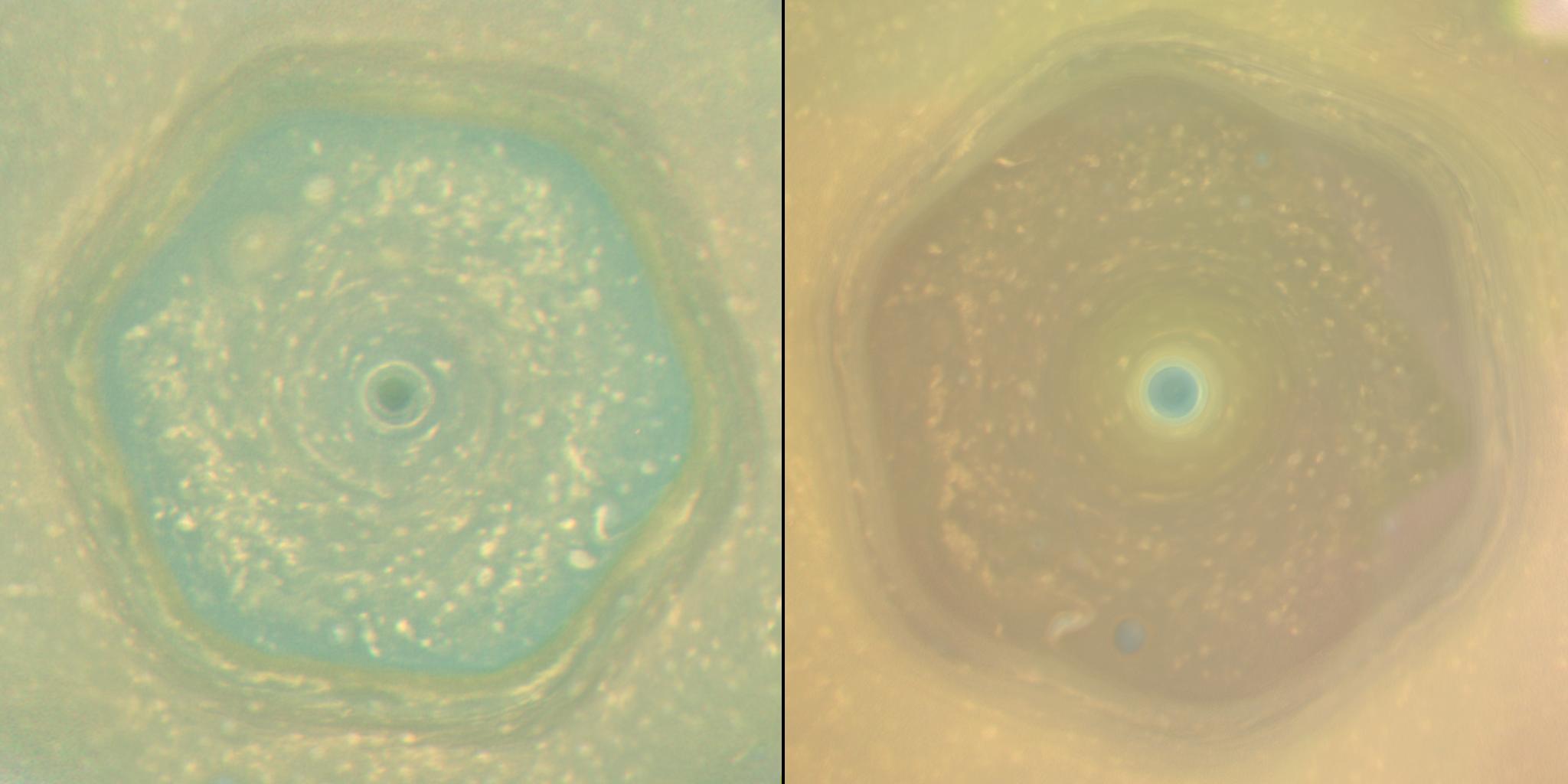
It even changed color
Here’s the detail that makes it feel almost alive. Saturn has seasons, just very slow ones — a Saturn year is about 29 Earth years. As the northern hemisphere tipped from winter toward summer and more sunlight reached the pole, Cassini watched the inside of the hexagon shift from a deep blue to a golden haze between roughly 2012 and 2016. Best guess: the returning sunlight kicked off a bit of atmospheric chemistry, brewing up a fine photochemical smog that tinted the whole enclosure gold. A hexagon that keeps its shape but changes its color with the seasons. 🎨
So… why a hexagon?
Honestly? We’re not 100% sure, and that’s part of the fun. The leading explanation is that when a fast jet stream wraps around a pole, small wobbles in the wind can lock into a stable standing wave — and for this particular combination of wind speed and the slower air on either side of it, the wave settles into six lobes. Lab experiments here on Earth, spinning fluids in a tank, have actually reproduced polygon shapes — triangles, squares, hexagons — just by changing how fast things spin. So it’s physics, not magic.
But “it’s a stable standing wave in a planetary jet stream” is the mechanism. The reason it has held its edges for over forty years without smearing back into a boring circle is still a genuinely open, actively-studied question. Saturn is quietly holding a shape and not fully telling us how.
Why this is on a good-news blog
Because the universe did not have to be interesting. It could have been all featureless fog and tidy circles. Instead, on a planet a billion kilometers away, the weather picked up a ruler and drew a hexagon the size of several Earths — and left it running for us to find.
And find it we did. A species that mostly lives outdoors on one small planet built two robots in the 1970s, flung them past Saturn, saw something impossible in the returned pictures, and then built another robot and sent it to go look for thirteen more years just to be sure. We didn’t need the hexagon for anything. We went because it was strange and beautiful and we wanted to understand it. 🔷💛
That’s the good news: the cosmos keeps drawing shapes we didn’t expect — and we keep going to look.


