

It is the morning of 27 July. You are in Finland. You are asleep.
Everyone else in the house is not asleep. Everyone else in the house is awake, and quiet, and standing in the doorway, and one of them is holding something. There is a specific and unmistakable sound coming from the bathroom, which is the sound of a bucket being filled.
You have lost. 😴
The rules of Unikeonpäivä are very simple
National Sleepy Head Day — Unikeonpäivä in Finnish, sjusovardagen in Swedish — is observed every year on 27 July. The rule is that whoever in the household is last out of bed gets woken with water.
The delivery method is left to the family. A cup will do. A bucket is traditional. If there is a lake handy, or the sea, or a river, the household may decide that the most efficient way of getting the water to the sleeper is to get the sleeper to the water. 🌊
The reasoning behind all this is properly medieval and extremely stern: sleep late on this particular morning and you will be lazy and unproductive for the entire rest of the year. That is the stated logic. Not “you’ll feel groggy.” Not “you’ll get a slow start.” The whole year. Gone. Because of one lie-in.
The day is loosely attached to the legend of the Seven Sleepers of Ephesus — seven young Christians who hid in a cave from the emperor Decius and, in the story, woke up about two hundred years later. That is where the name comes from in most of Europe: Siebenschläfertag in German, Seven Sleepers Day in English.
But Unikeonpäivä isn’t a religious observance, and hasn’t been one for a very long time. It is a joke your family plays on you. It has been in the Finnish almanac since 1652, which means Finnish families have had official calendar permission to do this for the better part of four centuries. ⛪
Small linguistic bonus, free of charge: unikeko is also the Finnish name for the edible dormouse, Glis glis — the animal the Germans call the Siebenschläfer, the seven-sleeper. It hibernates for seven months of the year and sleeps about twenty hours a day the rest of the time. It is, by an enormous margin, the best at this holiday. 🐭
And then there is Naantali
Most of Finland handles Sleepy Head Day at home, with a bucket.
Naantali — a small, extremely pretty harbour town on the south-west coast, near Turku, whose other main claim to fame is that Moomin World is there — decided a long time ago to do it as a town.
Naantali has been celebrating Unikeonpäivä since at least the 1880s; the first newspaper account of it dates from 1886, and even that one describes it as happening the way it always had. The 1880s version was rowdier than today’s. Late sleepers were pelted with burdocks — the sticky ones — and the town’s remaining dozers were roused by a procession that woke them with, in the official history’s lovely phrase, “ear-deafening racket”: singing, shouting, instruments, and the rattling of the walls and windows of their own houses.
The children of the town were fully involved in this. They gathered the burdocks and sold them in paper bags, one Finnish mark a bag. 🌿
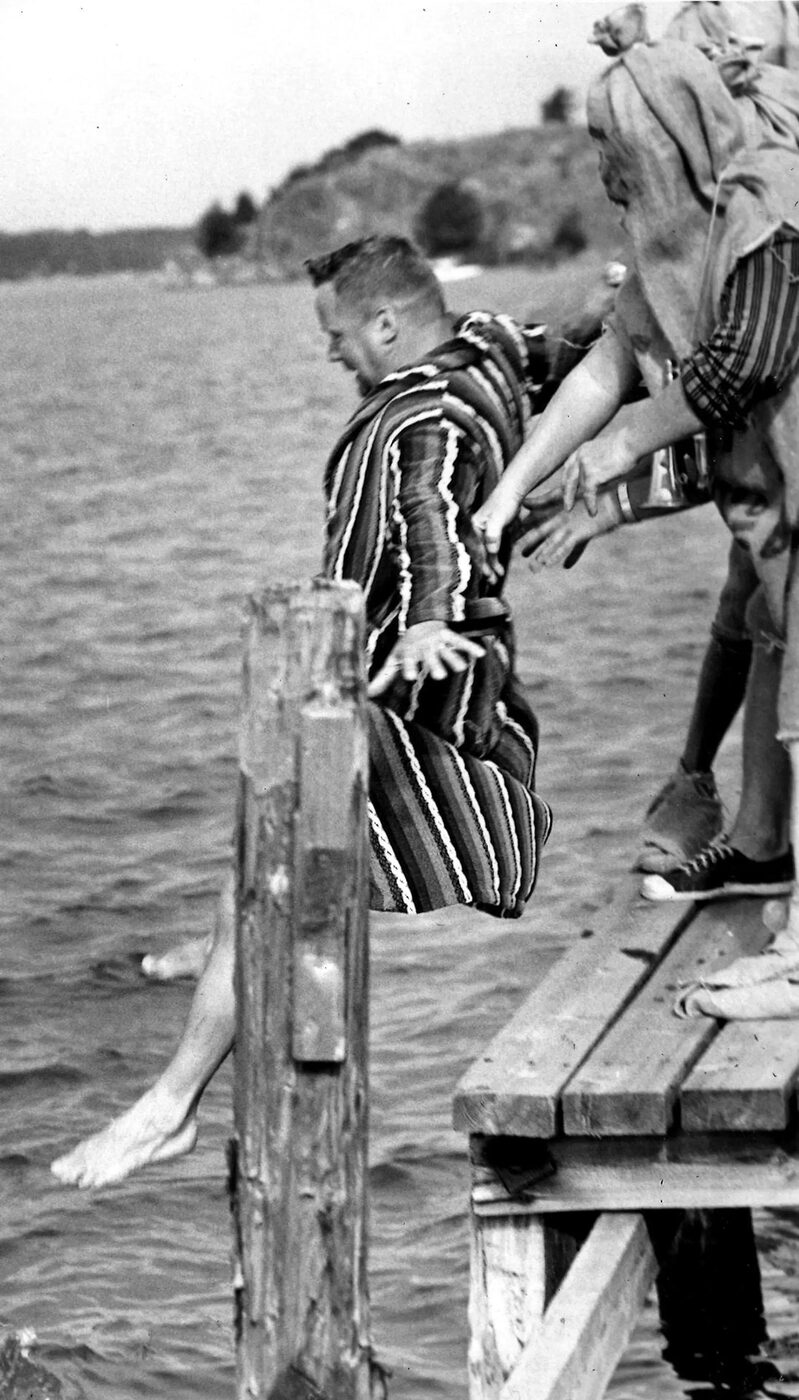
The tradition lapsed around the world wars and was revived at the end of the 1950s, at the initiative of a local restaurateur named Lauri Virra. That revival is where the modern centrepiece comes from: instead of chasing whoever happened to sleep in, the town would choose one Official National Sleepy Head in advance, and put them in the sea.
In the very early years this was not an honour. It was a duty of employment. The city’s own caretaker, Jaakko Sajo, was the Sleepy Head every single year from 1958 to 1968 — eleven consecutive dunkings — followed by another caretaker, Jaakko Väätänen, in 1969.
And it was two Jaakkos in a row for a reason. For those first years the town would only appoint a man named Jaakko, because that way the crowd could sing “Jaakko kulta, herää jo” at him — the Finnish version of Frère Jacques, “Are You Sleeping, Brother John.” An entire selection criterion, for a civic ceremony, built around a nursery rhyme pun. 🎵
They dropped the Jaakko rule in 1970. Since then the Sleepy Head has been chosen on a different basis: someone who has made Naantali known in a good way, or otherwise done something good for the town.
Which is where it gets lovely
Here is the thing about the modern Naantali Sleepy Head, and it is the reason this post exists.
Being honoured by your town and being thrown into the harbour are the same event.
The list of people this has happened to reads like a civic roll of honour, because that is exactly what it is: mayors, an architect, a vicar, a children’s doctor, a war veteran, a ringette captain, a singer, several painters, the artistic director of the Naantali Music Festival, the rector of the University of Turku, the CEO of Finnlines, the estate manager of the president’s summer residence. In 2013 they picked an entire organisation — the Naantali guides’ association — and in 2020, the families who run the guest harbour. In 2022 it was the poet Jenni Haukio, who at the time was the wife of the sitting president of Finland. Another year it was Dr Pentti Arajärvi, who was married to the president before that one.
Every mayor of Naantali has been thrown in at least once.
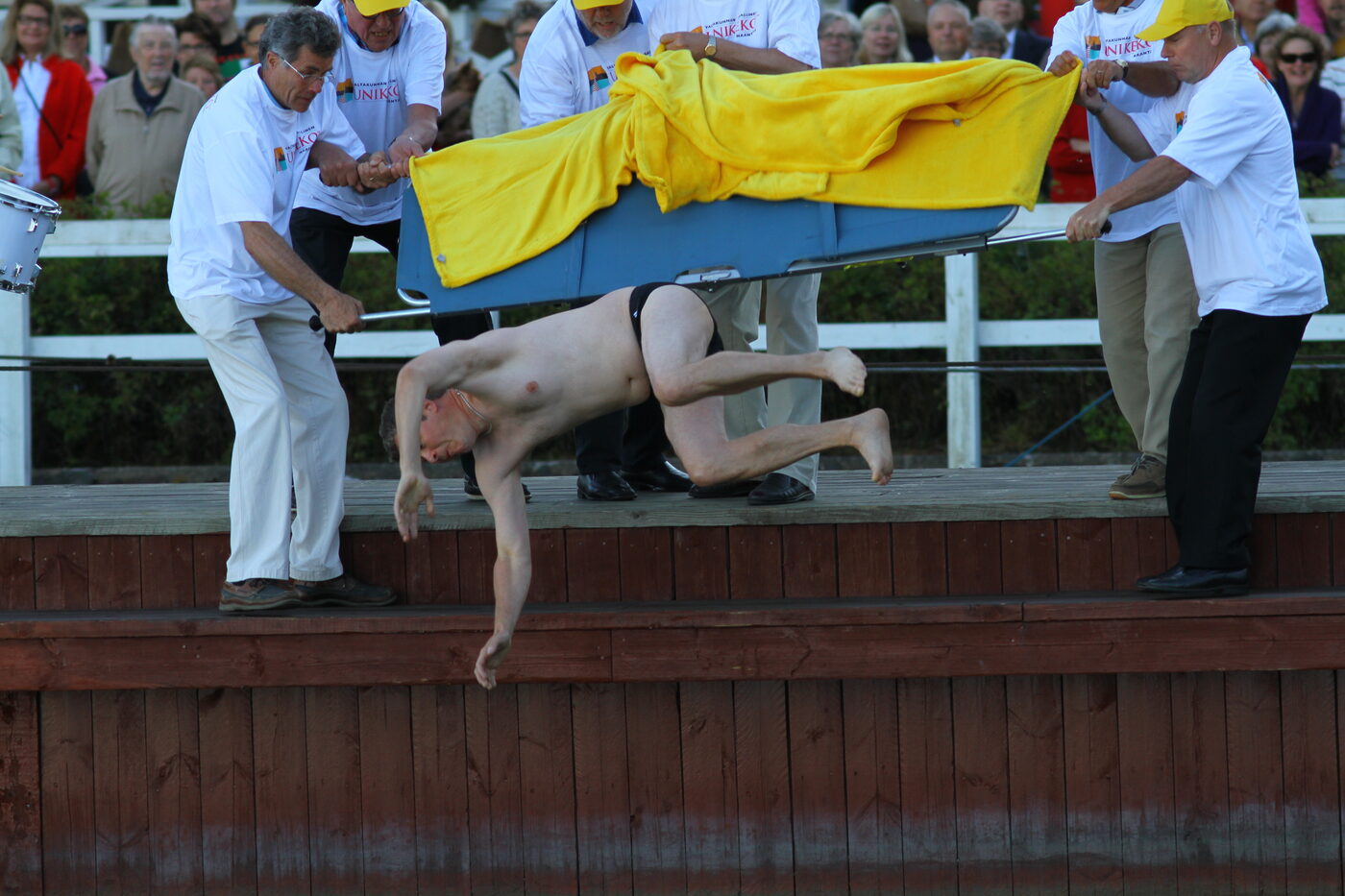
The man in the photograph at the top of this post, incidentally, is Tomi Lohikoski, and in 2012 he was the managing director of Moomin World — the Moomin theme park that sits on an island a short walk from that quay. He runs the happiest place in Naantali, so Naantali threw him in the sea. 🌊
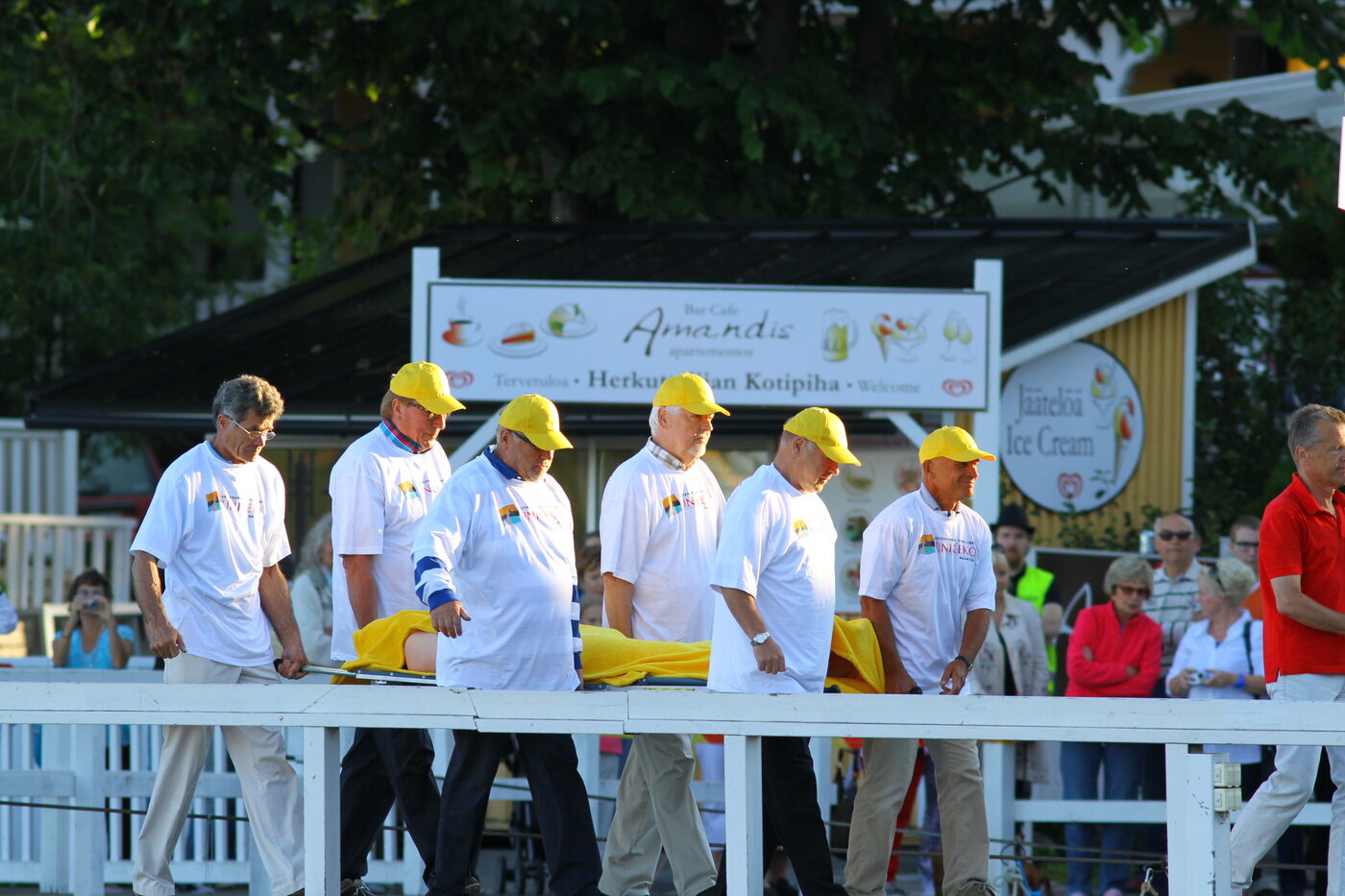
And look who is carrying the stretcher. Those aren’t stewards. They’re previous Sleepy Heads — men who were tipped into that same harbour in 1993, 1997, 2005, 2008, 2010 — turning up years later in the matching white shirt and the yellow cap to carry the new one down to the water. It’s an alumni association, and the initiation is getting wet.
The morning itself
Proceedings in Naantali start at 8:00. (In 2012 it was an hour earlier — the photographer’s camera clock puts the splash above at 07:00:22.)
The name of the Official National Sleepy Head is announced then, and not before. It is kept secret from the town until the morning of the 27th, which means a few thousand people gather at the Old Town guest harbour genuinely not knowing whose turn it is — and then find out very shortly before that person hits the water.
The one who does get told is the Sleepy Head, quietly and in advance. Here is Naantali’s parish organist Kari Vuola, the 2014 Sleepy Head, on how he found out — the Finnish headline translated to “the choice came from behind a tree,” which is the local way of saying out of absolutely nowhere:
“My selection as Sleepy Head for 2014 was completely unexpected. I wasn’t even in Naantali when I heard the news by phone. I thought about it for a moment, but I soon realised that you can’t refuse an honour like this.”
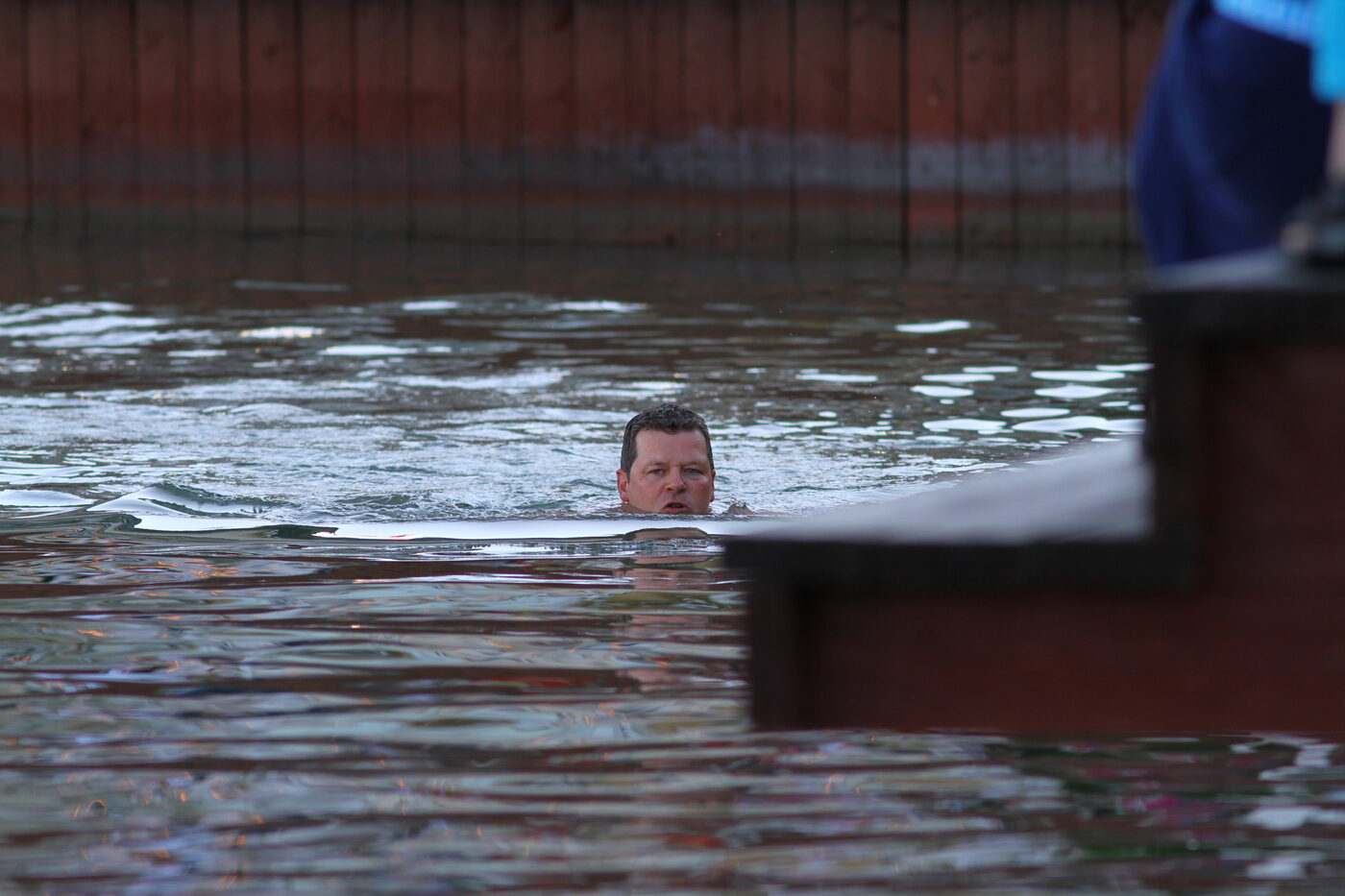
You cannot refuse an honour like this. He had thirty years in the town and a job playing the church organ, and a phone call told him that in a few days’ time several thousand of his neighbours were going to watch six former Sleepy Heads carry him down a pier on a stretcher and roll him into the Baltic, and his considered response was well, obviously I’ll do it. 😌
Then everybody has breakfast.
The rest of the day is a proper small-town summer festival, and it is deliberately gentle — the town leaned it that way in the 1990s to fit its family-holiday character. There’s a wake-up parade through the wooden lanes of the Old Town first thing, then a market, music, a children’s costume competition, and events along the waterfront and in the church park all day. Most of it is free. 🎪
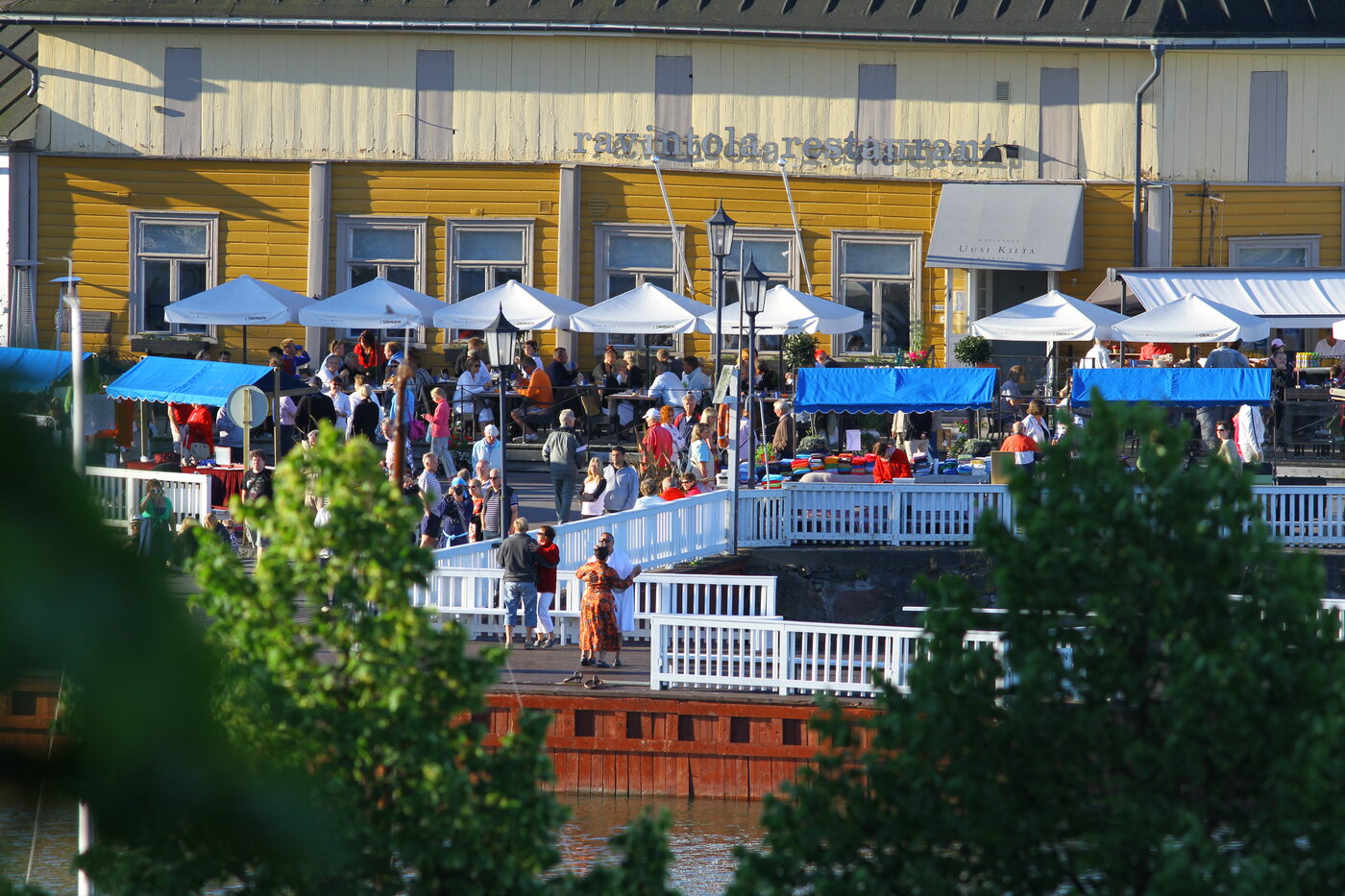
Naantali isn’t even alone in this any more. Hanko has had its own Sleepy Head Day since the 1960s. Salo has picked a Sleepy Head every year since 1983, and Heinola since 1995. The idea keeps spreading, because of course it does.
Why this lives on a good-news blog
Because of what the ceremony actually is, underneath the yellow blanket.
A town gets together in a committee. It thinks about who, this year, has quietly done something good for the place — kept the harbour running, played the organ for thirty years, taken care of the president’s garden, showed visitors around, been a decent mayor. It picks that person. And the way it says thank you, the highest civic honour Naantali has to give, is to carry them to the sea at eight o’clock in the morning in front of everybody and drop them in.
There is no statue. There is no plaque. There is a stretcher, a yellow blanket, six former honourees in matching caps, a couple of thousand of your neighbours, and the Baltic.
Sleep in on 27 July and you will be lazy all year, they say. Be genuinely good to your town, and you’re getting wet either way. 😴💛


