

Here is something so obvious it’s easy to miss: in the entire history of humanity looking at the Sun — every sunrise, every telescope, every spacecraft — we had only ever seen it from the side.
Think about that for a second. The Sun is right there. It’s the most-looked-at object in the sky, the thing we build calendars and religions and sundials around. And yet for 4.5 billion years of Earth having a Sun, and for the entire run of human history staring up at it, we had only ever seen its middle. Its equator. Its face. Never the top. Never the bottom. Like knowing someone your whole life only ever from one fixed chair across the room. ☀️
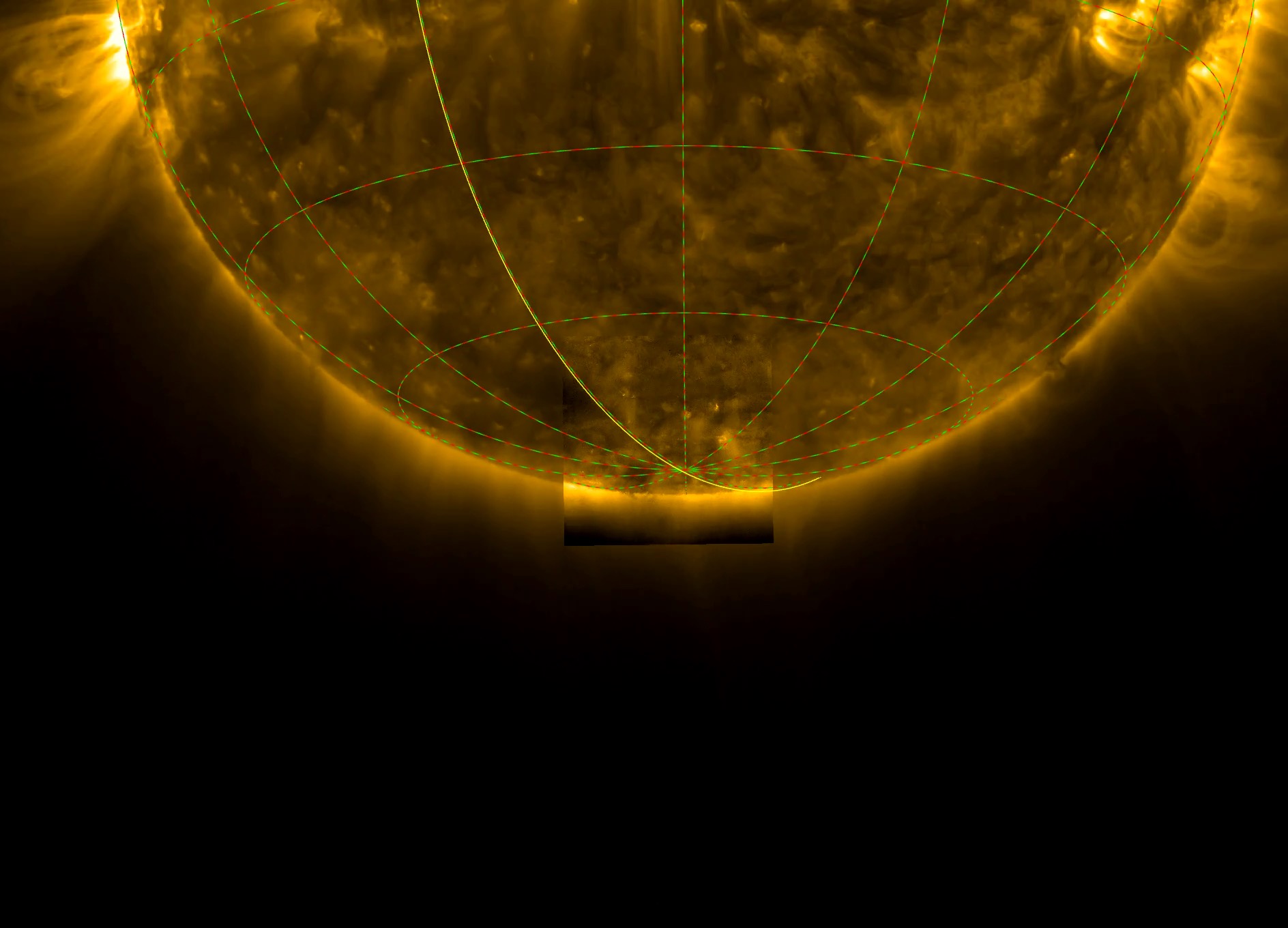
Then, in June 2025, the European Space Agency released a picture nobody had ever taken before: a look down at the pole of the Sun.
Why nobody had ever seen it
It isn’t that no one thought to look. It’s that looking is genuinely, physically hard — and the reason is a lovely bit of orbital geometry.
Everything in the solar system — Earth, the other planets, and basically everything we launch — travels in roughly the same flat plane, like marbles rolling around the rim of a very wide dinner plate. The Sun sits in the middle of that plate. So when you send a spacecraft to study it, that spacecraft naturally ends up going around the Sun’s equator, looking straight at its side. To get above or below — to look down at a pole — you’d have to climb up out of the plate entirely, and tilt your whole orbit. That takes a staggering amount of energy. It’s one of the hardest things you can ask a spacecraft to do.
So for decades, the Sun’s poles were simply a blind spot. We had guesses, models, sideways glimpses at a steep angle — but never a proper, straight-down photograph. The top and bottom of our own star were, quite literally, the last unseen faces in the neighbourhood.
How Solar Orbiter climbed out of the plate
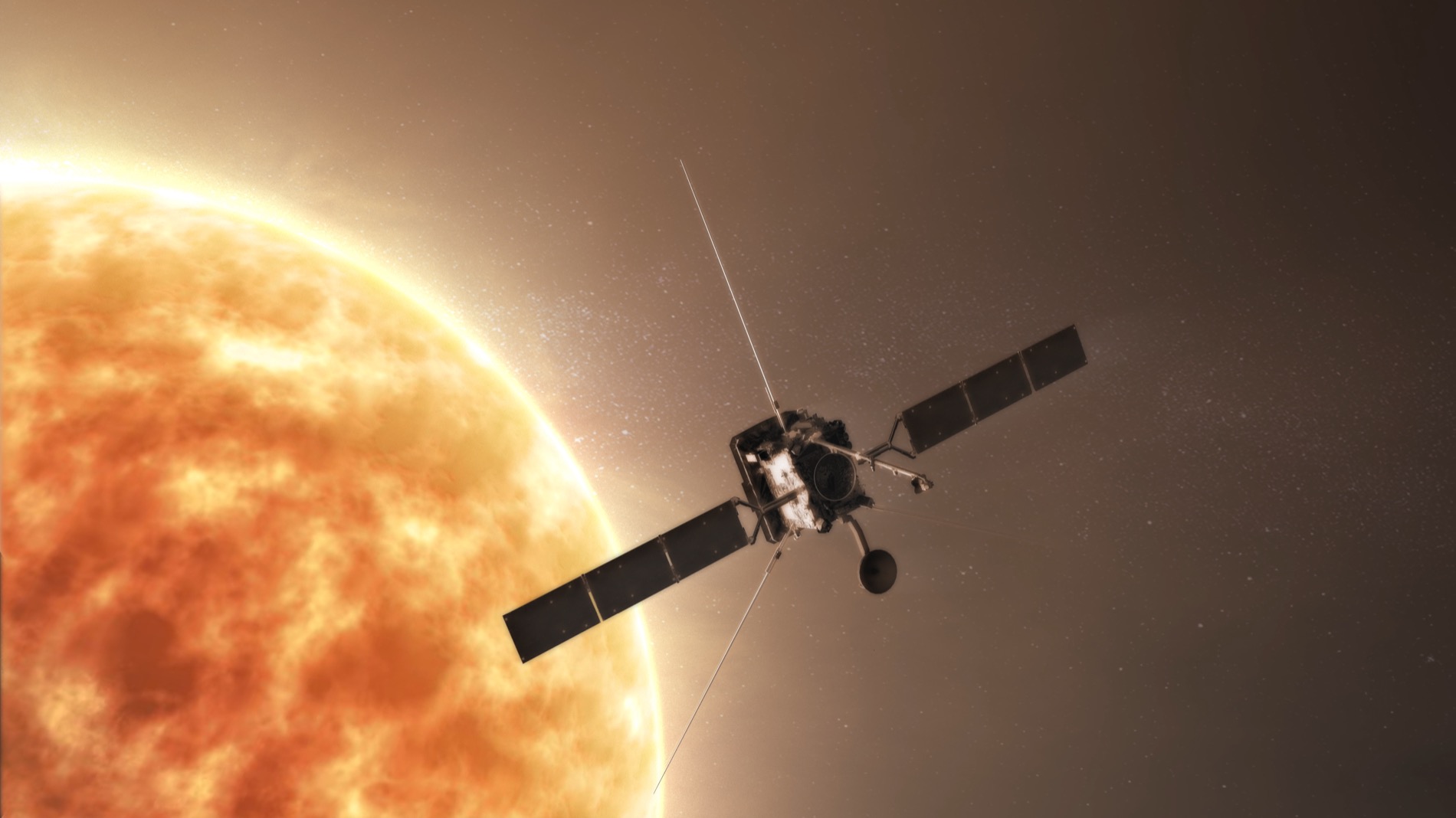
Solar Orbiter is an ESA mission (with NASA along for the ride) that launched in February 2020. And it solved the energy problem the same clever way the Parker Solar Probe did — not with a bigger rocket, but with a borrowed planet.
Every so often, Solar Orbiter swings past Venus and steals a little of the planet’s motion, using Venus’s gravity to nudge its orbit — not faster or slower this time, but tilted. Each flyby leans the orbit a bit further up out of the flat plane. It’s the patient trick again: you can’t shove your way above the Sun, so instead you lap the inner solar system for years, tipping your path a degree at a time.
By the Venus flyby of February 2025, Solar Orbiter’s orbit was tilted about 17 degrees below the Sun’s equator. Not a lot — but for the first time, enough. Enough to lean out over the edge and look down. On 16–17 March 2025, it pointed its cameras at the solar south pole and took the shots. ESA shared them with the world on 11 June 2025. 📸
Three cameras, one first look
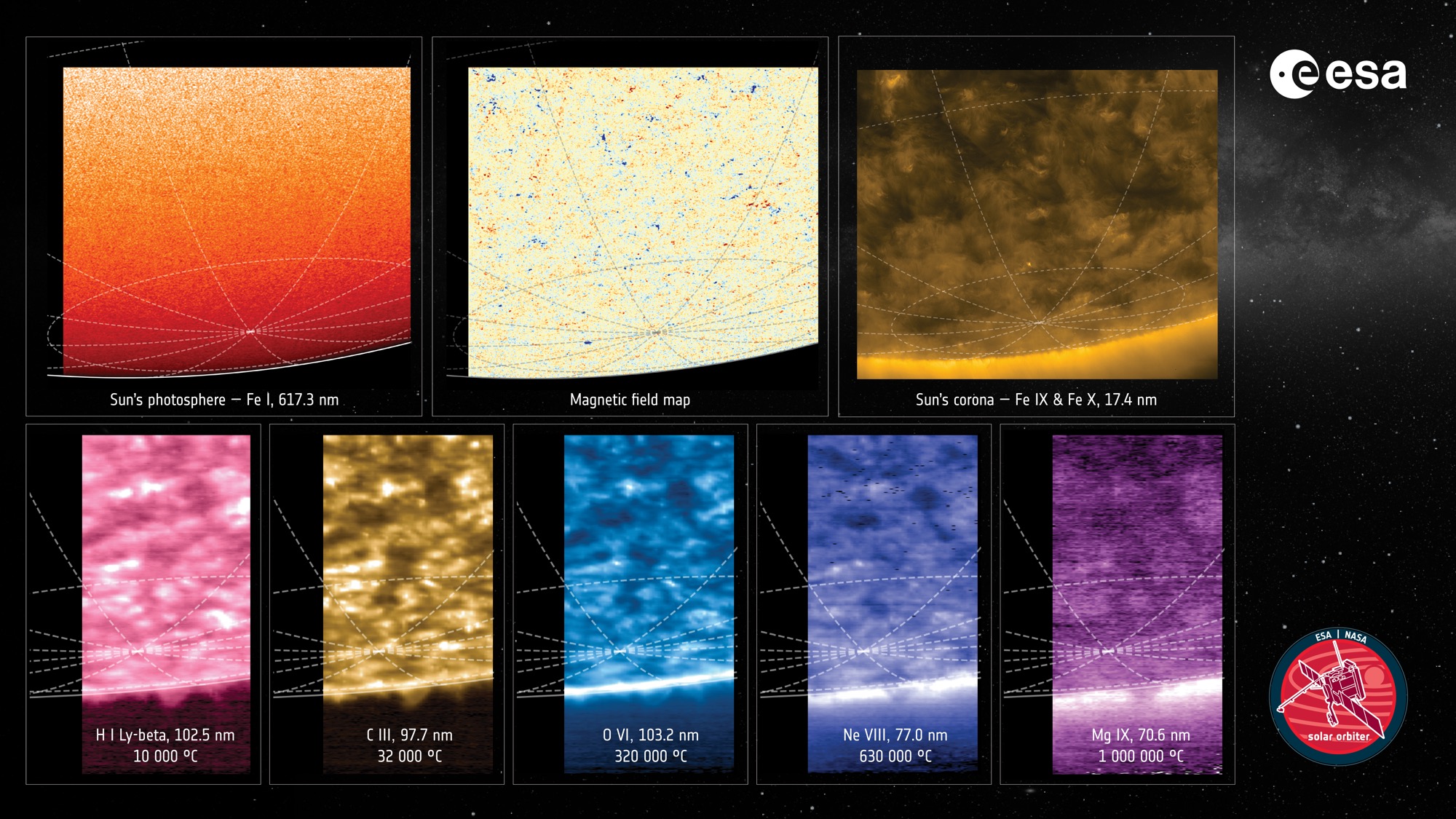
Here’s the part that makes it more than a pretty picture: Solar Orbiter didn’t just snap the pole — it studied it, with three different instruments at once, each seeing something the others can’t.
- PHI — the Polarimetric and Helioseismic Imager — reads the Sun’s magnetic field.
- EUI — the Extreme Ultraviolet Imager — sees the Sun’s atmosphere glowing in ultraviolet light.
- SPICE — maps temperature and motion, tracking how different gases move across the pole.
Put together, they don’t just show us what the pole looks like. They show us what it’s doing. The first-ever portrait of a place, and it arrived in full detail. 🔬
And the pole turned out to be delightfully messy
The very first look already told scientists something they’d hoped to catch: the south pole’s magnetism is, right now, a jumble.
You’d expect a pole to be tidy — one clear magnetic polarity, all north or all south, the way a bar magnet has a clean north end and south end. Instead, PHI found both polarities mixed up together down there, a patchwork of north and south crowded at the bottom of the Sun.
That mess is actually the whole point. The Sun runs on an 11-year cycle, and right now it’s near solar maximum — the rowdy peak when its magnetic field gets so tangled that the entire thing flips, north and south trading places across the whole star. Catching the pole in this jumbled state is like catching the Sun mid-cartwheel. Soon that chaos will settle, and a single clean polarity will take over the pole again — and, for the first time ever, we’ll have a spacecraft parked at the right angle to watch it happen. 🧲

It only gets better from here
The best part is that 17 degrees was just the first peek. Every future Venus flyby tips the orbit a little further: toward about 24 degrees by 2026, and possibly as steep as 33 degrees if the mission gets extended. Which means these first views — historic as they are — are the worst views of the Sun’s poles we will ever have again. From here on out, the angle only improves.
There’s a real scientific payoff waiting up there, too. The Sun’s poles are where a lot of its biggest mysteries live — how the magnetic field flips, how the solar wind streams out into the solar system, why the cycle keeps its steady 11-year beat. Answers to those help us forecast space weather, the solar storms that can rattle satellites and power grids here at home. So this isn’t just a new photo. It’s a new vantage point, on the object our entire world orbits.
Why this is on a good-news blog
Because it’s a reminder of how much wonder is still sitting in plain sight.
Not on some distant exoplanet. Not at the edge of the observable universe. The Sun. The most familiar object there is — the thing that has been shining on every person who ever lived — and it turns out we’d never once seen its bottom. There was a genuinely new thing to discover about the most-looked-at star in the sky, and all it took was the patience to spend five years tilting an orbit a few degrees at a time until we could finally lean over the edge and look down.
We’ve known the Sun our whole lives. In June 2025, we got to meet a part of it for the very first time. And the view is only going to get better. ☀️💛


