

Here is a thing that happens more often than you’d expect: somebody wants to do an ordinary job, discovers that the ordinary method is completely impossible where they happen to be standing, and invents something new by refusing to give up. Usually the invention is forgotten. Occasionally it becomes a whole category.
This is the story of the second kind. It starts with a shortage of ice. ☁️
The problem: German brewers, Californian weather
When the Gold Rush emptied half the world into San Francisco in 1849, a great many of the arrivals were German — and a great many of those knew how to brew. They brought the knowledge, and they brought lager yeast, which by then was the pride of Bavarian brewing.
There was just one catch, and it was a big one. Lager is a cold process. Lager yeast likes to work somewhere around 48–58 °F (9–14 °C), and the traditional lagering that follows happens colder still — close to 37 °F (3 °C), for weeks or months. In Bavaria you got that from deep cellars and mountain ice, cut in winter and packed in sawdust.
Gold Rush California had none of it. No mountain ice trade, no deep cold cellars, no refrigeration worth the name — and a fortune’s worth of thirsty miners who wanted a beer now. Ice was so scarce it was shipped around Cape Horn as a luxury good.
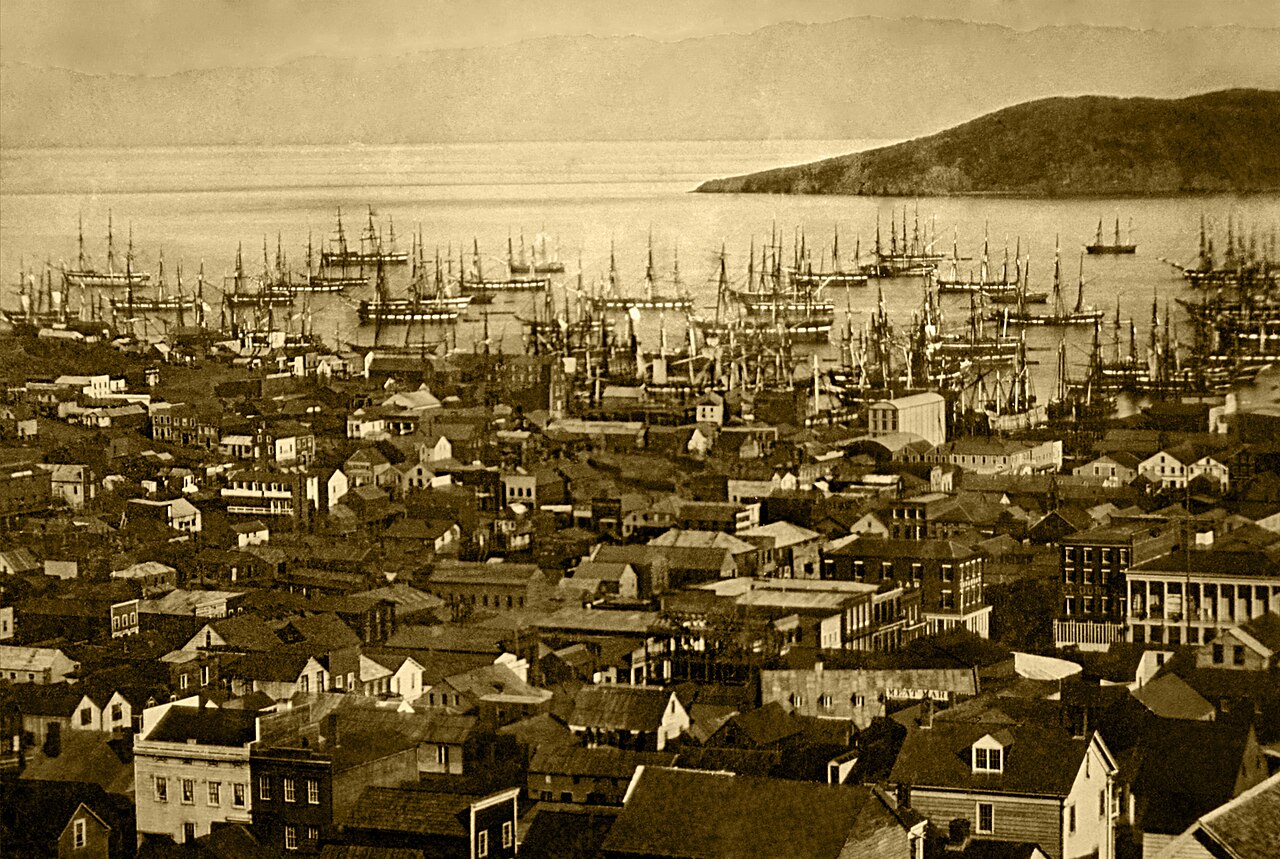
So the brewers did the sensible, slightly heretical thing. They kept the lager yeast — and let it ferment warm anyway, at the temperatures you’d normally reserve for ale.
Why that’s such a strange thing to do
Beer’s flavour comes enormously from which yeast you use and how warm you let it work. The two families are genuinely different animals:
- Lager yeast, worked cold and slowly, gives you something clean, crisp and restrained.
- Ale yeast, worked warm and fast, throws off fruity, spicy, characterful notes.
Steam beer refuses to pick a side. It takes lager yeast and runs it hot, and what comes out is a beer with a foot in each camp — the crisp, dry, grainy backbone of a lager wearing some of the fruity liveliness of an ale. Brewers call the result a hybrid, and there aren’t many honest ones.
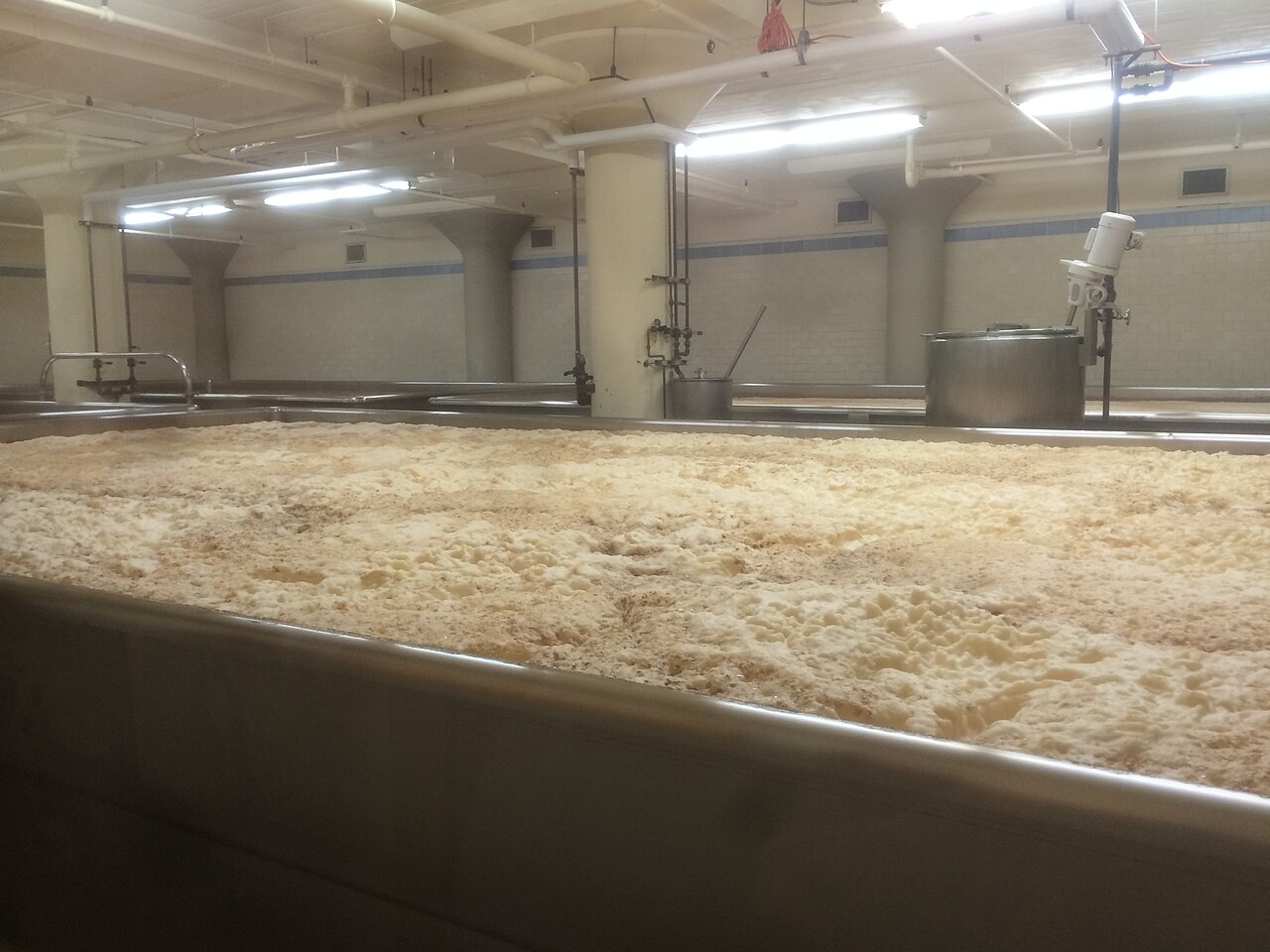
To shed all that extra heat without a refrigerator, the brewers went wide instead of deep: big, shallow, open-topped pans with an enormous surface area, so the warmth could simply rise off the top and leave. It is the least high-tech solution imaginable, and it works beautifully.
So where does “steam” come from?
Wonderfully, nobody actually knows. This is one of those bits of history where the honest answer is a shrug and three good guesses:
- The rooftop clouds. The most-repeated story, and the one Anchor Brewing itself told: with no way to chill the boiling wort, brewers pumped it up to shallow open bins on the roof, where the cold Pacific air did the cooling. On a foggy San Francisco night, a brewery working like that would sit under its own visible plume of steam. You could find the brewery by looking up.
- The very lively keg. Steam beer carbonates vigorously, and a nineteenth-century cask of it built up serious pressure — enough that you’d want to let off some “steam” before pouring, unless you enjoyed wearing your beer.
- The German cousin. There’s a traditional Bavarian style called Dampfbier — literally “steam beer” — also fermented unusually warm. Plenty of San Francisco’s brewers were German. The name may simply have travelled in someone’s luggage. (Though Dampfbier is an ale, so it isn’t quite the same beast.)
They’re all plausible, and they may all be a little bit true. A style invented by improvisation got its name the same way.
It was, emphatically, the cheap stuff
Let’s be clear about the social position of this beer, because it’s the best part. Steam beer was not a delicacy. It was the everyday drink of people doing hard work. The 1902 American Handy Book of Brewing and Malting — a serious industry textbook — filed it under refreshment for the working day, calling California steam beer “a very clear, refreshing drink, much consumed by the laboring classes.”
It shows up in the literature exactly where you’d expect. Frank Norris’s 1899 San Francisco novel McTeague opens with its hero fetching a pitcher of steam beer on a Sunday afternoon; later, his new wife’s campaign to civilise him includes swapping his steam beer for bottled. Jack London, remembering his teenage years setting up pins in a San Francisco bowling alley, notes that a glass of steam beer cost the saloon far less than the ginger ale he’d rather have had — and that ordering the ginger ale marked him out.
That’s a beer woven into a city’s ordinary weekday, which is a lovely thing for a beer to be.
The brewery that carried the torch
The thread runs through one building. A German brewer named Gottlieb Brekle was making steam beer in Gold Rush San Francisco; in 1896 his old brewery was bought by Ernst F. Baruth and his son-in-law Otto Schinkel Jr., who named it Anchor.
What followed reads like a stress test. The 1906 earthquake fires destroyed the place — rebuilt in 1907. Prohibition shut it — reopened in 1933. The new site burned down in 1944 — moved again. By the 1960s, with America’s beer drinking consolidating into a few enormous brands, Anchor was on its last legs; it had closed once already in 1959, and the beer had a reputation for turning sour.
Then in 1965, a young man named Fritz Maytag — of the washing-machine family — bought 51% of the brewery for a few thousand dollars, essentially on the grounds that it would be a shame to let it die. He had to learn brewing more or less from scratch, replace the equipment, and fix the sanitation. Production in 1969 was 800 barrels — a rounding error by industrial standards. Bottling didn’t begin until 1971, in four-packs, priced to sit near a mainstream six-pack.
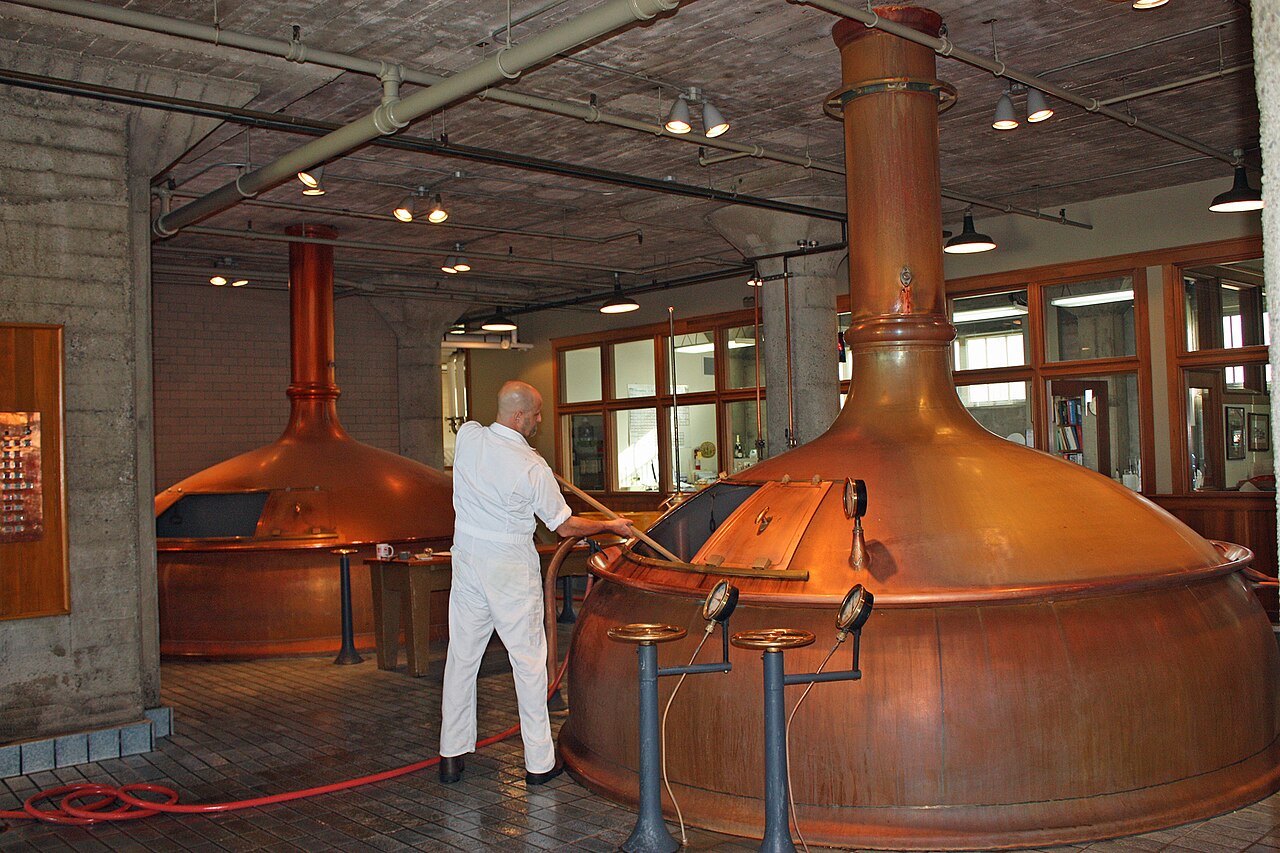
It worked. Through the 1980s the beer went national, and a tiny San Francisco brewery making an old local oddity turned out to be the template a whole generation copied. Anchor is routinely described as one of America’s first modern craft breweries, and its example directly encouraged others — New Albion among them — to try the same improbable thing.
A couple of details from that era are too good to leave out. When the 1989 Loma Prieta earthquake interrupted a batch mid-brew, the altered beer was released anyway, with its label printed upside down — collectors still call it Earthquake Beer. And in 2019, Anchor’s workers voted to unionise, making it the first unionised craft brewery in the United States.
An honest note about what’s in the glass
Here’s a piece of intellectual honesty the brewery itself insisted on: modern Anchor Steam was never claimed to be a faithful reproduction of the 1890s stuff. It’s a modern, carefully made craft lager in a historic idiom. The nineteenth-century original was a rougher product, often made with corn, grits or glucose alongside malt, and coloured to an amber shade. The style is a living tradition, not a museum piece — and the people who revived it said so out loud rather than selling a fairy tale.
Also worth knowing: “Steam Beer” is a registered trademark, held by Anchor since 1981. Which is why brewers and judges everywhere else use the generic name for the style — California common. Same beer, different paperwork. As a style it’s amber to light copper, built on toasty, bread-crust malt, hopped with woody, faintly minty Northern Brewer, and finishing dry and crisp.
Where things stand now
The recent chapters have been bumpy, and it would be dishonest to tidy them up. Anchor was sold to Sapporo in 2017, and in July 2023 it closed — after 127 years — to genuine public grief, with drivers reportedly shouting “keep brewing” at the building as they passed. The workers tried to buy it themselves as a co-operative.
In May 2024 the brewery and its assets were bought by Hamdi Ulukaya, the founder of Chobani, who said he intended to restart it and keep it in San Francisco. Progress has been quiet — licences secured in early 2025, then a long stretch of not much, enough that one trade outlet wrongly reported the brewery was leaving the city and had to publish a correction and an apology after the owners confirmed the San Francisco plans stand. As of mid-2026 the fairest summary is the one a local paper landed on: dormant, but not departed — with the beloved old illustrated labels reported to be heading back, and former staff publicly asking to be first in line when the lights come on.
So: not a tidy ending. A pause, with a lot of people watching the door.
Why this is on a good-news blog
Because the style is no longer anyone’s to lose. 🍻
That’s the quietly cheerful part. California common outgrew the company that trademarked it. It’s a defined, documented style that brewers across the United States and beyond make under their own names — and it’s a favourite of home brewers precisely because it’s forgiving: the yeast is happy at room temperature, which means you don’t need a cold cellar. Which means, rather beautifully, that the beer invented by people who had no way to keep things cold is now kept alive by people who still have no way to keep things cold, in kitchens and garages, on purpose.
A hundred and seventy-odd years ago some homesick brewers at the edge of a continent couldn’t get ice, shrugged, and let the Pacific fog cool their beer on the roof. They were only trying to get through the week. They accidentally left behind one of the very few beer styles this hemisphere can call its own — and then handed it, free, to anybody patient enough to try. The world does that sort of thing all the time. ⚓💛
(A note on this one: steam beer is an adult beverage, and we’ve written it up the way we’d write up any regional craft — for its history, its place and the people who made it. If you’re not of age, the far better souvenir here is the physics: wide shallow pans lose heat fast. That works for soup, too.)
Got a piece of hometown ingenuity that came out of a shortage? Sign the guestbook and tell us about it. ☁️


