

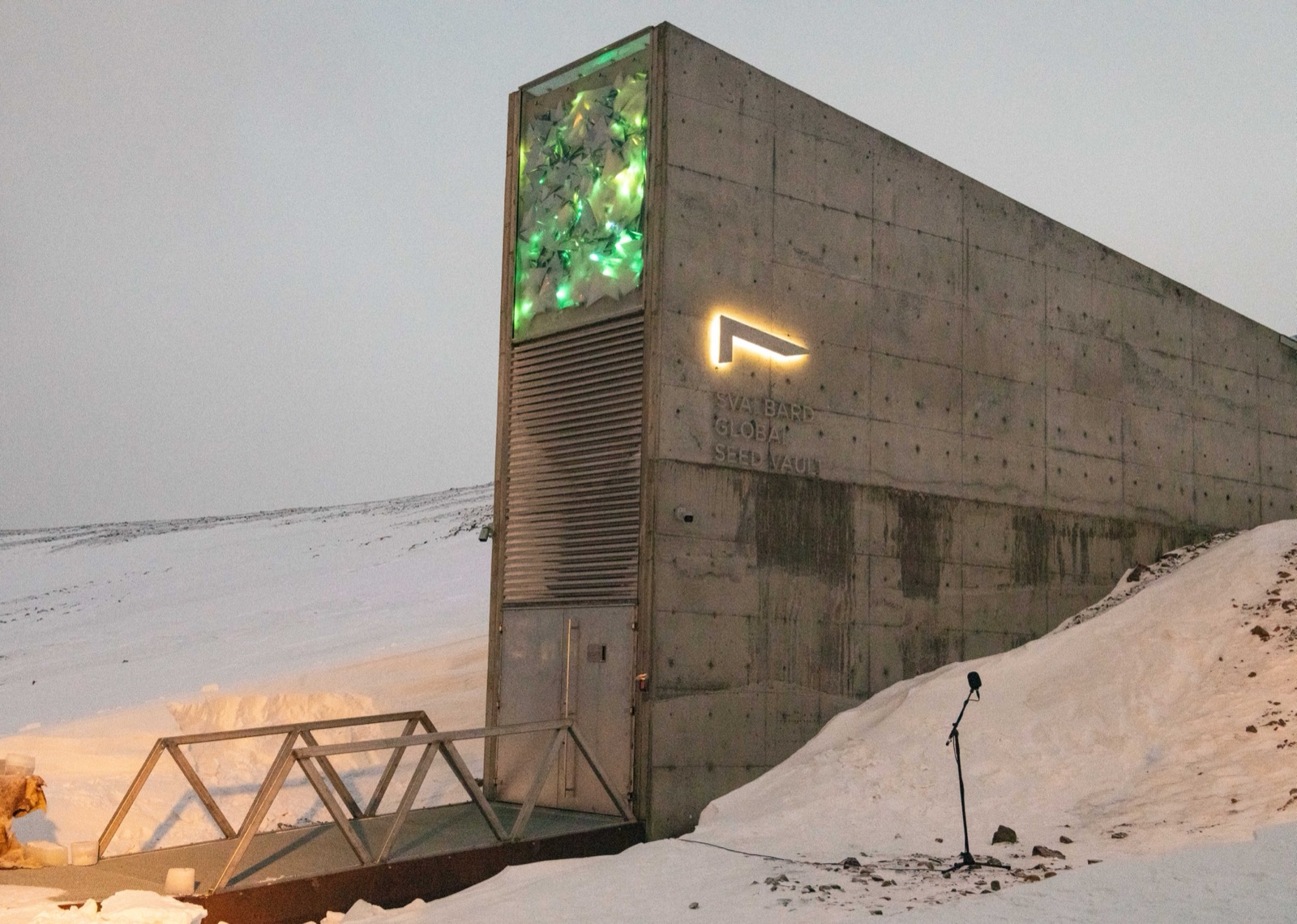
Picture the least dramatic superhero headquarters imaginable. No lasers. No staff. Just a single grey concrete wedge poking out of a snowfield near the top of the world, glowing faintly at its tip, with a door that stays shut almost every day of the year.
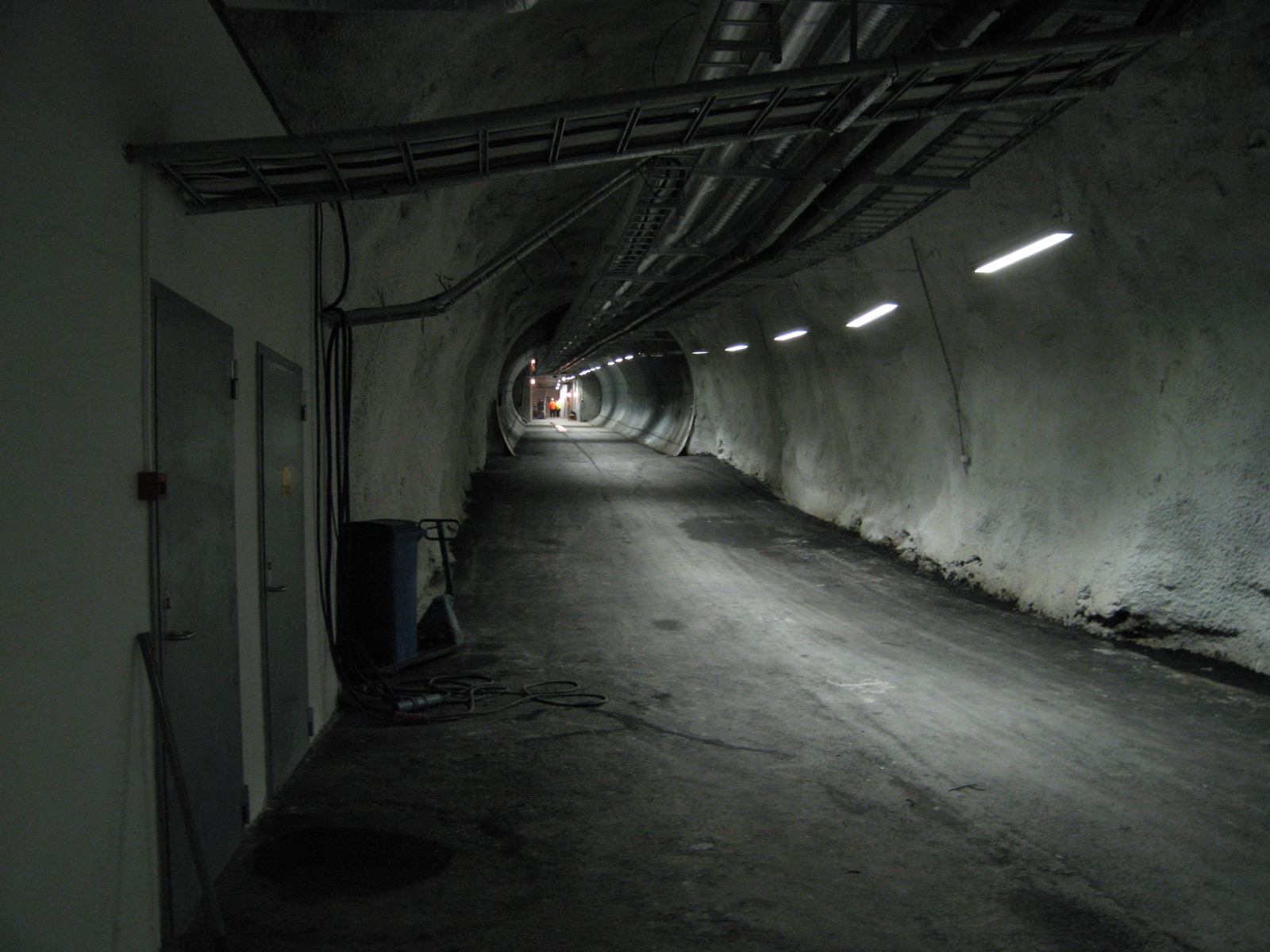
That wedge is the Svalbard Global Seed Vault, and behind its door — down a 130-metre tunnel bored straight into an Arctic mountain — is one of the quietest, kindest ideas humanity has ever committed to concrete: a free, frozen backup of the world’s food supply, held in trust for everyone, forever. 🌱
A safe-deposit box for crops, on top of the world
The vault is dug into a sandstone mountain on Spitsbergen, the main island of Norway’s remote Svalbard archipelago, roughly 1,300 km (800 mi) north of the Arctic Circle. This spot was chosen on purpose, and the reasons read like a checklist for “somewhere nothing bad happens easily”:
- No tectonic activity — the ground doesn’t shake.
- Permafrost — the mountain is naturally frozen, so the seeds stay cold even without help.
- 130 m above sea level — high enough to stay dry even in a worst-case scenario where the world’s ice caps melt.
Inside, refrigeration units chill the air to the internationally recommended seed-storage standard of −18 °C. And here’s the beautiful engineering detail: the cooling is really just a bonus. If every machine switched off tomorrow, the surrounding rock would keep the chambers below freezing for weeks, and estimates say it would take about two centuries just to creep up to 0 °C. The mountain itself is the real refrigerator. 🧊
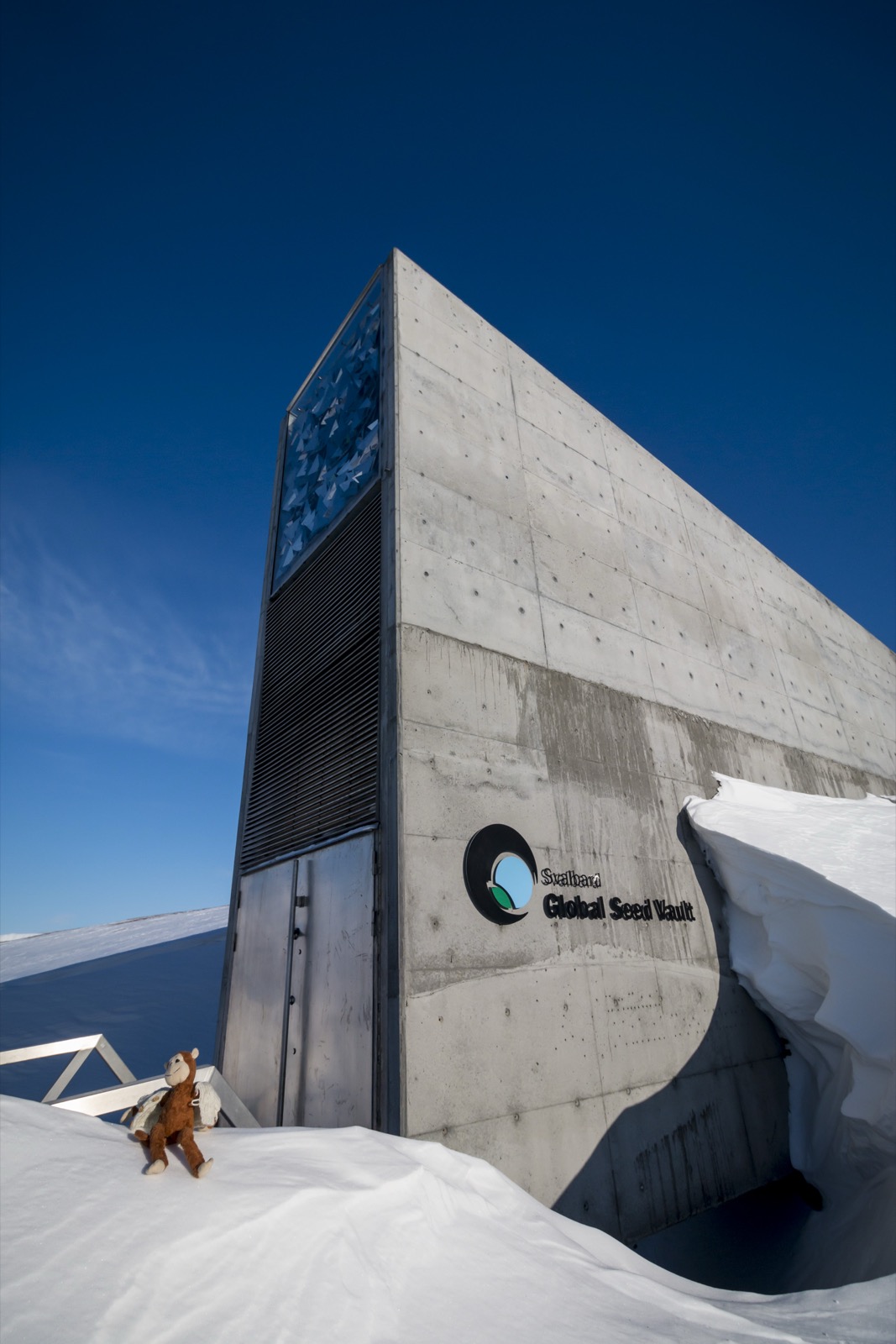
That soft glow along the roof isn’t a security light — it’s art. Norwegian law requires publicly funded construction projects to include public artwork, so the vault’s roof and entrance carry an installation called Perpetual Repercussion by artist Dyveke Sanne: highly reflective steel, mirrors and prisms that catch the endless polar summer light, and in the dark winter months, a network of 200 fibre-optic cables that give the whole tip a muted greenish-turquoise shimmer. Even the backup plan for civilization gets to be a little bit beautiful.
What’s actually inside: 1.35 million tiny insurance policies
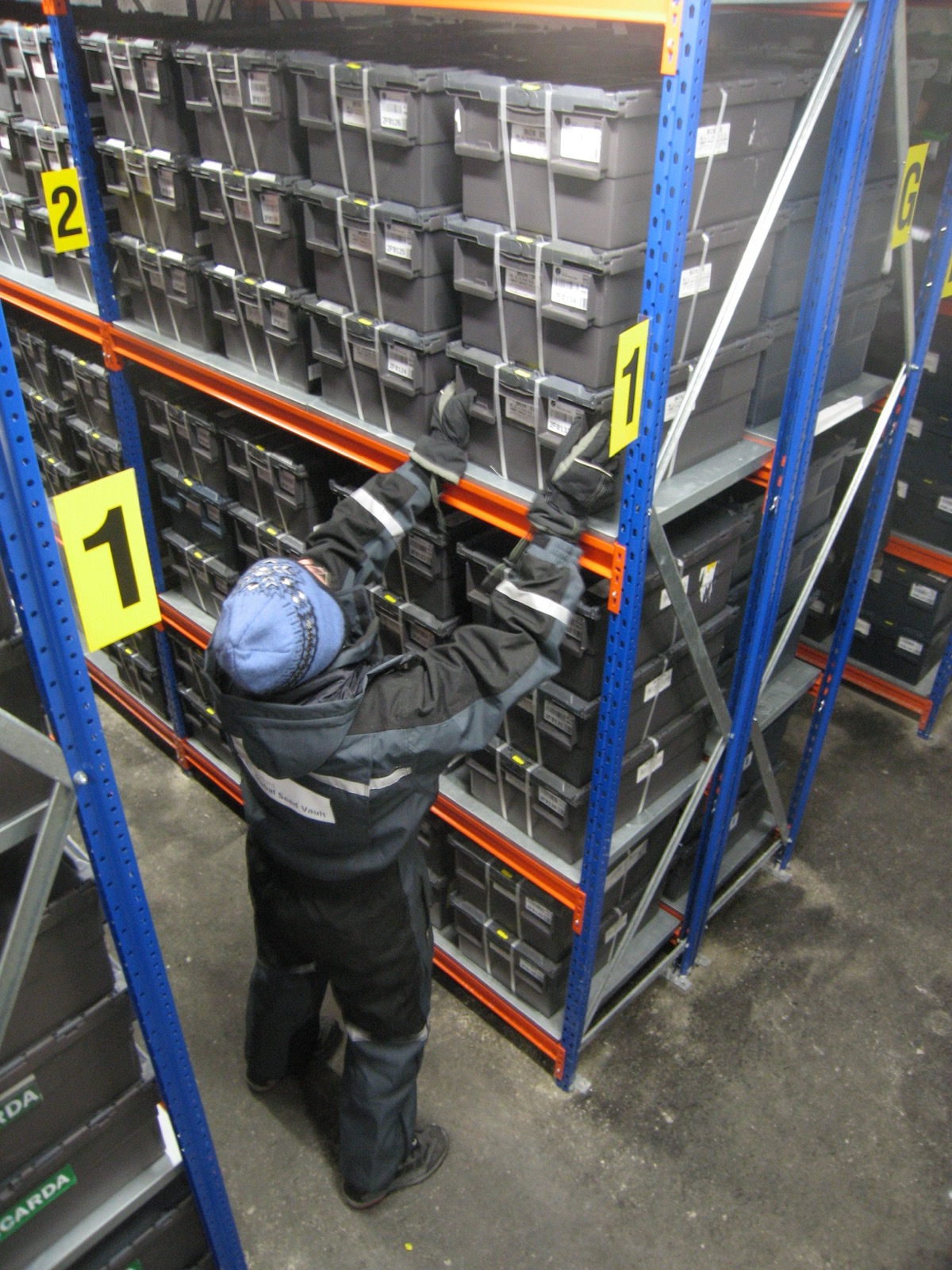
Walk down the tunnel and you reach the storage chambers, where the seeds sit sealed in foil packets, tucked into labelled boxes on ordinary metal shelving. It looks less like a doomsday bunker and more like the world’s most important stockroom.
As of June 2025, the vault holds 1,355,591 seed samples — each “accession” being a distinct variety of a crop, from staple grains to beans, potatoes, rice, and wildflowers you’ve never heard of. Together they represent more than 13,000 years of agricultural history: every one is the outcome of countless generations of farmers selecting, saving, and passing on the plants that fed them.
Crucially, the vault is a backup, not a museum and not a bank vault of treasures. Every sample here is a duplicate of seeds already held in one of the world’s roughly 1,750 gene banks. Those local gene banks are the front line; Svalbard is the copy you keep off-site in case the original is lost. And gene banks do lose things — to funding cuts, equipment failures, floods, fires, and war. The national gene banks of Afghanistan and Iraq were lost entirely; the Philippines’ was hit by flooding and then fire. Svalbard exists so that “lost locally” never has to mean “lost to the world.”
The part that makes it a good-news story: it’s free, and it’s for everyone
Here’s the detail that turns a clever piece of infrastructure into something genuinely moving.
The Norwegian government paid the entire construction cost — about US$8.8 million — and, together with the international Crop Trust, covers the running costs (a modest ~US$282,000 a year in 2019). Depositing seeds is completely free. There is no invoice, no membership tier, no fine print about who gets in.
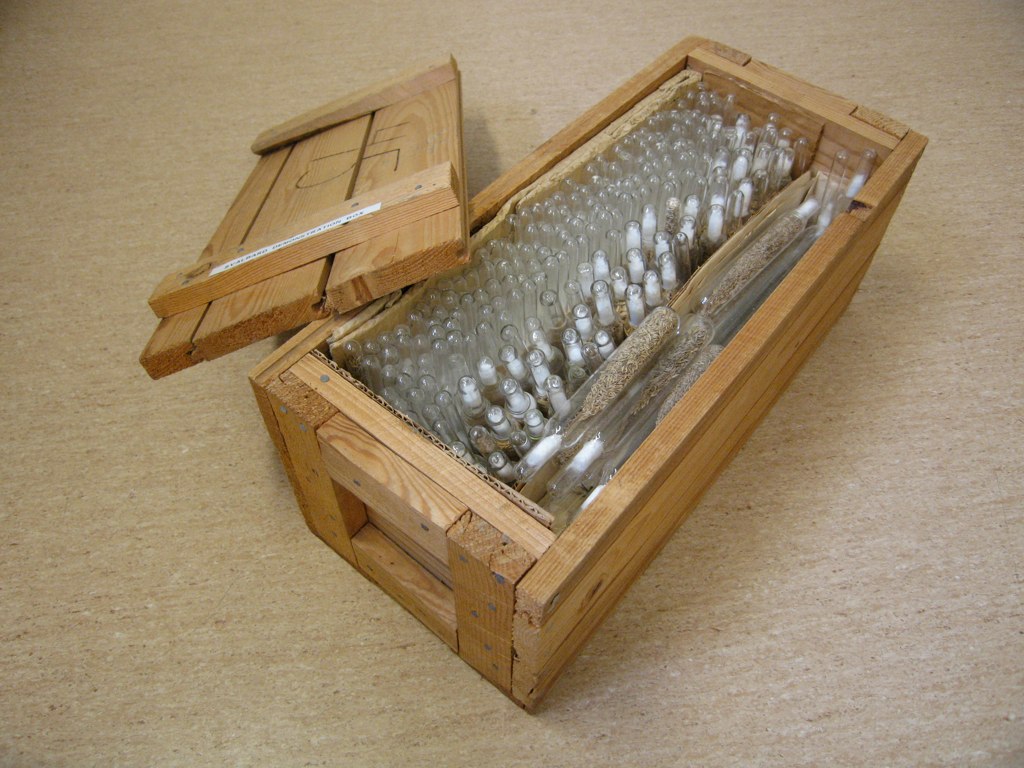
And you don’t hand your seeds over. It works like a safe-deposit box: depositors keep full ownership of everything they send. Only the depositor can withdraw their own samples — Norway can’t open someone else’s boxes, and never has. The whole thing runs on a tripartite agreement between the Norwegian government (which owns the vault), the Crop Trust (which funds operations), and the Nordic gene bank NordGen (which runs it and keeps the public database). Norway even forbids storing genetically modified seeds there.
So a wealthy nation dug a vault into one of the safest places on the planet, filled it with the most advanced cold-storage anyone could ask for, and then said to every country on Earth: send us a copy of your crops, we’ll keep them safe for free, and they’ll always be yours. Frame it however you like — it is, unmistakably, an act of enormous planetary optimism. 💛
The one time it really mattered
For years the vault just sat there, frozen and patient, doing nothing visible — which is exactly what a good backup does. Then, in 2015, it was called on for the first time.
The international agricultural research center ICARDA had run a major gene bank in Aleppo, Syria, holding priceless drought-tolerant varieties of wheat, barley, and lentils bred for a warming world. The Syrian civil war forced the center to abandon the city. But because ICARDA had faithfully sent duplicates to Svalbard, the collection wasn’t gone. Researchers made the vault’s first-ever withdrawal, pulled out their backed-up seeds, and used them to regrow the collection at new facilities in Lebanon and Morocco. Once re-established, they sent fresh duplicates back to Svalbard to refill the shelves.
That’s the whole idea, proven in real life. The seeds went in as insurance nobody hoped to use. When catastrophe came, the backup was there, it worked, and a body of knowledge that took generations to build was quietly restored. 🌾
Even the setbacks turned into good engineering
In 2016, unusually warm weather and heavy rain pushed meltwater about 15 m into the entrance tunnel before it froze. Headlines briefly panicked. But the vault had been designed to shrug off water intrusion, and the seeds — 100-plus metres deeper and well above the tunnel floor — were never at any risk. Norway’s public-works agency responded not with a shrug but by waterproofing the tunnel, removing heat sources, and digging drainage ditches in 2019, making an already-safe vault safer. The system met a stress test and came out stronger.
Why this lives on a good-news blog
Because it is a standing monument to long-term kindness — the rare kind of project built not for this quarter or this election but for the next thousand years, and given away for free.
Think about what the Svalbard Global Seed Vault actually is. It’s dozens of nations, including ones that agree on almost nothing else, all quietly mailing copies of their most precious crops to a frozen mountain so that a bad harvest, a broken freezer, or a war on the far side of the planet can never erase what farmers spent 13,000 years growing. It asks for nothing in return. It has no staff to impress and no visitors most days. It just keeps 1.35 million small promises cold and safe, so that whatever happens, the world can always plant again.
Somewhere near the North Pole, behind one shut door, humanity keeps a spare. And every single one of us is on the guest list. 🌱💛


