

Stand in the right patch of woods in Great Smoky Mountains National Park, on the right two weeks of the year, after the light has fully gone. You can’t see your own hands. You can hear a creek somewhere below you and a great many insects that are not doing anything visible yet.
Then the whole forest switches on. ✨
Not one firefly. Not a scatter. Thousands, across the hillside, in the trees, low over the leaf litter — all lighting up in the same instant, five to eight quick pulses each, so the dark fills up with floating yellow punctuation. And then, together, they stop. Complete blackout, for about eight seconds. Long enough that you start to wonder if that really just happened.
Then they do it again.
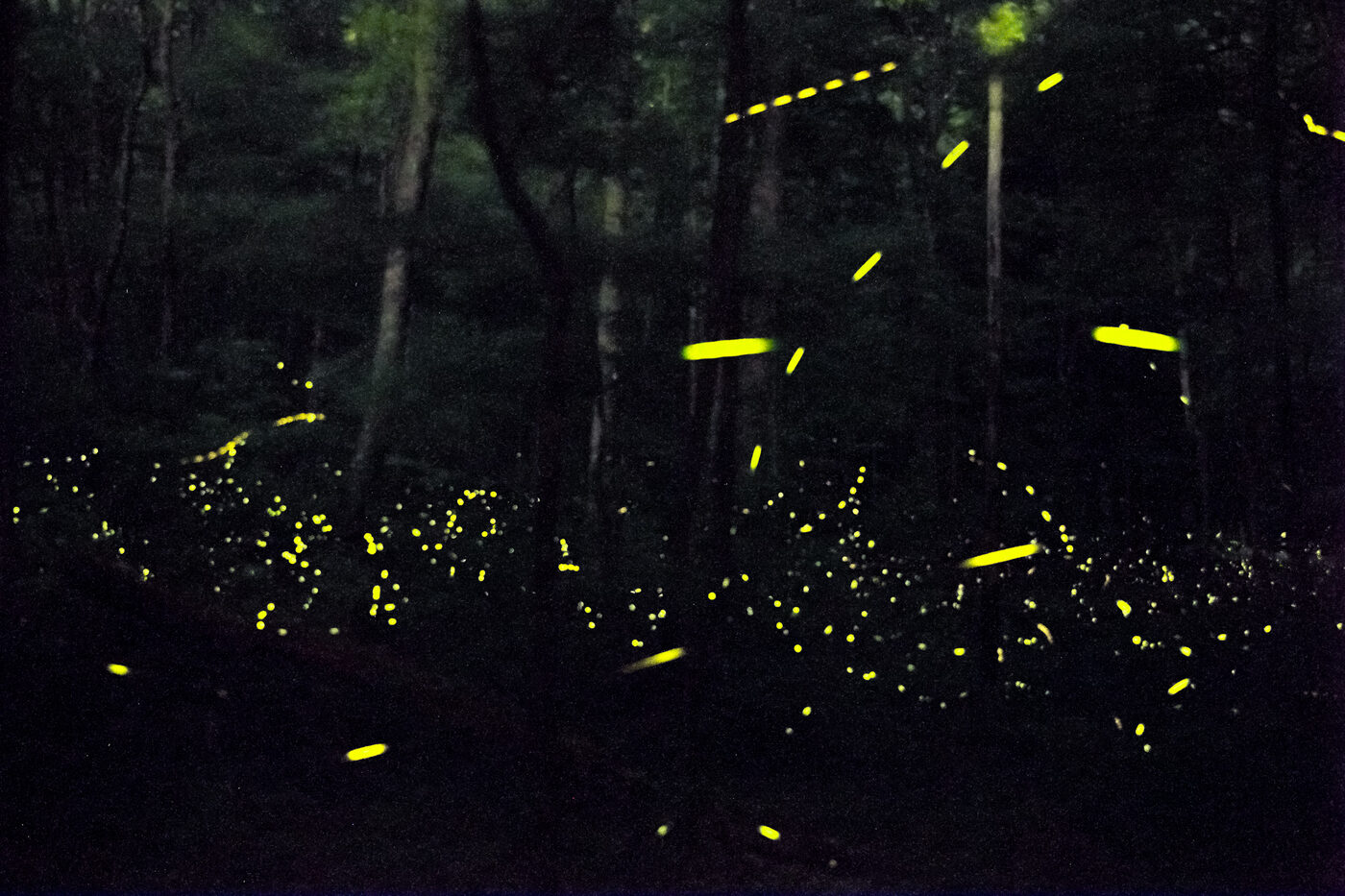
The display, exactly as it happens
The insect responsible is Photinus carolinus, a firefly about the size of a grain of rice, and the display it puts on is much stranger and more specific than “the woods sparkle.”
Here is the pattern. A male flies up out of the leaf litter and flashes five to eight times in quick succession — a little burst, like someone tapping out a word. Then he goes dark for roughly eight seconds. Then he does it again.
On its own, that’s a nice bit of insect behaviour. The remarkable part is that he is not the only one doing it, and they are all doing it at the same time.
Early in the evening it looks disorganised — a few insects flashing whenever, out of step, no rhythm to hold on to. Then more males join. And as they join, the timing tightens. Bursts start landing on top of each other. Within a while the whole hillside is running one clock: flash-flash-flash-flash-flash — dark — flash-flash-flash-flash-flash — dark. The pauses are the part nobody expects. A forest that’s merely full of fireflies never goes completely black. This one does, on the beat, over and over. 🖤
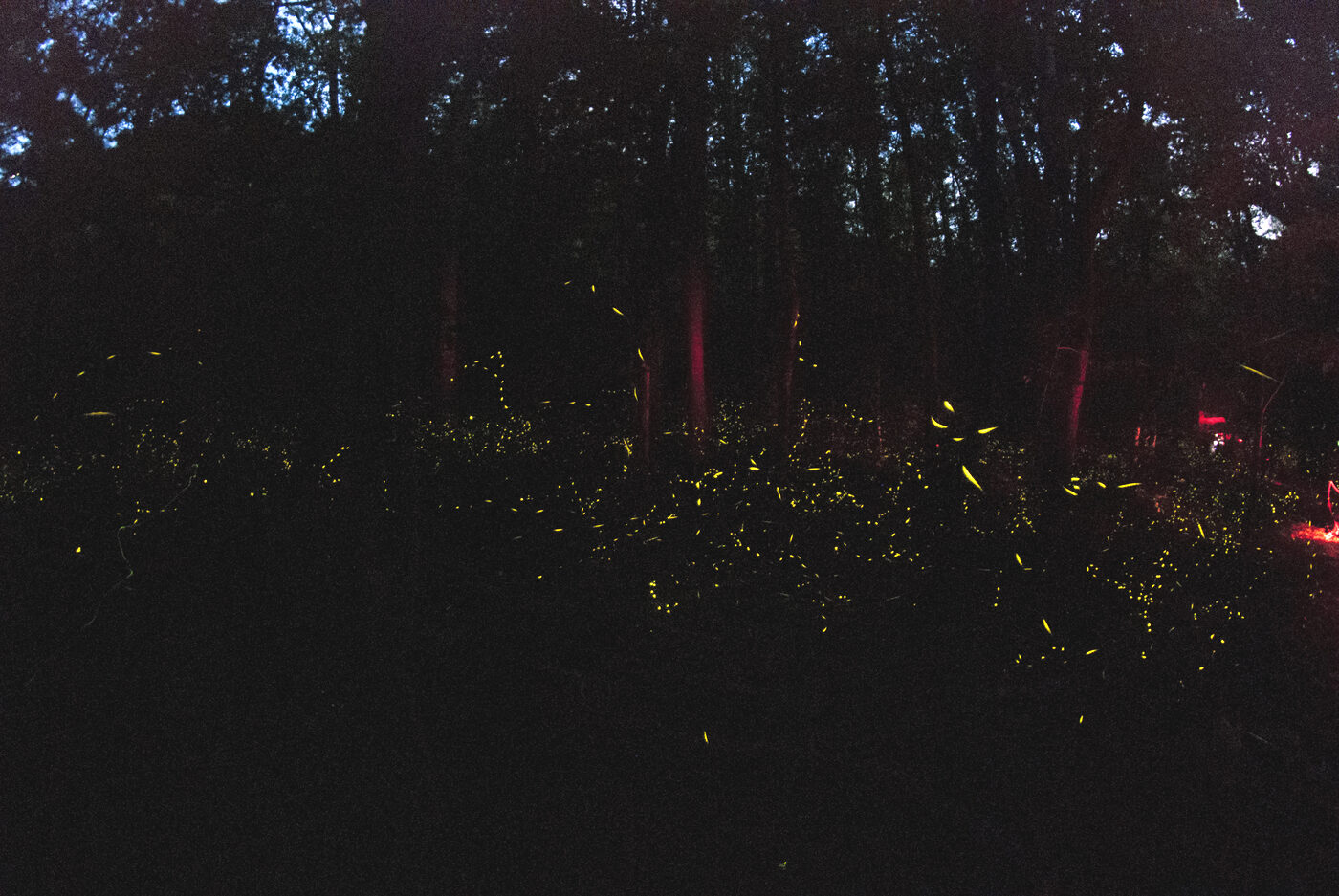
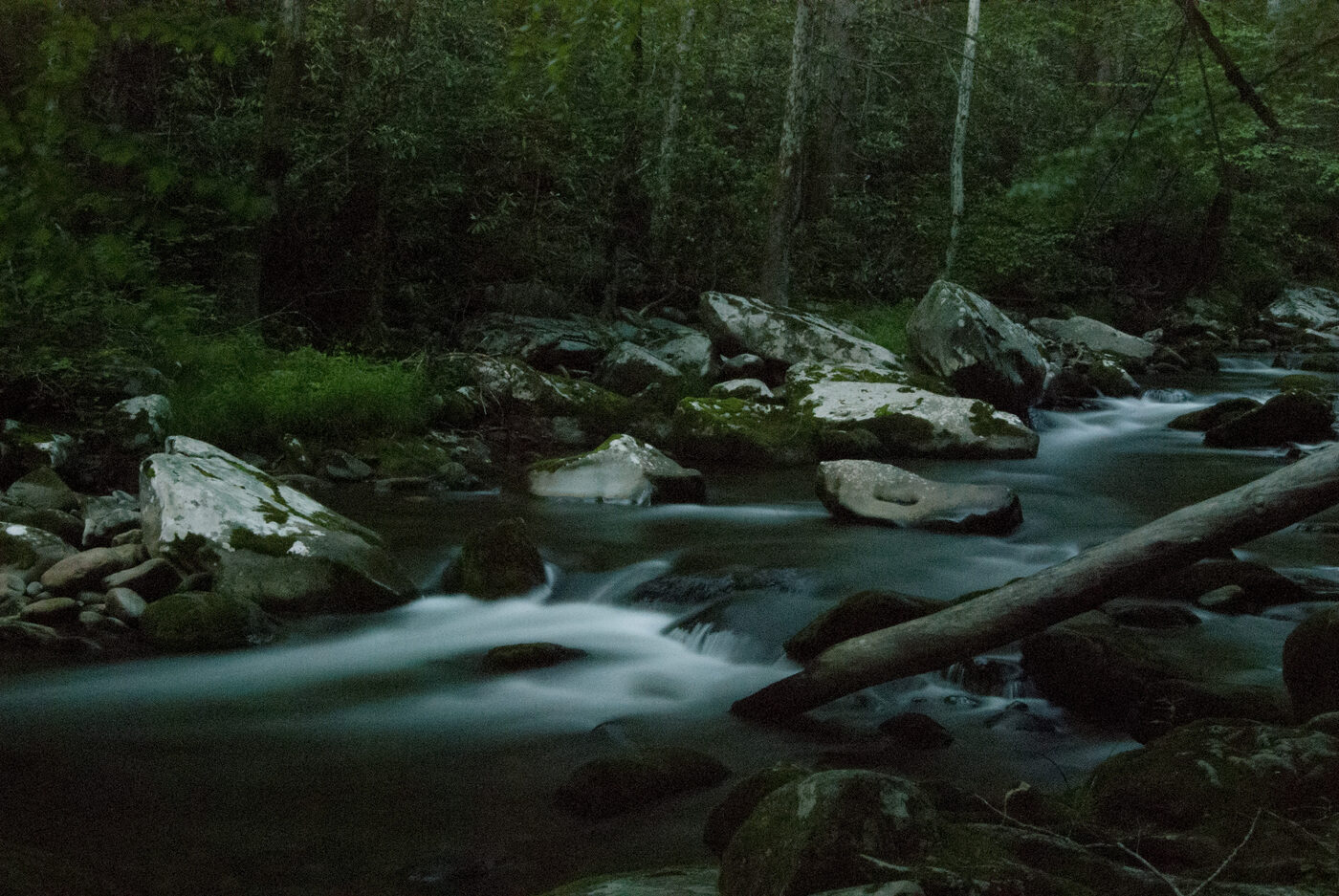
And for the other fifty weeks of the year, this is just a normal, pretty, extremely quiet Appalachian valley. Elkmont sits on the Little River, all rhododendron and mossy boulders and cold water. You could walk through it in daylight and never guess it has a night shift.
Nineteen species, one dark room
So: why bother synchronising? Why not just flash?
Start with the problem. Great Smoky Mountains National Park is home to 19 species of firefly. Nineteen. And every one of them is doing the same basic thing on the same summer nights — males signalling in the dark, females watching from the ground and answering the ones they like.
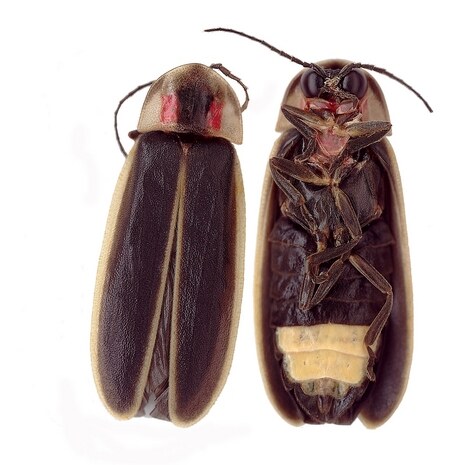
That’s a crowded room. Nineteen conversations in nineteen languages, in the dark, all at once, and getting the language wrong is genuinely costly: some fireflies eat other fireflies, and a few are notorious for faking another species’ signal to lure a meal in. A female needs to be sure before she answers.
Each species handles this with a distinctive flash pattern — its own dots and dashes. But P. carolinus appears to go further, and this is where the researchers are careful, so we will be too.
The best-supported explanation is that the synchrony is a signal-to-noise fix. A single male’s burst is easy to miss and easy to mistake. A whole hillside of males flashing the same burst at the same moment is unmistakable — and, crucially, the shared eight-second pause leaves a clean silence for the much dimmer females on the forest floor to answer into. There’s research suggesting females only respond once enough flashing has built up, and that they reply during the gaps. Talk together, then all shut up together so you can hear the reply.
That’s a protocol, not decoration. Collision avoidance and a reserved channel, worked out by beetles.
The honest caveat: the National Park Service says plainly that the behaviour is not yet fully understood, and that’s the right way to hold it. For a long stretch of the 20th century, some scientists insisted the synchrony wasn’t even real — an accident, or an illusion of the human eye. It wasn’t documented in proper detail until 2021, when Orit Peleg and Raphael Sarfati of the University of Colorado Boulder set two cameras a few metres apart in the middle of a swarm and reconstructed the flashes in three dimensions. What they found is lovelier than perfect unison: the insects don’t all fire at the exact same instant. The burst moves through the swarm as a fast cascading wave, each firefly taking its cue from the handful of neighbours it can actually see. Nobody is conducting. It just looks conducted, from where you’re standing.
A season nobody gets to schedule
The display runs for about two to three weeks a year, and that’s it. Show up in July and there is nothing to see.
You can’t pin it to a date, either, because the fireflies aren’t using a calendar — they’re using the ground. The park predicts the peak from soil temperature and moisture, and it drifts. Since 1993, the recorded peak has landed anywhere from the third week of May to the third week of June. Cold nights below about 50 °F thin the display out. Heavy rain can stop it. Mist, charmingly, does not bother them at all.
So the park watches the dirt, works out its best guess for the year, and announces the viewing window a few weeks ahead. Which brings us to the human part of this story, which is my favourite part.
The lottery for parking spaces
Word got out, as word does. Enough people wanted to stand in that dark cove that the crowds themselves became the threat — trampling, traffic, headlights washing out the very thing everyone had driven there to see. Female P. carolinus sit on the forest floor, which means an off-trail footstep is not a small thing.
The Park Service’s answer was not to close it. It was to run a ballot.
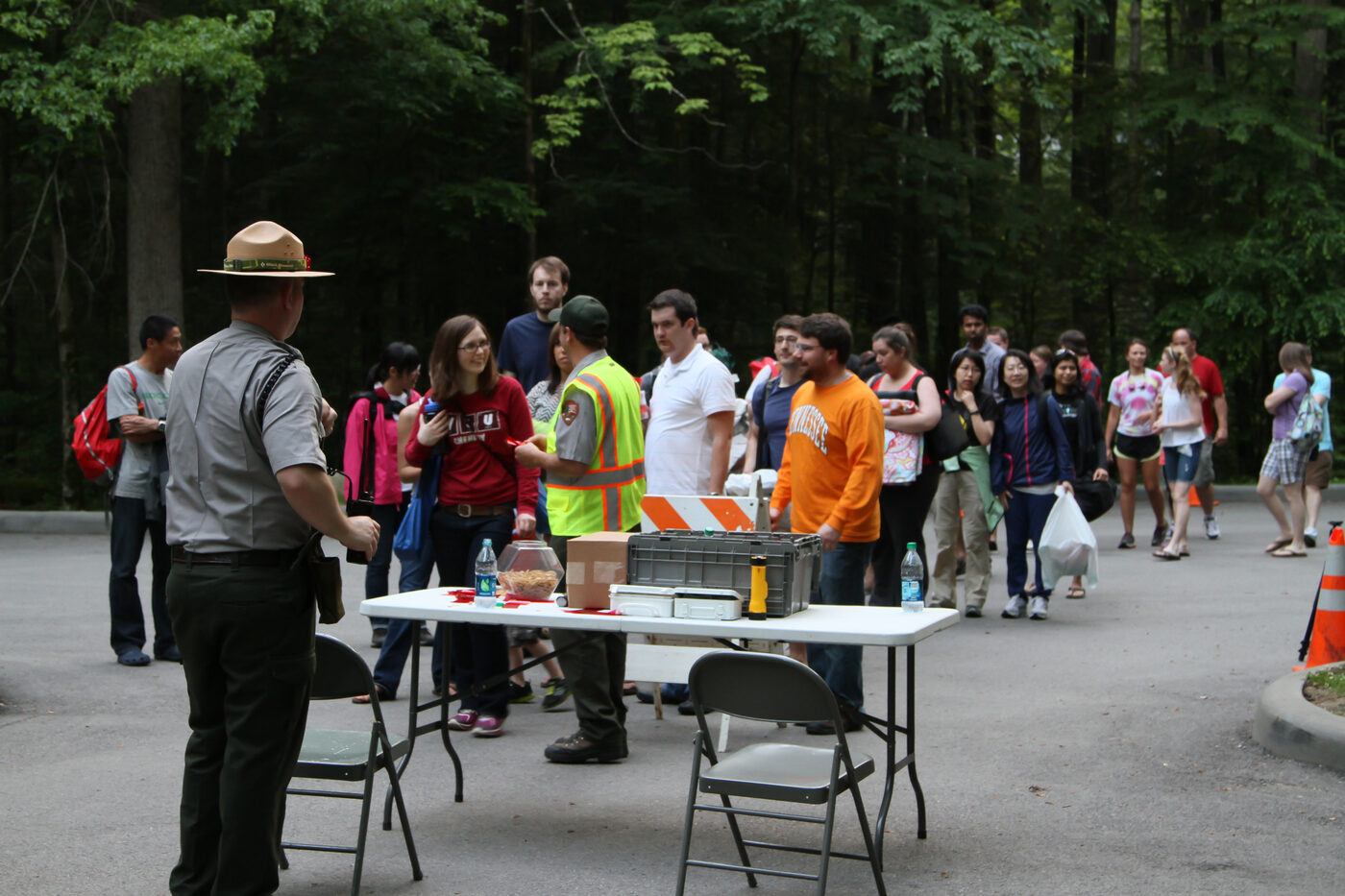
Every spring, Recreation.gov opens a short application window — a few days in late April — for vehicle reservations to the Elkmont viewing area during that year’s eight-night window. You pick a preferred night and an alternate. Entry costs a dollar; if you win, the reservation itself is a further fee that goes toward staffing and running the evenings. Then you wait to find out. Most people don’t get in. Most people enter again next year.
During those nights Elkmont is closed after dark to everyone except reservation holders and registered campers, and the whole thing runs on shuttles and good behaviour.
I want to sit with that for a second. A national park has to operate a randomised ballot for parking spaces because so many human beings want to go and quietly watch insects blink. Not a stadium. Not a band. Beetles, in the dark, after everyone’s bedtime. And the demand is so far past the supply that the fairest available system is a hat with everyone’s name in it.
That is a good fact about people. 💛
The red flashlight rule
Here’s the detail that turned me completely soppy about this.
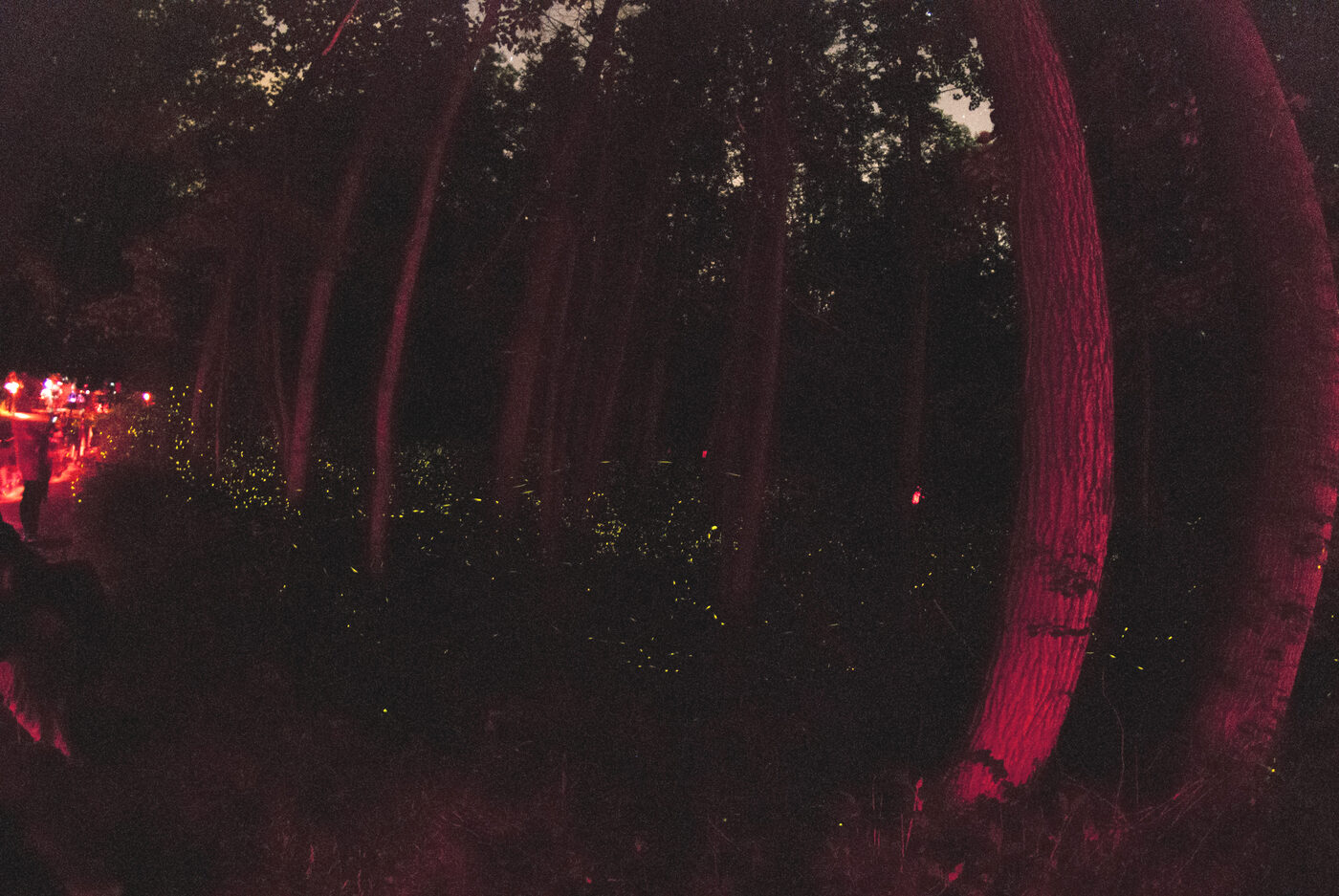
Everybody who goes brings a red flashlight — or tapes red cellophane over an ordinary one, in layers, until it’s dim. The park asks you to use it only while you’re walking in, point it at the ground, and then switch it off entirely once you’ve found your spot.
Not because white light is rude to the other visitors, although it is. Because white light drowns out the fireflies’ conversation. You standing there with a phone torch is, from a firefly’s point of view, someone blasting an air horn through a first date.
So a few hundred people, most of whom have never met, stand in a pitch-black forest in near silence, each holding a torch they have deliberately made worse, so that some beetles can hear each other. There’s no enforcement mechanism for this beyond everyone agreeing it’s the right thing to do. And everyone does it.
Why this lives on a good-news blog
Because the light itself is already a small marvel — luciferin, oxygen, and an enzyme called luciferase, mixed in a two-segment lantern on the underside of an insect, giving off almost pure glow and essentially no heat. A firefly is a better lightbulb than a lightbulb.
Because that insect spends one to two years as a larva in the leaf litter eating snails, and then gets three or four weeks as an adult, many of them never eating again — and it spends those weeks solving a coordination problem in mid-air with thousands of strangers.
And because of the shape of the whole thing: a forest works out a protocol; people find out about it; so many people want to see it that it needs a ballot; and the ones who win the ballot show up and turn their own lights red so as not to interrupt.
The world is also doing this: going completely dark for eight seconds, all together, on purpose, somewhere in Tennessee, for two weeks a year. ✨🖤✨
Go deeper (real links, no pop-ups, promise)
- 🔦 National Park Service: Synchronous Fireflies at Great Smoky Mountains — the authority on the season, the etiquette, and the lottery
- 🎟️ Recreation.gov: Firefly Viewing lottery — where the ballot actually happens, each spring
- 🪲 Firefly Conservation & Research: Synchronous fireflies
- 📻 CBC As It Happens: scientists on how fireflies flash in unison


