

Somewhere north of the Arctic Circle this afternoon, a cone of shadow about 293 kilometres wide touches the top of the world and starts moving. It crosses the Arctic, sweeps over Greenland, and at 17:43:28 UT it makes landfall on Earth’s most photogenic doorstep: Straumnes lighthouse, on the Hornstrandir peninsula in the Icelandic Westfjords, where about a hundred puffins and however many people got there first will suddenly be standing in the dark.
Then it keeps going. Down across Iceland, out over the Atlantic at roughly 3,400 km/h, and about thirty-five minutes later it comes ashore in northern Spain — with the Sun sitting low and orange over the western horizon, which is not how most people picture an eclipse at all. 🌑
This is mainland Europe’s first total solar eclipse since August 1999. About fifteen million people live inside the path, most of them Spanish. Something like a billion more — across Europe, north Africa and the northern half of North America — can step outside and see the Moon take a bite out of the Sun.
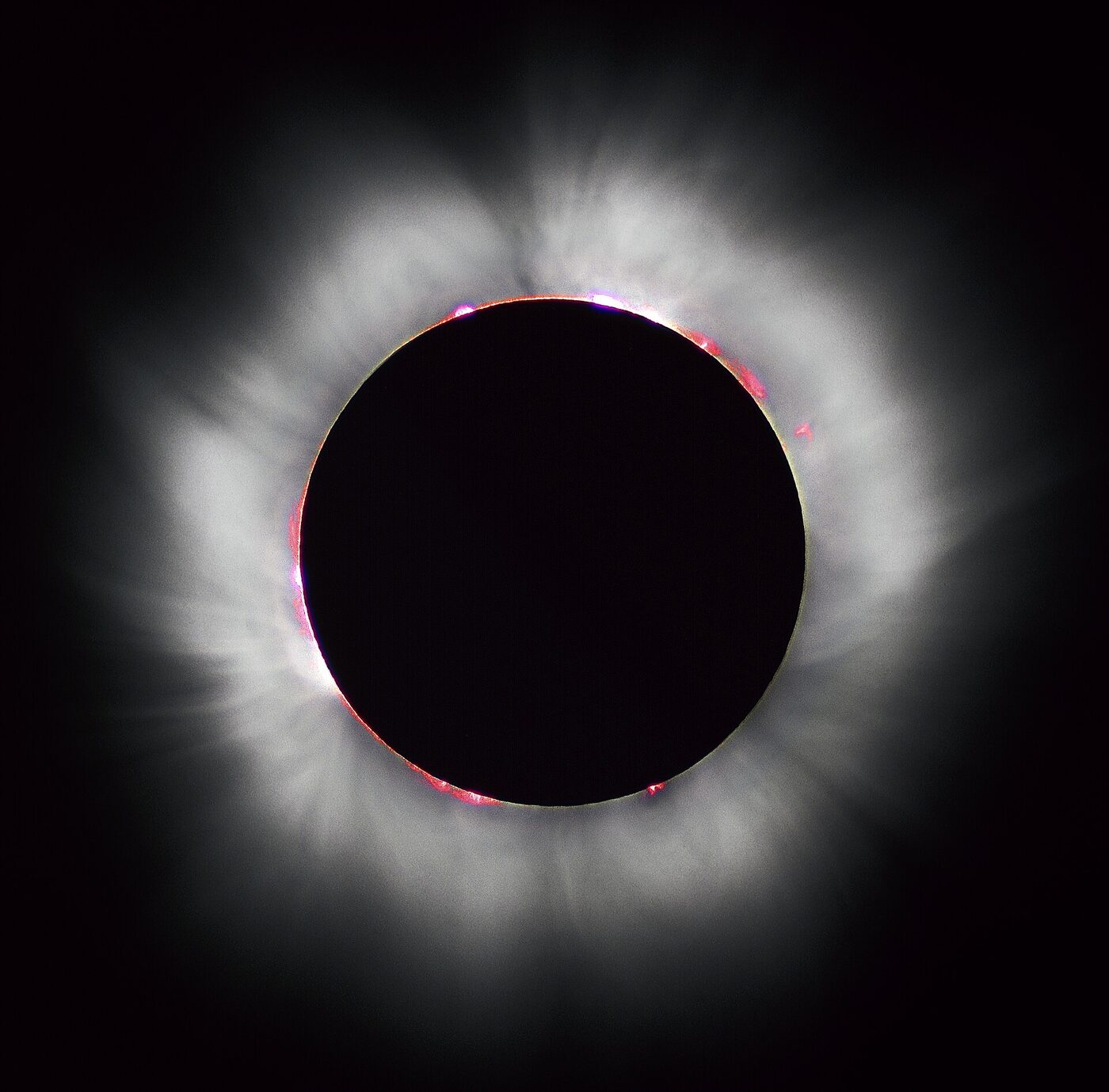
What’s happening today
Greatest eclipse — the instant the shadow’s centre comes closest to the middle of the Earth — is at 17:47 UTC, which is 1:47 p.m. US Eastern and 12:47 p.m. Central. The whole performance, from the shadow first touching Earth to leaving it, lasts about 1 hour 36 minutes.
The longest anyone gets is 2 minutes 18 seconds of totality, and — of course — the very best seat is unoccupied: it’s in the open ocean, about 44.7 km west of Látrabjarg, Iceland. The sea gets the good ticket. It usually does.
Everything about today comes from one very old, very well-behaved coincidence. The Sun is about 400 times wider than the Moon and also about 400 times further away, so the two discs come out almost exactly the same apparent size in our sky. Line them up perfectly — which needs a new moon, at the right point in a tilted orbit, at the right distance — and the Moon covers the Sun exactly, leaving the Sun’s outer atmosphere hanging there in the daytime like something you weren’t supposed to see.
There is no reason for that to be true. It just is, right now, in the era we happen to live in. 🌗
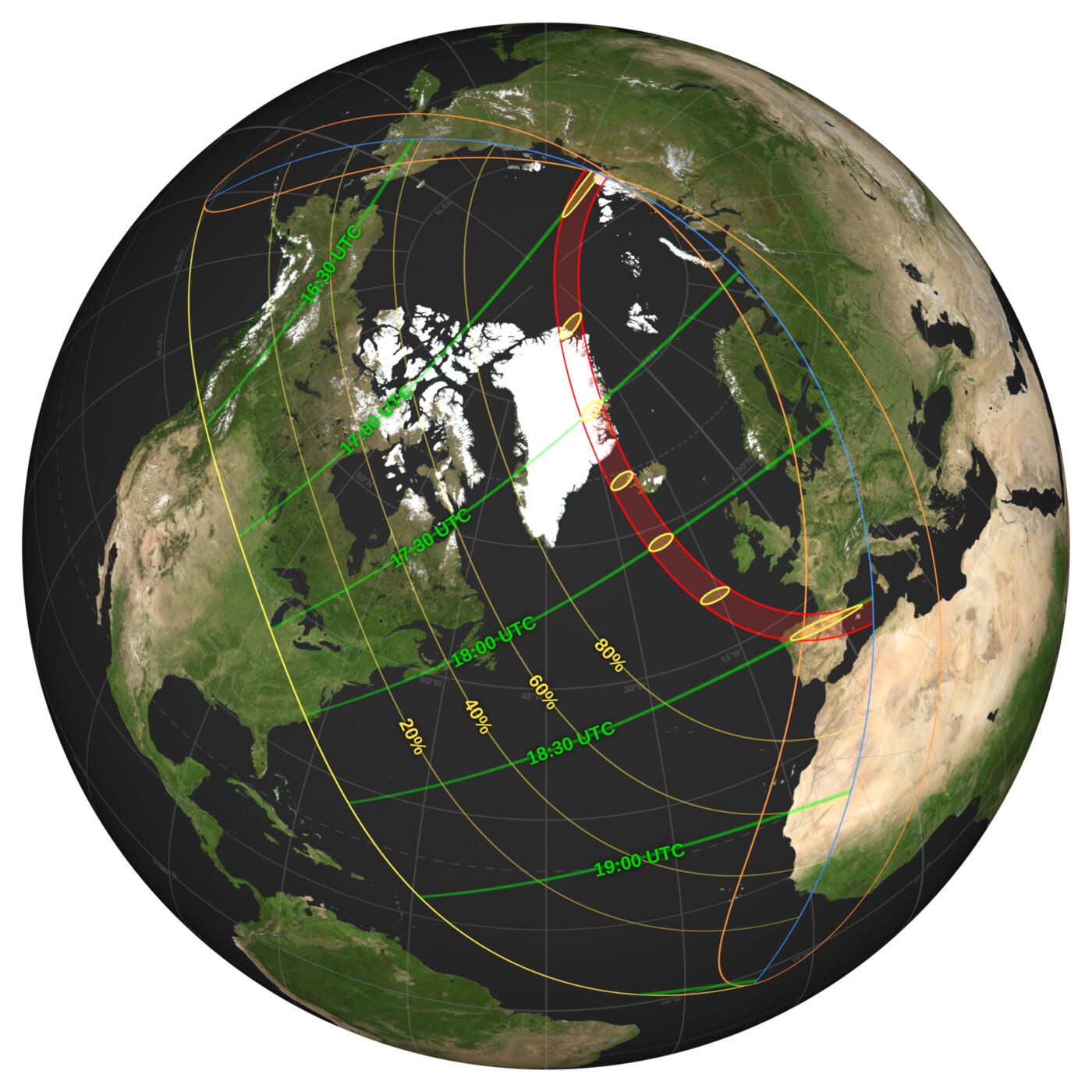
Where — the actual places, and when
Iceland gets it first, and only the westernmost sliver of the country is inside the path.
- Straumnes lighthouse, Hornstrandir, Westfjords — first landfall, 17:43:28 UT, with 1 minute 26 seconds of totality.
- Látrabjarg — Europe’s westernmost cliff, and Iceland’s best deal at 2 minutes 13 seconds.
- Reykjavík — partial phases start at 16:47 UT; totality runs 17:48:19 to 17:49:18 UT, maximum at 17:48:48. About one minute. The last total eclipse over Reykjavík was in 1433. The next is in 2245.
- Reykjanestá lighthouse — the last piece of Icelandic mainland in the dark, leaving the shadow at 17:50:07 UT after 1 minute 47 seconds.
All of Iceland’s totality — every second of it, countrywide — fits in 6 minutes 48 seconds, from 17:43:28 to 17:50:07 UT.
Then the shadow crosses the Atlantic and reaches Spain at 18:25:44 UT — clipping, on the way in, two almost comically small corners of Portugal, where a couple of tiny villages get about 23 seconds each.
Spain is where most of the fifteen million are. Local time is CEST (UTC+2), and the Sun is low — this is an eclipse at the end of the day.
- A Coruña — about 1 min 16 s, starting around 8:27 p.m. CEST (18:27 UT).
- Gijón — about 1 min 45 s, close to the centreline.
- Oviedo — about 1 min 48 s, a couple of seconds short of Spain’s maximum.
- Bilbao — inside the path, but right on its northern edge, so totality is brief and the edge is unforgiving.
- Teruel, at the Javalambre observatory — 1 min 21 s at 20:31 CEST; this is where ESA has parked its cameras.
- Castellón de la Plana — about 1 min 34 s.
- Valencia — about 1 minute in the city centre, starting around 8:32 p.m. CEST.
- Palma de Mallorca — about 1 min 36 s from around 8:31 p.m. CEST, with the Sun only about 3 degrees above the horizon.
That last detail is worth saying plainly, because it changes everything about the view: in Spain the eclipsed Sun is very nearly setting. Over the Balearics it’s a few finger-widths above the sea. Anyone watching from there needs a genuinely clear, unobstructed western horizon — a hill, a beach, a rooftop. A line of trees or one apartment block will simply eat the whole event. It also means the sky won’t go as strange as it does at midday, because the light is already golden and low. Different eclipse. Still an eclipse.
How to watch from anywhere — the free livestreams
Most of us are nowhere near a lighthouse in the Westfjords. Good news: this is one of the best-broadcast eclipses ever, and every one of these is free and needs no account.
- EarthSky — 16:30 UTC / 12:30 p.m. EDT — earthsky.org
- Instituto de Astrofísica de Canarias, via sky-live.tv — 17:00 UTC / 1:00 p.m. EDT — sky-live.tv
- NASA — 17:15 UTC / 1:15 p.m. EDT — live views from cameras spread along the path — nasa.gov/live
- The Virtual Telescope Project — 17:20 UTC / 1:20 p.m. EDT — robotic telescopes in Manciano, Italy, plus a feed from inside totality in Spain — virtualtelescope.eu
- ESA — 17:30 UTC / 1:30 p.m. EDT — hosted by Dame Dr Maggie Aderin-Pocock, with telescope feeds from the Javalambre observatory in Teruel and extra feeds from León and Frómista — esa.int/solareclipse
- Exploratorium — 17:30 UTC / 1:30 p.m. EDT — exploratorium.edu/eclipse
- Royal Observatory Greenwich — two simultaneous streams of the partial eclipse over London, one with an astronomer talking you through it and one deliberately silent. We couldn’t confirm a start time on the Observatory’s own pages this morning, so we’re not going to invent one — rmg.co.uk
- timeanddate.com — live coverage from León and Mallorca, with commentary — timeanddate.com live page
Stream start times drift, and broadcasters usually open the feed early and chat until the interesting bit. If you only tune in for one moment, make it 17:47 UTC (1:47 p.m. Eastern) for greatest eclipse, or 20:31 CEST for ESA’s coverage of totality from Teruel.
Safety, stated once and clearly
This is the part with no jokes in it.
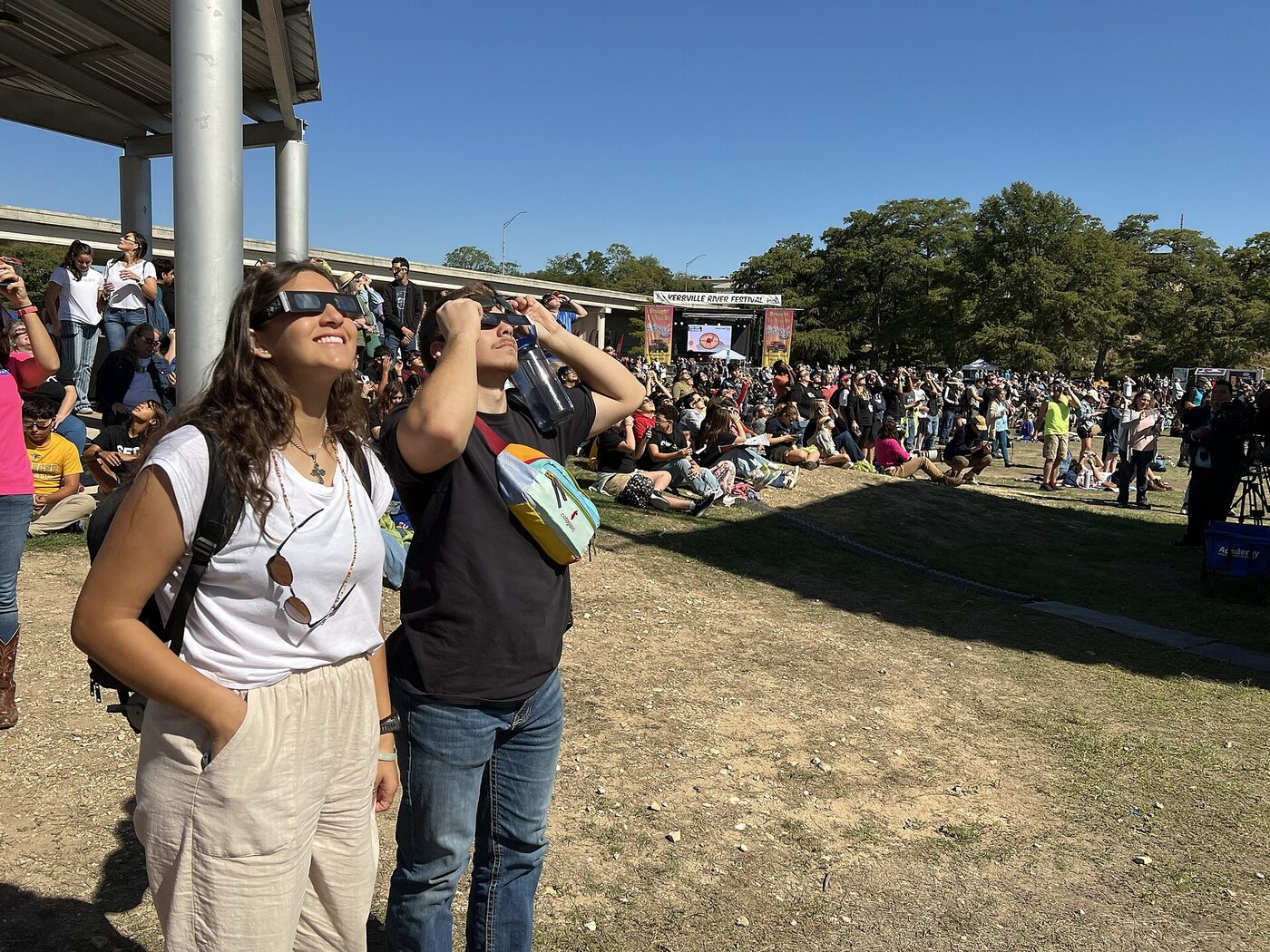
- Use eclipse glasses or a solar filter that meets ISO 12312-2. Sunglasses are not eclipse glasses — not stacked, not the dark ones, not welding goggles you’re unsure about. Certified filters cut the Sun by a factor of roughly a hundred thousand.
- Never look at a partial phase with unprotected eyes. Even a 99%-covered Sun is still the Sun.
- Never look through an unfiltered camera, phone, binoculars or telescope — not even while wearing eclipse glasses. An optic concentrates sunlight, so it will do damage faster than bare eyes will, and it will melt the glasses in front of them. A filter always goes on the front of the lens, never between the lens and your eye.
- Pinhole projection is free, safe, and genuinely delightful. A hole in a card, a colander, a cracker, the gaps between your fingers, the leaves of any tree — every one of them projects a little crescent Sun onto the ground. During a partial eclipse the shade under a tree fills up with hundreds of tiny crescents. It is the best low-effort magic trick in nature. 🕳️
- The one moment bare eyes are safe is totality itself — and only if you are inside the path, and only for exactly as long as the Sun is completely covered. The instant the first bead of sunlight returns, glasses go straight back on. If you are not inside the path, there is no such moment for you today. Glasses on, all of it.
Astronomers who have done this many times say the same thing: watch a clock or a countdown, don’t improvise. Totality today is one to two minutes long, and it ends without warning.
What totality actually looks like
If you get to stand in the shadow, here is roughly the order things happen — and everyone says the description undersells it.
In the last minutes, the light goes wrong. Not dim, exactly: thin, and oddly sharp-edged, a kind of half-light that doesn’t look like dawn or dusk or storm-light. Shadows go strange. The temperature drops, sometimes several degrees. A breeze comes up. Birds stop. Insects that only sing at night start up in the middle of the afternoon, get confused, and stop again.
Then, right at the edge:
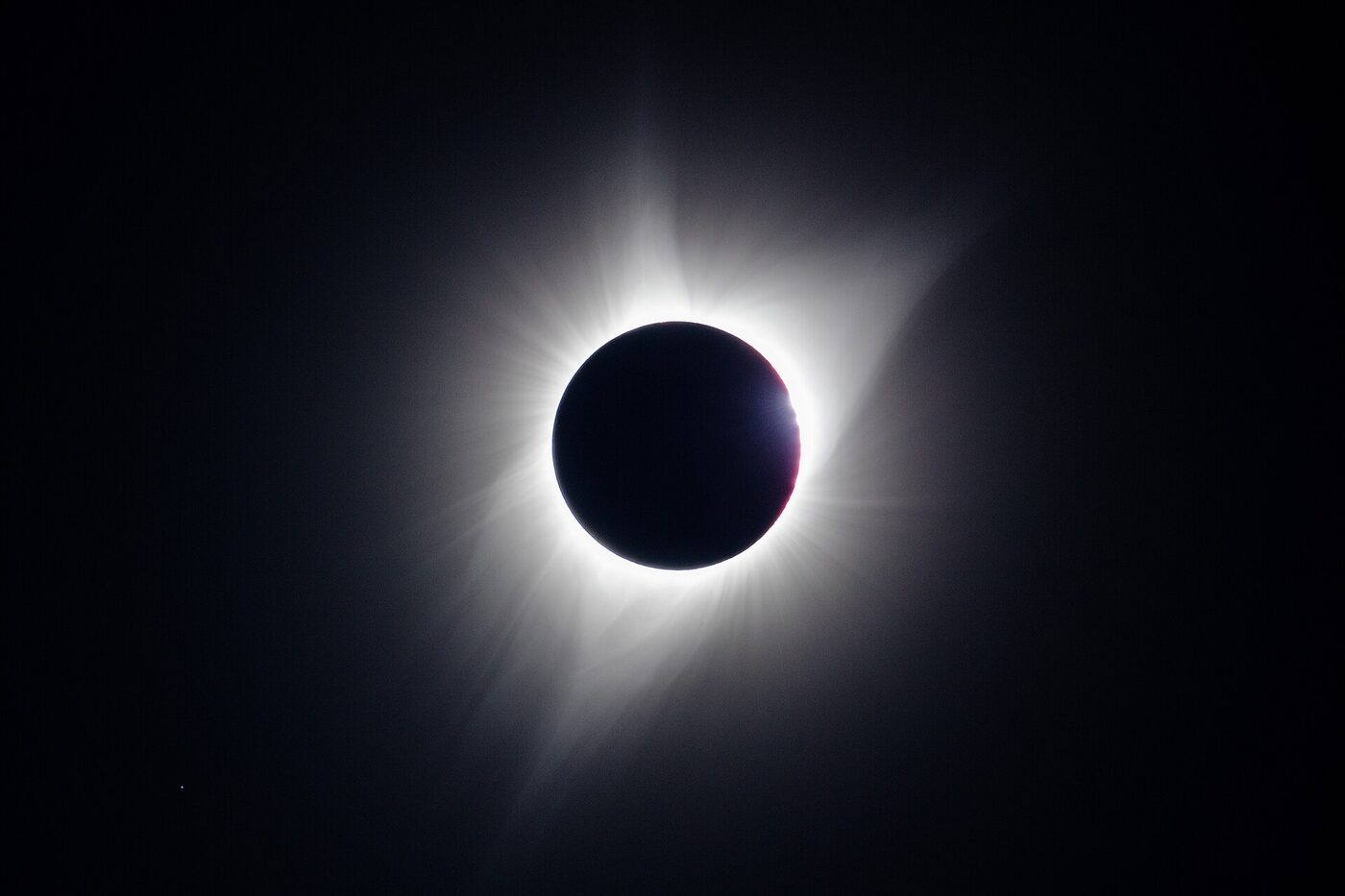
Baily’s beads — the Moon’s edge is mountainous, so the final sliver of Sun breaks into separate glints shining through lunar valleys. Then the beads wink out one by one until only one is left, blazing on a ring of pearl-coloured light: the diamond ring.
And then it’s gone, and the corona is out — the Sun’s outer atmosphere, a million degrees hot, feathered into streamers that reach out a couple of Sun-widths in every direction. It’s the one thing no photograph properly matches, because your eye handles the range of brightness in it and a camera doesn’t.
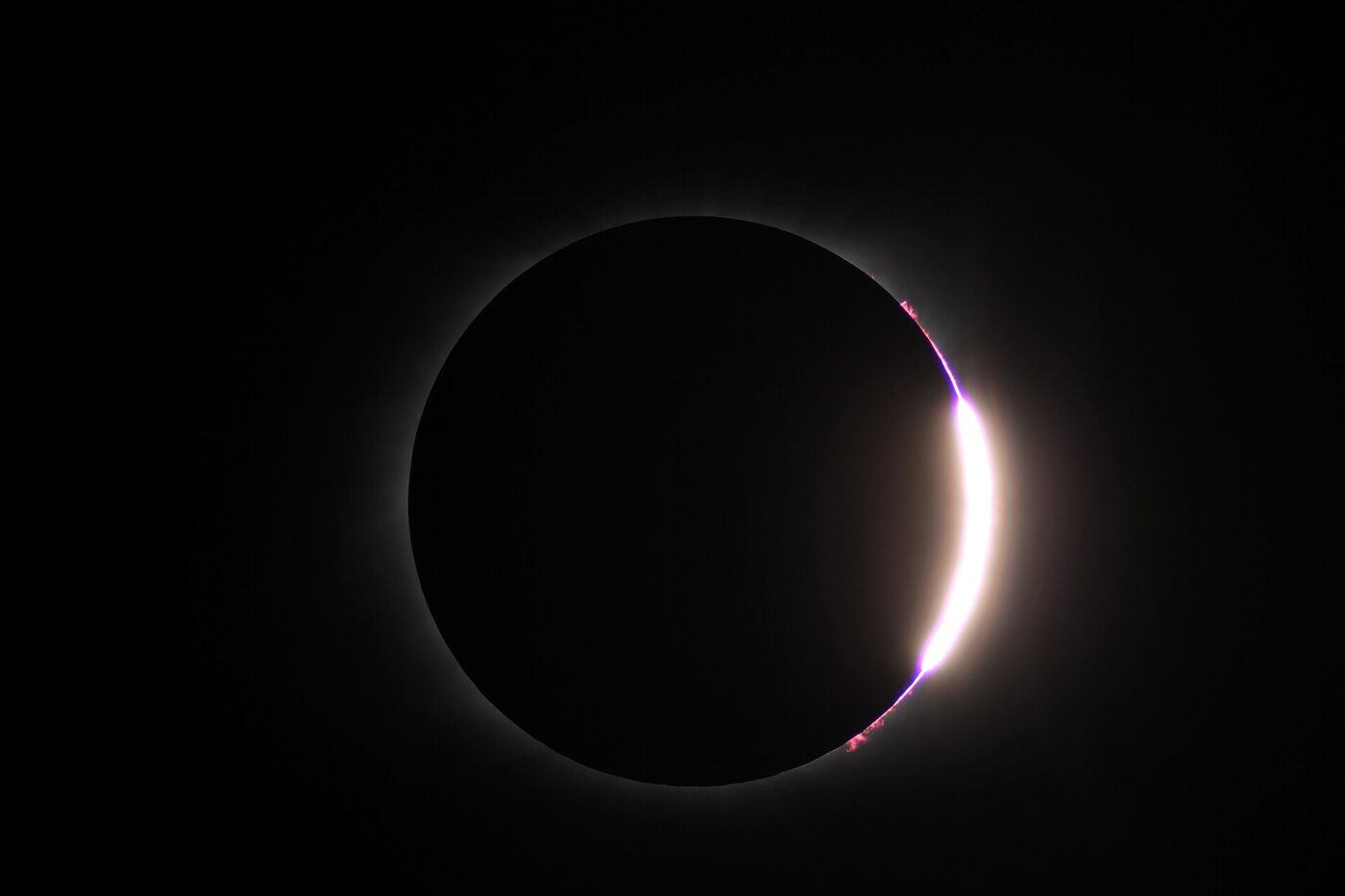
Look away from the Sun for a moment while you’re in it. The whole horizon glows orange all the way around, 360 degrees of sunset at once, because you’re standing in a shadow only a couple of hundred kilometres wide and it’s still daylight everywhere outside it. Planets come out — today Venus in the southwest, Jupiter and Mercury in the west, maybe Mars low in the northwest. The Sun is in Leo, so bright Regulus may show up just beside it.
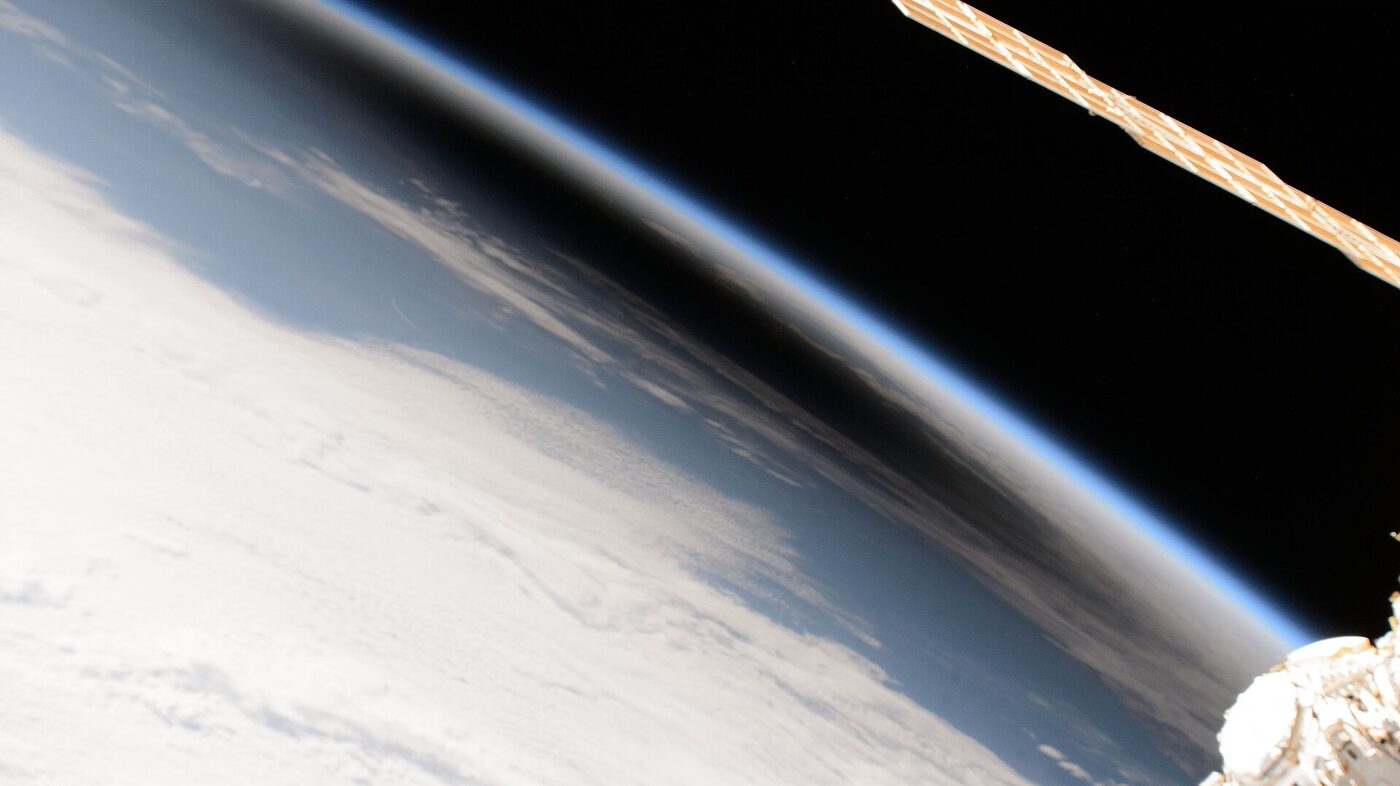
And there’s a version of this that’s easy to forget: the shadow is a real object, with a shape, sliding across a real planet. From orbit you can watch it happen.
And when the next one is
Total solar eclipses are not actually rare — Earth gets one every year or two. What’s rare is one arriving where you are. Averaged over the whole planet, any given spot waits roughly 375 years between totalities.
Which is why today matters to Iceland (last time: 1954) and to Reykjavík (last time: 1433), and why northern Spain is about to be very busy indeed.
The good news for Spain is that it doesn’t have to wait long at all. The next total solar eclipse in the catalogue is 2 August 2027 — Africa, Europe, the Middle East and western and southern Asia — and that one is a monster: the shadow tracks through southern Spain, north Africa and Egypt, and Luxor sits under it for something like 6 minutes 23 seconds. Nearly three times today’s best.
Before that, two nearer things: a partial lunar eclipse on 28 August 2026, visible from the eastern Pacific, the Americas, Europe and Africa — Earth taking a soft bite out of the Moon, no eye protection required, ever — and an annular eclipse on 6 February 2027 over South America, Antarctica and western and southern Africa, where the Moon is a touch too far away to cover the Sun and leaves a ring of fire behind instead.
We keep the whole catalogue — every solar and lunar eclipse the site knows about, drawn from NASA Goddard’s eclipse tables — on our own eclipse page, along with a countdown to the next one in your own local time and the safety rules written to stand on their own. It’ll still be telling you what’s next long after today’s shadow has run off the edge of the Mediterranean and out to sea.
Which is exactly what it does: the umbra crosses the Balearics with the Sun already touching the horizon, lifts off the Earth out past Mallorca, and the planet carries on turning.
Clear skies, everyone. 🌑


