

This morning the Moon’s shadow came down on a lighthouse in Iceland, ran across the Atlantic, and went ashore in Spain with the Sun sinking into the sea — the whole story is over here. Something like fifteen million people stood inside that shadow. Many millions more watched the partial phases from a pavement somewhere.
And nearly every single one of them did it through a rectangle of cardboard with two dark windows in it, which they then folded into a pocket, lost, or put in a bin.
Somebody kept his. Then he kept the next ones. Then he started buying old ones. 🕶️
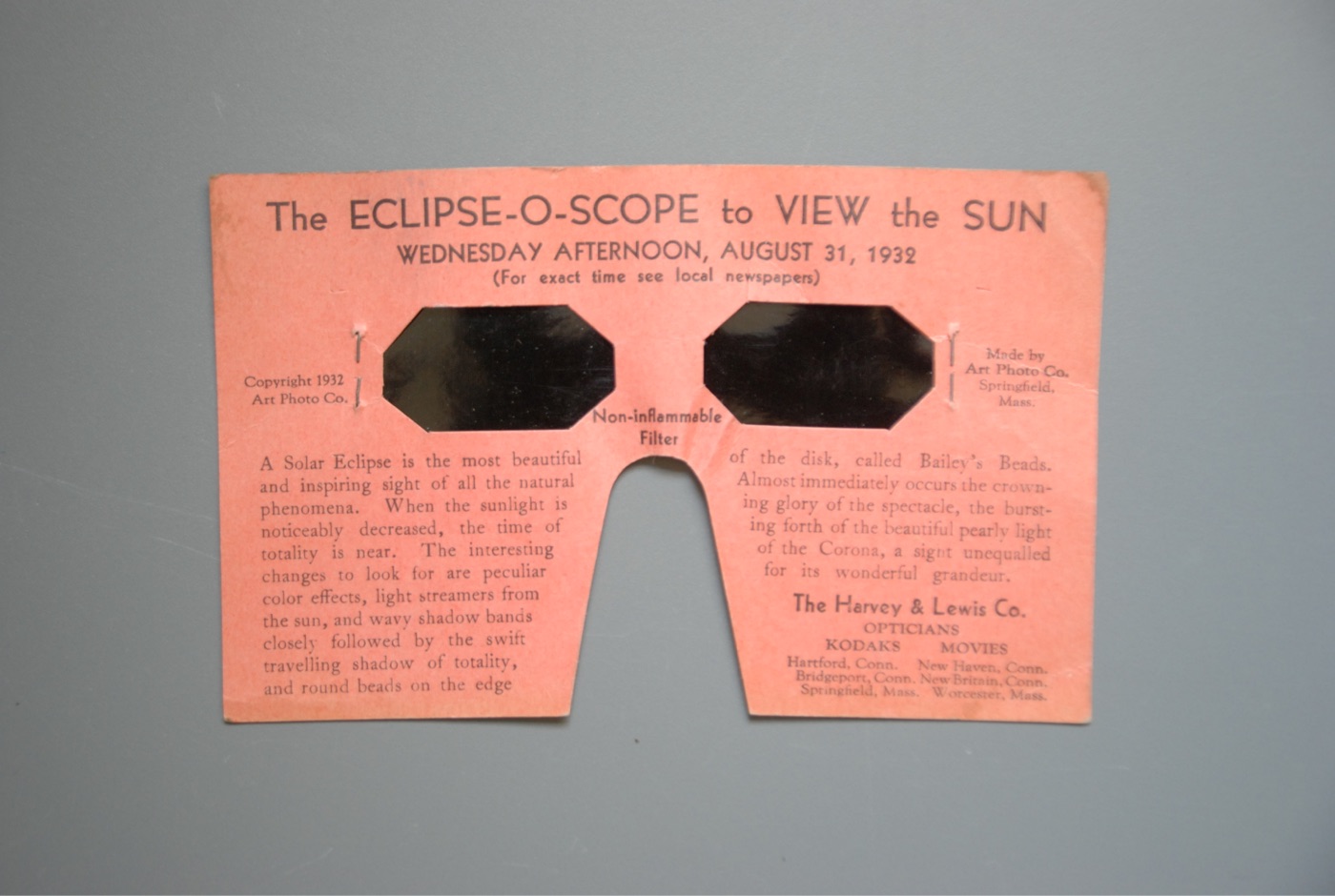
272 pairs of glasses in a New England basement
The Hopkins Observatory at Williams College, in Williamstown, Massachusetts, is the oldest observatory still standing in the United States — students built it between 1836 and 1838, and it has been picked up and moved twice since without ever quite being retired. It’s a planetarium and a small museum now.
It is also, somewhat unexpectedly, the world’s best archive of disposable eyewear.
The observatory has photographed and posted 272 objects: eclipse viewers, glasses, hand-held gazers, plus the postcards and pamphlets and railway notices that came with them. The dated ones cover roughly thirty separate eclipses, the earliest from 5 September 1793 and the most recent from 26 December 2019. Every image is free to look at, at full size, with the date printed under it. No login, no gift link, no cookie wall. Just the objects. 💛
The man who kept them
The collection belonged to Luke Cole — a name you may know from an entirely different field. Cole was one of the founders of the environmental justice movement in America: co-founder of the Center on Race, Poverty & the Environment in San Francisco, co-author of From the Ground Up, a lawyer who spent his career representing communities that had been handed somebody else’s pollution. He died in 2009, at 46, in a car crash in Uganda, on a trip he’d taken to go birdwatching.
He was born in North Adams, Massachusetts — about five miles down the road from the observatory where his glasses now live. His wife, Nancy Shelby, donated the whole collection to Williams in his memory; a Williams alumnus from the class of 1957, Skip Cole, made the introduction.
So the objects came home, more or less, and a college that has been pointing telescopes at the sky since 1838 now keeps them and shows them to anybody who asks.
The oldest ones were for a ring of fire over Iceland
Here’s the coincidence that made us sit up.
The two oldest viewers in the collection were made for 5 September 1793 — and that eclipse was annular, not total. The Moon was a shade too far from Earth to cover the Sun, so instead of going out it left a burning ring, for as long as six minutes, along a track that ran through Greenland, across Iceland — including Reykjavík — then southern Norway and Sweden, Denmark, Warsaw, and away east.
Which is almost exactly the ground today’s shadow covered, 233 years later.
And an annular eclipse is the one kind you can never, ever look at with a bare eye — there’s no totality, no safe moment, the Sun is bright the entire way through. Which is precisely why somebody in 1793 was already selling a filter to look through. The gadget is as old as the need for it.
31 August 1932: the day American advertising noticed the sky
Fifty-two objects in the collection — by far the biggest cluster — come from one Wednesday afternoon.
On 31 August 1932 a total eclipse crossed the Canadian Arctic and Quebec and came down over northeastern Vermont, New Hampshire, southwestern Maine, the top corner of Massachusetts and the far tip of Cape Cod. Totality was short — a minute and forty-five seconds at its absolute best. Millions of people lived within a day’s drive of the path, the Maine Central Railroad printed a notice about it, and every business in New England appears to have simultaneously realised the same thing:
you could put your name on the glasses.
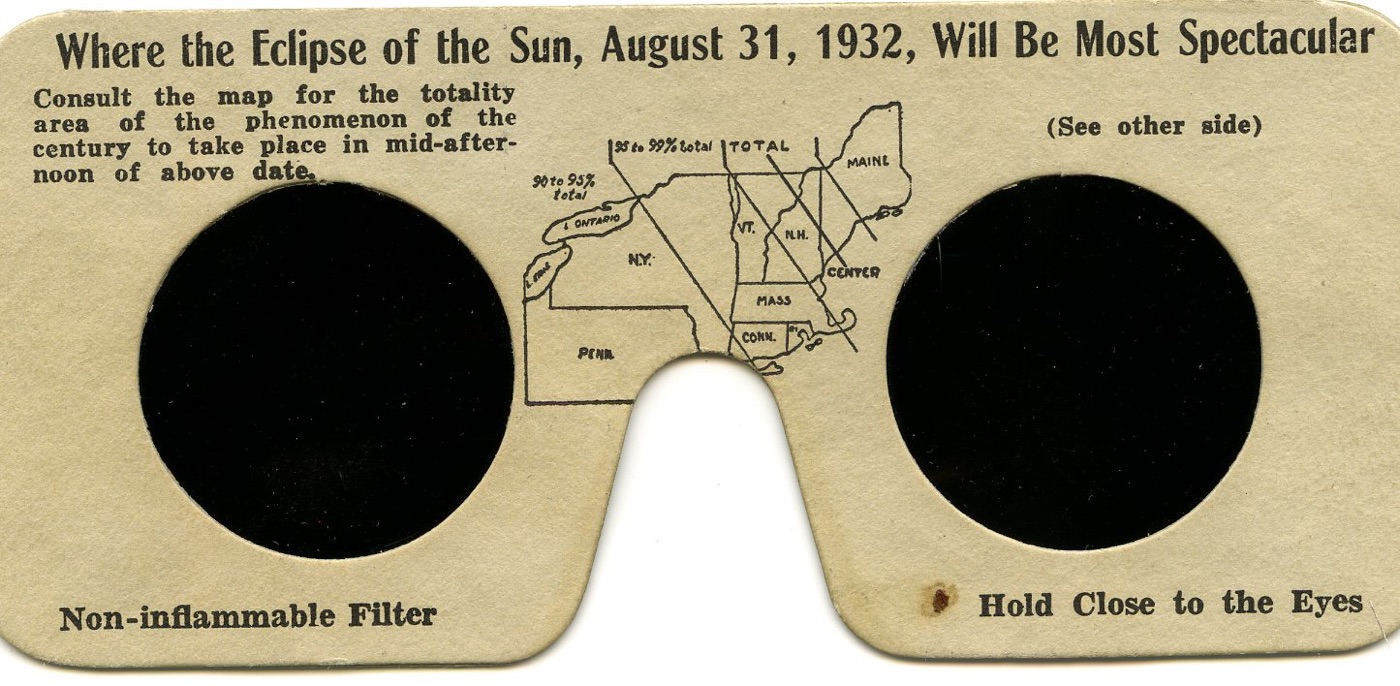
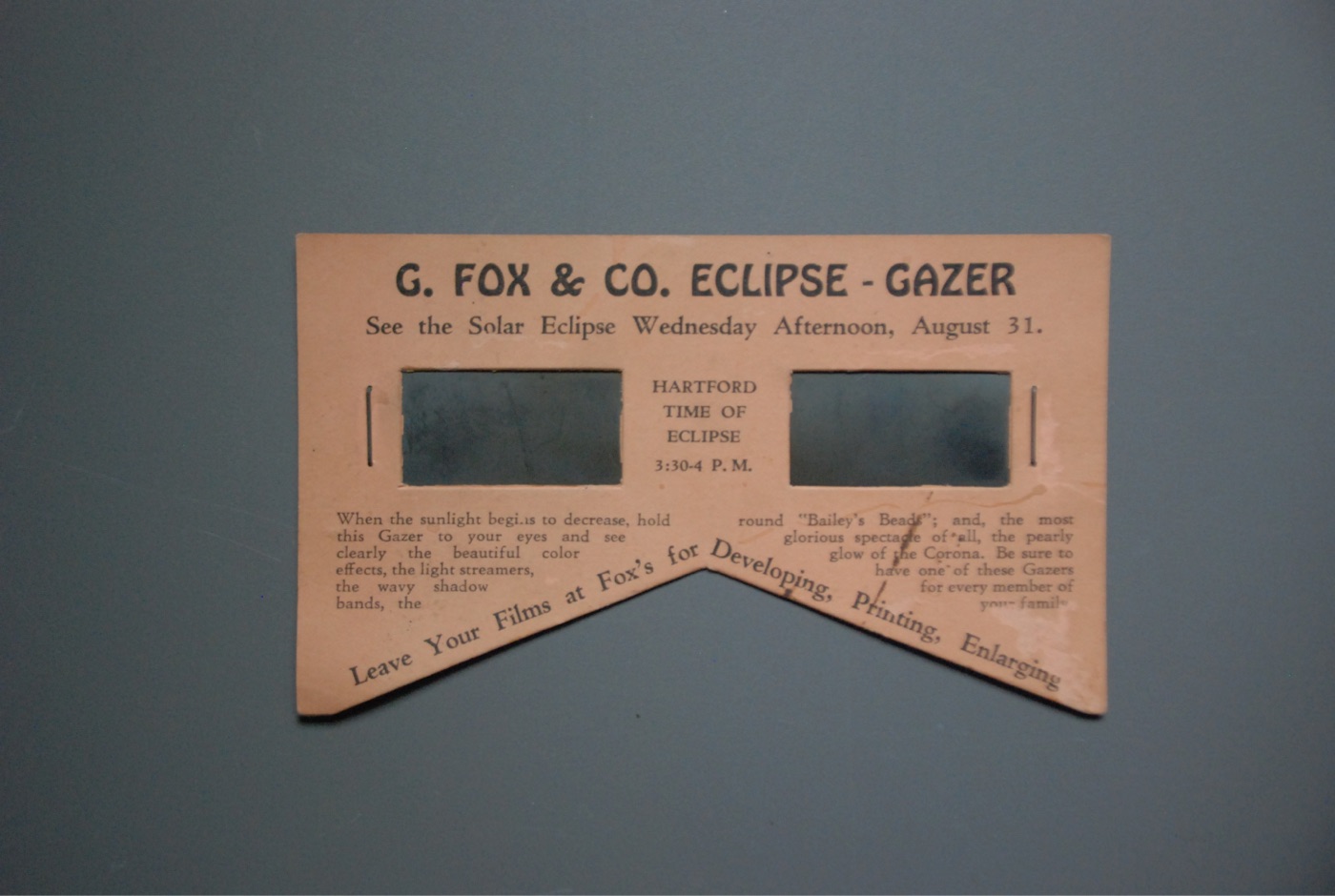
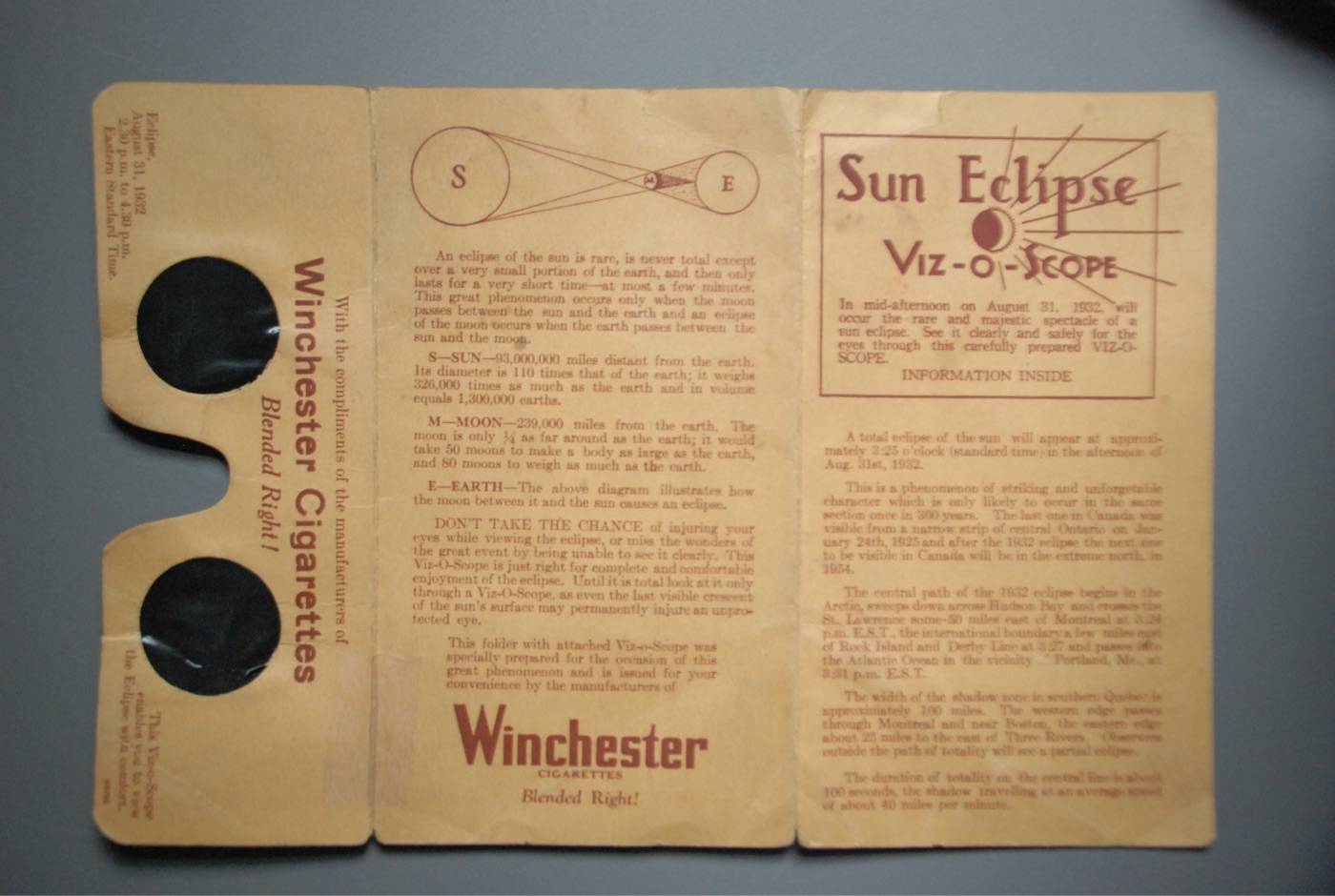
“DON’T TAKE THE CHANCE of injuring your eyes while viewing the eclipse, or miss the wonders of the great event by being unable to see it clearly.” — Winchester Cigarettes, 1932, being completely right
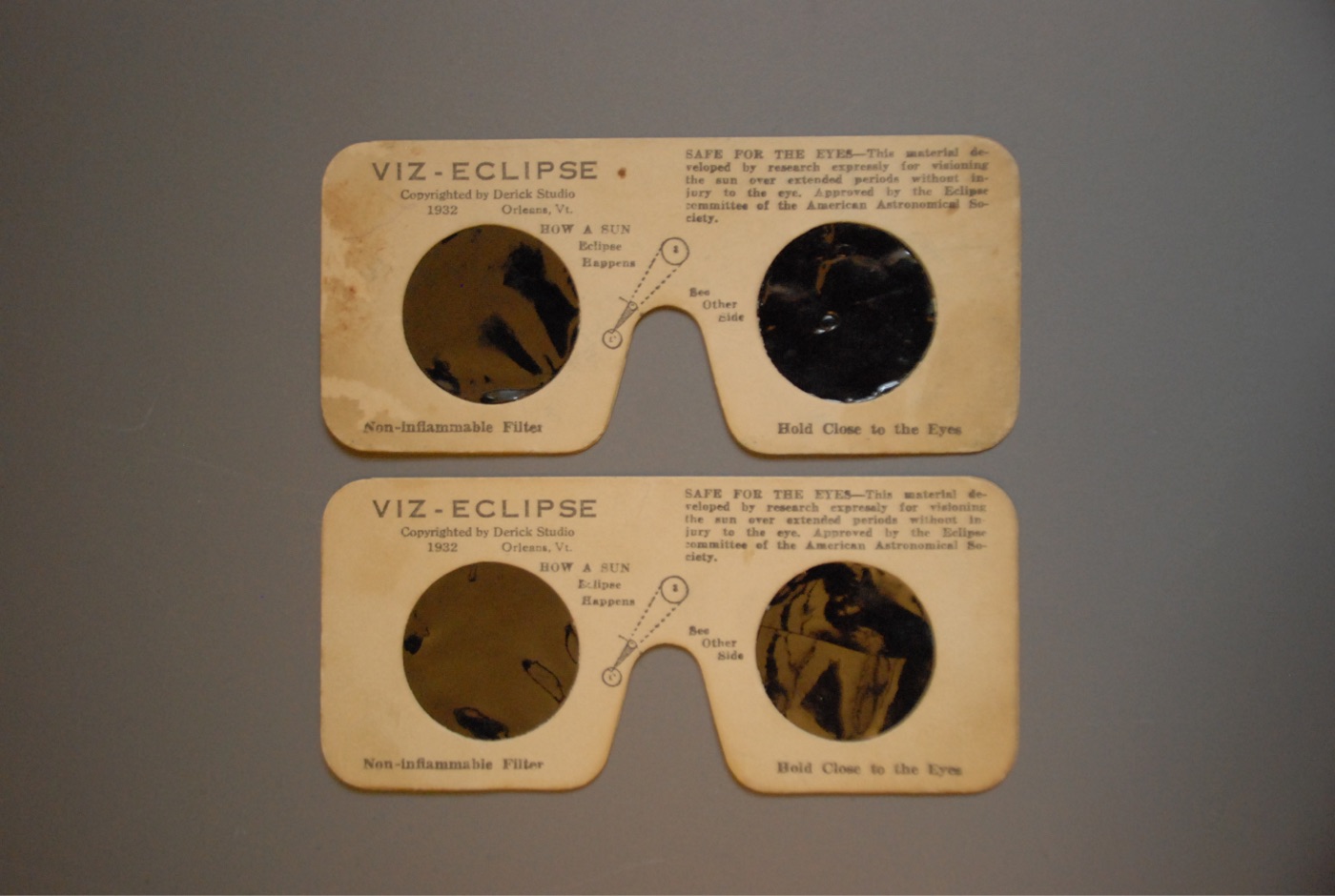
The rest of that 1932 shelf is a parade: the VIZ-ECLIPSE, copyrighted by the Derick Studio of Orleans, Vermont, which states on its face that it is “Approved by the Eclipse committee of the American Astronomical Society” — a sentence implying that in 1932 the AAS convened a committee to review novelty cardboard, which it did, because people’s eyes were at stake. And nearly every one of them carries the same two reassurances, printed small: “Non-inflammable Filter.” “Hold Close to the Eyes.”
Then the object changes, and changes, and stays exactly the same
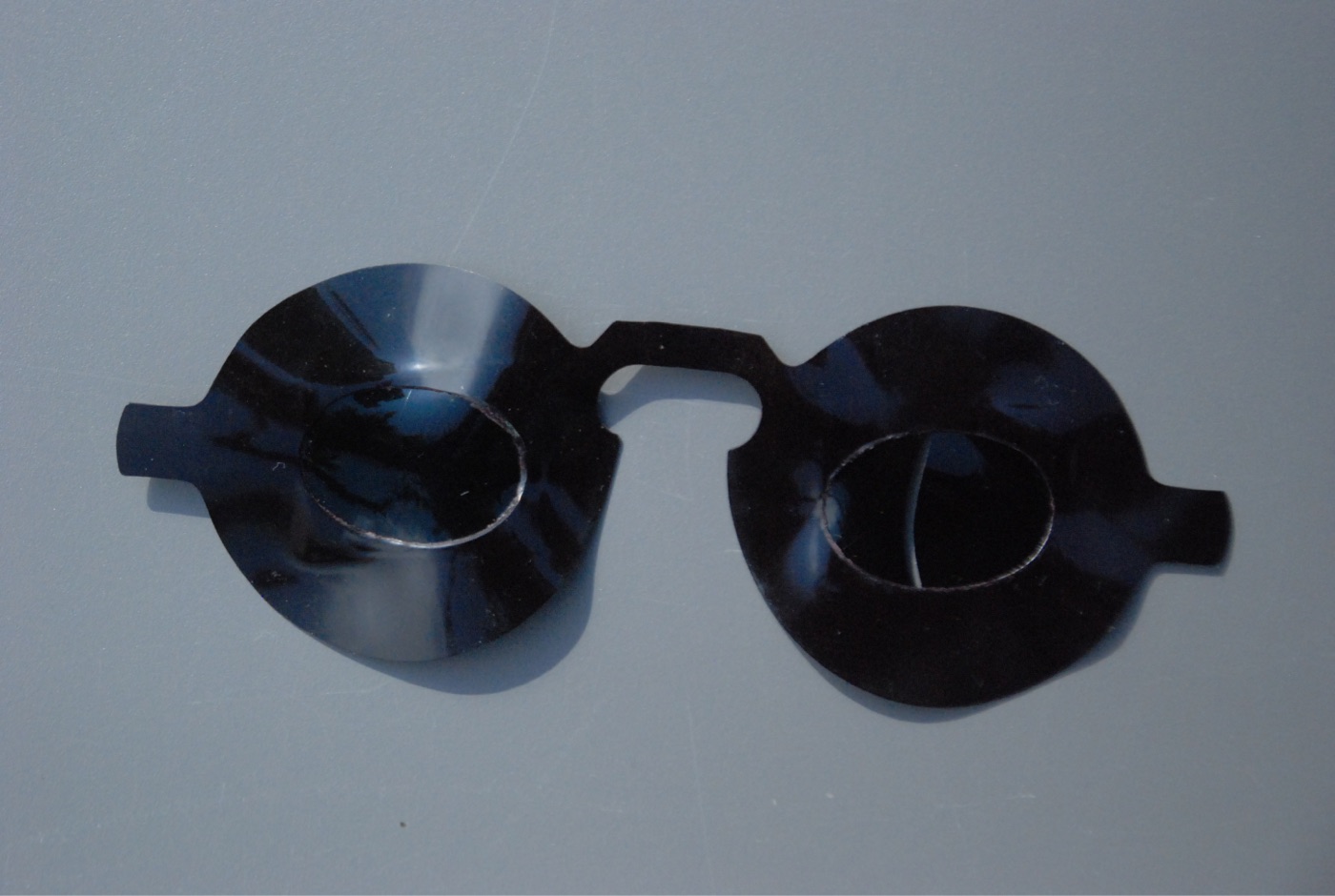
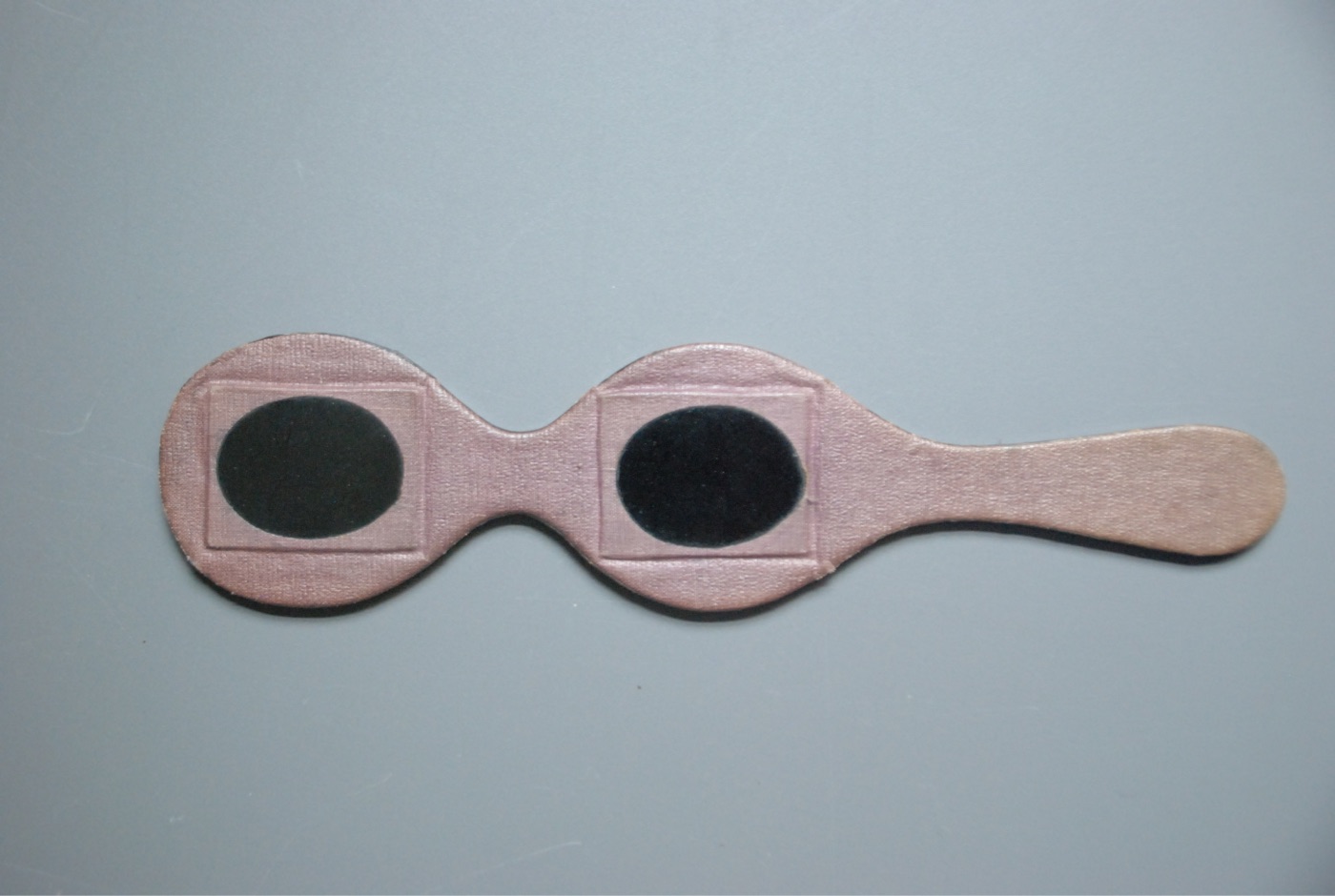
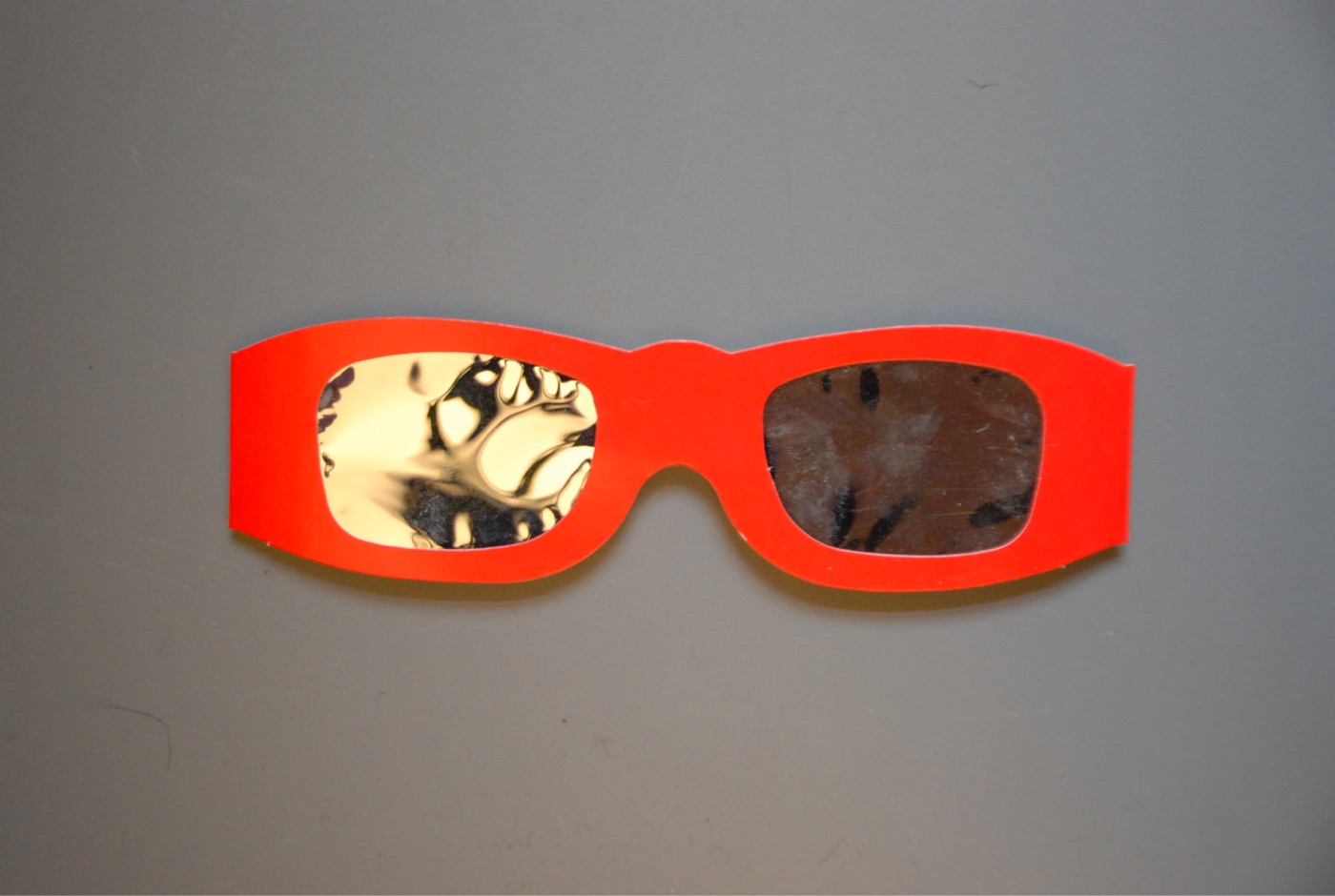
Flip forward through the collection and you can watch a century of manufacturing pass across a single unchanging product. Smoked glass gives way to exposed film. Film gives way to dyed acetate in die-cut card. The 1960s and 70s bring cheerful primary-coloured frames. Then in 1999, when a total eclipse crossed Europe from Cornwall to Romania and left forty items in this collection, the whole thing goes silver: aluminised polyester, wrap-around, stamped Éclip’smic, looking for all the world like something a robot would wear.
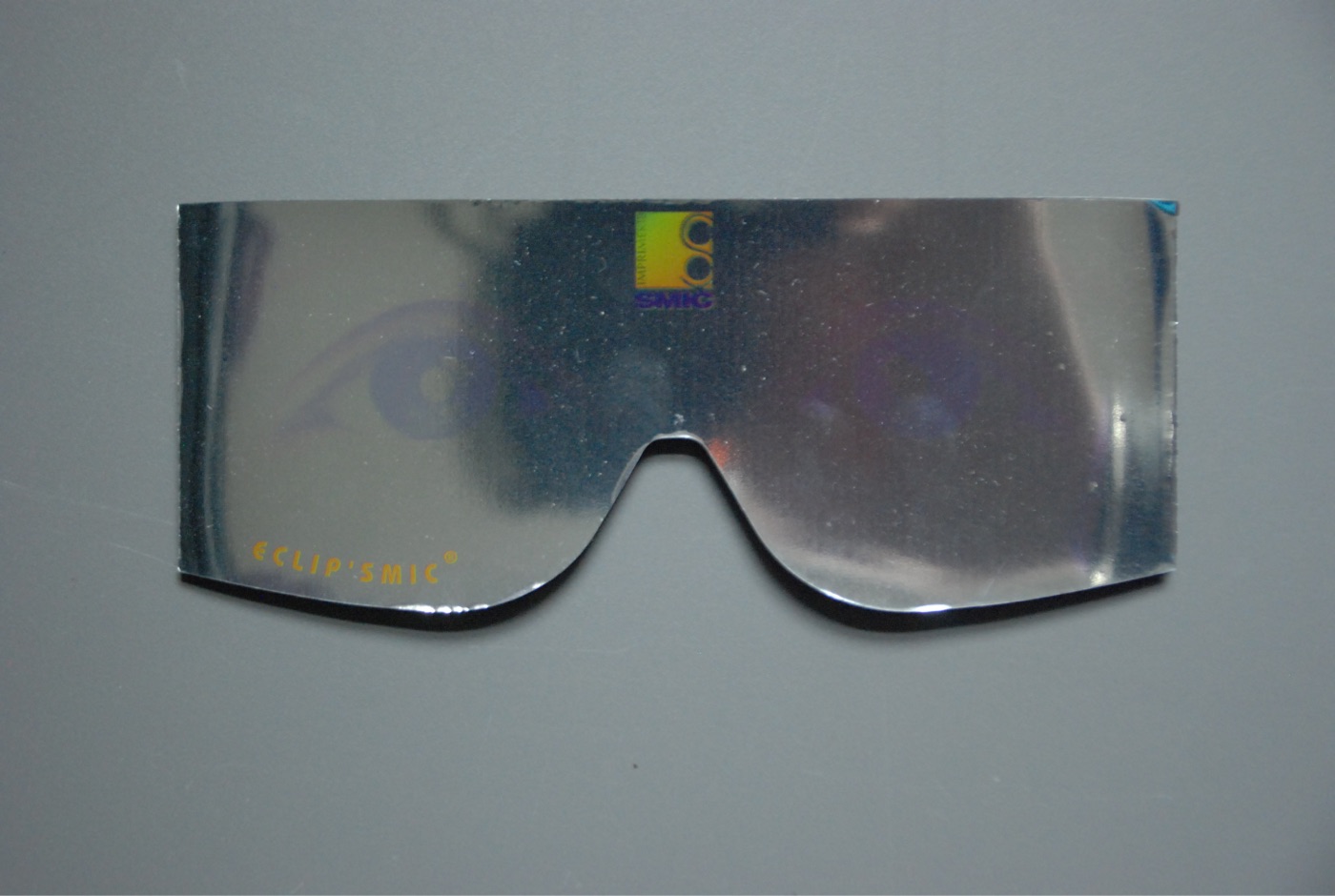
And the detail that makes this a college collection rather than a shelf of curiosities: for the oldest viewers, the gallery doesn’t stop at a photograph. It also shows a transmission plot — how much light of each wavelength that 233-year-old filter actually lets through — measured on a bench by Kevin Forkey of the Williams physics department.
Somebody looked at the oldest eclipse glasses in America and thought: hang on, were these any good? And then went and found out. 🔬
Please do not wear any of this
For the avoidance of doubt: antique viewers are museum objects, not eye protection. Filters age, films scratch, dye fades, and nobody in 1932 was testing for infrared. The modern rule is one line long — anything you look at the Sun through must meet ISO 12312-2 — and we keep it, along with every eclipse the site knows about, on the eclipse desk.
Why this is on a good-news blog
Because eclipse glasses are designed to be garbage. That is the entire brief: be cheap, be safe for four minutes, be thrown away by dinnertime. Hundreds of millions have been printed and essentially all of them are gone.
And yet here are 272 of them, laid out flat on grey card, photographed square-on, dated, measured and published for free by a small college observatory in the Berkshires — because one man in San Francisco who spent his working life on other people’s air and water couldn’t bring himself to bin a piece of cardboard that once had the Sun behind it.
Every object in that gallery is a receipt for a moment when a few thousand people all stood outside, at a time printed in the local newspaper, and looked up together. 🌑
Go deeper (real links, no pop-ups, promise)
- 🕶️ Eclipse Viewers — Williams College, Hopkins Observatory — the full gallery, all 272 of them
- 📰 kottke.org: A Collection of Eclipse Glasses (1793–2019) — where we found it
- ✂️ present & correct: Eclipse Viewers (1932) — where he found it
- ⚖️ Center on Race, Poverty & the Environment — the organisation Luke Cole co-founded
- 🔭 Hopkins Observatory — oldest one still standing in the United States


