

There is a photograph, and then there is the thing the photograph is doing to your brain.
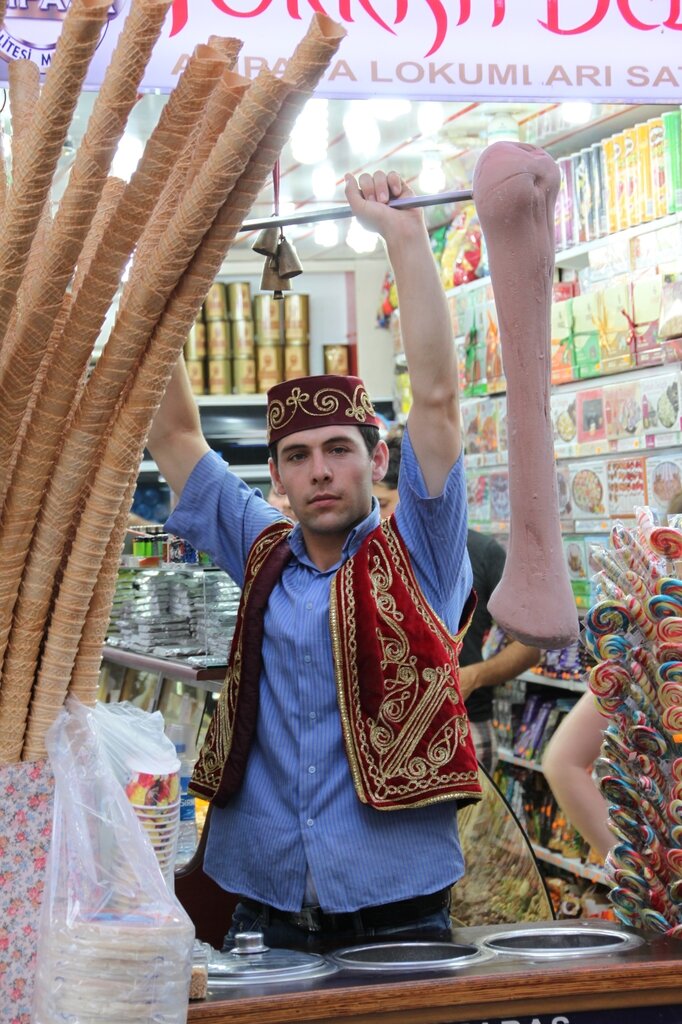
A young man in an embroidered vest and a little red cap is standing behind a counter in Istanbul. He is holding a metal bar over his head with both hands. Draped over that bar, hanging down like a heavy wet towel, is a slab of ice cream. It is not dripping. It is not sagging. It is not doing any of the things ice cream is supposed to do when a person holds it up in the warm air of a Turkish afternoon.
It’s just hanging there. Waiting. 🍦
First, the name
Dondurma is not a fancy word. It’s just the Turkish word for ice cream, from dondurmak, “to freeze.” Ask for dondurma in Turkey and you may well get a perfectly ordinary scoop.
The stuff that has made the internet lose its mind is one specific regional style: Maraş dondurması, from the city of Kahramanmaraş in southern Turkey. Locally it’s called dövme dondurma — pounded ice cream — because it isn’t gently churned so much as beaten into submission.
And in the Levant, the very closely related cousin goes by the Arabic name booza. Same idea, same ancestry, different accent.
The two ingredients that break the rules
Regular ice cream is a truce. Fat, sugar, water, and air, held in a temporary arrangement that starts falling apart the moment it leaves the freezer. That’s why a cone is a race.
Maraş dondurma cheats — beautifully, and with plants.
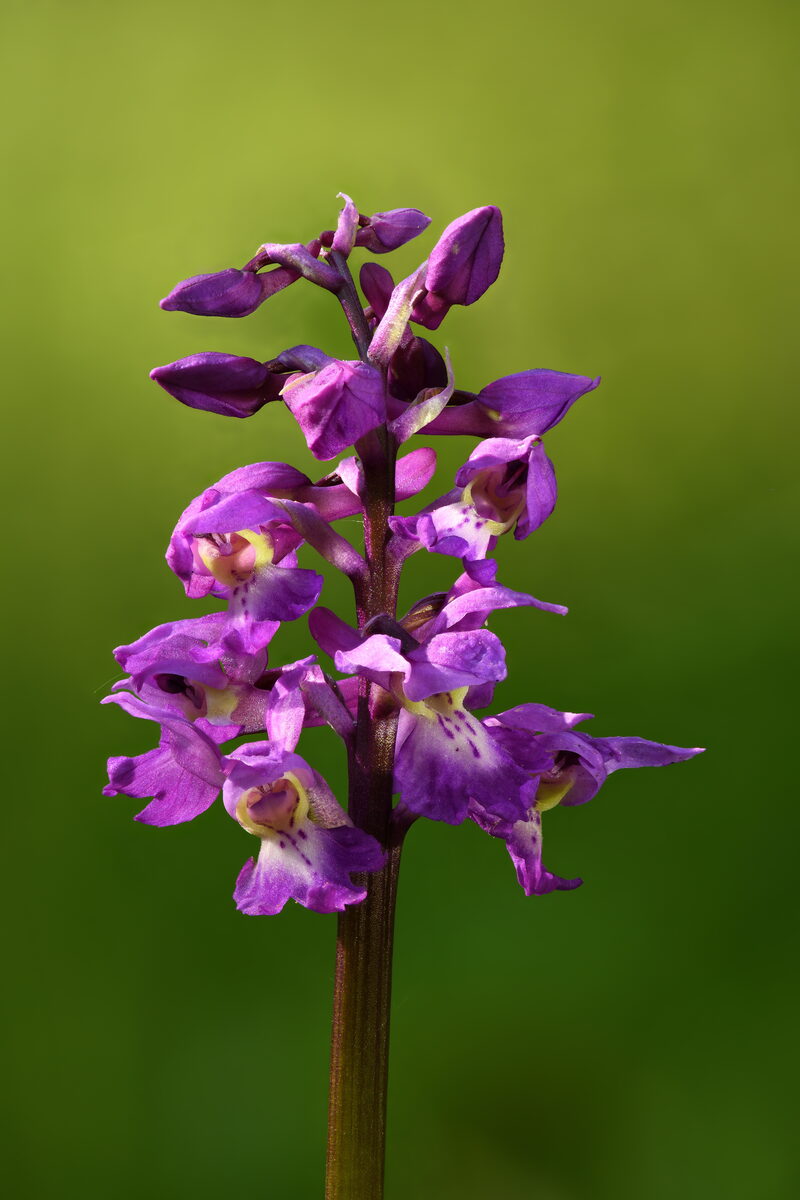
Salep is flour milled from the dried tubers of wild orchids in the genus Orchis. Those little tubers are packed with a polysaccharide called glucomannan, a hydrocolloid that grabs hold of water and refuses to let go. Stir enough of it into warm milk and the milk stops being a liquid in any casual sense — it becomes something with structure, something with opinions.
Mastic is a resin: the sap of the evergreen shrub Pistacia lentiscus, which weeps clear droplets when you cut its bark. It’s been chewed and cooked with around the Mediterranean since antiquity. In dondurma it adds a faint pine-and-cedar perfume and a distinctly springy chew.
Here’s the bit worth getting right, because almost everyone gets it backwards: the famous stretch — the long, taffy-like strands — comes from the salep, not the mastic. Mastic brings the chewiness and the scent. Salep is the reason the ice cream can hold its own weight.
A dessert with a flock
The Maraş recipe is unusually specific about where its milk comes from: goats. Not “mostly goats.” The registered standard is 100% goat’s milk, from animals grazing the slopes of Ahır Dağı, the mountain behind the city, where they eat wild thyme and crocus and whatever else the hillside is offering that week.
The milk has to reach the plant within about four hours, cold the whole way. It’s warmed, salep and sugar go in, the mixture rests for hours, and only then is it frozen and pounded. Maraş dondurması is a registered geographical indication in Turkey — to carry the name, it has to be made in Maraş.
Which means that somewhere in the paperwork of this ridiculous, stretchy, gravity-defying novelty dessert, there is a clause about a specific mountain and the herbs on it. 🐐
The paddle, the bar, and the bells
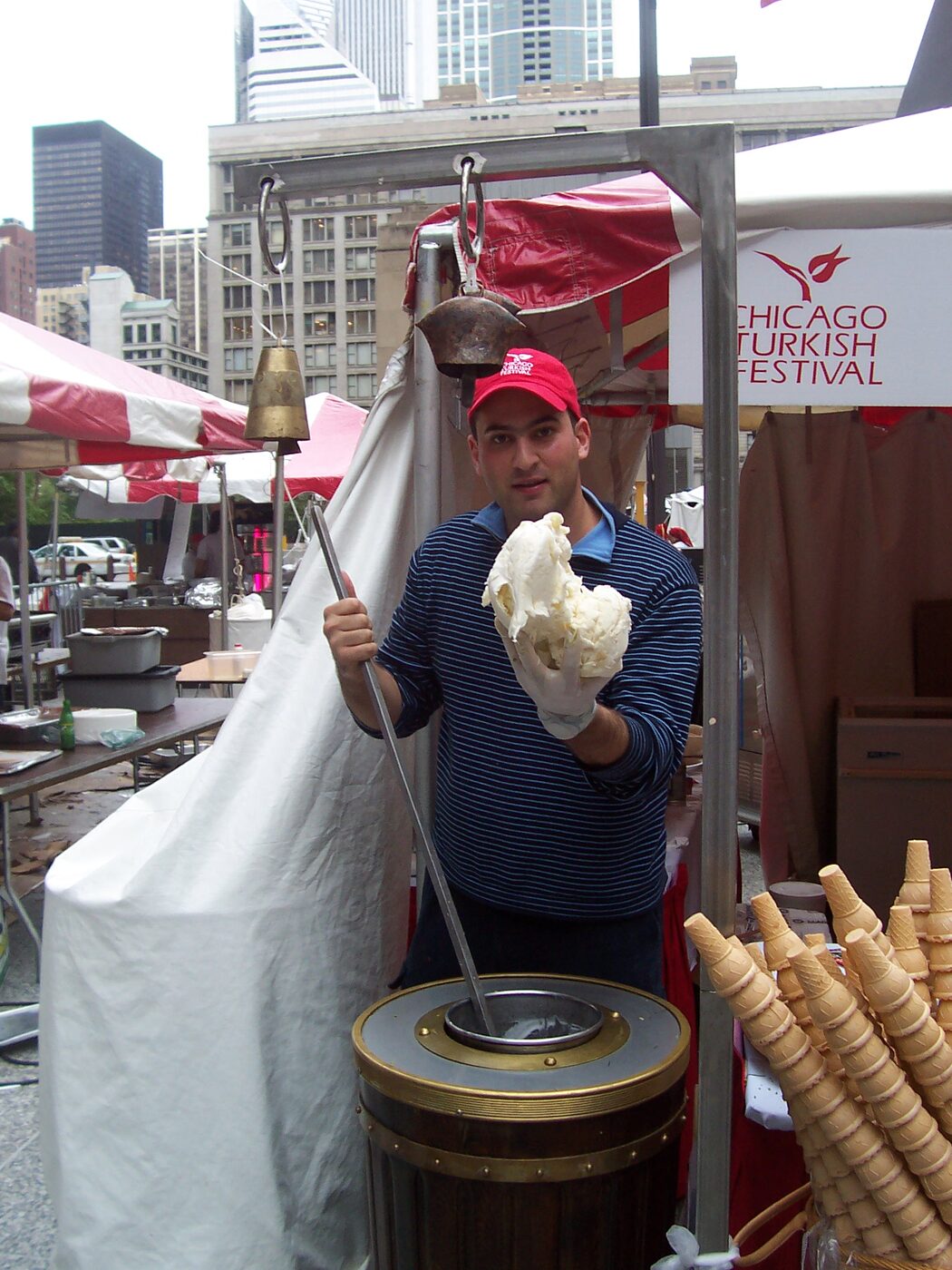
Because the finished mixture is so dense, it can’t be scooped. It has to be worked — churned in an upright barrel with a long-handled metal paddle that looks less like kitchen equipment and more like something you’d row with. Vendors keep it moving all day so it stays soft enough to serve at all.
And once you’ve got a person standing at a barrel holding an enormous paddle with a mass of ice cream stuck to the end of it, the temptation is obvious, and Turkish street vendors surrendered to it a long time ago.
The routine is legendary. Your cone is offered to you on the end of the pole. You reach for it. The pole rotates, and the cone is somehow behind the vendor now. You reach again. This time you get a cone — except the cone comes away empty in your hand, because it was a decoy cone nested on top of the real one. Brass bells clang. The line laughs. Somewhere in there, eventually, if you have been sufficiently patient and good-humoured, you are actually handed a dessert.
It’s a genuinely functional piece of street theatre: it entertains the people already waiting, and it stops the people walking past. It also only works because of the physics — a normal scoop would have hit the pavement on trick number one. 🎪
Where it came from (snow, an accident, and 1882)
The local origin story in Kahramanmaraş credits a man named Osman Ağa, who — as it’s told — stumbled onto the thing while making salep, and started selling a snow-and-salep slush called salepli karsambaç. Three generations later it had become the ice cream the city is known for. Treat that one as the affectionate house legend it is.
The paper trail is thinner and, in its own way, more charming. The food historian Priscilla Mary Işın notes that nobody knows when salep-based milk dondurma was first made, but the earliest known written recipe appears in 1882, in a Turkish cookbook called Ev Kadını (“The Housewife”), credited to Ayşe Fahriye.
The method: heat sugar, milk and salep together until the milk boils. Then add snow. Then move it to another container and beat it hard until the texture is right.
Işın points out the lovely divergence hiding in that recipe. European ice cream of the same era was being thickened with eggs. Turkish ice cream was being thickened with an orchid. Two kitchens, same problem, completely different answer.
Period equipment was no less delightful: a lidded lead-and-tin canister with a crank mechanism built into the lid, sitting inside a larger bucket with a drain tap, so the mixture could be stirred continuously without ever letting the warm air in.
Salep had a whole other career first
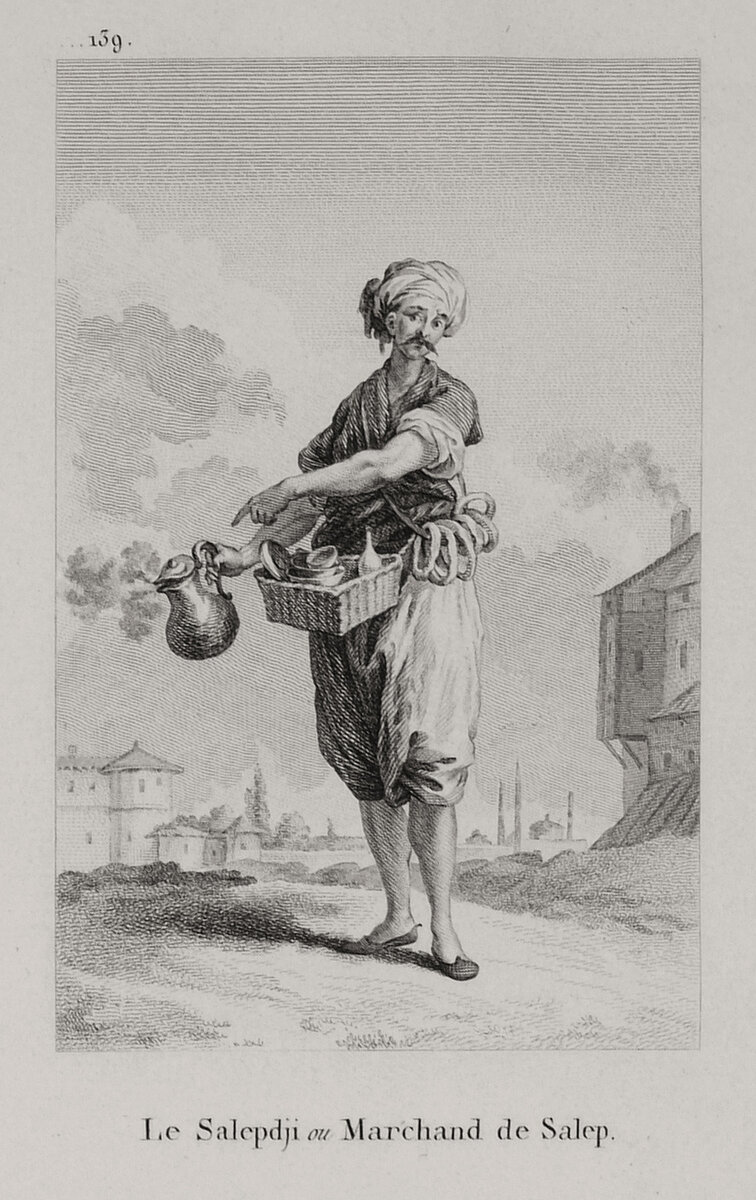
Long before it was holding ice cream together, salep was a hot drink — orchid flour whisked into milk or water, sweetened, dusted with cinnamon, sold on cold streets from a brass jug. It still is, across Turkey, Greece and the Levant, all winter long.
It even had a run in England. In the 17th and 18th centuries, before coffee and tea got cheap, London had saloop stalls — the same drink, sometimes made with imported Turkish salep and sometimes with local orchid roots that went by the wonderful name “dogstones.” Later, sassafras root took over the recipe entirely. Eventually the coffee stalls won, as coffee stalls do.
But for a while, a Londoner and an Istanbullu were warming their hands on the same cup. 🫖
The tears of Chios
The other half of the recipe has its own small epic.
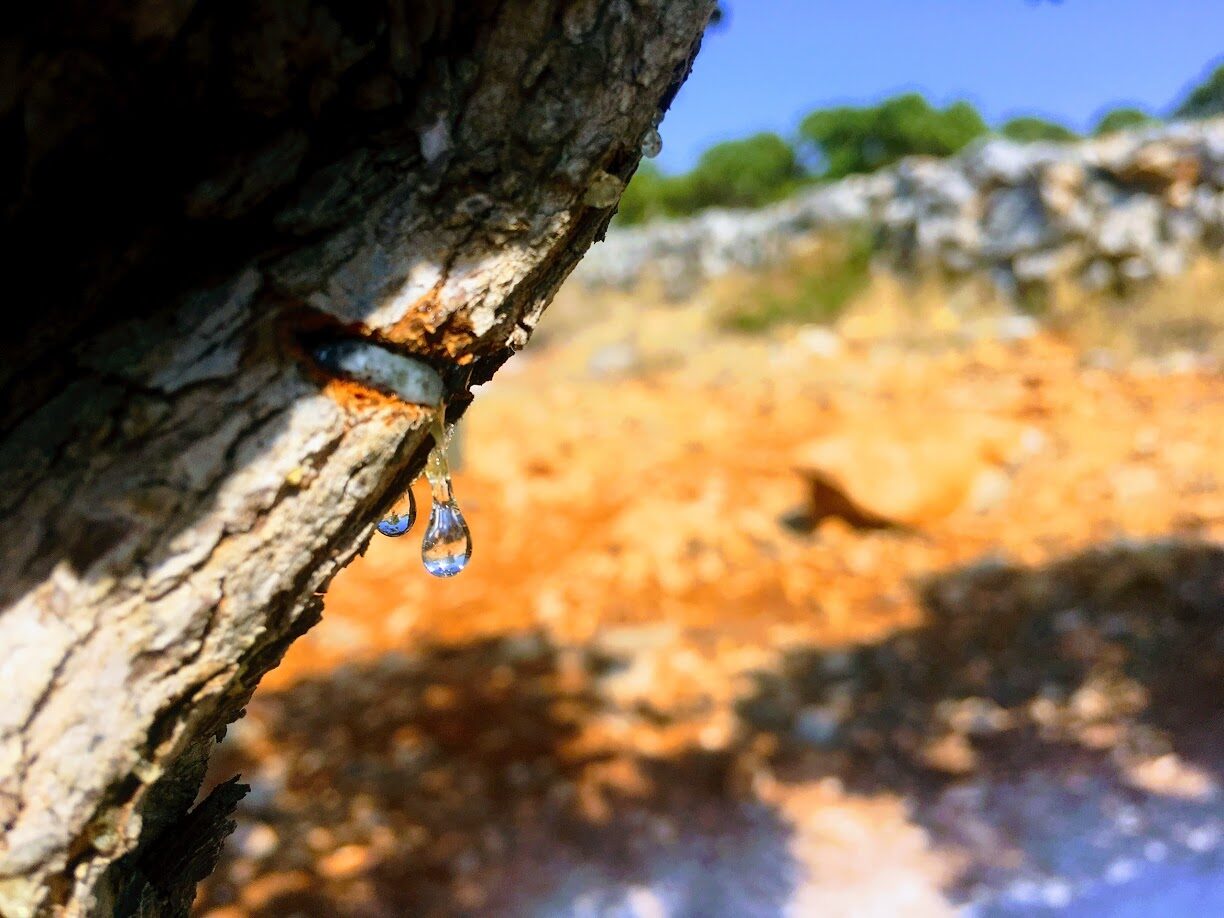
Mastic is harvested on the Greek island of Chios, in a stretch of villages known collectively as the mastichochoria — the mastic villages. The harvest, called kentos, runs from July into October. Growers sweep the ground under each tree and dust it with white calcium carbonate, then score the bark with five to ten small cuts every four or five days. Clear resin beads out, hangs, catches the light — this is where the name “tears of Chios” comes from — and takes two or three weeks to harden and drop onto the swept ground below.
Then comes the winter, most of which is spent picking sand out of the tears by hand.
Mastic was worth a fortune under Ottoman rule; the mastic villages were built like small fortresses, walled, with no street-level doors, entered by ladder, to protect the crop. Today “Masticha Chiou” carries a protected designation of origin in the EU. The Turkish name for Chios is Sakız Adası — gum island.
All of that, so a scoop of ice cream in Kahramanmaraş can be slightly chewier. 🌳
Meanwhile, in Damascus
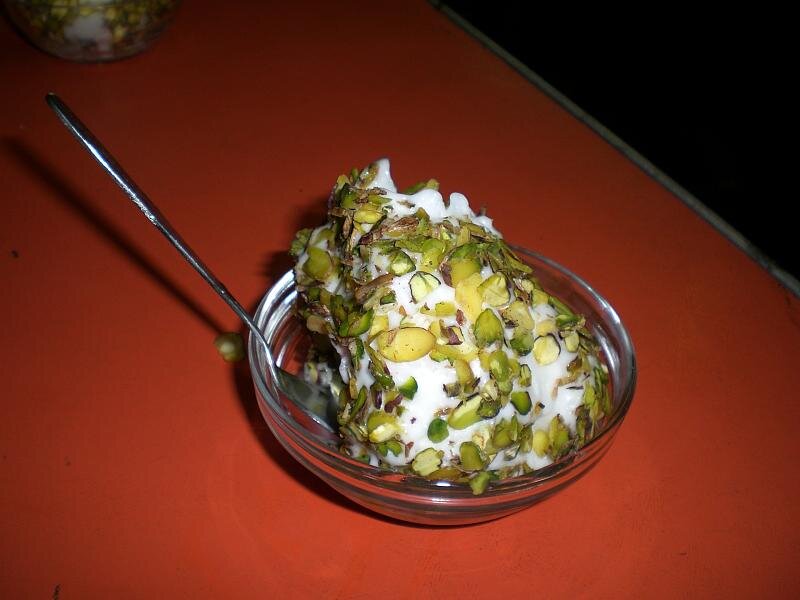
Follow the family tree south and you get booza — the Levantine sibling, made from the same salep-and-mastic playbook but pounded and stretched inside a chilled drum rather than churned. The texture that comes out is dense and elastic enough to be rolled into a log, sliced, and served in thick pale coins, usually under a blizzard of crushed pistachios and often with a spoonful of qishta clotted cream. Orange-flower water or rose water sometimes goes in too.
The most famous address for it is Bakdash, in the covered Al-Hamidiyah Souq in the Old City of Damascus, which has been making booza since at least 1895. Behind the counter, men with long wooden pestles pound the ice cream in rhythm, and the sound carries down the souq.
It has travelled, too: booza turns up in Ramallah, across Jordan, and — via people who grew up on it — in Williamsburg, Brooklyn, the Bay Area, and Sydney, where the first packaged take-home version was made in 2011. In northern Greece the same dessert lands under the names dudurmas or kaimaki.
One honest note about the orchids
This is a good-news blog, so here’s the part that has to be said plainly: wild orchids have paid for this.
Salep can’t be farmed the way wheat is. The flour comes from tubers dug out of the ground, and it takes somewhere between 1,000 and 4,000 tubers to make a single kilogram of it. Turkey harvests roughly 30 tonnes of tubers a year across dozens of species, and researchers tracking the trade in northern Iran estimated that millions of orchids were being lifted there in a single season, most of them bound for Turkish markets. Local populations have thinned badly in parts of Turkey, Greece and Iran.
Turkey noticed, and banned the export of real salep — which is exactly why so much of the “salep” powder on supermarket shelves worldwide is cornstarch or rice flour with flavouring, and why the drink you get abroad is usually a friendly imitation. It’s an imperfect fix for a real problem, and the question of how to keep making this dessert without emptying the hillsides is still an open one.
Worth knowing when someone hands you a cone. It came from a mountain, and mountains keep receipts. 🌸
The world picked it up anyway
The best evidence that dondurma is genuinely delightful and not merely a tourist trap is where the paddle turned up next.
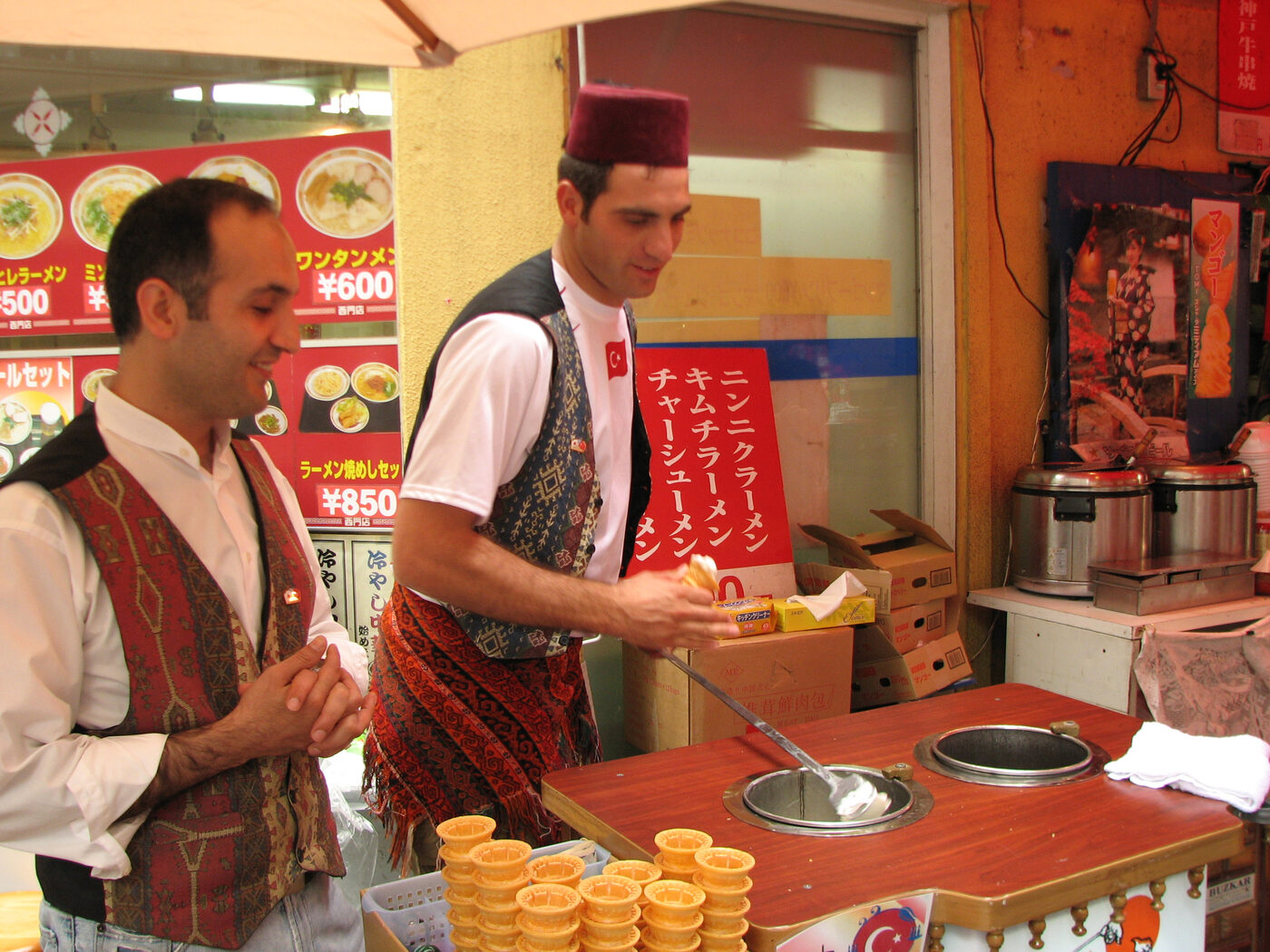
There is a stall in Kyoto’s Chinatown — Japan — with two Turkish vendors in fezzes and embroidered vests, a rack of enormous waffle cones, and the exact same routine, performed for a Japanese queue that is very much in on the joke. There are stalls doing it in Seoul, in Changwon, at world expos, in Las Vegas shopping malls, and on a hundred seaside promenades that have never been anywhere near Kahramanmaraş.
Turkey, for its part, is not even an especially big ice cream country. Around 2010 the average person there ate about 2.8 litres a year — against roughly 14 in the United States and nearly 18 in Australia, the world leader. Turkey doesn’t win on volume.
It just made the single most interesting ice cream on Earth and then exported the performance along with it.
Why this is on a good-news blog
Because somebody in southern Anatolia looked at a hillside orchid and a weeping shrub and thought these belong in dessert — and the result was a food that behaves like nothing else in the freezer aisle.
And then, having invented an ice cream that physically cannot be dropped, they didn’t quietly enjoy the advantage. They turned it into a bit. They built a whole comedy routine on top of it: the spinning pole, the fake cone, the bells, the mock outrage, the stranger laughing in a queue in a city they’ve never been to before.
That’s the part that travelled. Not just the recipe — the joke. A tourist in Istanbul gets pranked by a man with a paddle, goes home, and tells the story for years. Somebody in Kyoto sees it, thinks I want to do that, and learns the routine properly.
Two plants, a mountain goat, and a very old sense of humour. Then you get to eat it. 🍦💛
Got a gloriously improbable snack from your corner of the world? Sign the guestbook and tell us. Catch up on the series any time: Vol. 1, Vol. 2, Vol. 3, and Vol. 4. 🍬


