

There is a particular kind of good news that doesn’t look like much when it happens. No fireworks, no crowd — just a line on a graph, arriving from another planet, ticking steadily upward at six grams an hour.
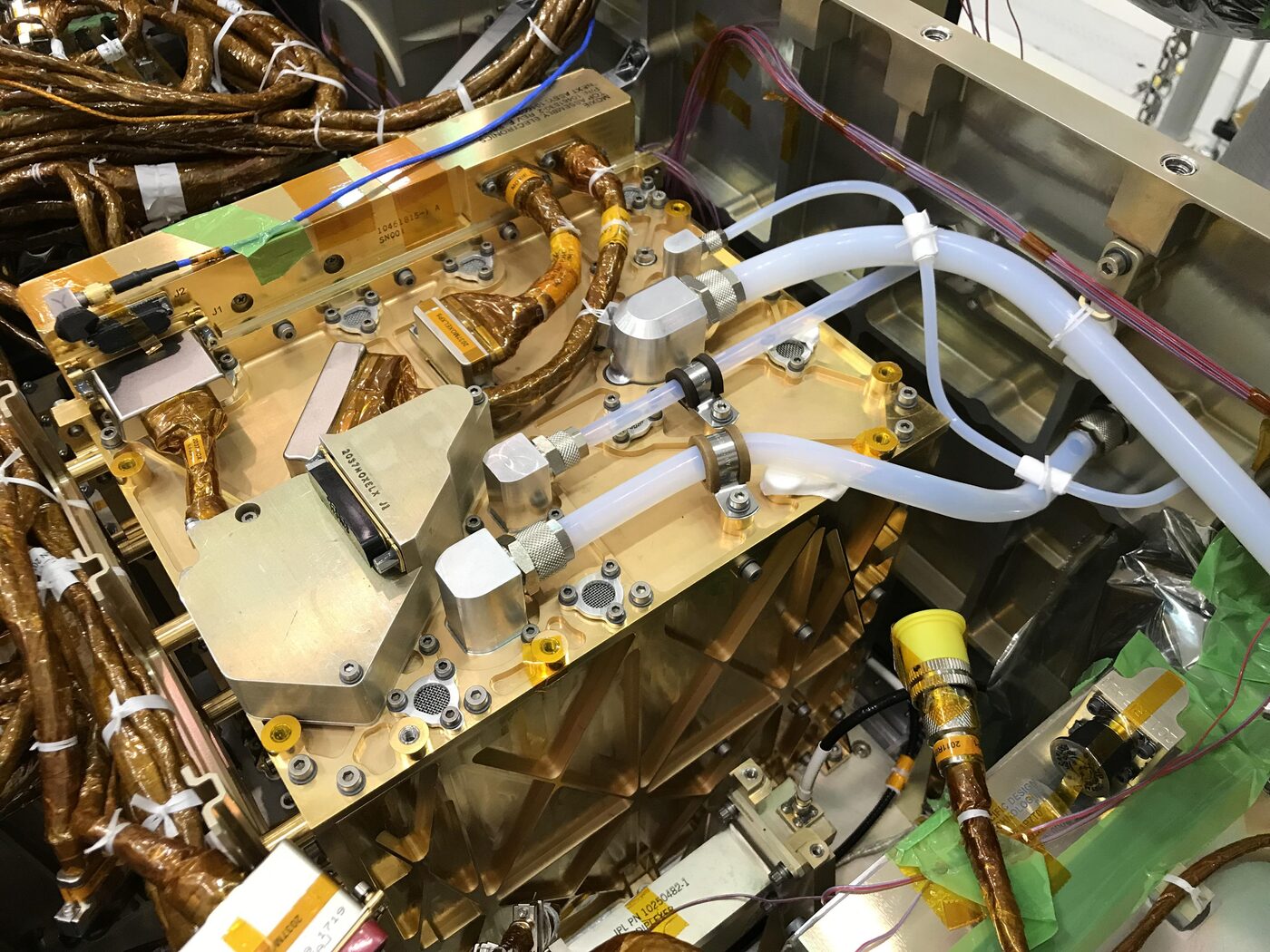
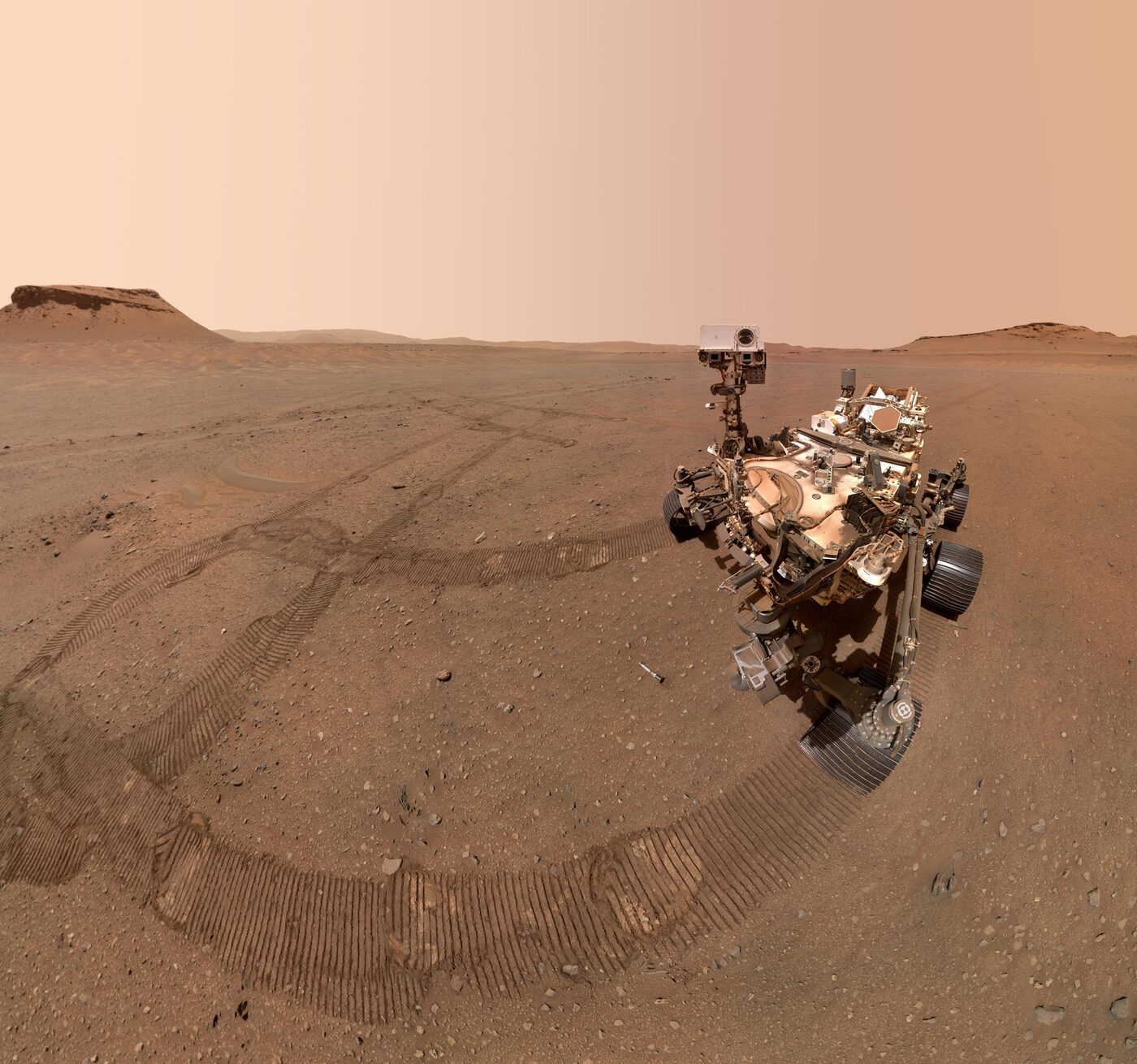
On 20 April 2021 — the 60th Martian day of the Perseverance rover’s mission, two months after it thumped down in Jezero Crater — a gold-plated box about the size of a toaster woke up inside the rover’s belly, took a deep pull of the thin Martian air, heated it to about 800 °C, and handed back 5.4 grams of pure, breathable oxygen. 🫁
Five grams. About a teaspoon of air. Enough for one astronaut to breathe for ten minutes.
And it was the first time in the entire history of our species that we made something useful out of another planet.
Everything you need is already there. It’s just in the wrong shape.
Here’s the thing about Mars that makes this story possible: the atmosphere is 96% carbon dioxide. Almost nothing else. Thin as a whisper — less than one percent of Earth’s air pressure — but chemically, it’s practically all one ingredient.
And carbon dioxide is CO₂. One carbon, two oxygens. The oxygen is right there. It’s simply glued to a carbon atom, and has been for a few billion years.
So the entire idea behind MOXIE — the Mars Oxygen In-Situ Resource Utilization Experiment, an acronym so hard-won it circles back around and spells a word meaning nerve — was beautifully blunt: build a machine that un-glues it.
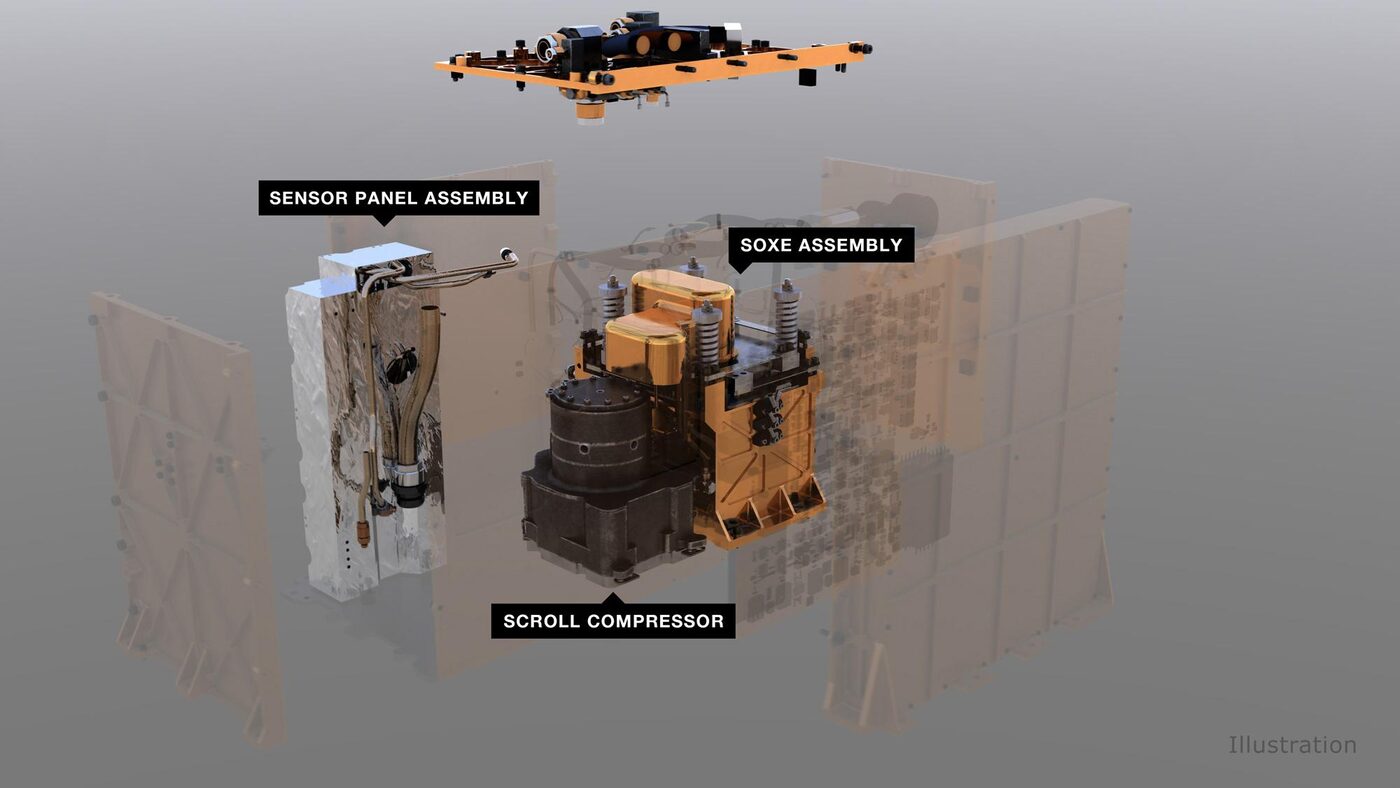
The way it works is genuinely lovely in its simplicity. A little scroll compressor sips in Martian air through a filter (Mars is dusty; you do not want the dust). The air gets squeezed and heated to about 800 °C. Then it’s fed through a stack of ceramic wafers — a solid oxide electrolysis cell — which, at that temperature, does something remarkable: it lets oxygen atoms, and only oxygen atoms, walk straight through the ceramic. Electricity coaxes them across. They pair up on the far side into O₂. The leftover carbon monoxide gets politely shown the door, back out into the Martian sky.
Air in one end. Breathable oxygen out the other. In a box you could fit on a kitchen counter.
Building something that has to work the first time, alone, forever
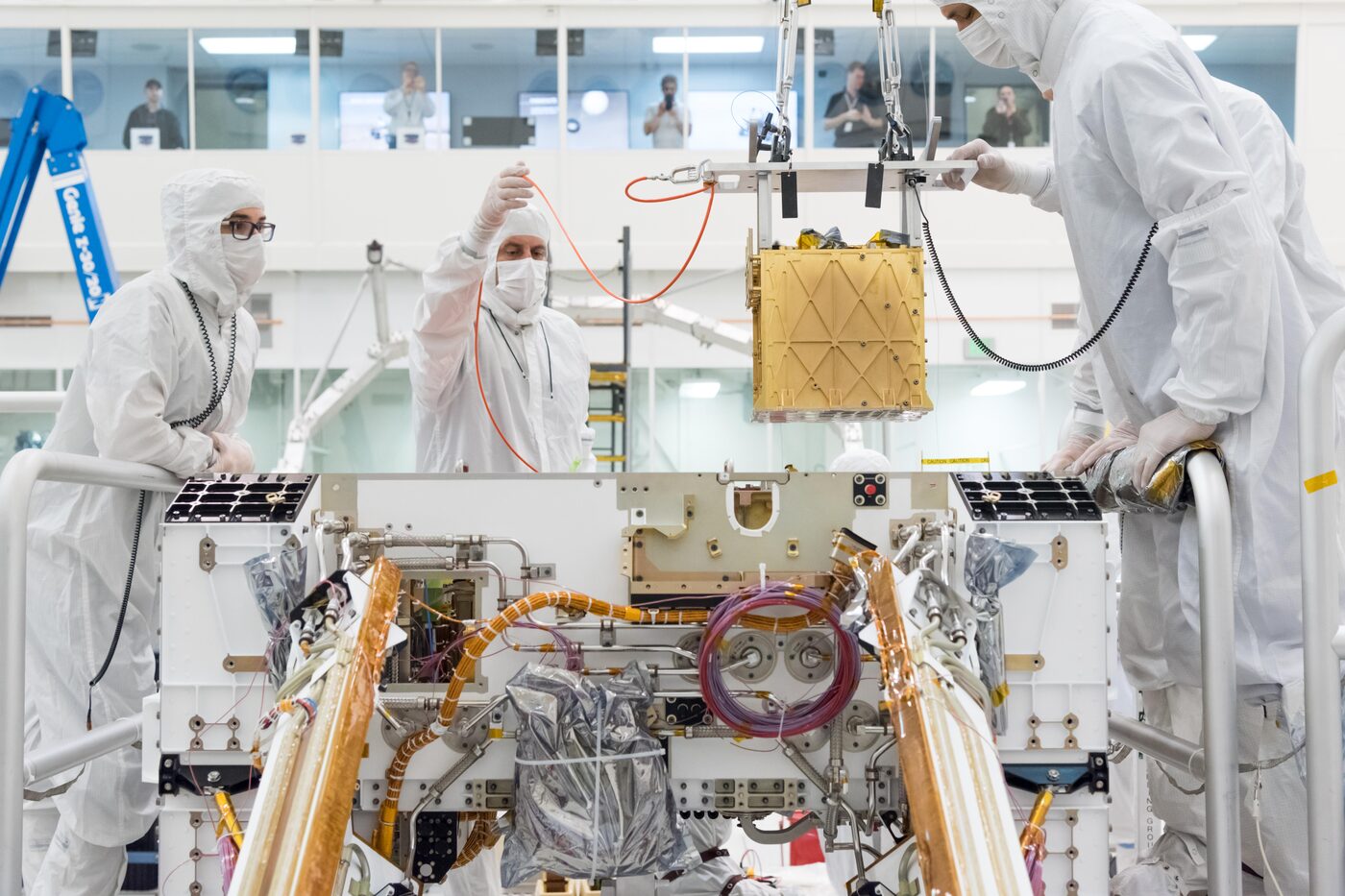
MOXIE weighed 17.1 kilograms and drew about 300 watts — roughly a hair dryer on low. It was led by principal investigator Michael Hecht of MIT’s Haystack Observatory, with former NASA astronaut Jeffrey Hoffman as his deputy, and built with JPL, OxEon Energy and a small constellation of universities.
The engineering constraints on it are the sort of thing that makes you laugh out loud when you list them:
- It had to survive a rocket launch, seven months of deep space, and a landing on Mars.
- It had to heat itself from as cold as −40 °C up to 800 °C — and then back down — over and over, without cracking.
- It had to do all that heating inside a rover, without cooking any of the delicate, irreplaceable science instruments bolted around it.
- Nobody could ever come and fix it.
Their solutions were charmingly physical. 3D-printed nickel alloy parts to shuttle heat around. A lightweight aerogel blanket to hold it in. And that thin gold coating on the outside — not for looks, but because gold is a superb mirror for infrared, so the heat MOXIE made stayed inside MOXIE instead of radiating into the rover’s ribcage.
Sixteen breaths
The first run was the nervous one — really just a check that the thing had arrived intact. It did. After a two-hour warm-up it settled into six grams an hour and ran for an hour.
Then it kept going. NASA’s plan was for at least nine more runs; MOXIE delivered sixteen in total, spread across a full Martian year — nearly two Earth years. That was the whole point. Mars is not one place with one weather; it’s a planet with seasons, and days, and nights, and dust. So they ran MOXIE in the afternoon and they ran it in the dark. They ran it in summer air and in thin winter air. They ran it hot and they ran it cool, deliberately poking at the edges of what it could do, because the machine that comes after MOXIE needs to work in all of it.
It kept beating its own homework. Its design target was six to ten grams an hour. At its best it produced 12 grams an hour at 98% purity or better — roughly double NASA’s original goal.
On 7 August 2023, it ran for the sixteenth and final time, made another 9.8 grams, and was retired having passed every single technical requirement it was given.
Grand total: 122 grams. About four ounces. NASA’s own cheerful comparison is that it’s about what a small dog breathes in ten hours. 🐕
Every gram of it was vented straight back out into the Martian atmosphere. It was never stored, never bottled, never breathed by anybody. That was always the plan — MOXIE wasn’t there to stockpile air. It was there to prove the machine works.
The part that isn’t about breathing
Here’s the twist that surprises most people, and it’s the real reason MOXIE exists.
If you send four astronauts to Mars for a year, they’ll breathe roughly one metric ton of oxygen between them. That’s a lot, but it’s manageable.
Getting those same four astronauts back off Mars requires about seven metric tons of rocket fuel — and twenty-five metric tons of oxygen to burn it with. Rockets need an oxidiser, and there’s no air on Mars to supply it. Twenty-five tons.
Hauling twenty-five tons of liquid oxygen from Earth to Mars is, to put it gently, not a plan. But shipping a one-ton machine that spends a quiet year on the surface making those twenty-five tons out of the local sky, before the crew even launches from Earth? That’s a plan. That’s a completely different kind of mission.
MOXIE is the proof-of-concept for that machine. NASA’s sketch is a descendant roughly 200 times bigger, paired with its own power plant, producing a couple of kilograms of oxygen an hour, working patiently and alone for a year before anyone arrives — so that the ride home is already fuelled and waiting.
Why this is on a good-news blog
Because for all of human history, everything we have ever used, we have carried.
Every expedition, every voyage, every ship and sled and capsule — you pack what you need and you hope it lasts, because where you’re going has nothing for you. That has been the iron rule since the first person walked out of sight of home.
And then on a Tuesday in April 2021, a small gold box on a planet with no oceans, no forests and no air worth the name made something we could use out of what was already lying around. Not shipped. Not stockpiled. Made, on site, from the local sky.
It was five grams. It went straight back into the atmosphere. Nobody breathed it and nothing was saved.
But it means that the first lungful of Martian-made air has, technically, already happened. Somebody is alive right now — possibly quite small, possibly in a school somewhere, possibly reading about rovers under a blanket — who may one day breathe the industrial-scale version of it, made by a machine descended from a toaster-sized experiment that ran sixteen times and never once complained.
We’ve started leaving the packing list behind. 🫁💛
Catch up on the series any time: Bennu, delivered to the Utah desert, Solar Orbiter over the Sun’s poles, the ocean inside Enceladus, and Philae’s landing on a comet. ☄️


